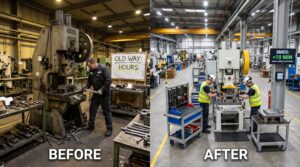
Workers applying the 5S methodology to maintain a clean, organized, and efficient manufacturing workspace.
The first time I ran a 5S methodology event, I made almost every mistake you can make. At the time, we had a machining cell that looked like a garage sale. Three supervisors, a borrowed pallet jack, and a box of red tags later, we had a spotless cell by Friday afternoon. However, six weeks later it looked exactly like it did before we started, except now there was a laminated sign on the wall telling everyone how organized it was supposed to be.
As a result, that experience taught me something I still repeat to every plant manager I work with: the 5S methodology is not a cleaning project. Instead, it is a way of building a workplace that tells you, at a glance, when something is wrong. If you treat it like a spring cleaning weekend, then you will get spring cleaning results. On the other hand, if you treat it like the foundation of how your shop runs, it will quietly pay you back every single shift.
For that reason, this guide walks through each step the way I actually teach it on the floor. In addition, it covers the parts most articles skip: how to run a red tag process that does not stall, how to set locations operators will actually use, how to write standards people read, and how to keep the whole thing alive after the consultants leave.
What the 5S Methodology Actually Is
The 5S methodology comes out of the Toyota Production System, the same source behind most lean manufacturing principles, and is built around five Japanese words: seiri, seiton, seiso, seiketsu, and shitsuke. In English, we usually say Sort, Set in Order, Shine, Standardize, and Sustain. If you want the background, you can read a solid overview of the terms and their origins on the Wikipedia entry for 5S.
Similarly, the Lean Enterprise Institute’s Lean Lexicon entry on 5S describes it as a set of workplace practices that support visual control and lean production. Moreover, the same entry makes a point I wish more companies took seriously: whether you use four, five, or six S’s, the effort should be woven into your lean system rather than run as a separate program on the side.
Still, the best definition I have come across is from Gwendolyn Galsworth, who wrote that a 5S workplace should be “self-explaining, self-ordering, and self-improving.” Read that again. Notably, nothing in it says “clean.” In fact, clean is a byproduct. Instead, the real goal is a work area where an operator who has never seen the cell before can walk in and know where every tool lives, what is missing, and what is out of place.
Why the 5S Methodology Still Matters in 2026
I hear the objection all the time. “We have an MES, we have sensors on every spindle, and we have dashboards. So why are we talking about tape on the floor?”
The answer is simple, because the dashboard cannot tell you that your second shift operator spent eleven minutes hunting for a torque wrench. Likewise, it cannot tell you that the coolant leak under machine four has been there for a month because nobody can see the floor through the scrap bins. In other words, data shows you the symptom. By contrast, a well run 5S methodology exposes the cause, right there on the floor where people work.
What Changes When a Plant Commits to the 5S Methodology
Consequently, here is what I consistently see after a plant takes 5S seriously:
Less searching. After all, motion and waiting are two of the most expensive wastes in any shop, and they hide inside “looking for stuff.”
Faster changeovers. When every fixture, gauge, and tool for a changeover has a home next to the machine, setup time drops without spending a dollar on new equipment. That recovered time goes straight back into your production schedule.
Fewer injuries. Above all, clear aisles and clean floors prevent the slips, trips, and falls that make up a large share of industrial accidents. Indeed, ISHN’s breakdown of 5S makes a strong case that a natural result of 5S is a safer floor, whether or not you formally add safety as a sixth S.
Better compliance. For example, OSHA’s general requirements for walking and working surfaces under 29 CFR 1910.22 require workplaces to be kept clean, orderly, and sanitary. Therefore, a working 5S system is one of the most practical ways to meet that standard every day instead of scrambling before an inspection.
A culture that notices problems. Most importantly, 5S trains people to see abnormalities, and a team that sees abnormalities is a team that can do kaizen.
Before You Start the 5S Methodology: Pick the Right Pilot Area
First of all, do not launch 5S plantwide. I cannot say this strongly enough. Instead, pick one area, prove it works, and then let the results sell the next one.
In my experience, a good pilot area has three things going for it:
A visible pain point. For instance, long changeovers, frequent tool hunts, or a messy staging area that slows down material handlers. Ideally, pick a place where improvement will be felt.
A willing team lead. Above all, you need someone on the floor who wants this, not someone who is being told to put up with it.
A manageable size. In practice, that means one cell, one line, or one maintenance crib. Not “the whole east building.”
Before touching anything, take photos. In fact, take lots of them. Specifically, get wide shots, close ups of benches, drawers, the floor under machines, and the top of cabinets where nobody looks. Later on, these “before” photos will be your most persuasive tool when someone says nothing really changed.
Step 1 of the 5S Methodology: Sort (Seiri)
Sort is where the 5S methodology either succeeds or falls apart. Although the goal is simple to say, it is hard to do: remove everything from the work area that is not needed for the work done there.
How I Run a Red Tag Process
To begin with, the red tag is the workhorse of the Sort step. Every item whose purpose is not immediately obvious gets a tag. Furthermore, Learn Lean Sigma’s guide to 5S red tagging lays out the basics well: tag the item, record what it is and where it came from, and then move it to a designated red tag area for evaluation.
Accordingly, on every tag I want to see:
- What the item is
- Where it was found
- Who tagged it and when
- Why it was tagged (not needed, excess quantity, wrong location, unknown purpose)
- A decision deadline
That deadline, by the way, matters more than people think. Without it, your red tag area simply becomes the new junk pile. For this reason, I usually give teams two to four weeks. Then, when the deadline hits, every item gets a decision: return it to the area, move it to central storage, transfer it to another department that needs it, sell it, recycle it, or scrap it.
Rules That Keep Sort Honest
Use frequency, not feelings. In short, the question is not “might we need this someday?” Rather, the question is “how often do we use this?” Daily items stay at the point of use. Meanwhile, weekly items can live nearby. Monthly items, on the other hand, go to storage. Finally, anything used less than once a year needs a very good reason to stay in the area.
Assign one owner for the red tag area. Only that person can release items from it. Otherwise, operators quietly carry their favorite broken clamp back to the bench.
Watch the reasons, not just the items. For example, if you find six identical boxes of fasteners in one cell, that is not a 5S problem. Instead, it is a purchasing or kanban problem, the kind that shows up fast in plants trying to run just in time inventory. In this sense, red tags are diagnostic. So track what you find and follow the trail upstream.
What Usually Comes Out
Of course, every shop is different, whether it is a small job shop or a large automotive parts plant. Even so, in nearly every first Sort I have led, we pull out obsolete fixtures for parts the plant stopped making years ago, duplicate hand tools, expired chemicals, broken gauges waiting for a calibration that will never happen, and a surprising number of personal items. Naturally, the volume always shocks people. That shock, however, is useful. So use it.
Step 2 of the 5S Methodology: Set in Order (Seiton)
Once only the necessary items remain, you then give every one of them a home. The old line still holds: a place for everything, and everything in its place.
That said, the point of Set in Order is not tidiness. Rather, it is speed and visibility. An operator should be able to grab any tool in seconds and, just as importantly, notice immediately when something is missing.
Principles I Use for Locations
Point of use storage. Store items where they are used, not where there happens to be shelf space. For instance, if a gauge is used at the lathe, then it lives at the lathe.
Frequency drives distance. Generally, the most used items go in the most reachable zone, roughly between waist and shoulder height, within arm’s length. Less frequent items, by contrast, go higher, lower, or further away.
Store by sequence. Similarly, for changeover kits, arrange tools in the order they will be used. After all, operators work faster when the setup reads left to right.
Ergonomics first. Heavy items never go on top shelves. Likewise, nobody should be bending to the floor fifty times a shift just because that is where the bin fit.
Visual Controls That Actually Work
At this point, the floor starts to tell its own story.
Shadow boards for hand tools, so that a missing wrench leaves an obvious outline.
Floor marking for aisles, work zones, WIP locations, and equipment footprints. Also, use a consistent color code across the plant and post it.
Labels on everything that holds something: drawers, bins, cabinets, racks, and shelves. In other words, if you have to open it to know what is inside, it needs a label.
Min and max markers on material locations, so anyone can see when to reorder.
Address systems for storage, so that locations can be written into work instructions.
One warning, though. I have walked into plants where every square inch of floor has tape on it, and yet nobody can explain what half the colors mean. Ultimately, visual controls are only valuable if they communicate something. Therefore, if a marking does not change behavior, remove it.
Involve the Operators
Equally important, the people who run the equipment should decide where tools go. Engineers and managers can certainly propose a layout, but the operators know which reach is awkward and which drawer jams. When operators set the locations, they own them. Conversely, when management sets the locations, operators simply work around them.
Step 3 of the 5S Methodology: Shine (Seiso)
Shine is the step everyone thinks they understand. Ironically, it is also the one most often done wrong.
Yes, Shine means cleaning. But in the 5S methodology, cleaning is also a form of inspection. So when an operator wipes down a machine, they should be looking for oil leaks, loose bolts, worn belts, frayed cords, cracked guards, and anything else that is not right. In effect, a clean machine makes abnormalities visible. Meanwhile, a dirty machine hides them until they turn into downtime.
Making Shine Part of the Job
Start with a deep clean. Typically, the first Shine is a big effort: degreasing machines, scrubbing floors, and painting where needed. Above all, get it to a true baseline condition.
Then shrink it into routine. After the baseline, Shine should take five to ten minutes per shift, built into the schedule. Otherwise, if cleaning only happens “when there is time,” there will never be time.
Assign zones. Next, map the area and give every zone an owner. After all, shared responsibility is no responsibility.
Create cleaning checklists. In addition, list what gets cleaned, how, how often, and what to look for while doing it.
Find the sources of dirt. For example, chips flying off a mill, coolant mist, a leaking hydraulic line, resin dust around an injection molding press, or cardboard dust from packaging. Cleaning the same mess every day is waste. Fixing the source, however, is improvement. Thus, this is where Shine connects directly to your maintenance program, TPM, and ultimately your OEE.
A Story From the Floor
At one stamping plant I supported, operators were told to wipe down a press at the end of each shift. Within two weeks, one of them noticed a small hydraulic weep on a fitting that had always been buried under grime. Maintenance then tightened it and replaced a seal. Notably, a failure on that circuit had shut the line down twice the previous year. Clearly, nobody would have caught it without Shine. In the end, that is the kind of result that turns skeptics into believers.
Step 4 of the 5S Methodology: Standardize (Seiketsu)
The first three S’s get you a great looking area. Standardize, however, is what makes it repeatable.
Essentially, the aim is to turn the conditions you created into a clear, visible standard that anyone can check against. Ideally, if two people walk through the cell, they should agree on whether it meets the standard without arguing.
What Good Standards Look Like
Photo standards. A picture of what “right” looks like, posted at the location. In my experience, this is far more effective than a paragraph of text.
One point lessons. Similarly, a single page that explains one task or one condition, mostly visual, readable in under a minute.
5S checklists and job cycle charts that spell out who does what and how often. For instance, the Adobe overview of 5S for lean manufacturing highlights these tools as a way to formalize responsibilities. Indeed, in my experience they are what keep Standardize from being a vague intention.
Consistent visual language across the plant. In other words, yellow means the same thing in shipping that it means in assembly. Likewise, labels use the same font, size, and format. As a result, people moving between departments do not have to learn a new system, and customer auditors working under IATF 16949 see one consistent system instead of ten.
Standards Must Be Easy to Follow
If a standard requires a binder, then it will not be followed. Similarly, if it requires a fifteen minute daily checklist with forty items, it will be pencil whipped by week three. So keep it short. Keep it visual. And put it where the work happens.
Also, remember that a standard is not permanent. Instead, it is the current best known way. So when an operator finds a better location or a faster cleaning method, update the standard. In fact, a standard that never changes is a sign that nobody is improving anything.
Step 5 of the 5S Methodology: Sustain (Shitsuke)
Here is the hard truth: almost every failed 5S methodology fails at Sustain. Not at Sort, and not at Shine. At Sustain.
Fundamentally, Sustain is about discipline and habit. In practice, it is the difference between a plant that “did 5S once” and a plant that runs on 5S. For example, Siemens’ lean manufacturing guide recommends regular leadership reviews, recognition for teams that keep the standard, and dedicated time and budget for 5S activities. I agree with every one of those. Moreover, I would add a few things from my own experience.
Audits That Mean Something
Without a doubt, audits are the heartbeat of Sustain. In general, a good 5S audit:
- Uses a scored checklist covering all five S’s
- Happens on a fixed cadence, weekly at the area level and monthly across departments
- Rotates auditors so that scoring does not depend on one person’s opinion
- Posts results on the team board where everyone can see them
- Turns every finding into an action item with an owner and a due date
At first, expect low scores. That is fine, because the trend line is what matters, not the starting number. In fact, I would rather see a cell climb from a weak score to a solid one over six months than see an area score perfectly once and never be audited again.
Leaders Have to Go to the Floor
If managers never walk the area, then operators will reasonably conclude that 5S does not matter. Therefore, supervisors and plant leaders should do short, regular gemba walks, asking questions rather than handing out criticism. For example, “What made this hard to keep in place?” teaches far more than “Why is this out of place?”
Furthermore, the Lean Enterprise Institute’s roundup on 5S shares Michael Ballé’s view that the real purpose of lean tools is to build a kaizen mindset in every employee, not just to tidy each process for a quick gain. That, in essence, is the heart of Sustain. You are developing people, and consequently the clean floor is the evidence.
Avoid the Bureaucracy Trap
Likewise, the same Lean Lexicon entry I mentioned earlier warns about 5S turning into a rule heavy program focused on appearance instead of waste. I have seen it firsthand: plants that score perfectly on audits while operators still walk forty feet to get a part, because the “standard” put the bin in the neat spot instead of the useful spot. In short, when 5S becomes about looking good for tours, it has lost its way. Similarly, Mark Graban’s Lean Blog made the same point years ago: 5S is not about taping everything or tidying up for visitors.
What About 6S and Safety?
These days, many plants run 6S, adding Safety as its own step. Personally, I do not have a problem with that, especially in high hazard environments where an explicit safety review keeps attention where it belongs.
Nevertheless, I always tell teams this: safety should already be built into every S. For instance, Sort removes trip hazards and expired chemicals. Next, Set in Order puts heavy items at safe heights and keeps aisles and egress paths clear. Then Shine finds leaks and damaged guards. Afterward, Standardize makes safe conditions the norm. Finally, Sustain keeps them that way. So whether you call it 5S or 6S, if safety is not part of every step, a sixth label will not fix it.
The 5S Methodology Mistakes I See Most Often
After years of supporting 5S rollouts, I notice the same problems come up again and again:
Treating it as a one time event. Admittedly, a blitz week can kick things off. However, if there is no plan for daily ownership and audits, the area will slide back.
Management doing it to people instead of with them. Unsurprisingly, operators who are excluded from decisions will not maintain what they did not design.
Skipping Sort. Put simply, organizing junk just gives you neatly labeled junk.
Over decorating. Too much tape, too many signs, and too many colors create noise instead of clarity.
No time in the schedule. If 5S is expected but not scheduled, then production pressure will win every time.
Ignoring root causes. Again, cleaning up the same coolant puddle every shift is not Shine. Fixing the leak is, and a quick root cause analysis usually tells you where to start.
Rolling it out everywhere at once. When you spread thin, nothing sticks. So prove it in one area first.
A Practical 30 Day Plan to Start the 5S Methodology
If you want a simple roadmap, here is the one I give most first time teams.
Week 1: Prepare. First, choose a pilot area and select the team. Then train everyone on the five steps, take your “before” photos, and set up a red tag area with an owner.
Week 2: Sort and Set in Order. Start by running the red tag sweep. After that, work with operators to set point of use locations, build shadow boards, and add floor markings and labels.
Week 3: Shine. Next, complete the deep clean. Then assign zones and owners and build the daily cleaning checklist. In addition, log every abnormality found during cleaning and route it to maintenance.
Week 4: Standardize and Sustain. Now post photo standards and one point lessons. Then run the first scored audit and set the audit schedule. Finally, hold a short review with leadership and share before and after photos with the whole plant.
After that, keep going. Specifically, close out red tag decisions on deadline, audit weekly, and recognize the team publicly. Then, when the pilot is stable, pick the next area and let the pilot team help lead it. After all, nothing sells 5S to a skeptical crew like hearing it from operators on the next line over.
Connecting the 5S Methodology to the Rest of Your Lean System
Interestingly, the 5S methodology is rarely the last thing a plant does. Instead, it is usually the first. For instance, Planet Lean notes that 5S is often the opening move in a lean transformation, used by organizations from factories to hospitals to farms to introduce a kaizen culture.
The Lean Tools That Depend on 5S
Moreover, once your areas are stable, 5S makes everything else easier:
SMED and quick changeover depend on organized, point of use tooling.
TPM depends on operators who clean and inspect their equipment.
Kanban depends on clearly marked, consistently stocked locations.
Standard work depends on a workplace that is the same every shift.
Visual management depends on an environment where abnormalities stand out.
Similarly, MSC Industrial Supply’s quick start guide frames 5S as the foundation for efficient work processes, and I think that is exactly right. Otherwise, if you try to build advanced lean tools on top of a disorganized floor, you will spend most of your time fighting the chaos instead of improving the process.
Final Thoughts on the 5S Methodology
When I think back to that machining cell from my first 5S event, I realize the problem was never the tape or the tags. Rather, the problem was that we cleaned the area for the people who worked there instead of with them. Furthermore, we never gave them a reason or a routine to keep it that way.
Ultimately, the 5S methodology works when it becomes the way your people see their work. First, Sort teaches them to question what belongs. Second, Set in Order teaches them to design for speed. Third, Shine teaches them to inspect. Then Standardize teaches them to agree on what good looks like. Finally, Sustain teaches them to hold the line and keep raising it.
So start small. Also, involve the operators, audit honestly, and fix root causes. Above all, keep at it long enough for the habits to take hold. In the end, a cleaner, faster shop floor is not a weekend project. Instead, it is a decision you make every shift.
Frequently Asked Questions
What are the 5 steps of the 5S methodology?
The five steps are Sort, Set in Order, Shine, Standardize, and Sustain, translated from the Japanese seiri, seiton, seiso, seiketsu, and shitsuke. For a deeper look, the Lean Enterprise Institute’s lexicon entry on 5S explains each term and how they support visual control.
How long does it take to implement the 5S methodology?
Typically, a pilot area can be through the first four steps in about a month. However, Sustain never ends, so most plants need six months or more of consistent audits before 5S becomes habit. For planning, MSC Industrial’s quick start guide is a useful resource.
What is a red tag in 5S?
A red tag marks an item whose need is uncertain during the Sort step. Afterward, tagged items move to a holding area until a decision is made. For more detail, Learn Lean Sigma’s red tagging guide covers the process step by step.
What is the difference between 5S and 6S?
Essentially, 6S adds Safety as a sixth step. Even so, many practitioners argue safety should already be built into all five S’s, as discussed in ISHN’s article on 5S and safety.
Does 5S help with OSHA compliance?
Yes. In fact, OSHA requires workplaces to be kept clean, orderly, and sanitary under 29 CFR 1910.22. Therefore, a sustained 5S system supports that requirement daily.
Why do most 5S methodology programs fail?
Usually, they fail at Sustain, either because 5S is treated as a cleanup event instead of a daily discipline or because it becomes a bureaucratic appearance program. To avoid that trap, see the Lean Enterprise Institute’s 5S roundup.
Can 5S be used outside manufacturing?
Absolutely. In fact, hospitals, warehouses, offices, and even farms use it. For example, Planet Lean’s overview of 5S shares cases well beyond the factory.
References
- Lean Enterprise Institute. 5S (Lean Lexicon)
- Lean Enterprise Institute. Lean Roundup: 5S
- Wikipedia. 5S Workplace Organization Overview
- Occupational Safety and Health Administration. 29 CFR 1910.22, General Requirements for Walking and Working Surfaces
- ISHN. 5S: Sort, Set in Order, Shine, Standardize and Sustain
- MSC Industrial Supply. Quick Start Guide to 5S
- Siemens Asset Management. 5S for Lean Manufacturing
- Adobe for Business. 5S Basics for Lean Manufacturing
- Planet Lean. What Is 5S?
- Lean Blog. 5S Week on Lean Blog
- Learn Lean Sigma. 5S Red Tagging Guide