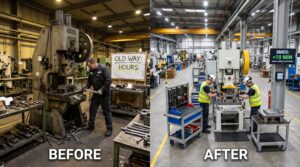
Production planners reviewing schedules to coordinate manufacturing tasks and maintain efficient workflow.
The first production scheduling plan I ever published went out on a Friday afternoon. By Monday at 9 a.m., however, it was already wrong. A press went down for a hydraulic seal, a resin delivery for our injection molding cell came in short, and then the customer we had promised a Wednesday ship date called to pull the order forward. As a result, I spent the morning rebuilding the week on a whiteboard while a supervisor stood behind me asking which job his crew should run next.
That morning taught me something no textbook did. Production scheduling is not about producing a perfect plan. Instead, it is about producing a plan that survives contact with the shop floor and can be repaired quickly when it doesn’t.
Over the years I have built schedules for job shops, batch plants, and mixed model assembly lines. Still, the same handful of methods keep showing up in every operation that runs well. This article therefore walks through them in plain terms: what the schedule actually is, the data it depends on, the main loading and sequencing methods, how to protect your bottleneck, and finally how to keep the whole thing stable enough that people trust it.
What Production Scheduling Actually Is
People often use planning and scheduling as if they mean the same thing. In reality they don’t, and mixing them up is the root of a lot of confusion.
Planning Versus Production Scheduling
Planning answers the questions of what and how much. Typically, it works in weeks or months, at the level of product families and total capacity. Your sales and operations plan and your master production schedule both live here.
Production scheduling, on the other hand, answers when, where, and in what order. Its job is to take the planned orders and turn them into specific jobs on specific machines with start and finish times. Put another way, the schedule converts the MPS or real customer orders into tasks the floor can execute, each with a start and finish, which places it squarely between planning and execution.
Why the Middle Position Is Hard
That middle position is exactly why the job is hard. While the planner above you is thinking in buckets and forecasts, the supervisor below you is thinking about the next two hours and which operator called in sick. Consequently, the scheduler has to translate between those two worlds every single day.
A good schedule does three things. First, it tells each work center what to run next. Second, purchasing and the warehouse get dates they can rely on. Finally, sales gets a realistic promise date. If your schedule is doing all three, you are ahead of most plants I have walked into.
The Data Behind Good Production Scheduling
Before you choose any method, look hard at your data. After all, every scheduling technique, from a magnetic board to an advanced planning system, inherits the quality of what you feed it.
The Five Inputs I Check First
Whenever I take over a schedule, these are the inputs I review before anything else:
Routings. Does every part have the correct sequence of operations and the correct work centers? For example, a routing that skips a deburr step or sends a part to the wrong press will push every downstream date out.
Standard times. These cover setup time and run time per piece. In my experience, they are also the most common source of bad schedules, because standards get written once during a product launch and never revisited. So if your standards say a job takes four hours and the floor consistently runs it in six, your schedule is fiction before you publish it.
Bills of material. When the BOM is missing a component, you will schedule a job that cannot start because a part never got ordered.
Calendars and shifts. Holidays, planned maintenance windows, and that second shift running only four days a week all count. Small details, in other words, carry big consequences.
Material availability. Since you cannot run a job without its material, the schedule needs to see what is on hand and what is arriving. This matters even more in plants running just in time inventory, where there is very little stock on hand to cover a late delivery.
Start with Your Standards
My rule is simple. Before you buy software or redesign your process, spend a month comparing actual run times against standards on your top twenty parts. Then fix the worst offenders. In fact, that single exercise has improved schedule accuracy more than any tool I have ever implemented.
Infinite Versus Finite Loading in Production Scheduling
This is the first real fork in the road. Moreover, it decides whether your schedule describes what you want or what you can actually do.
How Infinite Loading Works
Infinite loading places each job against its due date without checking whether the resource has room for it. For instance, if three jobs all need the same machine on Tuesday, infinite loading puts all three there and leaves you to sort it out. Most traditional MRP logic works this way. It is quick and simple, which is why it remains so common; however, it overpromises, because nothing in the math stops a machine from being loaded to 300 percent.
How Finite Loading Works
Finite loading, by contrast, respects the real hours available on each resource. If Tuesday is full, the next job slides to Wednesday, and everything downstream moves with it. As a result, the dates it produces are dates you can actually hit. The catch is that finite logic only works when your capacity data is honest. Feed it inflated standards or an optimistic shift calendar, and you simply get a very precise wrong answer.
Using Both Where They Fit
In practice, you rarely need to choose one for the whole plant. My recommendation, which is also widely shared in the industry, is that most shops gain the most by applying finite scheduling to their bottleneck resources at the very least. In short, use infinite loading for rough capacity checks months out, then apply finite logic where it matters most: the machines that actually limit your output.
A quick way to see the problem for yourself is to run a load report by work center for next week. If any center shows more than about 110 percent of its available hours, then your current production scheduling is promising something your floor cannot deliver.
Forward and Backward Production Scheduling
Once you decide how to treat capacity, you decide which direction to schedule from.
The Two Directions
Forward scheduling starts each job at the earliest possible moment and calculates when it will finish. You use it, for example, when you want to know the soonest you can ship something, when you are clearing a backlog, or when a customer asks for the fastest possible date.
Backward scheduling begins at the due date and works back through each operation to find the latest possible start. Its appeal is that material and labor don’t get committed until they are needed, which keeps work in process and inventory low.
Adding Slack and Blending Both
The risk with pure backward scheduling, however, is that it leaves no slack. Because every job starts at the last possible moment, a single breakdown makes it late. For that reason, I usually build backward schedules with a deliberate time buffer in front of the due date, often a day or two depending on how variable the process is. That way, the floor has room to absorb a hiccup without missing the ship date.
Many plants also blend the two. Long lead items are scheduled backward to avoid building inventory too early, whereas urgent or expedited orders are scheduled forward to find the real earliest date. Neither method is better in general. Rather, they answer different questions.
Sequencing Rules in Production Scheduling: Deciding What Runs Next
Loading puts jobs on work centers. Sequencing, meanwhile, decides the order in which those jobs run once they are queued. This is exactly where the supervisor’s question from my first Monday comes in: “What do I run next?”
Four Common Dispatching Rules
A few dispatching rules cover most situations:
First in, first out. Jobs run in the order they arrive. Although it feels fair and is easy to explain, it ignores due dates entirely.
Earliest due date. Whatever is due soonest goes first. This rule is simple and good for minimizing how late your latest job runs.
Shortest processing time. Here the quickest job goes first. Doing so moves the most jobs through a work center and reduces average waiting time. Even so, long jobs can sit in the queue for days if you are not careful.
Critical ratio. In job shops, this is the one I rely on most. You divide the time remaining until the due date by the work remaining on the job. A ratio below 1.0 means the job is already behind, while a ratio above 1.0 means it has slack. Accordingly, you run the lowest ratio first.
A Quick Critical Ratio Example
Here is how it plays out. Job A is due in 4 days and has 2 days of work left, so its ratio is 2.0. Meanwhile, Job B is due in 3 days with 4 days of work left, giving it a ratio of 0.75. Therefore, B goes first, even though A might look more urgent on paper because of who the customer is.
Why Consistency Matters
Above all, the value of a dispatching rule is consistency. When every supervisor uses the same rule, you stop having jobs jump the line because someone shouted the loudest. So write the rule down, post it at each work center, and let exceptions go through the scheduler, not around them.
Production Scheduling Around the Constraint with Drum Buffer Rope
Every line has one resource that limits total output. It might be a heat treat oven, a paint booth, or a CNC cell with a two week queue. Eliyahu Goldratt’s Theory of Constraints argues that this resource deserves almost all of your scheduling attention, and the method built for it is called Drum Buffer Rope.
The Drum, the Buffer, and the Rope
The idea is easy to picture. The bottleneck acts as the drum that sets the tempo for the whole line, a time buffer sits in front of it to absorb upstream disruptions, and the rope ties the release of new material to the rate the bottleneck actually consumes it.
In practice, this means three things. To begin with, you build a detailed, finite schedule for the constraint only; that is your drum. Next, a time buffer goes in front of it, so that if an upstream machine goes down, the constraint still has work waiting. After all, an hour lost at the bottleneck is an hour lost for the whole plant. Finally, raw material enters the first operation based on the drum’s pace, not on how fast the first machine can run.
Why the Rope Is the Hard Part
That last step is the one people resist. Operators hate standing idle, and managers likewise hate seeing idle machines. But running a non bottleneck at full speed doesn’t increase output. Instead, it just builds piles of work in process in front of the constraint.
What It Looked Like on a Real Floor
I introduced this approach at a fabrication shop where the laser was the constraint. Rather than scheduling every work center in detail, we focused our production scheduling on the laser plus a release rule. Within a few months, work in process on the floor dropped noticeably, and on time delivery improved, largely because jobs stopped getting lost in queues. If you want to go deeper, John Blackstone’s review of Drum Buffer Rope and buffer management is a solid starting point.
Leveling the Load: Heijunka in Production Scheduling
If Drum Buffer Rope is about protecting the constraint, heijunka is about smoothing everything. It comes from the Toyota Production System, the foundation of most lean manufacturing principles, and simply means leveling.
Why Lumpy Demand Hurts
Customer orders are lumpy. One week you get a flood, and the next week a trickle. If your production scheduling chases every swing, your floor alternates between overtime and idle time, and both are expensive.
Leveling Volume and Leveling Mix
Heijunka addresses this in two ways. Daniel Jones of the Lean Enterprise Academy separates it into leveling output by volume and leveling it by product type or mix.
Leveling by volume means producing a steady daily quantity based on average demand, using a small finished goods buffer to absorb the peaks and valleys.
Leveling by mix means running a small repeating pattern every day, such as A, A, B, C, A, A, B, C, instead of running all of product A on Monday and all of product B on Thursday. Consequently, customers get every product sooner, and you hold less inventory of each.
The Changeover Catch
There is a catch, though, and it is a big one. Mixing products every day means more changeovers. If a changeover takes three hours, a daily mix is impossible. That is why shorter changeovers through SMED usually have to come first, since leveling the mix requires switching products far more often. In other words, shorten setups first, then level.
Heijunka works best in repetitive environments with a stable product family, which describes a lot of automotive parts manufacturing. It is harder in true custom job shops; even there, though, you can level the load at the gateway operation so the floor sees a steadier flow of work.
Time Fences That Stabilize Production Scheduling
Here is a truth every scheduler learns: a schedule that changes every day is no schedule at all. Once the floor sees the plan rewritten each morning, they stop trusting it and start running whatever is easiest.
How Time Fences Work
Time fences are how you build stability into the plan. The near term schedule is locked, the middle period allows limited changes, and the far horizon stays flexible. A typical arrangement uses a frozen zone of roughly two to four weeks where changes happen only by exception, a slushy zone that permits substitutions within capacity, and a liquid zone governed by the forecast.
How long should your frozen zone be? At minimum, it should cover the time it takes to get material and set up production. Oracle’s JD Edwards documentation, for example, recommends a planning fence of at least one and a half times the cumulative lead time.
Handling Requests to Break the Fence
Of course, the frozen zone is not a wall. Emergencies happen, and a key customer may need something urgently. The discipline lies in making those changes visible. Whenever sales asks to break the fence, I show them what gets pushed out to make room. Once the cost is on the table, about half of those “urgent” requests quietly go away. The other half are usually worth doing, and now everyone knows what was traded.
Changeovers: The Hidden Capacity in Production Scheduling
Every time a machine stops to switch from one product to another, you lose capacity. On a high mix line, in fact, changeovers can quietly eat a significant share of available hours.
Your production scheduling choices can either fight this or help it. Here are a few practical habits:
Group by family. Sequence jobs that share tooling, color, material, or temperature settings back to back. For instance, running light to dark colors on a paint line, or thin to thick gauge on a stamping press, can cut setup time considerably.
Separate internal and external setup. Anything that can be prepared while the machine is still running, such as staging dies, pulling material, or preheating, should be done before it stops. That is also the core of SMED, and it goes much faster when tools and dies live in an organized 5S area instead of somebody’s memory.
Make setup time visible in the schedule. If your schedule shows run time but buries setup time, nobody will see how much capacity you are losing. So show it as its own block.
Naturally, there is a tension here. Long runs reduce changeovers but build inventory and delay other products. Short runs, by comparison, improve flow but cost setup time. The right balance depends on your setup times and demand mix, which is exactly why shrinking changeovers gives the scheduler more freedom.
Measuring Whether Your Production Scheduling Works
You can’t improve a schedule you don’t measure. For that reason, these are the numbers I track weekly:
Schedule adherence. Of the jobs planned for this week, how many ran as planned and in the planned sequence? This tells you whether the floor is following the schedule and also whether the schedule was realistic in the first place. Generally, I aim for 90 percent or better.
On time in full (OTIF). This is the share of customer orders shipped on the promised date with the complete quantity. It is also the metric your customers actually feel, and automotive customers auditing suppliers under IATF 16949 will be watching it closely.
Work in process. If WIP keeps climbing, you are releasing work faster than the floor can finish it. In that case, tighten the rope.
Constraint utilization. How many hours did your bottleneck actually run versus the hours available? Every lost hour here means lost output for the entire plant, which is why I like to track it alongside the bottleneck’s OEE.
Frozen zone changes. Count them. A rising number tells you either that demand is genuinely volatile or that someone has figured out how to get around the fence.
When adherence drops, don’t blame the floor first. More often than not, the schedule was built on bad standards or ignored a capacity limit. So go back to your data, and if the misses keep repeating, run a proper root cause analysis instead of patching the symptoms week after week.
A Weekly Production Scheduling Rhythm That Works
Methods matter, but routine matters more. Below is the cadence that has worked across most plants I have supported.
Early in the Week
Monday morning: Review last week’s adherence and OTIF. Then note what went wrong and why, whether it was a breakdown, a material shortage, or a bad standard.
Monday afternoon: Confirm material availability for the next two weeks, and flag any shortage to purchasing immediately.
Tuesday: Run a rough cut capacity check for the coming four to six weeks against your constraint. If you are overloaded, raise it now, while overtime or outsourcing is still an option.
Midweek Through Friday
Wednesday: Build and publish the detailed schedule for the following week. Afterward, walk it with the supervisors in person. An emailed schedule tends to get ignored, whereas one explained at the whiteboard gets followed.
Daily: Hold a short huddle at the start of each shift covering what ran yesterday, what is running today, and what problems are coming. Keep it to fifteen minutes, standing up.
Friday: Lock the frozen zone for the next week and document any changes made during the current week.
Tools Come Second
None of this requires expensive software. In fact, I have run this rhythm with a spreadsheet and a magnetic board. Software certainly helps when your volume and mix get complex, but it amplifies whatever process you already have. Put simply, a messy process with good software just produces mess faster.
Common Production Scheduling Mistakes
A few traps show up again and again:
Scheduling everything in detail. If you try to finely schedule thirty work centers, you will spend all day rescheduling. Instead, schedule the constraint tightly and let the rest flow.
Ignoring setup time. Without setup time, a schedule will always look achievable on paper and yet always fail on the floor.
Releasing work too early. Starting jobs early feels productive, but it isn’t. In reality, early release clogs the floor and hides which jobs truly need attention.
No frozen zone. Constant changes destroy trust. Once the floor stops believing the schedule, you have lost control.
Treating the schedule as the scheduler’s document. Rather, it belongs to everyone who executes it. Involve supervisors when you build it, and they will help defend it.
Final Thoughts on Production Scheduling
Production scheduling is equal parts method and discipline. The methods themselves are well established: finite loading where capacity is tight, a clear sequencing rule, Drum Buffer Rope to protect your bottleneck, heijunka to smooth demand, and time fences to keep the near term stable. None of them is complicated on its own.
The discipline, however, is the harder part. That means keeping standards honest, holding the frozen zone when sales pushes, walking the schedule with supervisors every week instead of just emailing it, and looking at adherence data even when it is uncomfortable.
If you are starting from scratch, pick one thing. For example, check your standard times against actual run times on your highest volume parts, or identify your constraint and build a finite schedule for it alone. Treat it like any small kaizen project: get that working first, and the rest of your production scheduling becomes much easier to build on.
Looking back, that Monday morning whiteboard session taught me the schedule will always be challenged. Ultimately, the goal is a plan that bends without breaking, and a team that trusts it enough to follow it.
Frequently Asked Questions
What is production scheduling in simple terms?
Production scheduling is the process of deciding which jobs run on which machines, in what order, and at what times, so that orders get made on time with the people, equipment, and materials available. In effect, it turns the master production schedule into daily work instructions for the floor. This guide to manufacturing production schedules covers the full planning to execution flow.
What is the difference between production planning and production scheduling?
Planning decides what and how much to make over weeks or months. Scheduling, by contrast, decides exactly when and where each job runs, usually over days or hours. In short, planning sets the targets, and scheduling turns them into a sequence the floor can follow. PlanetTogether’s comparison of finite and infinite loading shows how that handoff plays out in practice.
Should I use finite or infinite capacity scheduling?
Use infinite loading for rough capacity checks far out, and finite scheduling where capacity is tight, especially on your bottleneck. This explanation of finite versus infinite capacity scheduling also shows why MRP schedules built on infinite loading often break on the floor.
What is Drum Buffer Rope scheduling?
It is a Theory of Constraints method where the bottleneck sets the pace for the whole line, a time buffer protects it, and material release is tied to its rate. For more detail, read this Drum Buffer Rope scheduling overview.
How long should a frozen zone be?
It should be long enough to cover the time needed to secure material and prepare production, so many plants use two to four weeks. The master production schedule overview on Wikiversity explains the different types of time fences.
What is heijunka and does it work for a job shop?
Heijunka levels production by volume and product mix to create a steady, repeating rhythm. Although it works best in repetitive environments, job shops can still level the load at their gateway operation. The iSixSigma guide to heijunka covers the heijunka box and how to apply it.
Do I need production scheduling software?
Not to start. A spreadsheet and a visual board can run a disciplined schedule for a small or medium operation. Later on, software becomes valuable as product mix and volume grow, but it only amplifies the process you already have. Microsoft’s finite capacity planning documentation shows what that looks like inside a typical ERP.
References
- Taylor, A. Guide to Manufacturing Production Schedule: Methods, Examples, Templates, and KPIs. Cleverence.
- Finite vs Infinite Capacity Scheduling: Why MRP Schedules Break on the Floor. Fabrico.
- Finite Capacity Scheduling and Infinite Capacity Loading Differences. PlanetTogether.
- Finite Capacity Planning and Scheduling. Microsoft Learn.
- Drum Buffer Rope (DBR) Scheduling Explained. Fabrico.
- Blackstone, J. H. A Review of Literature on Drum Buffer Rope, Buffer Management and Distribution. Theory of Constraints Handbook, Goldratt.
- Jones, D. Heijunka: Leveling Production. SME.
- Heijunka: The Art of Leveling Production. iSixSigma.
- Heijunka: Leveling Production to Smooth the Chaos. Fabrico.
- Master Production Schedule (MPS). Lightsource.
- Understand Time Fences and System Messages. Oracle JD Edwards Documentation.
- Master Production Schedule. Wikiversity.