
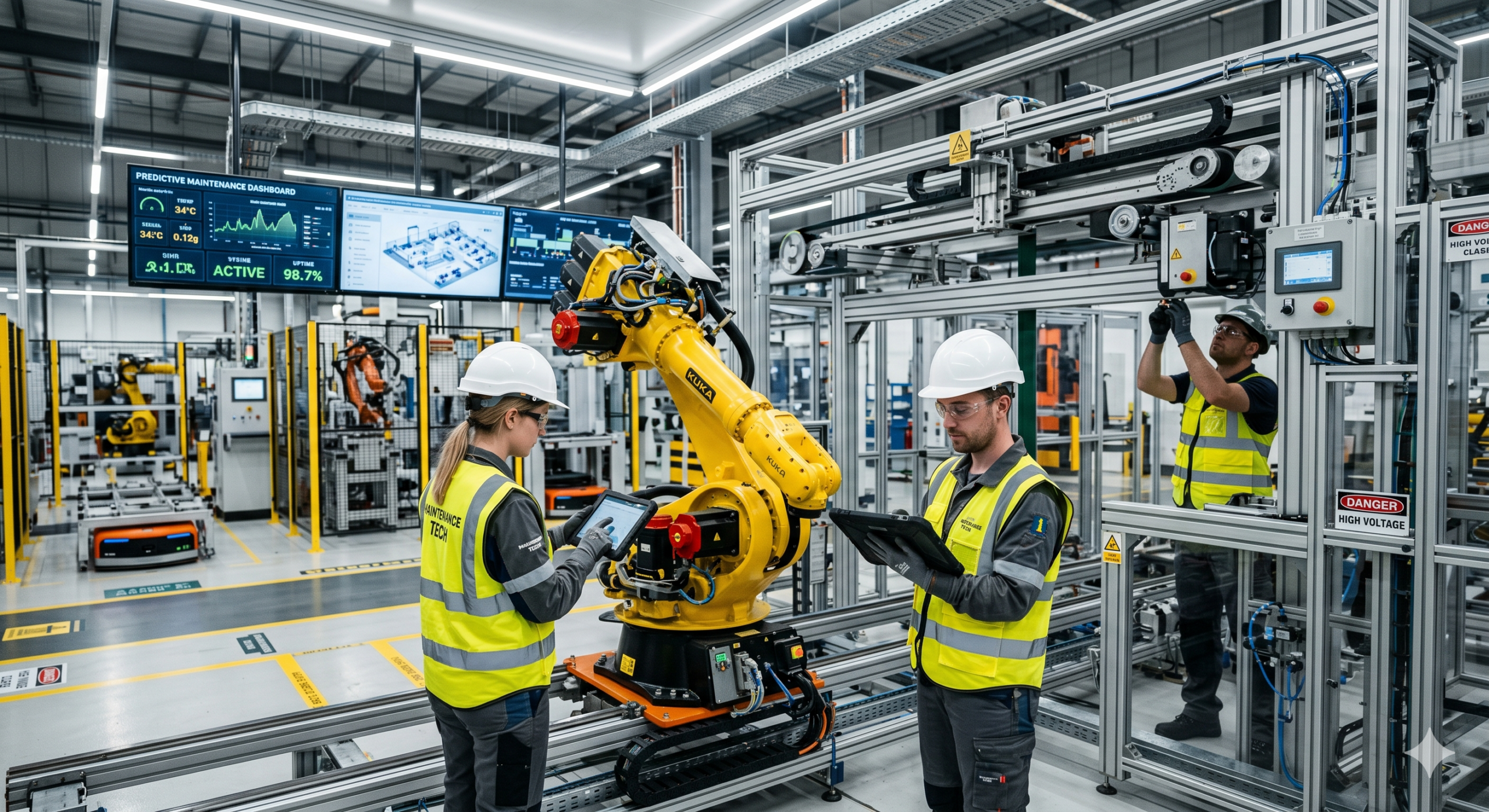
Manufacturing facility maintenance is a critical discipline that ensures equipment reliability, operational efficiency, and safety. As modern plants become more data-driven, aligning maintenance with broader operational strategies is essential. For a deeper understanding of how maintenance fits into overall operations, refer to this Manufacturing Facility Management Guide.
What Is Manufacturing Facility Maintenance?
Manufacturing facility maintenance refers to the processes, strategies, and systems used to keep equipment, machinery, infrastructure, and utilities in optimal working condition. It covers everything from routine inspections and repairs to predictive analytics and asset lifecycle management.
The goal is simple: maximize uptime while minimizing costs and risks.
Maintenance applies to:
- Production machinery (CNC machines, conveyors, robotics)
- Utilities (HVAC, compressed air, water systems)
- Electrical systems
- Facility infrastructure (floors, lighting, safety systems)
- IT and automation systems
Why Maintenance Matters in Manufacturing
Effective maintenance is directly tied to business performance. Poor maintenance leads to downtime, safety hazards, and increased operational costs.
Key Benefits
1. Reduced Downtime
Unplanned downtime can cost thousands—or millions—per hour. Maintenance ensures continuous production flow.
2. Improved Equipment Lifespan
Well-maintained machines last longer and perform more efficiently.
3. Enhanced Safety
Faulty equipment increases the risk of accidents. Maintenance ensures compliance with safety standards.
4. Better Product Quality
Machines operating within optimal parameters produce consistent, high-quality outputs.
5. Cost Efficiency
Preventing failures is significantly cheaper than repairing catastrophic breakdowns.
Types of Maintenance Strategies
Modern manufacturing facilities rely on a mix of maintenance strategies. Choosing the right combination is essential.
1. Reactive Maintenance (Run-to-Failure)
This approach involves repairing equipment only after it fails.
Pros:
- Low upfront cost
- Simple to implement
Cons:
- High downtime
- Expensive emergency repairs
- Risk of production disruption
Best for non-critical equipment.
2. Preventive Maintenance (PM)
Scheduled maintenance based on time or usage intervals.
Examples:
- Lubrication every 500 hours
- Filter replacement monthly
Pros:
- Reduces unexpected failures
- Extends equipment life
Cons:
- May lead to unnecessary maintenance
- Requires scheduling discipline
3. Predictive Maintenance (PdM)
Uses sensors and data analytics to predict when equipment will fail.
Technologies involved:
- IoT sensors
- Vibration analysis
- Thermal imaging
- AI-driven analytics
Pros:
- Minimizes downtime
- Optimizes maintenance timing
Cons:
- Higher initial investment
- Requires technical expertise
4. Condition-Based Maintenance (CBM)
Maintenance is performed when indicators show signs of deterioration.
Examples:
- Temperature thresholds
- Oil quality monitoring
5. Reliability-Centered Maintenance (RCM)
A strategic approach focusing on maintaining system functionality based on risk and criticality.
Best for:
- Complex manufacturing environments
- High-value assets
Core Components of a Maintenance Program
A robust maintenance system includes several interconnected elements.
1. Asset Management
Maintaining a detailed inventory of all equipment:
- Asset ID and specifications
- Maintenance history
- Warranty and lifecycle data
2. Work Order Management
Structured processes for:
- Creating tasks
- Assigning technicians
- Tracking completion
Digital work orders improve accountability and efficiency.
3. Spare Parts Inventory
Poor inventory management can delay repairs.
Best practices:
- Maintain critical spare parts
- Use automated inventory tracking
- Optimize reorder levels
4. Maintenance Scheduling
Balancing maintenance with production schedules is crucial.
Tools used:
- CMMS (Computerized Maintenance Management Systems)
- ERP integrations
5. Documentation and Reporting
Accurate records help with:
- Compliance
- Performance tracking
- Continuous improvement
Role of Technology in Modern Maintenance
Technology has transformed manufacturing maintenance into a data-driven function.
1. CMMS (Computerized Maintenance Management Systems)
CMMS platforms centralize maintenance operations.
Features:
- Work order tracking
- Asset management
- Reporting dashboards
2. IoT (Internet of Things)
Sensors collect real-time data from machines.
Applications:
- Monitoring vibration, temperature, pressure
- Detecting anomalies early
3. AI and Machine Learning
AI analyzes historical and real-time data to predict failures.
Benefits:
- Reduced downtime
- Optimized maintenance schedules
4. Digital Twins
A digital replica of physical assets allows simulation and predictive analysis.
5. Mobile Maintenance Solutions
Technicians use mobile devices for:
- Work order updates
- Real-time diagnostics
- Access to manuals and data
Key Maintenance Metrics (KPIs)
Tracking performance is essential for continuous improvement.
Important KPIs:
- MTBF (Mean Time Between Failures)
Measures reliability. - MTTR (Mean Time to Repair)
Measures repair efficiency. - OEE (Overall Equipment Effectiveness)
Combines availability, performance, and quality. - Planned vs. Unplanned Maintenance Ratio
- Maintenance Cost as % of Asset Value
Best Practices for Manufacturing Maintenance
1. Shift from Reactive to Predictive
Reactive maintenance is costly. Investing in predictive systems yields long-term savings.
2. Standardize Procedures
Create SOPs (Standard Operating Procedures) for:
- Inspections
- Repairs
- Safety checks
3. Train Your Workforce
Technicians should be skilled in:
- Mechanical systems
- Electrical systems
- Digital tools and analytics
4. Use Data for Decision-Making
Leverage analytics to:
- Identify recurring issues
- Optimize schedules
- Improve asset performance
5. Integrate Maintenance with Production
Maintenance should not be isolated. Collaboration with production teams improves planning and reduces conflicts.
6. Implement Safety Protocols
Maintenance tasks must comply with:
- Lockout/Tagout procedures
- Hazard assessments
- PPE requirements
Common Challenges in Facility Maintenance
1. Aging Equipment
Older machines are more prone to failure and harder to maintain.
Solution: Gradual modernization and retrofitting.
2. Lack of Skilled Technicians
The skills gap is a growing issue in manufacturing.
Solution: Continuous training and upskilling programs.
3. Poor Data Management
Disconnected systems lead to inefficiencies.
Solution: Implement integrated digital platforms like CMMS and ERP.
4. Budget Constraints
Maintenance is often seen as a cost center.
Solution: Demonstrate ROI through reduced downtime and improved efficiency.
5. Resistance to Change
Transitioning to digital maintenance systems can face internal resistance.
Solution: Provide training and highlight benefits.
Maintenance and Industry 4.0
Industry 4.0 has redefined how maintenance operates.
Key Trends:
- Smart factories with interconnected systems
- Real-time monitoring and analytics
- Autonomous maintenance using robotics
- Cloud-based maintenance platforms
Maintenance is now part of a larger ecosystem where machines communicate, learn, and optimize themselves.
Building a Future-Ready Maintenance Strategy
To stay competitive, manufacturers must adopt a forward-thinking approach.
Steps to Build an Effective Strategy:
- Assess Current Maintenance Maturity
Identify gaps in processes and technology. - Define Clear Objectives
Examples:- Reduce downtime by 20%
- Improve MTBF by 15%
- Invest in Technology
Prioritize systems that deliver measurable ROI. - Develop a Skilled Workforce
Combine technical and digital skills. - Adopt Continuous Improvement
Use feedback loops and performance data.
Sustainability and Maintenance
Sustainability is becoming a key focus in manufacturing.
Maintenance contributes to sustainability by:
- Reducing energy consumption
- Minimizing waste
- Extending asset lifespan
- Supporting environmentally friendly operations
Efficient machines consume less energy and produce fewer defects, contributing to greener manufacturing.
Conclusion
Manufacturing facility maintenance is no longer a background function—it is a strategic pillar of operational success. With the rise of digital technologies, predictive analytics, and smart systems, maintenance has evolved into a proactive and intelligent discipline.
Organizations that invest in modern maintenance strategies benefit from improved efficiency, reduced costs, enhanced safety, and greater competitiveness. By combining best practices, advanced tools, and skilled personnel, manufacturers can build resilient, future-ready operations.
In 2026 and beyond, the question is no longer whether to modernize maintenance—but how fast you can do it to stay ahead.