

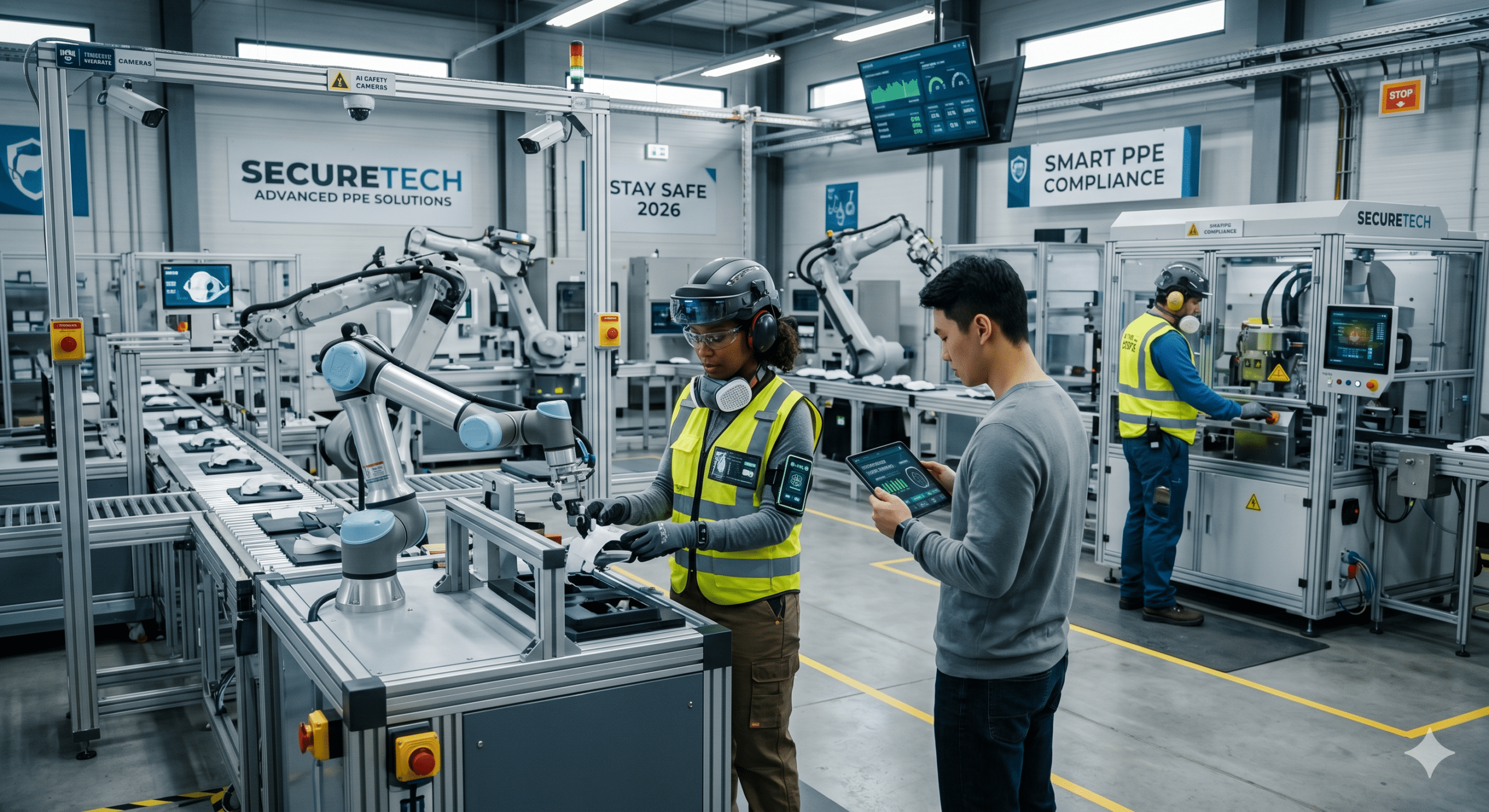
Manufacturing environments are evolving rapidly as companies adopt robotics, automation, artificial intelligence, and connected industrial systems. Although these technologies improve operational efficiency and production speed, they also introduce new workplace risks that require stronger safety measures. Because of these changes, PPE in manufacturing remains one of the most important components of workplace safety and industrial risk management.
In 2026, personal protective equipment goes far beyond traditional hard hats and safety glasses. Instead, modern manufacturers now use smart PPE systems equipped with sensors, real-time monitoring capabilities, biometric tracking, and AI-powered safety alerts to improve employee protection and operational visibility. As a result, industrial facilities are becoming safer, smarter, and more responsive to workplace hazards.
At the same time, manufacturing companies understand that employee safety directly affects productivity, operational stability, workforce morale, and regulatory compliance. Therefore, organizations that invest in advanced PPE technologies often experience fewer workplace accidents, lower downtime, and stronger workforce confidence.
This article explores how PPE in manufacturing is evolving in smart factories and why advanced protective equipment is becoming essential for modern industrial operations.
Why PPE in Manufacturing Is More Important Than Ever
Manufacturing facilities contain many workplace hazards that can threaten employee safety. For example, workers often operate near heavy machinery, robotic systems, electrical equipment, chemicals, high temperatures, and noisy environments. Without proper protection, these risks can lead to serious injuries and operational disruptions.
Strong PPE in manufacturing programs help organizations reduce workplace accidents while maintaining compliance with safety regulations. In addition, protective equipment creates a safer environment where employees can perform tasks more confidently and efficiently. Many manufacturers also follow recommendations outlined in PPE in Manufacturing Industry: A Guide to improve workplace protection and strengthen industrial safety procedures.
Modern PPE strategies help manufacturers:
- Reduce workplace injuries
- Improve operational safety
- Strengthen OSHA compliance
- Protect employees from hazards
- Improve workforce confidence
- Reduce liability risks
- Support operational continuity
- Strengthen workplace safety culture
Consequently, PPE has become a critical investment for manufacturers focused on long-term operational success.
The Evolution of PPE in Smart Factories
Traditional personal protective equipment focused mainly on physical protection. However, smart factories now require more advanced safety solutions because industrial environments are becoming increasingly connected and automated.
Modern PPE in manufacturing now includes:
- Smart helmets
- Connected safety glasses
- Wearable fatigue monitors
- Biometric safety devices
- Smart gloves
- Environmental sensors
- Real-time communication systems
- GPS-enabled worker tracking
Unlike traditional equipment, connected PPE systems can collect and transmit safety data in real time. As a result, supervisors can identify risks immediately and respond faster during emergencies.
For example, smart helmets can detect worker fatigue, monitor environmental conditions, and provide instant communication during hazardous situations. Similarly, connected safety glasses can display operational instructions and hazard alerts directly within the worker’s field of vision.
Because of these innovations, PPE is becoming an active part of industrial safety management rather than simply a passive protective layer.
Common Workplace Hazards Requiring PPE
Manufacturing environments expose employees to multiple hazards that require specialized protective equipment.
Physical Hazards
Physical hazards are among the most common industrial risks.
Examples include:
- Falling objects
- Moving machinery
- Sharp materials
- Flying debris
- Slippery surfaces
- Excessive noise
To reduce these risks, workers often wear:
- Hard hats
- Safety goggles
- Hearing protection
- Protective gloves
- Steel-toe footwear
Therefore, physical PPE remains essential in nearly every manufacturing environment.
Electrical Hazards
Electrical systems create serious risks in industrial facilities. Without proper safeguards, electrical failures can lead to fires, equipment damage, operational downtime, and severe workplace injuries. Therefore, manufacturers must implement strict safety procedures and preventive maintenance programs to reduce electrical risks and improve workplace protection.
Electrical hazard protection often includes:
- Arc flash clothing
- Insulated gloves
- Face shields
- Dielectric footwear
- Lockout and tagout procedures
- Electrical equipment inspections
- Grounding systems
- Emergency shutdown controls
In addition, regular electrical maintenance and employee safety training help organizations reduce the likelihood of accidents and improve operational reliability.
Chemical Hazards
Many manufacturing operations involve chemicals, solvents, gases, and hazardous cleaning agents.
Chemical exposure can cause:
- Skin irritation
- Respiratory problems
- Chemical burns
- Long-term health complications
Consequently, manufacturers provide PPE such as:
- Respirators
- Chemical-resistant gloves
- Protective suits
- Face shields
In addition, companies must train employees on proper chemical handling procedures and PPE maintenance.
Ergonomic Hazards
Repetitive tasks and physically demanding work can cause long-term injuries.
Modern ergonomic PPE solutions may include:
- Support braces
- Anti-vibration gloves
- Wearable posture monitors
- Back support systems
As a result, manufacturers can reduce musculoskeletal injuries while improving employee comfort and productivity. Moreover, ergonomic improvements often reduce employee fatigue and workplace strain.
Smart PPE Technology in Manufacturing
Technology is transforming how personal protective equipment functions within industrial environments.
Modern PPE in manufacturing now includes connected technologies that improve workplace visibility and hazard detection.
Wearable Safety Sensors
Wearable sensors can monitor:
- Worker fatigue
- Heart rate
- Body temperature
- Air quality exposure
- Motion patterns
Because of these capabilities, organizations can detect safety concerns before accidents occur. Additionally, connected monitoring systems help supervisors respond more quickly during emergencies.
Smart Helmets
Smart helmets now feature:
- Integrated communication systems
- Environmental monitoring
- GPS tracking
- Impact detection
- Augmented reality displays
Consequently, workers gain greater situational awareness while supervisors improve workforce monitoring. In many facilities, smart helmets also improve communication during hazardous operations.
Connected Safety Glasses
Advanced safety glasses can provide:
- Real-time instructions
- Hazard alerts
- Video communication
- Digital workflow guidance
In many smart factories, connected glasses improve both operational efficiency and employee safety. Furthermore, augmented reality displays help workers complete technical tasks more accurately.
AI-Powered PPE Monitoring
Artificial intelligence systems can now monitor PPE compliance automatically using computer vision technology.
For example, AI-powered cameras can detect:
- Missing helmets
- Improper glove usage
- Unsafe clothing
- Unauthorized area access
As a result, manufacturers can strengthen workplace compliance and reduce operational risks. Likewise, automated alerts allow supervisors to correct unsafe behavior immediately.
OSHA Requirements for PPE in Manufacturing
The Occupational Safety and Health Administration establishes workplace safety standards that require manufacturers to provide appropriate PPE for employees.
OSHA regulations generally require employers to:
- Assess workplace hazards
- Provide suitable PPE
- Train employees properly
- Maintain safety equipment
- Enforce PPE compliance
Manufacturers that fail to follow PPE regulations may face:
- Workplace injuries
- Compliance violations
- Financial penalties
- Legal liability
- Production disruptions
Therefore, strong PPE in manufacturing programs are essential for maintaining safe and compliant industrial operations. In addition, proactive compliance efforts help organizations avoid operational disruptions and regulatory issues.
Employee Training and PPE Compliance
Even advanced protective equipment cannot fully protect workers without proper training and consistent usage.
Organizations should educate employees on:
- PPE selection
- Proper equipment usage
- Maintenance procedures
- Hazard awareness
- Emergency response protocols
Modern training methods now include:
- Virtual reality simulations
- AI-powered coaching tools
- Mobile safety applications
- Interactive learning platforms
- Real-time compliance tracking
As a result, employees retain safety knowledge more effectively and participate more actively in workplace safety programs. In addition, ongoing training helps workers adapt to evolving technologies and changing operational conditions.
Most importantly, consistent training encourages stronger PPE compliance across all operational departments.
PPE in Automated Manufacturing Facilities
Automation is changing how employees interact with manufacturing equipment.
Workers now operate alongside:
- Robotic arms
- Automated conveyor systems
- AI-driven machinery
- Smart warehouse systems
- Collaborative robots
Although automation reduces some physical risks, it also introduces new safety challenges.
Modern PPE in manufacturing programs must address hazards involving:
- Robotics movement zones
- High-speed machinery
- Laser systems
- Sensor-controlled equipment
- Autonomous vehicles
Therefore, manufacturers must combine protective equipment with automation safety systems such as emergency stops, motion sensors, and restricted access controls. At the same time, organizations must update safety procedures regularly as automation technologies continue evolving.
Cybersecurity and Connected PPE Systems
As PPE becomes more connected, cybersecurity is becoming increasingly important.
Connected PPE devices often transmit operational data through cloud platforms and industrial networks. Consequently, organizations must protect these systems from cyber threats.
Cybersecurity measures for smart PPE may include:
- Encrypted communications
- Secure cloud platforms
- Multi-factor authentication
- Access control systems
- Threat monitoring software
In addition, cybersecurity awareness training helps employees understand digital safety responsibilities within connected workplaces. Likewise, secure network monitoring helps organizations identify unusual activity before operational systems become compromised.
Building a Strong PPE Safety Culture
Protective equipment programs are most effective when organizations create a workplace culture that prioritizes safety.
A strong PPE culture encourages employees to:
- Follow safety procedures consistently
- Report hazards immediately
- Participate in safety training
- Support continuous improvement
- Encourage coworker accountability
Leadership also plays a major role in reinforcing PPE compliance.
Successful manufacturers often prioritize:
- Clear communication
- Routine safety audits
- Employee involvement
- Consistent policy enforcement
- Recognition for safe behavior
As a result, organizations build stronger workforce engagement and improved operational reliability. Furthermore, positive workplace cultures often improve employee morale and reduce turnover.
Common Challenges With PPE in Manufacturing
Although PPE improves workplace safety significantly, many manufacturers still face implementation challenges.
Employee Resistance
Some workers may find PPE uncomfortable or inconvenient. Therefore, organizations should involve employees when selecting protective equipment.
Inconsistent Compliance
Without strong oversight, employees may fail to follow safety requirements consistently. Consequently, supervisors must monitor compliance regularly and reinforce safety expectations.
Rapid Technology Changes
Advanced PPE systems require continuous training and operational updates. In addition, businesses must adapt quickly to changing workplace technologies.
Equipment Maintenance
Damaged or poorly maintained PPE reduces workplace protection. Therefore, organizations should conduct routine inspections and replace damaged equipment immediately.
Integration Costs
Smart PPE technologies may require significant upfront investments. However, many companies find that long-term safety improvements outweigh initial implementation costs.
Best Practices for Improving PPE Programs
Manufacturers seeking stronger safety performance should focus on continuous improvement and proactive safety management.
Conduct Workplace Hazard Assessments
Identify operational risks before selecting PPE solutions. As a result, businesses can choose equipment that matches specific workplace hazards.
Invest in Smart PPE Technology
Connected safety systems improve hazard visibility and operational awareness. Furthermore, real-time monitoring helps organizations respond faster during emergencies.
Strengthen Workforce Training
Continuous education improves PPE compliance and hazard recognition. Likewise, interactive learning systems improve employee engagement and knowledge retention.
Monitor Equipment Conditions
Routine inspections ensure PPE remains effective and reliable. Consequently, organizations can reduce equipment failures and safety risks.
Encourage Employee Feedback
Workers can provide valuable insights about PPE usability and operational risks. Therefore, businesses should encourage open communication regarding workplace safety improvements.
Review Safety Policies Regularly
Safety procedures should evolve alongside changing technologies and workplace conditions. Ultimately, continuous improvement helps manufacturers strengthen workplace protection and operational resilience.
The Future of PPE in Manufacturing
The future of industrial PPE will become increasingly intelligent, connected, and data-driven.
Emerging innovations include:
- AI-powered wearable safety systems
- Augmented reality safety equipment
- Real-time biometric analytics
- Smart environmental monitoring
- Predictive fatigue detection
- Connected exoskeleton systems
- Autonomous hazard response systems
In the coming years, PPE will become more integrated with smart factory operations and industrial analytics platforms. As technology advances further, organizations will gain better visibility into workplace conditions while improving employee protection and operational performance.
Because of these advancements, companies will continue strengthening workplace safety through predictive and connected technologies.
Conclusion
Modern PPE in manufacturing programs are essential for protecting employees, maintaining compliance, and supporting long-term industrial success. As manufacturing environments become more automated and technology-driven, personal protective equipment must evolve alongside operational demands.
Today’s manufacturers combine smart PPE systems, AI-powered monitoring, connected sensors, predictive analytics, and workforce training to create safer industrial workplaces. As a result, organizations that prioritize advanced protective equipment often experience stronger productivity, lower accident rates, improved workforce confidence, and greater operational resilience.
Ultimately, the future of manufacturing safety depends on creating workplaces where employees and advanced technologies can operate together safely and efficiently. Therefore, companies that invest in modern PPE strategies today are building smarter, safer, and more sustainable industrial operations for tomorrow.