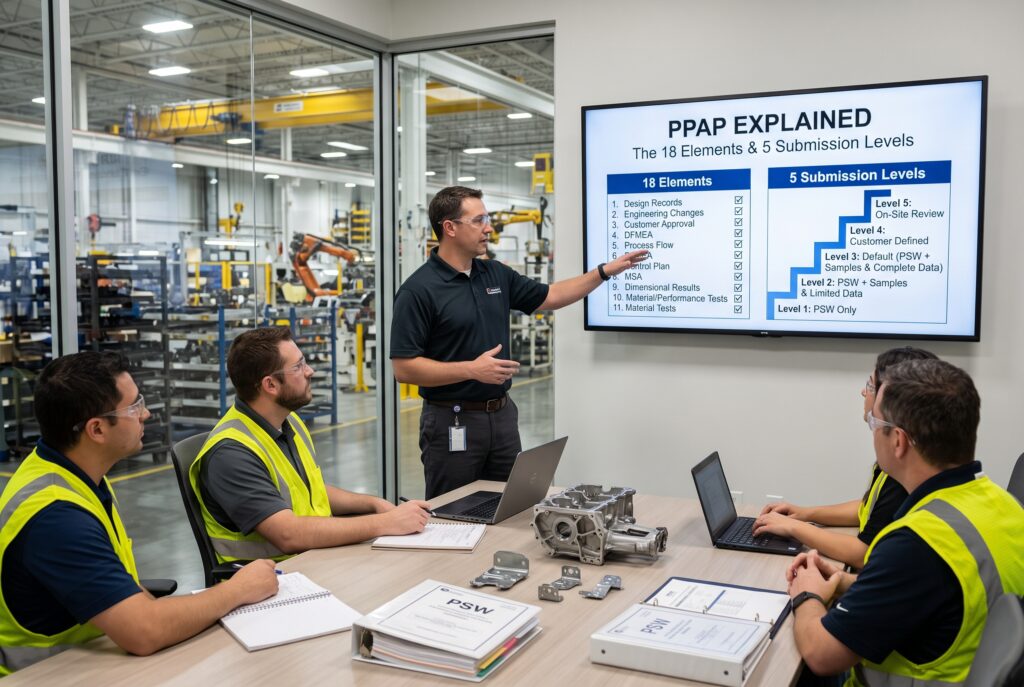
PPAP helps suppliers demonstrate that their production processes consistently meet customer requirements.
I have spent a good part of my career on the receiving end of PPAP packages. Some arrive as tidy binders that tell a clear story from drawing to capability data. Others arrive as a zip file with forty unlabeled PDFs, a Part Submission Warrant that someone signed without ever walking the line, and a control plan that someone obviously copied from a different part number. As a Supplier Quality Engineer, I can usually tell within ten minutes which kind of package I am holding, and I can usually tell how the launch is going to go.
This article is my attempt to explain PPAP the way I wish someone had explained it to me early on. Not as a list of forms, but as a conversation between a supplier and a customer about one simple question: can you make this part, correctly, every time, at the rate you promised?
What PPAP Actually Is
PPAP stands for Production Part Approval Process. It is the formal method a supplier uses to prove to its customer that it understands every engineering and specification requirement for a part, and that its production process can consistently meet those requirements during a real production run at the quoted rate.
The framework comes from the automotive world, and it remains a gate for nearly every component in the automotive parts manufacturing supply chain. The Automotive Industry Action Group (AIAG) publishes the PPAP manual, which Chrysler, Ford, and General Motors originally created to replace three separate approval systems with one common standard. Today you will find PPAP, or close variations of it, in aerospace, medical devices, heavy equipment, electronics, and plenty of general industrial supply chains. Aerospace has its own version under AS9145, and the German automotive world uses VDA 2 PPA, but the logic is the same everywhere.
Here is the part most people miss. PPAP does not build quality. It shows quality. The real work happens during Advanced Product Quality Planning (APQP), when the supplier analyzes the design, plans the process, builds the tooling, and studies the measurement systems. PPAP is the evidence package that comes out the other end. When a customer rejects a submission, the problem is almost never the paperwork. The paperwork is just where the upstream gaps finally become visible.
When a PPAP Is Required
Suppliers sometimes ask me why they need to submit a new PPAP for a part they have been shipping for six years. The answer is that PPAP follows change, not just new parts. The common triggers include:
- A brand new part or product.
- Correction of a discrepancy on a previously submitted part.
- An engineering change to the design record, specification, or material.
- New, replacement, or refurbished tooling, or added tooling such as an additional cavity on an injection mold.
- Moving production to a different plant or a different location within the same plant.
- A change of subsupplier for parts, materials, or services such as heat treating or plating.
- Tooling that the supplier restarts after it sat idle for twelve months or longer.
- A change to the test or inspection method.
The rule I give suppliers is simple. If you are thinking about changing anything that could affect fit, form, function, or performance, call your SQE before you do it. A five minute phone call costs nothing. An unapproved change that surfaces as a field issue can cost a supplier its business.
The Significant Production Run Behind Every PPAP
Before we get into the elements, there is one concept that sits underneath all of them. PPAP data must come from a significant production run. That means parts that production operators make with production tooling, production gauges, production materials, and the production process, at the production rate. Whether the part comes off a stamping press or a CNC machining cell, the rule is the same. Unless the customer says otherwise, the usual expectation is a run of one to eight hours that yields at least 300 consecutive parts.
I have rejected packages because the dimensional results came from parts the toolmaker hand selected during tool tryout. Those parts tell me the tool can make a good part. They do not tell me the process can. That distinction is the entire point of PPAP.
The 18 Elements of PPAP
The AIAG manual defines 18 elements. Not every submission needs all of them, but the customer expects the supplier to have every applicable element complete and on file regardless of the level requested. I will walk through each one and share what I actually look for when I review it.
1. Design Records as the PPAP Foundation
This is the released drawing, the CAD model, and any specifications they call out. For a proprietary component, it may be the customer’s drawing. For a supplier designed part, it is the supplier’s own released documentation. I always check that the revision level on the drawing matches the revision on the PSW, the control plan, and the dimensional report. Revision mismatches are one of the most common reasons I send a package back.
2. Authorized Engineering Change Documents
If the customer has approved engineering changes that the drawing does not yet reflect, they belong here. Think of an engineering change notice that the customer signed off while the engineering team still has not updated the drawing. Without this element, I have no way to know which requirements actually apply.
3. Customer Engineering Approval
Some customers require evidence that their engineering team has tested and signed off on the part, often through vehicle or system level trials. When a customer requires it, it is a hard gate. No engineering approval, no PPAP approval.
4. Design FMEA
If the supplier owns the design, the supplier must complete a Design Failure Mode and Effects Analysis. I want to see that the team actually considered how the part could fail in use, what the effects would be, and what design controls protect against those failures. A DFMEA that lists generic failure modes like “part breaks” with no real causes is a warning sign that the team did the analysis to fill a slot, not to learn anything.
5. Process Flow Diagram
This maps every step from receiving raw material to shipping finished goods, including inspection, rework loops, storage, and handling. I read this one carefully because it is the backbone for the PFMEA and the control plan. If a step exists on the shop floor but not on the flow diagram, nobody will analyze it for risk and nobody will control it.
6. Process FMEA, Where Most PPAP Reviews Focus
The Process FMEA looks at how each process step could produce a defect and what controls prevent or detect it. This is where I spend most of my review time. A good PFMEA is specific to the actual equipment and the actual part. It names real causes, like a worn locator or a skipped torque step, and links them to real controls. Teams that practice disciplined root cause analysis tend to write far better PFMEAs. A strong PFMEA is the best predictor I know of a smooth launch.
7. Control Plan
The control plan describes how the supplier monitors every special characteristic and key process parameter during production: what the team measures, with which gauge, how often, how many pieces, and what happens when something goes out of tolerance. I cross check it line by line against the PFMEA. Every control the PFMEA claims should appear in the control plan. If the PFMEA says “100 percent vision inspection” and the control plan says “visual check once per shift,” we have a problem.
8. Measurement System Analysis Studies for PPAP
MSA proves that you can actually trust the gauges that accept your parts. For variable gauges, this usually means a Gauge R&R study. The general guidance is that under 10 percent of tolerance is acceptable, 10 to 30 percent may be acceptable depending on the application and the customer, and above 30 percent is not acceptable. Attribute gauges need their own studies. I always ask the same question here: if your gauge cannot tell a good part from a bad one, what are your other 17 elements worth?
9. PPAP Dimensional Results
This is the full layout of every dimension and note on the drawing, measured on actual parts from the production run. Most customers want a ballooned drawing with each characteristic numbered and matched to a line on the report. If the tool has multiple cavities or the process has multiple lines, each one needs its own results. I check that every balloon has a measurement, that the measured values are real numbers rather than “OK,” and that anything out of tolerance has a documented disposition.
10. Records of Material and Performance Test Results
These are the results of every material, chemical, physical, and performance test that the drawing or the specification calls out. That might include material certifications, salt spray tests, hardness checks, or functional tests. I look for the test standard, the lab that performed it, the date, and a clear pass or fail against the requirement.
11. Initial Process Studies and PPAP Capability
This is capability data for special characteristics, usually expressed as Ppk during the initial run. The common acceptance criteria are a Ppk above 1.67 as acceptable, 1.33 to 1.67 as possibly acceptable with customer agreement, and below 1.33 as not acceptable without a reaction plan. Remember that capability only means something if the process is stable and the measurement system is sound. A beautiful Ppk calculated from a gauge that failed its R&R study is just a pretty number.
12. Qualified Laboratory Documentation
Any lab that performed testing for the submission, whether internal or external, must prove its qualification. That typically means ISO/IEC 17025 accreditation or a defined scope the customer accepts. I have seen whole packages stall because a lab with no accreditation for that method ran the plating thickness test.
13. Appearance Approval Report
The AAR applies to parts with appearance requirements, such as color, grain, gloss, or texture. It is especially common for interior trim and visible surfaces. Not every part needs one, and the customer will tell you if yours does.
14. Sample Production Parts
These are actual parts from the production run that the supplier ships to the customer as specified. Label them clearly with the part number, revision, cavity or line, and the PPAP sample identification.
15. Master Sample
The supplier keeps a master sample that carries the customer approval date, for as long as the part is active or until the customer releases it. It becomes the physical reference for operator training and future disputes. I always ask suppliers where they store their master sample, because a master sample that nobody can find is no master sample at all.
16. Checking Aids
These are fixtures, templates, and special gauges that the supplier builds for the part. The supplier must certify that they conform to the part’s dimensional requirements and document their calibration and maintenance. If you use a checking fixture to accept parts, I want the MSA for it as well.
17. Customer Specific Requirements
Every major customer layers its own requirements on top of the AIAG manual. These can include special forms, labeling rules, extra testing, or specific capability targets. For automotive suppliers certified to IATF 16949, meeting those requirements is part of the quality system itself. Suppliers who skip reading the customer specific requirements are the ones who get rejected on technicalities that the customer wrote down long ago.
18. Part Submission Warrant, the PPAP Cover Sheet
The PSW is the one page summary that ties everything together. It names the part, the revision, the reason for submission, the submission level, and the supplier’s formal declaration that the parts meet all requirements. Every level requires it. When an authorized person at the supplier signs the PSW, they are making a promise on behalf of the company. I take that signature seriously, and suppliers should too.
The 5 PPAP Submission Levels
The 18 elements describe what a supplier must have. The submission level describes how much of it actually goes to the customer. The customer, usually through the SQE, decides the level based on risk, part criticality, and the supplier’s history.
PPAP Level 1: PSW Only
The supplier submits the Part Submission Warrant, and an Appearance Approval Report if appearance items apply. Everything else stays on file at the supplier. Level 1 is common for low risk parts, simple commodities, or minor changes from suppliers with a strong track record.
PPAP Level 2: PSW With Product Samples and Limited Supporting Data
The supplier sends the PSW, sample parts, and a limited set of supporting data that the customer specifies. Customers often choose this level for moderately risky parts or when they want to verify a few specific items without reviewing everything.
PPAP Level 3: PSW With Product Samples and Complete Supporting Data
This is the default level unless the customer says otherwise, and it is the one most suppliers will see most often. The full package goes to the customer: PSW, samples, and all applicable supporting documentation including FMEAs, process flow, control plan, MSA, dimensional results, test records, and capability studies. If you are new to PPAP, assume Level 3 until your SQE tells you otherwise.
PPAP Level 4: PSW and Other Requirements as Defined by the Customer
Level 4 is a custom level. The customer defines exactly what the supplier must submit, which might be more or less than Level 3 depending on the situation. I use it when a part has a specific risk that does not fit cleanly into the other levels.
PPAP Level 5: Complete Data Reviewed at the Supplier’s Location
Level 5 includes everything in Level 3, but the review happens on site at the supplier’s manufacturing location. As an SQE, this is my preferred level for critical safety parts, brand new suppliers, or launches where something has already gone wrong. Walking the line and comparing the floor to the paperwork tells me more than any document can.
What Happens After You Submit a PPAP
Once the customer reviews the package, it issues one of three dispositions.
Full Approval means the part and process meet all requirements and the supplier may ship production quantities.
Interim Approval allows limited shipments for a defined time or quantity while the supplier resolves specific issues. It always comes with an action plan and a deadline. I treat interim approval as a loan, not a gift. If the deadline passes without closure, the approval goes away.
Rejected means the submission does not meet requirements. The supplier must correct the issues and resubmit before shipping production parts.
The supplier also has to retain PPAP records for the length of time the part is active plus one calendar year, unless the customer specifies something longer.
Why Customers Reject PPAP Packages
After reviewing more packages than I can count, I can tell you the rejections cluster around the same handful of issues:
- Revision levels that do not match across the drawing, PSW, control plan, and dimensional report.
- Dimensional results that leave out balloons or show “OK” instead of actual values.
- Capability studies that use too few parts or parts that did not come from a significant production run.
- MSA studies that failed, or that the team never ran on the gauges the line actually uses.
- A PFMEA and control plan that do not agree with each other or with the process flow.
- Customer specific requirements that nobody read.
- A PSW that someone signed without the authority, or without the knowledge, to make that declaration.
Notice that none of these are really about filling in forms. They are about whether the supplier’s team actually understood the part and built the process with care.
How I Advise Suppliers to Prepare a PPAP
If I could give every supplier one piece of advice, it would be this: start building your PPAP on the day you receive the purchase order, not the week before the due date. The elements are the natural output of good planning. When a supplier runs APQP properly, PPAP becomes a matter of collecting what already exists.
A few practical habits make a big difference. Hold a kickoff meeting with your SQE to confirm the submission level, the due date, and the customer specific requirements. Build the process flow, PFMEA, and control plan together as one linked set rather than three separate documents. Run your MSA before you run capability, so you know the numbers mean something. Do a full internal review against a checklist before anything goes out the door. And have the person signing the PSW actually look at the package.
Suppliers who treat PPAP as a quality conversation rather than a paperwork exercise launch faster, get fewer rejections, and build the kind of trust that makes the next program easier. That trust is worth more than any single approval.
PPAP Frequently Asked Questions
What does PPAP stand for?
PPAP stands for Production Part Approval Process. It is the standardized method suppliers use to show customers that their production process can consistently make parts that meet every requirement. The Quality One PPAP overview gives a good summary of the framework.
How many elements are in a PPAP?
There are 18 elements in a full PPAP, starting with design records and ending with the Part Submission Warrant. Not every submission includes all 18, but the supplier must keep every applicable element on file. The iSixSigma PPAP dictionary entry walks through the full list.
Which PPAP level is the default?
Level 3 is the default unless the customer specifies another level. It includes the PSW, product samples, and complete supporting data. The Plex guide to PPAP explains each level in detail.
What is the difference between PPAP and APQP?
APQP is the planning framework that builds quality into a product and process during development. PPAP is the evidence package the supplier submits at the end to prove the process can make conforming parts. The Kaizen Institute article on PPAP covers how the two connect.
Does every PPAP level require the Part Submission Warrant?
Yes. The PSW is the one element that all five submission levels require, because it is the supplier’s formal declaration that the submission is complete and accurate. Kissflow’s PPAP overview describes its role in the submission workflow.
Is PPAP only for the automotive industry?
No. PPAP started in automotive, but aerospace, medical device, electronics, and general manufacturing companies now rely on it too. Ideagen’s article on why PPAP matters notes its role in both automotive and aerospace supply chains.
Where can I get the official PPAP manual?
The Automotive Industry Action Group publishes the official manual, and you can buy it through AIAG or the ANSI Webstore AIAG standards page.
References
- PPAP: Production Part Approval Process, Quality One International
- Production Part Approval Process (PPAP), iSixSigma
- Guide to Production Part Approval Process (PPAP), Plex
- PPAP: The Production Part Approval Process Explained, Kaizen Institute
- What Is PPAP and Why Is It Important, Ideagen
- PPAP Software for Supplier Submissions, Kissflow
- Production Part Approval Process, WayKen
- AIAG Standards, ANSI Webstore


