
How Automotive Parts Manufacturing Works: Materials, Methods and Quality Checks

The first time I walked a stamping line as a junior engineer, I assumed the press was the whole story of automotive parts manufacturing. A coil of steel went in one end, and a door inner panel came out the other. However, it took about six months, one rejected part approval and a very long night chasing a burr problem before I understood that the press is maybe a third of it.
The rest is material selection, process planning and the quiet, stubborn work of proving that part number 40,001 matches part number one. In fact, that is what the job really comes down to. It’s a system built to make the same component hundreds of thousands of times with almost no variation. At the same time, the cost still has to let the supplier stay in business.
In this article, I’ll walk through how automotive parts manufacturing works from the plant floor. First, we’ll cover the materials we use and why. Then we’ll look at the main forming and machining methods. Finally, we’ll go through the quality checks that decide whether a part ever leaves the shipping dock.
What Makes Automotive Parts Manufacturing Different
People who come from general job shops usually notice three surprises when they join an automotive plant.
First, the volume. A single bracket program can run 300,000 to 1 million pieces a year for five years or more. As a result, volume changes how you design a process. Saving two seconds of cycle time is worth real money, and so is a die that lasts an extra 200,000 hits or every hour you cut from unplanned downtime.
Second, the price pressure. OEMs expect annual price reductions, so the process has to get cheaper every year while quality holds steady or improves. Therefore, there’s very little room to “inspect quality in” with extra labor, which is why lean principles run so deep in supplier plants.
Third, the consequences. A lot of what we make is safety critical. For example, a cracked steering knuckle or an undersized weld nugget is not just a warranty claim. Instead, it can become a recall, or worse. That’s why traceability runs through everything, down to which coil of steel and which heat of metal went into a given batch.
The supply chain has layers, too. OEMs such as Ford, Toyota or Stellantis assemble the vehicle. Meanwhile, Tier 1 suppliers deliver complete systems like seats or brake modules. Tier 2 and Tier 3 suppliers then feed them stampings, castings, fasteners and raw material. It’s also worth separating OEM parts, which go straight to vehicle assembly lines, from aftermarket parts, which come from companies other than the original manufacturer. Quality expectations differ a lot between those two worlds.
The Materials Behind Automotive Parts Manufacturing
Material choice is where most of the cost and most of the risk gets locked in. By the time a part reaches my team, the material usually sits on the drawing already. Still, understanding why engineers chose it helps you run it well.
Steel: Still the Backbone
Steel remains the most common material in a vehicle, and for good reason. It’s strong, affordable, weldable and easy to recycle. However, the number of steel types we handle has changed a lot over my career.
Mild steel still shows up in parts that need deep draws and don’t carry crash loads. For body structures, though, the trend has moved toward advanced high strength steels, usually shortened to AHSS. According to WorldAutoSteel, the number of commercially available AHSS grades nearly doubled in under a decade, going from 38 in 2017 to close to 70 by late 2025.
The benefit is simple: stronger steel lets you use thinner sheet. For instance, one automaker switched to a 980 MPa third generation steel on several body parts and cut 0.4 mm of thickness with no loss in crash performance. On a line running half a million parts a year, that adds up fast.
The catch is formability. Because higher strength steel springs back more after forming, it wears tooling faster and cracks more easily at tight radii. For the strongest parts, like B pillars and roof rails, we use press hardened boron steel. Automakers place these martensitic and boron based grades in the passenger compartment structure because they improve crash safety.
Aluminum: Lighter, but Harder to Tame
Aluminum shows up in three main forms: castings, extrusions and sheet. Castings cover engine blocks, transmission cases, suspension parts and a growing number of structural nodes. Similarly, extrusions go into bumper beams and battery enclosures. Sheet, on the other hand, goes onto hoods, doors and closures where weight savings matter most.
For die cast body structures, aluminum silicon alloys are the usual choice because they are light, fill molds well, suit mass production and offer good strength. The downside, however, is cost. Aluminum also brings joining and corrosion issues that steel plants rarely have to think about.
Cast Iron, Magnesium and Other Metals
Gray and ductile iron remain common for brake rotors, differential cases and some knuckles. After all, iron is forgiving, damps vibration well and casts cheaply.
Magnesium is the lightest structural metal we use. Even so, it stays a niche material because of cost and corrosion. Instrument panel beams are the classic example, since suppliers cast them in AM50 and AM60 alloys at volumes above 4 million.
Plastics, Composites and Elastomers
Walk around any modern car and you’ll find plastics everywhere: bumper fascias, interior trim, air intake manifolds, fluid reservoirs and wiring clips. Polypropylene plays an especially big role because it’s an inexpensive general purpose plastic with solid performance. In addition, glass filled nylons handle the heat under the hood. Finally, rubber and other elastomers make up the seals, hoses and suspension bushings where flexibility matters.
How We Choose Between Them
In practice, material selection in automotive parts manufacturing is a negotiation between design engineering, purchasing and manufacturing. Design wants strength and stiffness at the lowest weight. Purchasing, meanwhile, wants the cheapest option with a stable supply. We want something we can form, weld and machine consistently at rate.
That’s why the questions I always ask are simple. Can we form it without splitting? Can we join it reliably? How fast does it wear the tooling? Also, does it need a coating or heat treatment that adds another supplier to the chain? Those answers often decide the process before anyone draws a die.
The Core Methods in Automotive Parts Manufacturing
Most parts go through one primary forming process, then one or more secondary operations. Below are the methods you’ll find in almost every supplier plant.
Metal Stamping
The stamping process is the workhorse of body and chassis production. A press forces sheet metal through a set of dies to cut, bend and draw it into shape. For example, small brackets usually run in progressive dies, where the strip moves through several stations inside a single press. Larger panels, by contrast, run in transfer or tandem lines, with robots or transfer fingers moving the part from die to die.
Stamping looks simple from the aisle, but the real engineering happens long before production. Die design, simulation and tryout can take months for a complex panel. For this reason, current WorldAutoSteel guidance leans heavily on simulation, so engineers validate forming virtually before they commit to physical tooling. I can tell you from experience that it works. The fewer times you recut a die, the smoother the launch.
Hot stamping is the variation we use for press hardened steel. First, the line heats the blank to around 900°C. Then the press forms it and quenches it inside a cooled die. You get very high strength and almost no springback. On the other hand, the cycle runs slower and the equipment costs far more.
Casting
Casting pours or injects molten metal into a mold. Foundries still use sand casting for large, complex parts like engine blocks and some transmission cases, where the sand forms the cavity around a pattern.
For aluminum, however, high pressure die casting dominates. It’s the most common way to make aluminum castings. The machine doses molten metal into a shot chamber, and then a hydraulic ram pushes it into the die cavity at a controlled speed. As a result, cycle times stay short and dimensional accuracy is good. The enemy is porosity. Because trapped gas and shrinkage voids can weaken a part or cause leaks, we control melt quality, die temperature and shot profile very tightly.
Gigacasting is the biggest story in automotive parts manufacturing right now. Standard aluminum die casting usually runs below 4,000 metric tons of press force. Gigacasting machines, however, go well beyond that to produce huge single piece structural sections. When a plant does it right, casting one module instead of welding dozens of body parts can, in theory, sharply reduce the cost per unit. Scrap gets expensive, though. If one casting replaces 70 parts and it has a defect, you lose all 70 at once.
Forging
Forging shapes hot or cold metal under compressive force. It creates a continuous grain flow that gives excellent fatigue strength. That’s why we forge crankshafts, connecting rods, gears, hubs and many steering knuckles. Forgings almost always need machining afterward. Still, the strength advantage is worth it for parts that see high cyclic loads.
CNC Machining
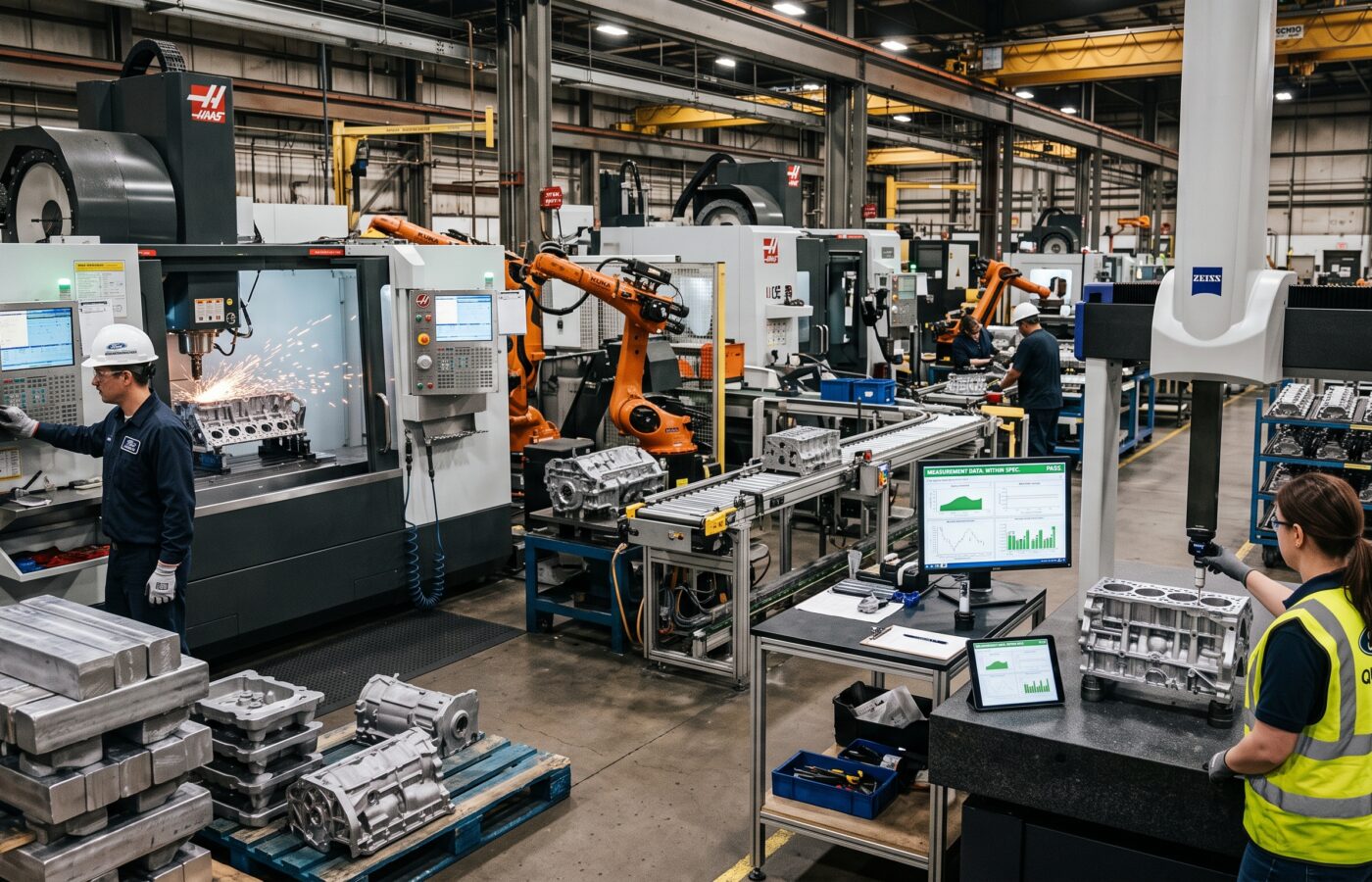
Machining removes material to hit tight tolerances on critical features. Think of the bores in an engine block, bearing seats in a transmission case or the sealing face on a brake caliper. In high volume plants, this work happens on dedicated transfer lines or cells of CNC machines with automated loading. Consequently, tool life tracking, in process gauging and thermal stability matter a lot here. After all, a few microns of drift can scrap a whole shift’s output.
Injection Molding
Most plastic parts come from injection molding. The machine melts the pellets, injects them into a steel mold, cools the part and then ejects it. Good molding depends on mold design, gate location, cooling and properly dried material. Otherwise, you end up chasing warp, sink marks and short shots.
Joining, Heat Treatment and Finishing
Individual parts rarely ship alone. Instead, plants weld, rivet, bond or bolt them into assemblies. Resistance spot welding is the most common welding method in automotive production, although newer material grades make consistent weld quality harder to guarantee. With AHSS, for example, liquid metal embrittlement can cause surface cracks during spot welding.
After forming, we heat treat many parts to reach final hardness. We often carburize gears and induction harden shafts. Finally, coating lines add corrosion protection through zinc plating, electrocoating or powder coating, depending on where the part lives on the vehicle.
Quality Planning Starts Before Production
This is the part outsiders underestimate. In automotive parts manufacturing, quality is not a department at the end of the line. Instead, teams plan it into the process from the very first program meeting.
IATF 16949 and the Core Tools
The framework behind that planning is IATF 16949. It acts as a specialized extension of ISO 9001:2015 for the automotive supply chain, so no plant can implement it on its own. Alongside it sit the AIAG Quality Core Tools, which AIAG calls the building blocks of a working quality system: APQP, the control plan, PPAP, FMEA, MSA and SPC.
APQP and PFMEA
APQP (Advanced Product Quality Planning) is the roadmap. It moves a new part from concept through process design, validation and launch, with defined deliverables at each gate.
Next comes PFMEA (Process Failure Mode and Effects Analysis). Here, the team sits down and asks what can go wrong at every step. Each realistic failure gets a severity, an occurrence rating and a plan to prevent or detect it.
Control Plan, MSA and SPC
The control plan then turns the PFMEA into daily instructions. It lists every characteristic we check, how we check it, how often and what we do when it’s out of spec.
MSA (Measurement System Analysis), meanwhile, proves we can trust our gauges. A gauge R&R study shows how much of the variation comes from the part and how much comes from the measurement itself. So if your gauge eats 40 percent of the tolerance, your SPC chart is mostly noise.
SPC (Statistical Process Control) tracks key dimensions over time. That way, we can react to drift before we make bad parts.
PPAP: The Final Exam
PPAP (Production Part Approval Process) brings it all together. It’s the package of documents, data and physical parts proving the team carried out the planning properly. In fact, a failed submission nearly always points back to gaps in APQP. The customer chooses from five submission levels, with Level 3 as the common default, and a full package can include up to 18 elements.
I’ve watched good parts fail PPAP because the MSA was sloppy or the control plan didn’t match what operators actually did. Customers read these documents closely, and they should.
Quality Checks on the Production Floor
Once the customer approves a part, the job becomes keeping it approved. Here’s what daily quality control in automotive parts manufacturing looks like shift by shift.
Incoming Material Inspection
Every coil, bar and resin lot arrives with a certification from the mill or supplier. First, we verify it against the specification. Then we spot check hardness, thickness or chemistry. Traceability also starts here, because we tag every lot so we can link it to finished parts later.
Setup and First Piece Approval
After any die change, tool change or long stoppage, the first parts off the line get a full dimensional check before production resumes. As a result, we catch setup mistakes early, when they cost a few pieces instead of a full rack.
In Process Checks and Error Proofing
Operators check key characteristics at the frequency the control plan sets, usually with pass/fail gauges or checking fixtures. However, the best plants rely less on people spotting defects and more on error proofing. For instance, sensors confirm that the die punched a hole, that a nut sits in place before welding or that a clip is fully seated. If the sensor doesn’t see the right condition, the machine won’t cycle.
Machine vision is also growing fast here. In fact, AIAG has published CQI 38, a standardized method for assessing and managing AI based vision inspection systems in automotive plants.
Statistical Process Control and Capability
For critical and significant characteristics, we plot measurements on control charts and calculate process capability. As a rule of thumb, customers expect initial studies to show a Ppk of at least 1.67. Likewise, they expect ongoing production to hold a Cpk of 1.33 or better. Below that, you’re usually on 100 percent inspection until you fix the process.
In my experience, the charts are almost always there. What’s often missing, though, is anyone actually reacting to them. That gap shows up in audits more than most plants would like to admit.
Dimensional Layout and CMM Inspection
Coordinate measuring machines check complex geometry against the CAD model. Most customers also require an annual full layout, where the lab measures every dimension on the drawing using production parts. Besides CMMs, blue light and laser scanners are now common for panels and castings, since they show deviation across the entire surface instead of a handful of points.
Destructive and Functional Testing
Some quality you can only verify by breaking parts. So we chisel test spot welds, section castings to look for porosity and pull test fasteners. In addition, we leak test and torque audit assemblies, and sometimes we run them on functional test stands at the end of the line.
Layered Process Audits
Layered process audits put supervisors, managers and even the plant manager on the floor on a set schedule. During each audit, they check that operators run the process as written. Each one takes maybe ten minutes. Even so, it sends a clear message about what leadership cares about.
What Happens When Something Goes Wrong
No process in automotive parts manufacturing is perfect. So when a defect escapes to the customer, the response follows a familiar pattern.
Containment comes first. We quarantine suspect stock at our plant, in transit and at the customer, and then we sort it. Speed matters here, because most customers run on just in time inventory, so a quality hold can starve their line within hours. Next comes root cause analysis, which the team usually documents in an 8D report. The team defines the problem, finds the true cause with tools like 5 Why and fishbone diagrams, and puts permanent corrective actions in place. Finally, we update the PFMEA and control plan so the lesson sticks, the same steady improvement loop behind the best kaizen examples.
Repeat escapes can put a supplier on controlled shipping, where a third party inspects every part before it leaves. Needless to say, it’s expensive and embarrassing. Believe me, it’s something you work very hard to avoid.
Where Automotive Parts Manufacturing Is Heading
A few trends are reshaping the work right now.
To begin with, electric vehicles are changing the part mix in automotive parts manufacturing. There are fewer engine and transmission components and more battery enclosures, motor housings, busbars and thermal management parts. Many of these also need new processes and much tighter cleanliness control.
Parts consolidation is another big theme, and not only through gigacasting. For example, a WorldAutoSteel study with Ricardo found that more AHSS, combined with modest assembly line changes, could cut a front body structure from 38 parts to 25 and lower manufacturing investment by about US$21 million.
Finally, data is the third shift. Manufacturing execution systems now link machine data, overall equipment effectiveness, SPC and traceability records in real time. As a result, it’s far easier to answer the question every quality engineer dreads: “Which parts did we make with that tool, on that shift, from that coil?”
Final Thoughts
After years in plants, my view of automotive parts manufacturing is fairly simple. The materials and machines get the attention, but consistency is the real product. A supplier that picks the right material, designs a stable process and runs its quality system honestly will keep winning programs. By contrast, a supplier that treats the paperwork as a formality eventually learns otherwise, usually at the worst possible time.
So if you’re new to the industry, learn the core tools and spend as much time on the floor as you can. The parts will teach you the rest.
Frequently Asked Questions
What materials are most common in automotive parts manufacturing?
Steel is still the most common, especially advanced high strength steel for body structures. In addition, aluminum, cast iron, plastics like polypropylene and rubber play major roles. The AHSS Application Guidelines from WorldAutoSteel are a great starting point for steel grades.
What is the difference between APQP and PPAP?
APQP is the planning framework teams use to develop a new part and its process. PPAP, on the other hand, is the evidence package proving the plan worked and the process can make good parts consistently. KAIZEN Institute’s PPAP guide explains how the two connect.
Is IATF 16949 certification mandatory for automotive suppliers?
It isn’t a legal requirement. However, most major OEMs expect their production suppliers to hold it. It builds on ISO 9001 with automotive specific requirements. See AIAG’s Quality Core Tools page and the IATF 16949 overview on Wikipedia.
What is gigacasting and why does it matter?
Gigacasting uses very large high pressure die casting machines to make big single piece aluminum structures that replace dozens of stamped and welded parts. Both S&P Global Mobility and ASSEMBLY Magazine cover its benefits and risks.
How do manufacturers make sure every part is the same?
They combine capable processes, trustworthy gauges, statistical process control, error proofing and regular audits. Above all, teams plan quality in through tools like PFMEA and the control plan rather than leaving it to final inspection.
What does Cpk mean in automotive quality?
Cpk measures how well a process fits inside its tolerance, accounting for both spread and centering. Generally, a Cpk of 1.33 or higher is a common requirement for key characteristics in ongoing production.
References
- WorldAutoSteel. WorldAutoSteel Releases Latest Advanced High Strength Steel Application Guidelines
- WorldAutoSteel. Steel Your Strength
- WorldAutoSteel. steeluniversity Automotive Courses
- FormingWorld. Advanced High Strength Steel Application Guidelines
- Vehicle Dynamics International. Advanced High Strength Steels Unlock 34% Parts Reductions, Finds Study
- S&P Global Mobility. Gigacasting: The Hottest Trend in Car Manufacturing
- ASSEMBLY Magazine. Gigacasting: The Next Big Idea in Automotive Manufacturing?
- ScienceDirect Topics. High Pressure Die Casting Overview
- Materials via PubMed Central. Life Cycle Assessment of Plant Fiber Composite Microcellular Foam Molded Automotive Components
- AIAG. Quality Core Tools
- KAIZEN Institute. PPAP: Production Part Approval Process
- arXiv. Compliance Evidence in the Automotive Supply Chain
- Wikipedia. IATF 16949
- The Manufacturer. How Are Car Parts Manufactured?