
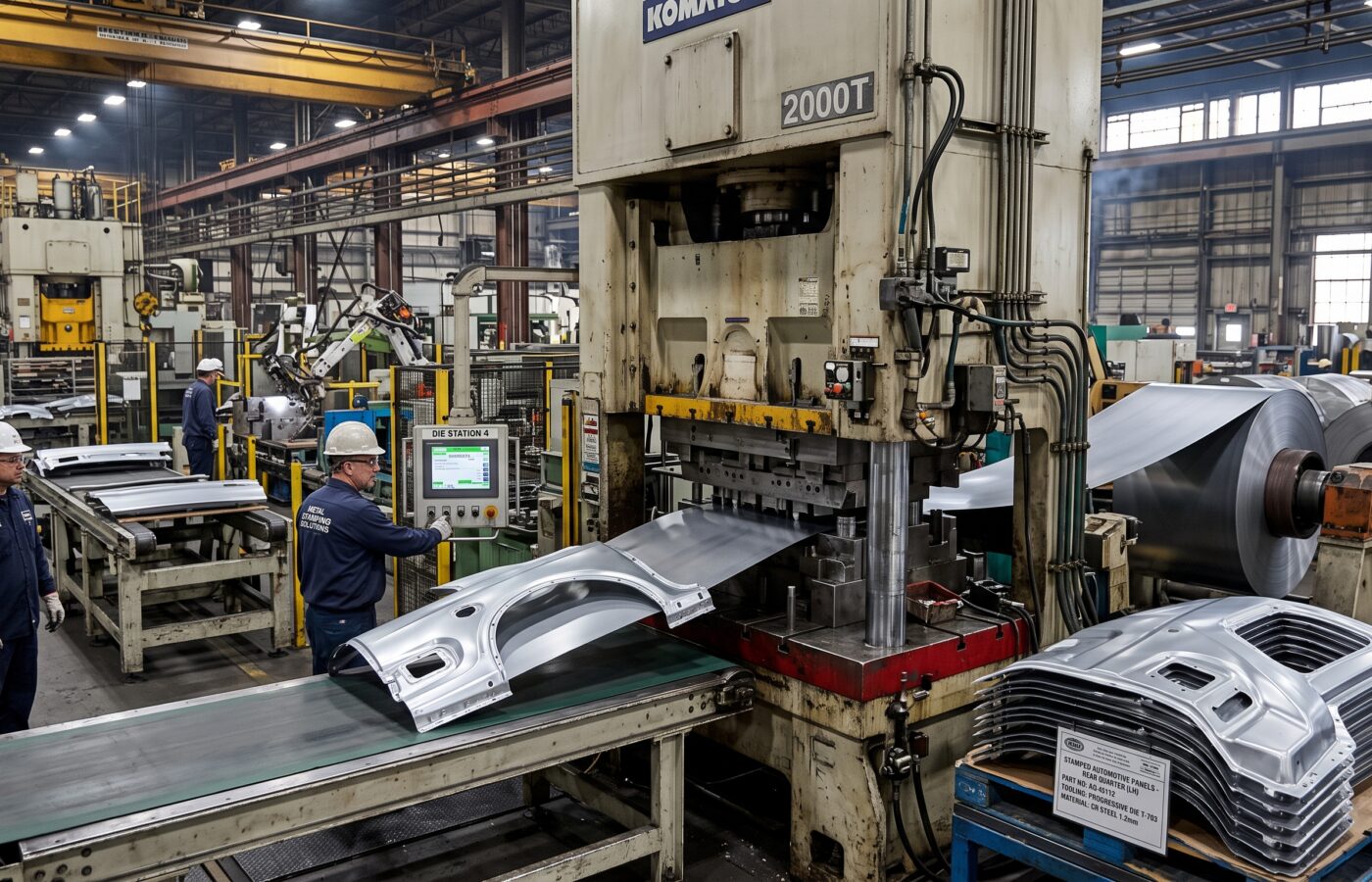
Metal Stamping Process Explained: Types, Tooling and Automotive Uses

Walk into any stamping plant and the first thing you notice is the rhythm. A big press cycles at a steady beat, coil feeds in on one side, and finished parts drop into a bin on the other. The metal stamping process looks simple from the aisle. However, it isn’t. Behind every one of those strokes sits months of die design, material testing, press sizing and tryout work, along with a lot of hard lessons about how sheet metal behaves when you push it past its comfort zone.
This guide walks through the metal stamping process the way engineers and die makers actually talk about it. First, we will cover the core operations. Then we will look at the main types of stamping, how presses differ, why tooling eats most of the budget, and why the automotive industry remains the single biggest user of stamped parts. So whether you are a buyer sourcing stamped components, an engineer new to forming, or a plant manager weighing a new press line, this should give you a solid working picture.
What the Metal Stamping Process Actually Is
At its simplest, the metal stamping process is cold forming. An operator or feeder places a flat sheet or coil of metal between a punch and a die, the press closes, and the tooling cuts or shapes the metal into a new form. In other words, the die defines the outside shape, the punch pushes the material into it, and the press supplies the force.
What makes stamping so valuable is repeatability at speed. Once a die maker builds and proves a die, it can produce the same part hundreds of thousands of times with very little variation. For that reason, Total Materia describes sheet metal stamping as the most common way to make metal parts for cars, since it combines a high production rate with low cost per piece.
The tradeoff, however, is upfront investment. You pay heavily for the tooling before the first good part comes off the line. As a result, stamping makes financial sense only when volumes are high enough to spread that cost across a large number of parts. For a run of fifty brackets, you would laser cut and bend them. For fifty thousand a month, on the other hand, you build a die.
The Core Operations Inside a Stamping Die
Every stamped part, no matter how complex, comes from a short list of basic operations. Die designers combine and sequence these to get from a flat strip to a finished component.
Cutting Operations
Blanking cuts the outer profile of the part from the sheet. The punch drives through the material, and the piece that falls through the die becomes the part you keep.
Piercing (sometimes called punching) works the opposite way. The punch cuts a hole, and the slug that falls through becomes scrap. For example, mounting holes, pilot holes and lightening holes all come from piercing.
Shaping Operations
Bending folds the metal along a straight line. Brackets, clips and channels, for instance, all depend on it.
Forming is a broader term for shaping the metal without cutting it, such as adding ribs, beads or offsets that stiffen a panel.
Drawing pulls the sheet into a cavity to create depth. Cups, housings, oil pans and fuel tank halves are all drawn parts. Deep drawing is where the metal stamping process gets demanding, because the material must flow without tearing or wrinkling.
Edge and Detail Operations
Flanging turns an edge up at an angle. According to Fractory, flanging comes in two types, stretch flanging and shrink flanging, and it often serves as the step before hemming.
Hemming folds an edge back onto itself. Car doors and hoods, for example, use hems to join the outer skin to the inner panel. A hem can lie closed and flat, or it can stay open with a small air gap.
Coining and embossing press fine detail into the surface under very high pressure. Coining squeezes the metal so it flows into every feature of the die, which is why engineers choose it for tight tolerance details.
Why Station Order Matters
A single progressive die may run six or ten of these operations in sequence. Therefore, the art lies in the order. A patent for laminated brake abutment clips makes the point well: the inventors found that simply rearranging the order of stations eliminated delamination problems in the finished part. In short, station sequence is not paperwork. It decides whether the part works. Small, deliberate changes like this are exactly what the best kaizen examples are built on.
Types of Metal Stamping
There is no single metal stamping process. Instead, there are several, and part size, geometry, material and annual volume all drive the choice among them. Industry sources generally group dies into four families: single stage, progressive, compound and transfer. Deep drawing and hot stamping also deserve their own sections because they change the rules.
Single Stage and Line Dies
A single stage die does one operation per press stroke. For a large part, a plant might run a line of presses, each with its own die, and move the part between them. In the past, operators carried parts from tool to tool by hand, which the industry called “pick and place.” Today, however, robots or tandem line automation handle that job on most automotive panel lines.
Single stage tooling costs less to build and is easier to adjust. Consequently, it suits prototypes, lower volumes, or very large panels that no single die could handle.
Progressive Die Stamping
Progressive stamping is the workhorse of high volume production. A coil of metal feeds through a die with several stations. Each press stroke advances the strip one step, and meanwhile every station performs its operation at the same time. As a result, a finished part drops off the end of the die with every stroke.
Small bridges called carriers hold the part to the strip until the final cutoff. In addition, pilot holes pierced early in the strip keep everything registered as it moves forward.
The speed is hard to beat. StampingSimulation notes that progression tools are the highest volume tooling and can run upward of 60 parts per minute, while small parts on high speed presses go much faster than that. The downside, though, is cost and rigidity. Progressive dies are expensive to build, and because every part stays tied to the strip, you cannot perform operations that need a free part, such as necking, curling or certain deep draws.
Transfer Die Stamping
Transfer stamping solves that limitation. The die cuts the part free from the strip early, and then mechanical fingers or a transfer rail move it from station to station. Because the part no longer rides on a carrier, the die can rotate it, draw it deeply and work it from angles a progressive die could never reach.
Transfer presses usually run slower than progressive setups. Even so, they handle larger and more complex parts. That is why many automotive structural components, such as cross members and deep drawn reinforcements, come off transfer lines.
Compound Die Stamping
A compound die performs more than one cutting operation at the same station in a single stroke, for example blanking the outside and piercing a center hole at once. Since both features come from one hit, their relationship to each other is extremely accurate. Washers and flat precision parts are classic compound die work. That said, the tooling is precise and heavy, so it costs more upfront than a simple blanking die.
Deep Draw Stamping
Deep drawing forms parts whose depth is large compared to their diameter. Think of a steel can, a kitchen sink or a motor housing. A binder or blank holder grips the blank while the punch pulls it into the die cavity. If the hold is too strong, the metal tears. If it is too weak, on the other hand, the metal wrinkles. Getting that balance right, often across several redraw stages, is the core skill of a deep draw shop.
Hot Stamping (Press Hardening)
Hot stamping is the most significant change to the metal stamping process in the last few decades, and car safety standards drove it almost entirely.
First, a furnace heats a boron alloyed steel blank, most often grade 22MnB5, to above 900°C until its structure transforms. Next, a transfer system moves it quickly into a water cooled die, where the press forms it while it is still soft. Finally, the die stays closed and quenches the part. The result is a fully martensitic part with tensile strength around 1,500 MPa, several times stronger than ordinary mild steel.
The benefits are real. Because the metal forms hot and then hardens, springback is minimal and shape accuracy is excellent. Also, a single hit can form complex shapes. SSAB points out that the classic application is the A and B pillars, and patents from major automakers list roof rails, rockers, bumper beams, door intrusion beams and tunnel reinforcements as common hot stamped parts.
Nevertheless, the drawbacks include energy use, slower cycle times and cost. Furnaces are large, and the part must dwell in the closed die to cool properly. Therefore, automakers reserve hot stamping for places where crash performance justifies it.
Stamping Presses: Mechanical, Hydraulic and Servo
The die gets the attention, but the press decides what the die can do.
Mechanical Presses
Mechanical presses use a flywheel to store energy and a crank or eccentric to drive the slide. They are fast and relatively inexpensive, so most shops default to them for blanking and progressive work. Their weakness, however, is the tonnage curve. A mechanical press delivers its full rated force only near the bottom of the stroke, and makers typically rate it at a point like 0.187, 0.25 or 0.5 inch above bottom dead center. Higher in the stroke, less force is available.
Hydraulic Presses
Hydraulic presses, by contrast, deliver full tonnage at any point in the stroke and allow long, controlled dwell. That makes them well suited to deep drawing and heavy forming. The catch is speed, since they cycle more slowly.
Servo Presses
Servo presses replace the flywheel with a servo motor that controls slide speed and position throughout the stroke. For example, you can slow the slide just before contact to reduce shock, dwell at bottom, and then speed up on the return. The Fabricator’s coverage of early servo adopters described how shops traditionally held blanking on a conventional 250 ton press to about half its rating, whereas a servo drive lets them use a larger share of rated tonnage. Press maker SEYI estimates servo presses use about 40% less energy than a comparable mechanical press and roughly 70% less than a hydraulic one. At the same time, it admits the purchase price can be about double.
Matching the Press to the Material
Servo presses matter most when stamping advanced high strength steels and aluminum. These materials create heavy reverse tonnage, the snap through shock when the punch breaks through the material, and that shock damages dies and presses. Slowing the slide at breakthrough controls it. Similarly, press hardening depends on programmable dwell at bottom dead center, because the part needs time under full load to cool and harden correctly.
Press selection sounds like a purchasing decision. In practice, though, it is an engineering one, and a wrong choice shows up as cracked dies, inconsistent parts and falling overall equipment effectiveness within months.
Tooling: Where the Real Money Goes
Ask any stamping supplier where their cost and risk sit, and they will point to the tool room. After all, the die is the product. Everything else is support.
Die Construction and Materials
A large automotive draw die has a cast iron or cast steel body, and die makers set hardened tool steel inserts into the high wear zones. Small progressive dies, on the other hand, often come machined from tool steel throughout, with carbide for cutting edges on very thin, high speed work.
The AHSS Guidelines from WorldAutoSteel describe a common tool steel shorthand: TD2 for high wear resistance with lower shock resistance, TS7 for high shock resistance with lower wear resistance, and TA2 as a balanced middle choice. Choosing among them, therefore, means knowing whether a station mostly cuts, mostly forms, or takes impact.
Material strength also changes the rules. Research summarized in the same guidelines found that die materials and coatings that performed well on steel up to 980 MPa tensile strength failed to hold up on 1,180 MPa grades. In other words, a die that works on one steel may fail quickly on a stronger one, even if the part looks identical.
Coatings and Surface Treatments
Because advanced steels are so abrasive, shops often coat die surfaces. The Fabricator identifies three common coating methods for AHSS dies: physical vapor deposition (PVD), chemical vapor deposition (CVD) and thermal diffusion (TD). Many shops also take a duplex approach, nitriding the tool steel first to harden the substrate and then applying a PVD coating on top. Consequently, coatings reduce galling, which happens when sheet metal welds itself to the die surface and tears the part.
Simulation Before Steel Is Cut
Modern die design starts in software. Forming simulation predicts where the sheet will thin, split, wrinkle or spring back before anyone machines a block of tool steel. It can also predict where wear will be severe, so designers place durable inserts exactly where the die needs them rather than across the whole tool. As a result, simulation has cut tryout time dramatically compared with the old days of hand grinding a die until the part came out right.
Even so, simulation does not replace experience. One veteran stamping consultant writing in The Fabricator estimated that in high speed work, about 20% of problems trace back to material and about 80% to die design and build. So while the software helps, the die maker still matters.
Maintenance and Die Life
A die is a wear item. Over time, cutting edges dull, forming radii polish and wear, and inserts crack. Good plants track hits per die, sharpen on a schedule, and check burr height, which is often the first sign a cutting edge is going. Skipping maintenance to meet a shipment, by contrast, usually costs more later in scrap, emergency repairs and unplanned press downtime.
Tooling is also where automakers keep control. Sandvik Coromant notes that carmakers typically build more than a third of their stamping dies in house, which says a lot about how strategic tooling is to vehicle programs.
Automotive Uses of the Metal Stamping Process
No industry depends on the metal stamping process more than automotive. In fact, nearly every sheet metal part on a vehicle started life in a stamping die before moving on to vehicle assembly.
Body in White
The body in white is the welded steel shell of the car before paint, trim and powertrain go in. Hundreds of stamped parts make it up, including floor pans, side frames, roof panels, wheelhouses and reinforcements. Plants usually run large outer panels on tandem lines or large transfer presses, while smaller reinforcements often come from progressive dies. Many stamping plants also sit right beside the assembly plant and deliver panels on a just in time basis.
Closures and Exterior Panels
Plants stamp doors, hoods, fenders and liftgates from steel or aluminum, and then hem and assemble them. These are Class A surfaces, meaning the customer sees them, so the standard for surface quality is extremely high. For instance, a tiny low spot or skid line that nobody would notice on a bracket becomes a reject on a door skin.
Safety and Structural Parts
Pillars, roof rails, bumper beams and side impact beams are where hot stamped and advanced high strength steel parts do their work. Engineers design these parts to hold their shape during a crash so the passenger cabin stays intact. Moreover, The Fabricator has reported that some vehicles now use advanced high strength grades for more than half the body structure. Stronger steel allows thinner gauges, which in turn cuts weight without giving up crash performance.
Chassis and Functional Components
Stamped parts also show up in suspension arms, brackets, heat shields, exhaust components, seat frames and brake hardware. For example, suppliers like Evans Tool & Die list structural reinforcements, suspension parts, heat shields and exhaust components among typical automotive stamping work. Tier 1 and Tier 2 suppliers make many of these parts under IATF 16949 quality systems, the automotive industry standard.
Electric Vehicle Components
Electric vehicles have added new work for stampers as well. Battery enclosures, cross members that protect the pack, motor housings and electrical contacts all involve stamped metal. As a result, precision progressive stamping of copper busbars and terminals has become a growth area for shops that once focused mainly on brackets and clips.
The Challenge of Stronger Steels
The push for lighter, safer cars has made the automotive metal stamping process harder. Advanced high strength steels have less stretch, spring back more, and wear dies faster than mild steel. For this reason, The Fabricator’s Die Science column has long advised larger entry radii, better lubricants, slower forming speeds and premium tool steels when working these grades. Ultimately, stampers who invested early in servo presses, simulation and coated tooling are the ones winning automotive programs today.
Choosing the Right Stamping Approach for a Part
If you are sourcing a stamped part, a few questions will steer you toward the right method.
What is the annual volume? Low volume favors single stage tooling or even laser cutting and press brake bending. High volume, however, justifies progressive or transfer dies.
How big is the part? Small to medium parts fit progressive dies, whereas large panels need transfer or tandem lines.
How deep is it? Shallow parts run well in progressive dies. Deep draws, by contrast, usually need transfer or dedicated draw tooling.
What material and strength? Mild steel is forgiving. On the other hand, AHSS, aluminum and stainless demand more press capacity, better tooling and more tryout time. Press hardened parts also need a hot stamping line.
What tolerances matter? If features must hold a tight relationship to each other, you may need compound dies or restrike stations.
A good supplier will ask these questions before quoting. So if a supplier quotes a complex part without asking about volume, material or critical dimensions, treat that as a warning sign.
Common Defects and How Plants Control Them
Every stamping engineer spends a large part of the job fighting the same handful of problems.
Forming Defects
Springback is the metal’s tendency to partially return to its original shape after forming. It gets worse as material strength rises. To compensate, die designers overbend the part or add restrike stations.
Wrinkling happens when compressed metal buckles, usually in drawn parts with too little binder pressure.
Splits and tears occur when the die stretches metal past its limit. Typically, larger radii, better lubrication and revised blank shapes fix the problem.
Cutting and Surface Defects
Burrs are rough edges that cutting leaves behind. They grow as cutting edges dull or clearances drift, which is why inspectors check burrs as a standard part of in process inspection.
Galling is material transfer between sheet and die. Fortunately, coatings and proper lubrication control it.
Why Variables Stack Up
A 2026 study published in Materials looked at progressive stamping and found that part quality depends on more than setting shut height correctly. Instead, die clearances, punch condition and lubrication all interact, and the effect of each builds from station to station. That matches what experienced die setters already know: a good part at station eight depends on everything that happened at stations one through seven.
Final Thoughts
The metal stamping process has been around for well over a century, yet it has never stood still. Servo presses, forming simulation, coated tool steels and hot stamping have all changed what a single press line can produce. Still, the fundamental equation hasn’t changed. Invest in good tooling and good process control, backed by solid lean principles on the press floor, and you get millions of consistent parts at a cost no other method can match. Skimp on either, however, and the press will let you know quickly.
For automotive programs especially, stamping is no longer just a commodity service. Rather, it is an engineering partnership, and the suppliers who understand material behavior, die design and press capability are the ones carmakers trust with their safety critical parts.
Frequently Asked Questions
What is the metal stamping process in simple terms?
It is a cold forming method where a press forces sheet metal between a punch and a die to cut or shape it into a part. Manufacturers rely on it for high volume production of consistent metal components. For a good visual overview, see Fractory’s stamping guide.
What are the main types of metal stamping?
The four main die types are single stage, progressive, compound and transfer. In addition, deep drawing and hot stamping are specialized variations for deep parts and ultra high strength parts. See this breakdown of die types.
What is the difference between progressive and transfer stamping?
In progressive stamping, the part stays attached to the metal strip as it moves through each station. In transfer stamping, by contrast, the die cuts the part free early and mechanical fingers move it, which allows larger parts and deeper forming. Wikipedia’s progressive stamping entry covers the tradeoffs.
Why do automakers use hot stamping?
Hot stamping forms heated boron steel and quenches it in the die, so the finished parts have very high strength and little springback. For this reason, automakers choose it for crash critical parts like A and B pillars and roof rails. SSAB explains the trend here.
What materials do die makers use for stamping dies?
Large dies often have cast iron or cast steel bodies with hardened tool steel inserts. Die makers pick tool steels for wear or shock resistance, and they frequently coat dies for advanced steels with PVD, CVD or TD coatings. The AHSS Guidelines on tooling go into detail.
Are servo presses better than mechanical presses?
Not always. Servo presses offer programmable motion, lower energy use and better control over tough materials, but they cost considerably more. So for simple, high speed blanking of mild steel, a mechanical press often gives better value. SEYI’s comparison lays out both sides.
How long does a stamping die last?
It depends on material, part design and maintenance. A well maintained die running mild steel can last for millions of hits. However, dies stamping ultra high strength steel wear much faster and need regular insert replacement and sharpening.
References
- Fractory. Metal Stamping: Process, Press Types and Operations Guide
- Total Materia. Metal Stamping Dies
- Wikipedia. Progressive Stamping
- Wikipedia. Stamping Press
- Wikipedia. Press Hardening
- StampingSimulation. Sheet Metal Stamping Dies: The Basics
- The Fabricator. Die Materials and Wear in Stamping AHSS
- The Fabricator. Achieving Successful Stamping of AHSS
- The Fabricator. The Science Behind the Servo Press
- The Fabricator. Ask the Stamping Expert: Tool Steels for High Speed Progressive Dies
- The Fabricator. Die Science: Guidelines for Forming High Strength Material
- AHSS Guidelines (WorldAutoSteel). Tooling and Die Wear
- AHSS Guidelines (WorldAutoSteel). Press Requirements
- SSAB. Why Press Hardening Steel Is Hot for Auto Designers
- SEYI. Mechanical vs. Servo Press for Modern Metal Stamping
- Sandvik Coromant. Stamping Dies in Automotive
- Evans Tool & Die. Automotive Metal Stamping
- Materials (MDPI), via PMC. Impact of Process Variables on Part Quality in Progressive Stamping