
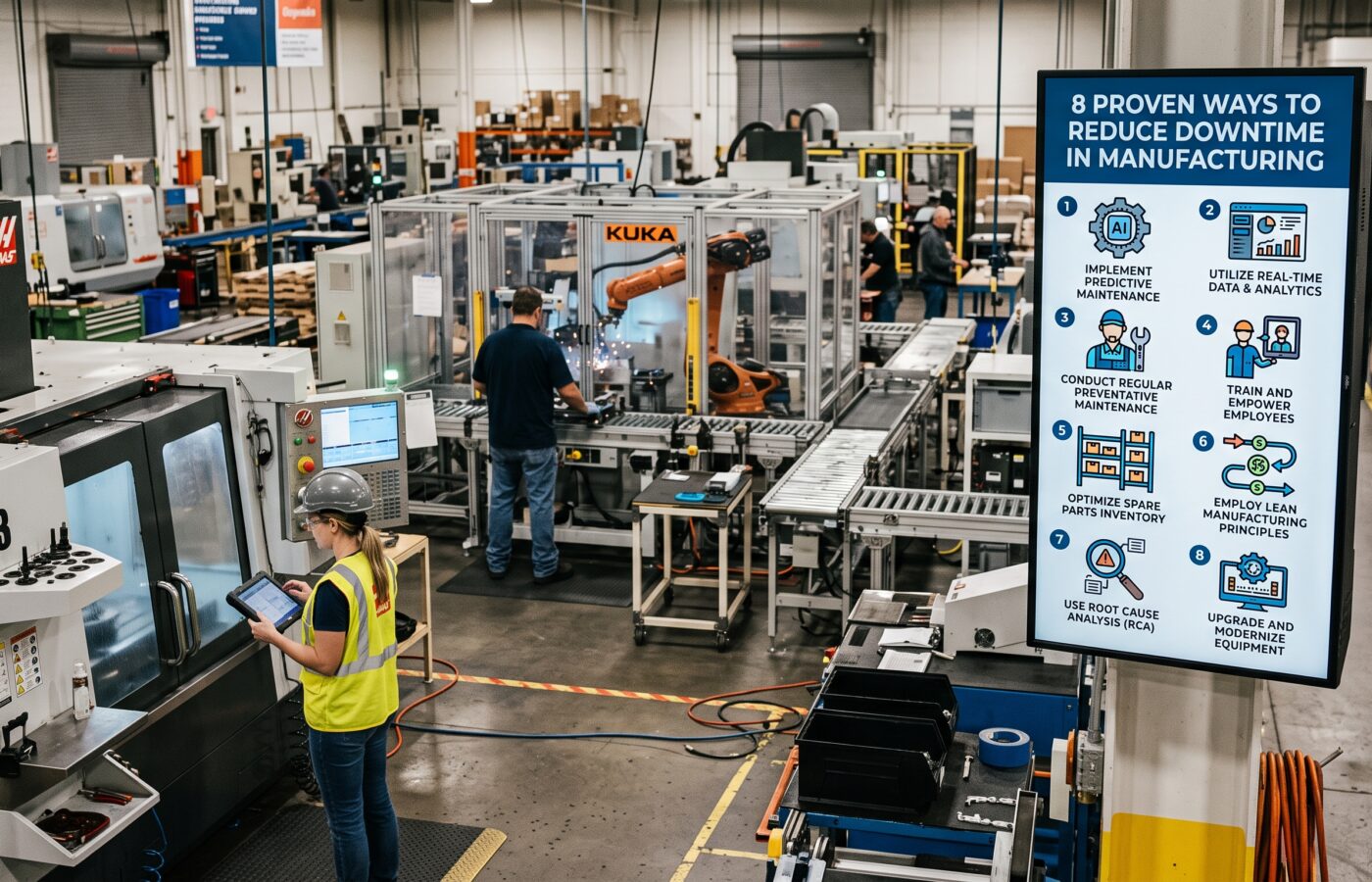
8 Proven Ways to Reduce Downtime in Manufacturing

Every engineer who works to reduce downtime in manufacturing has a story that got them started, and mine began at 2:40 in the morning, when a gearbox on our main line ran dry and seized. Its sight glass had been painted over months earlier, so nobody could see the level. On top of that, the PM task on the work order only said “check oil.” Somebody did check it, in the sense that they looked at the glass and signed the sheet. As a result, we lost most of a shift and a truckload of product waiting on a replacement gearbox from three states away.
Most Downtime Is Not Mysterious
I have spent the better part of two decades since then as a manufacturing and plant engineer. Still, that night taught me something I repeat to every new engineer I mentor: most downtime is not mysterious. Instead, it is the result of small, boring gaps that nobody owned. So if you want to reduce downtime in manufacturing, you usually don’t need a moonshot. Rather, you need discipline, good data, and a few systems that keep working when the people who built them go on vacation.
This article covers the eight methods that have consistently moved the needle in the plants I have worked in, from food and beverage to metal fabrication and automotive supply. None of them are theoretical. In fact, all of them take effort. But every one of them pays back.
Why Downtime Deserves a Seat in Every Budget Meeting
Before I get into the methods that reduce downtime in manufacturing, it helps to understand why leadership should care. After all, you will need their support to fund most of what follows.
Siemens’ True Cost of Downtime 2024 report found that unscheduled downtime drains about 11 percent of annual revenue from the world’s 500 largest companies, roughly $1.4 trillion. By comparison, the figure was $864 billion in 2019 and 2020. In automotive plants, for example, the hourly figure reached $2.3 million, which works out to about $600 every second.
Costs Are Rising Faster Than Inflation
What caught my attention in that report, though, is the trend. Over the five years studied, U.S. inflation totaled 19%. Meanwhile, the cost of an hour of downtime rose 113% in automotive and 319% in heavy industry. At the same time, the average facility surveyed had 25 downtime incidents a month, down from 42 in 2019. In other words, plants are getting better at preventing stoppages, but each stoppage hurts far more than it used to.
Similarly, smaller operations are not exempt. ABB’s Value of Reliability research, which surveyed more than 3,200 plant maintenance leaders, found that two thirds of companies experienced unplanned downtime at least monthly, at around $125,000 per hour.
For this reason, when I present numbers like these to a plant manager, I always follow up with our own. Industry averages open the door. Ultimately, your own cost per hour is what gets a project approved.
1. Measure Downtime Honestly Before You Try to Fix It
You can’t reduce downtime in manufacturing if you don’t know where it is actually coming from. Unfortunately, in my experience, most plants don’t. They think they do, of course. They have a whiteboard, a shift log, and maybe a spreadsheet the production supervisor fills out on Fridays. But when I dig into those records, I usually find the same three problems.
The Three Blind Spots in Most Downtime Logs
First, short stops disappear. For instance, a filler that jams for 90 seconds, fifteen times a shift, never makes the log. That adds up to over 20 minutes a shift, and yet nobody writes it down because nobody thinks of it as “downtime.”
Second, the reason codes are useless. Typically, “Mechanical” and “Other” together account for half the entries. Consequently, those categories tell you nothing about what to fix.
Third, the numbers are negotiated. When downtime is tied to someone’s performance review, it has a way of getting reclassified.
A Better Way to Track It
Instead, capture stops automatically wherever you can, using a machine signal from the PLC or a simple sensor on the line. Then have operators attach a reason to each stop from a short, specific list, ideally no more than 15 to 20 codes per asset type. After that, review the data weekly in a standing meeting that includes production, maintenance and engineering.
The metrics that matter most are straightforward. Specifically, mean time to repair (MTTR), mean time between failures (MTBF) and overall equipment effectiveness (OEE) show you where problems are occurring. MTBF tells you how reliable an asset is. Likewise, MTTR tells you how good you are at recovering. Finally, OEE ties both back to output.
To illustrate, one plant I supported installed basic stop tracking on its two bottleneck lines. Within days, it discovered that a label applicator nobody talked about was responsible for more lost time than the “problem” palletizer everyone complained about. The palletizer was loud and visible, whereas the labeler was quiet and constant. In the end, data settled the argument in a week.
2. Rank Your Equipment by Criticality
If you want to reduce downtime in manufacturing with a limited team, accept early that not every asset deserves the same attention. In fact, trying to treat them equally is one of the fastest ways to burn out a maintenance team.
A criticality ranking is simply a structured way of asking: if this piece of equipment fails, how bad is it? Generally, I score each asset on a few factors, such as safety impact, environmental impact, production impact, quality impact, repair cost, and whether there’s redundancy. Then I multiply or weight those scores to produce a ranked list.
The result is almost always eye opening. In a typical plant, 10 to 20 percent of assets drive the large majority of downtime risk. These are usually your bottleneck machines, your single point utilities (the one air compressor, the one boiler, the main transformer), and anything without a backup.
Turning the Ranking Into a Strategy
Once you have the ranking, your strategy follows naturally:
- Critical assets get condition monitoring, detailed PM procedures, spare parts on the shelf, and a written recovery plan.
- Important assets get solid time based PM and reasonable spare coverage.
- Low impact assets with cheap, fast replacements can often run to failure without much consequence.
That last point surprises people. However, running something to failure is not negligence when it’s a deliberate decision. For example, a $90 exhaust fan motor in a break room does not need a vibration route. Moreover, spending technician hours on it takes those hours away from your bottleneck.
Finally, revisit the ranking at least once a year and any time you add equipment or change the product mix. After all, a machine that was noncritical last year can become the constraint the moment a new product runs through it.
3. Shift From Calendar Maintenance to Condition Based and Predictive Maintenance
Traditional preventive maintenance runs on a calendar: change the bearings every six months, rebuild the pump every year. Admittedly, it’s far better than doing nothing. Still, it has two weaknesses. First, you replace parts that still have life in them. Second, you still get failures between intervals, because equipment doesn’t read the calendar.
The Condition Monitoring Toolkit
Condition based maintenance, on the other hand, flips that logic. Instead of asking “how long has it been?” you ask “what condition is it in?” The most useful tools in my kit, roughly in order of how often I use them, are:
- Vibration analysis for rotating equipment such as motors, pumps, fans and gearboxes
- Infrared thermography for electrical panels, connections, bearings and steam traps
- Oil analysis for gearboxes, hydraulics and large compressors
- Ultrasound for compressed air leaks, bearing lubrication and electrical arcing
- Motor current analysis for electrical and some mechanical faults
Predictive maintenance then takes this one step further by trending the data over time. Increasingly, it also uses software to flag anomalies before a person would notice them.
What the Research Shows
The results are well documented. For example, Deloitte’s analytics group reports that predictive maintenance on average raises productivity by 25%, cuts breakdowns by 70% and lowers maintenance costs by 25%. Likewise, Siemens noted that fewer companies now list predictive maintenance as a strategic priority, simply because it has become standard practice for protecting asset health.
How to Start Without Overspending
My practical advice, therefore, is to start small. After all, the surest way to reduce downtime in manufacturing with condition monitoring is to prove it on a few assets first. Pick five to ten of your most critical rotating assets from the criticality ranking and put them on a monthly vibration route, either with a contractor or a portable analyzer. Next, build a baseline. Once your team sees a bearing defect caught three weeks early and swapped during a planned stop, you won’t need to sell the program anymore. Instead, the floor will ask for more.
One warning from experience, though: sensors without a response process are just expensive decorations. So decide in advance who reviews alerts, how quickly, and what triggers a work order. Otherwise, you’ll have beautiful dashboards and the same breakdowns.
4. Put Operators in Charge of Basic Equipment Care
Operators spend eight or more hours a day standing next to the machine. By contrast, your maintenance tech might see it once a week. Therefore, it makes no sense to have the person who knows the equipment best be the one least involved in caring for it.
This is the idea behind autonomous maintenance, one of the pillars of Total Productive Maintenance, which works hand in hand with core lean principles. Essentially, it shifts ownership of basic equipment care (cleaning, inspecting, lubricating, tightening and spotting abnormalities) from the maintenance department to the operators who run the machines daily.
Of course, the goal isn’t to turn operators into mechanics. Rather, the goal is early detection. An operator who cleans a machine every shift notices the oil weep, the loose guard bolt, and the belt that sounds different today. In my experience, those are the early signs of almost every failure I’ve investigated.
Making Operator Care Stick on the Floor
To make it work, follow these steps:
- Start with a deep clean. First, clean the equipment back to its original condition with operators and maintenance working side by side. Along the way, you’ll find leaks, cracks and missing fasteners you didn’t know existed.
- Build short, visual checklists. Keep them to five to ten items, with photos. Otherwise, if it takes more than ten minutes, it won’t get done consistently.
- Make abnormalities easy to see. For example, mark gauge ranges in green and red, use clear covers where safe, add match marks on critical bolts, and replace painted over sight glasses (yes, I’m still bitter about that one).
- Close the loop. When an operator tags a problem, maintenance must respond and let them know what was done. After all, nothing kills an operator care program faster than tags that go nowhere.
Keep in mind that autonomous maintenance is continuous and operator led, while preventive maintenance is periodic and technician led. In other words, the two work as complementary layers. Operator care doesn’t replace your PM program. Instead, it frees your technicians to spend time on the work only they can do.
5. Cut Changeover Time With SMED
Unplanned breakdowns get the headlines. Yet planned downtime is often a bigger chunk of lost capacity, and changeovers are usually the largest piece of it. In high mix operations, for instance, I’ve seen changeovers eat 15 to 25 percent of available production time. That’s why attacking changeovers is one of the cheapest ways to reduce downtime in manufacturing.
The best tool I know for this is SMED, or Single Minute Exchange of Die. The Lean Enterprise Institute describes it as a way to change production equipment from one part number to another as fast as possible. Specifically, the goal is to get changeovers into single digit minutes, meaning under ten. The method was born on stamping presses, where die changes once took hours.
The core insight comes from Shigeo Shingo’s work at Toyota, one of the best known kaizen examples. He separated internal setup steps, which can only happen while the machine is stopped, from external steps that can be done while it’s still running. Then he worked to convert internal steps into external ones.
Running a SMED Project Step by Step
Here’s how I run a SMED project in practice:
- Film a real changeover from start to finish. Not a demonstration, but an actual one on a normal shift.
- Watch it with the crew and list every step with its time. Invariably, people are surprised by how much of it is walking, searching and waiting.
- Move everything possible outside the stop. For example, stage tools, dies, change parts and materials on a cart before the machine shuts down. Also preheat whatever needs preheating.
- Simplify what’s left. Replace bolts with quick release clamps, add locating pins, and standardize fastener sizes so one tool does the job. In addition, eliminate adjustments with fixed stops.
- Standardize and train. Finally, write the new method down with photos and train every shift on it.
Speed Through Method, Not Pressure
One point I stress hard, however: SMED is not about telling people to work faster. Rushing a changeover is how people get hurt and how parts get installed wrong, which in turn creates quality downtime later. Instead, the time savings come from better method, not more pressure.
For example, on a packaging line I worked with, the first SMED pass took a 70 minute format change down to about 32 minutes. Mostly, that came from staging change parts on a shadow board cart and eliminating a single search for the right Allen key. The second pass then got it under 20. As it turned out, that capacity was worth more than the new machine the plant had been considering buying.
6. Get Your Spare Parts and MRO Storeroom Under Control
I’ve watched a two hour repair turn into a two day outage more times than I’d like to admit. Almost always, the cause was the same: the part wasn’t there. Either it was never stocked, someone took the last one without recording it, or it was on the shelf but mislabeled and nobody could find it.
In short, your storeroom is part of your plan to reduce downtime in manufacturing, whether you treat it that way or not.
Storeroom Changes That Protect Uptime
Fortunately, a few changes make a big difference:
- Tie critical spares to your criticality ranking. For every critical asset, identify the parts with long lead times or high failure likelihood and make sure they’re stocked. Typically, gearboxes, specialty motors, VFDs, custom drive components and PLC cards are the usual suspects.
- Build a bill of materials for each critical asset. That way, when a machine goes down at 3 a.m., the tech can pull up exactly which parts fit it instead of guessing from memory.
- Control access and transactions. An open storeroom feels helpful. However, it only lasts until the inventory numbers become fiction. So every part out should be recorded against a work order.
- Set sensible min and max levels based on real usage and lead times, and then review them quarterly.
- Store parts properly. For instance, rotate motor shafts in storage periodically, keep bearings sealed and dry, and protect electronics from dust and moisture. After all, a spare that has been sitting in a damp corner for three years is not really a spare.
Kitting and the Finance Conversation
Kitting is another habit worth building. For planned work, have storeroom staff pull and stage all parts before the job starts. As a result, technicians spend their time repairing, not hunting.
Admittedly, finance teams sometimes push back on spare parts inventory as tied up cash, especially in plants that run lean on just in time inventory. I understand that. Nevertheless, when you frame a $12,000 spare gearbox against the hourly cost of the line it protects, the conversation tends to end quickly.
7. Run Root Cause Analysis That Actually Closes the Loop
Every plant says it does root cause analysis. However, far fewer plants actually prevent repeat failures. The difference, in most cases, is follow through.
The pattern I see most often goes like this. First, a machine fails. Next, a technician replaces the broken part, the line restarts, and the event gets recorded as “replaced bearing.” Two months later, the same bearing fails again. That’s because the part was the symptom. Meanwhile, the cause (misalignment, contamination, overloading, poor lubrication practice) is still there.
A Simple RCA Process That Works
Fortunately, a good RCA process doesn’t need to be complicated. Here’s the approach I use:
- Set a clear trigger. For example, any stop over 60 minutes on a critical asset, any repeat failure within 90 days, or any safety related failure gets a formal RCA.
- Preserve the evidence. Keep the failed part and take photos before cleanup. After all, a worn bearing tells a story if you let it.
- Use a simple structured tool. The 5 Whys works for most events. Meanwhile, a fishbone diagram helps when several factors are involved. Save fault tree analysis for complex or high consequence failures.
- Get the right people in the room. That means the operator who was running the machine, the technician who fixed it, and an engineer. Also keep it short and blame free, or else people stop telling you the truth.
- Assign corrective actions with owners and dates. Unfortunately, this is the step that gets skipped. An RCA without tracked actions is just a meeting.
- Verify the fix. Lastly, check back after 60 or 90 days to confirm the failure hasn’t returned.
Why the Payoff Compounds
Over time, the payoff compounds. Each closed RCA removes one failure mode permanently. Consequently, over a year or two, the list of chronic problems shrinks, and your team gets to spend more time improving equipment instead of rescuing it. That’s why, when plants ask me how to reduce downtime in manufacturing without spending much capital, this is usually my first answer.
8. Invest in the People Who Keep the Plant Running
Every method above depends on skilled people. For example, vibration data needs someone who can interpret it. Similarly, SMED needs a crew willing to change how they work, and RCA needs technicians who understand failure mechanisms. Unfortunately, that talent is getting harder to find.
A 2024 study by Deloitte and The Manufacturing Institute estimates the U.S. manufacturing industry could need as many as 3.8 million workers by 2033. Even worse, up to 1.9 million of those roles could go unfilled if the skills and applicant gaps aren’t addressed. So when your most experienced maintenance tech retires, a lot of undocumented knowledge walks out the door with them.
Practical Ways to Build and Keep Skills
Here’s what I’ve seen work:
- Cross train deliberately. Build a skills matrix for maintenance and operations. Then identify single points of failure in knowledge, such as the one person who knows how to recover the servo press, and fix that before it becomes a problem at 2 a.m.
- Capture tribal knowledge. Have senior technicians record short videos of tricky repairs and adjustments. Afterward, store them where the next tech can find them, linked to the asset in your CMMS.
- Write procedures people actually use. That means step by step, with photos, at the machine. In contrast, long text documents in a binder in the office don’t count.
- Pair new hires with veterans on real work, not just in the classroom.
- Train troubleshooting as a skill. Many technicians are excellent at repair but have never been taught a structured approach to finding a fault. Therefore, teaching a logical method, starting with safety and checking the simplest things first, can cut MTTR dramatically.
It’s also worth remembering that people are more likely to stay where they feel competent and respected. As a result, a plant that invests in training usually has lower turnover, which in turn protects all the other improvements you’ve made.
Where to Start
If you’ve read this far, you may be wondering where to begin if you want to reduce downtime in manufacturing at your own plant. Trying all eight methods at once, however, is a recipe for doing all of them poorly. Instead, here’s the sequence I usually recommend.
First, start with measurement (method 1) and criticality ranking (method 2). Both cost very little, and they tell you where to point everything else. From there, pick one bottleneck line and apply the rest in a focused pilot: operator care, a vibration route, a SMED event, a cleaned up spares list for that line, and RCA on every significant stop. Then prove the results on that line, document what worked, and roll it out.
Also, expect the first 90 days to be slower than you’d like. Good data often makes things look worse at first, because you’re finally seeing losses that were always there. That’s not failure. On the contrary, that’s the starting line.
In the end, the plants I’ve seen succeed long term aren’t the ones with the most expensive technology. Rather, they’re the ones where production, maintenance and engineering look at the same numbers, agree on the priorities, and follow through week after week. Above all, that kind of consistency is what truly allows you to reduce downtime in manufacturing and keep it down.
Frequently Asked Questions
What is the most effective way to reduce downtime in manufacturing?
There’s no single fix. However, the most effective starting point is accurate downtime tracking combined with a criticality ranking of your equipment. Together, they show you where losses actually occur so you can focus effort where it pays. For more detail, MaintainX has a useful breakdown of downtime types and the KPIs used to track them.
What is the difference between planned and unplanned downtime?
Planned downtime is scheduled in advance for maintenance, changeovers or upgrades. In contrast, unplanned downtime happens without warning, usually due to equipment failure, material shortages or quality problems. Therefore, planned downtime is reduced through better preparation, while unplanned downtime is reduced through reliability work and early detection. See Tractian’s guide for more.
How much does unplanned downtime cost a manufacturer?
It varies widely by sector. For example, Siemens found the cost of a lost hour ranges from around $36,000 in FMCG plants to over $2 million in automotive factories. The full report is available from Siemens.
Does predictive maintenance really reduce downtime?
Yes, as long as it’s paired with a clear process for acting on alerts. In fact, Deloitte’s research links predictive maintenance to about 70% fewer breakdowns and roughly 25% lower maintenance costs. Read the Deloitte overview for context.
How long does it take to see results from a downtime reduction program?
Quick wins, such as SMED on a single line or clearing up spare parts gaps, often show results within one to three months. On the other hand, predictive maintenance and operator care programs usually take six to twelve months to mature, because they depend on building baselines and new habits.
What is SMED and how does it reduce downtime?
SMED (Single Minute Exchange of Die) is a lean method for shortening changeovers. Essentially, it moves setup work outside the machine stop and then simplifies what remains. The Lean Enterprise Institute explains the concept and its origins.
References
- Siemens. The True Cost of Downtime 2024.
- Plant Services. Maintenance Mindset: Inflation driven trends are causing unplanned downtime costs to surge 300% in heavy industry.
- Institute for Supply Management. The Monthly Metric: Unscheduled Downtime.
- Deloitte. Predictive Maintenance and the Smart Factory.
- Deloitte Insights. Supporting U.S. Manufacturing Growth Amid Workforce Challenges.
- Lean Enterprise Institute. Single Minute Exchange of Die.
- MaintainX. Downtime in Manufacturing: Types, Causes and How to Reduce It.
- Tractian. How to Reduce Downtime in Manufacturing.
- MachineMetrics. How to Reduce Machine Downtime in Manufacturing.
- Kaizen Institute. Autonomous Maintenance.
- Facilio. Autonomous Maintenance Explained.
- Manufacturing Dive. Manufacturing could be short 1.9M workers if the talent gap isn’t fixed.