Just in Time Inventory: How Automakers Use It and When It Fails

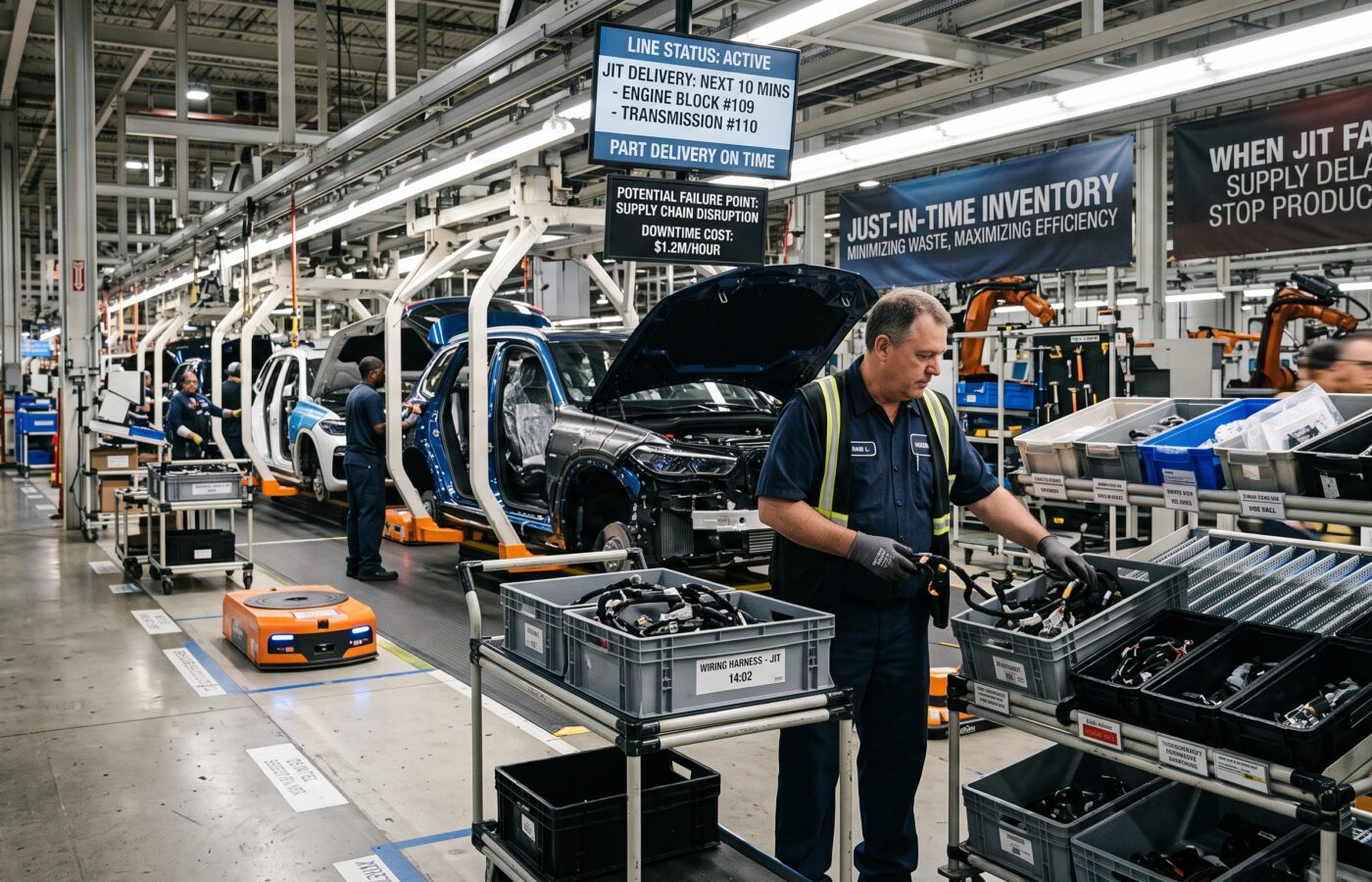
Ask ten plant managers what just in time inventory means and you will get ten slightly different answers. Most of them will say something about “low stock” or “parts arriving when you need them.” That is not wrong, but it misses the point. After years of walking assembly plants, reviewing supplier contracts, and sitting in the war rooms that open up when a line goes down, I have come to see just in time inventory less as an inventory policy and more as a promise. Every supplier, carrier, and workstation promises the next one that the right part will show up at the right moment. When everyone keeps that promise, the system is beautiful. When one party breaks it, the whole chain feels it within hours.
The auto industry invented this promise, refined it, and tested it harder than any other sector. It has also watched the promise fail in public. If you run operations in any industrial business, the automakers’ story deserves close study, because the lessons transfer almost perfectly to machinery, electronics, food processing, and any other operation built on tight material flow.
What Just in Time Inventory Actually Means
At its simplest, just in time inventory is a pull system, and it sits among the core lean manufacturing principles. No process makes or moves anything until the process downstream signals a need for it. Toyota’s own description is that just in time means making only what is needed, when it is needed, and in the quantity needed, at every stage of production.
It Does Not Mean Zero Stock
The goal is not a warehouse with nothing in it. That is the most common misunderstanding I run into with clients. One researcher who studied Toyota closely put it plainly: many people assume just in time equals zero inventory, but buffers do exist in the system; plants simply rarely touch them. The stock serves as a safety net, not as a place to hide problems.
Why Removing the Cushion Matters
That distinction matters. In a traditional push system, a factory builds to a forecast and parks the extra output in a warehouse. The warehouse becomes a cushion that absorbs late deliveries, quality defects, machine breakdowns, and bad planning. The trouble is that the cushion also hides all of those problems. Nobody fixes a chronic late delivery if three weeks of parts sit on the racks.
Just in time inventory strips that cushion away on purpose. It forces problems to the surface where people can see them and fix them. Lower holding costs, less floor space, and less capital tied up in stock are the rewards, but the real engine is discipline.
How Toyota Built the System
The idea goes back further than most people realize. Kiichiro Toyoda proposed just in time production when operations began at the Koromo Plant, and that marked the start of the approach Toyota still uses today. The war and the lean years after it interrupted the effort, and the concept only came to full life in 1954, when Toyota introduced the “supermarket method.”
That supermarket image is still the best way I know to explain the system to a new team. When a shopper takes a carton of milk off the shelf, the store restocks exactly that carton. It does not guess what shoppers might want next month. On a plant floor, the downstream process is the shopper and the upstream process is the shelf.
The Two Pillars
Taiichi Ohno turned that idea into working practice. Toyota credits him with establishing the Toyota Production System and creating the basic framework for the just in time method, with strong backing from Eiji Toyoda. Toyota describes the whole system as standing on two pillars, and the second pillar is just in time, built on synchronizing production so that all plants and processes link together in a continuous flow. The first pillar, jidoka, means stopping the line the moment something goes wrong so defects never travel downstream.
Those two pillars depend on each other. You cannot run lean on inventory if bad parts keep slipping through, because nothing on the shelf can replace them. That is why Toyota insists that every component must fit perfectly the first time, since no alternatives sit waiting.
How Automakers Run Just in Time Inventory on the Plant Floor
The textbook version sounds tidy. The real version on a modern vehicle assembly line is a carefully choreographed operation with several moving parts.
Kanban Signals
The kanban card, or its digital equivalent, is the trigger. When a worker empties a bin of fasteners, the card goes back to the supplying process as an order for exactly one more bin. To make this flow work, plants rely on signals from kanban boards or on forecasts of parts usage, though forecasting only works when production numbers stay stable.
Takt Time and Leveled Schedules
Every process runs at the pace of customer demand. Just in time uses takt time, continuous flow, pull systems, and leveled production to eliminate the waste of overproduction. Leveling, which Toyota calls heijunka, is the unglamorous part that makes everything else possible. If the assembly schedule swings wildly from day to day, suppliers cannot keep up without building their own hidden stockpiles. Leveling also depends on short changeovers upstream, in operations like metal stamping, so presses can run small batches instead of big ones.
Sequenced Delivery
For large, variant heavy parts like seats, dashboards, and bumpers, many automakers go a step beyond just in time into just in sequence. The seat supplier does not simply deliver a truckload of seats. It delivers them in the exact order that vehicles will roll down the line: black leather for car 412, grey cloth for car 413, and so on. Supplier plants for these automotive parts often sit a short drive from the assembly plant, sometimes on the same campus.
Milk Runs and Cross Docks
For smaller parts from many suppliers, a single truck may loop through several supplier sites on a fixed schedule and then drop everything at a cross dock near the plant. The frequency is high and the loads are small. That keeps inventory low without paying for dozens of half empty trucks.
Deep Supplier Relationships
This is the part competitors have struggled most to copy. Toyota does not treat suppliers as interchangeable vendors it picks on price each year. It builds long relationships, shares engineering people, and in many cases owns a stake in them. As we will see, that web of relationships became the real safety net when things went wrong.
Why It Works When It Works
When the environment stays stable, the results speak for themselves. Plants that run just in time inventory well carry a fraction of the stock of a traditional operation. Quality tends to improve because defects show up immediately instead of surfacing weeks later in a pile of finished goods, which also lifts overall equipment effectiveness. Floor space that used to hold pallets becomes production capacity. Cash that used to sit in parts goes to better uses.
The system also changes how people think. Workers and supervisors get used to asking why a problem happened rather than reaching for the spare stock. That habit, repeated thousands of times, drives most of the long term gains, much like the kaizen examples Toyota is known for. Toyota notes that manufacturers and many other kinds of businesses around the world have studied and adapted its production system to run more efficiently.
The catch sits in that phrase “when the environment stays stable.” Just in time inventory handles risks that are small and frequent: a late truck, a bad batch, a machine that jams. It handles rare, enormous risks far less well. Over the last three decades, automakers have learned that lesson four times over.
When It Fails: Four Hard Lessons
1. The Aisin Fire, 1997
Business schools still teach this case, and for good reason. On February 1, 1997, a major fire tore through one of Aisin Seiki’s plants that supplied brake fluid proportioning valves to every Toyota vehicle built by Toyota group plants in Japan. These small parts regulate pressure to the rear brakes, and without them no plant could finish a car.
The risk was concentrated in a way that should make any procurement lead uncomfortable. Toyota relied on Aisin alone for these valves and kept inventory low under its just in time setup, which threatened to shut down Toyota’s 20 plants in Japan for weeks. A business reason drove the single source: Aisin earned major economies of scale that it passed on to Toyota as lower prices.
What happened next is the part everyone studies. Toyota quickly sent more than 400 engineers to Aisin. Suppliers across the group, and even companies with no brake experience, retooled to make the part. Aisin even persuaded a sewing machine manufacturer to help, and the first usable valves reached Toyota on the Wednesday after the fire, letting car production resume. More than 200 firms contributed to the recovery.
It was a remarkable recovery, but it was not free. Researchers estimated the disruption cost Toyota around 70,000 vehicles in lost sales. The lesson I take from it is not that just in time inventory survived. The system survived because of relationships, not because of the inventory policy itself.
2. The Tohoku Earthquake, 2011
Fourteen years later, the test was far larger. The March 2011 earthquake and tsunami knocked out suppliers across northeastern Japan, including a key maker of automotive microcontrollers. Renesas Electronics made those chips and supplied them to Toyota through main vendors such as Denso.
This time the network could not simply improvise its way out. Toyota’s production fell 78% year on year in April 2011. Researchers who later studied the event set out to understand why Toyota needed three months to return to its pre earthquake production level.
The answer, in large part, was visibility. Toyota knew its direct suppliers very well, but it knew far less about the suppliers of its suppliers. A single chip fab several tiers down turned out to be a hidden choke point for hundreds of parts. After the disaster, Toyota identified 1,200 affected components and flagged some 500 to keep on hand to prevent a repeat, semiconductors among them.
3. The Global Chip Shortage, 2021 to 2023
The pandemic created the perfect storm for a pure just in time model. When demand collapsed in early 2020, automakers cut their chip orders sharply. Chipmakers diverted capacity to consumer electronics during the worst of the slowdown in auto sales. Then car demand came roaring back, and no spare capacity waited for it.
Timing made it worse. The industry needs six to nine months of lead time to get chips through a complex web of suppliers. A system designed to respond in hours suddenly faced a supply base that responds in quarters. McKinsey summed up the problem well: in normal times low inventory pays off financially, but when an unexpected shortage hits, the practice causes immediate disruption across the whole supply chain.
How Toyota Turned the Lesson Into an Advantage
Here is the twist that every operations leader should study. The company that invented just in time inventory handled the shortage best. Toyota was the first automaker to shift from a purely just in time model to a hybrid one in which it stockpiles more critical parts such as semiconductors. It requires suppliers of those components to hold up to six months of buffer chips dedicated to Toyota orders.
It also built the visibility it lacked in 2011. Toyota created a system called RESCUE, a centralized database mapping thousands of nodes across its suppliers and their suppliers. According to its former procurement chief, RESCUE cut the time needed to locate the source of a problem from two weeks to just 12 hours. The payoff showed up in the sales numbers, as Toyota’s months long chip stockpile kept its U.S. production going while rivals idled plants.
4. The Nexperia Crisis, 2025
Just when the industry thought it had learned its lesson, a new kind of failure arrived. This one was not a fire or an earthquake. It was politics. The Dutch government took control of Nexperia from its Chinese owner Wingtech on September 30, and Beijing retaliated weeks later with export controls on certain Nexperia products made in China.
Nexperia does not make glamorous chips. It makes the basic, cheap components that nobody thinks about until they disappear. S&P Global Mobility analysts noted that Nexperia accounts for only about 5% of the automotive discrete chip market by revenue, but its share by volume runs much higher.
The buffers that should have protected the industry turned out to be thin. Analysts pointed out that suppliers typically hold only two to three weeks of inventory, so shortages could hit production quickly. And they did. Honda halted production at a Mexican factory building its HR V crossover for North America. The company later said its North American output would likely take a hit of 110,000 units, costing about ¥150 billion. Nissan set aside a ¥25 billion provision for supply risks, partly to absorb the Nexperia impact.
Notice what happened here. Many automakers built chip buffers after 2021, but they built them for the chips that caused the last crisis. They treated cheap, commodity parts from a single dominant supplier as low risk. That is the classic mistake: preparing for the previous disaster instead of the next one.
The Pattern Behind Every Failure
When I lay these four events side by side for clients, the same three conditions show up every time.
Concentration
A single supplier, a single region, or a single plant supplies a part that the whole operation cannot run without. The Aisin fire and the Nexperia crisis were almost textbook examples.
Long Recovery Time
Nobody can make the part quickly somewhere else. Skilled machinists can improvise a brake valve in days. Nobody can improvise a microcontroller from a specialized fab. The longer the recovery time, the more dangerous a thin buffer becomes.
Blindness Beyond the First Tier
Most companies know their direct suppliers well and know almost nothing about who supplies those suppliers. In 2011, that blindness cost Toyota months.
Just in time inventory does not cause any of these failures on its own. The root cause is applying the same lean policy to every part, regardless of how risky that part is. A cup holder and a microcontroller should not live under the same inventory rules, yet in many plants they do.
How to Keep Just in Time Without Getting Burned
None of the automakers I have worked with abandoned the approach after these crises, and I would not advise anyone to. The savings and quality benefits are too large to walk away from. What changed was the thinking. Here is the framework I use with clients today.
Segment Parts by Risk, Not Just Cost
Score every component on two questions: how concentrated is the supply, and how long would a replacement take? Parts that score high on both get strategic buffers. Everything else stays lean. Toyota did exactly this after 2011, and it explains why the approach works. Industry commentators have argued that this applies to all critical components with long lead times, not just semiconductors, and that the first step is identifying them, as Toyota did after the Fukushima earthquake.
Map Past the First Tier
You cannot protect against a risk you cannot see. Build a map of your sub tier suppliers for your critical parts, even if it starts as a spreadsheet. Update it at least yearly and after every supplier change.
Put Buffers Where They Make Sense
Strategic stock does not have to sit in your own warehouse. Toyota pushed the buffer upstream by asking suppliers to hold dedicated inventory. That keeps your own floor lean while still protecting the line.
Build Supplier Relationships Early
The Aisin recovery worked because hundreds of companies chose to drop what they were doing and help. No company can buy that kind of goodwill during a crisis. You build it during normal times through fair pricing, shared engineering support, and long term commitments.
Go Direct on Critical Technology
Many automakers used to buy chips only through their Tier 1 suppliers, one step removed from the actual chipmakers. Recent disruptions pushed automakers to build direct relationships with semiconductor manufacturers. If a component can stop your line, someone in your organization should know the people who make it.
Rehearse the Bad Day
Run a tabletop exercise once a year. Pick a critical supplier, assume it goes dark tomorrow, and walk through the next 72 hours. You will find gaps you never knew existed, and finding them in a conference room costs far less than finding them on a stopped line.
Final Thoughts
Just in time inventory remains one of the most powerful ideas in industrial operations. It cut waste, improved quality, and helped a small Japanese carmaker compete with the giants of Detroit and Europe. But the last thirty years have shown that a system built for efficiency needs deliberate protection against rare, severe shocks.
The companies that handled recent crises best did not choose between lean and resilient. They stayed lean on parts they could replace quickly and built resilience around parts they could not. They knew their supply chain several layers deep. And they had relationships strong enough that suppliers would pick up the phone at two in the morning. If your operation can say the same, just in time will keep paying off. If it cannot, the next disruption is already on its way, and the only question is whether you will see it coming.
Frequently Asked Questions
What is just in time inventory in simple terms?
It is a pull based system where suppliers and processes produce and deliver materials only when the next step needs them, in the exact quantity needed. Toyota’s official overview of its production system is a good starting point: Toyota Production System.
Does just in time inventory mean keeping zero stock?
No. Well run systems keep small, deliberate buffers. The aim is to remove excess stock that hides problems, not to remove every safety margin. See the SSRN guide to just in time production for a deeper look.
Why did the chip shortage hit automakers so hard?
Automakers cut chip orders early in the pandemic, chipmakers shifted capacity to electronics, and chip lead times of six to nine months meant supply could not recover quickly. McKinsey’s analysis explains the causes in detail: Coping with the auto semiconductor shortage.
How did Toyota avoid the worst of the chip shortage?
After the 2011 earthquake, Toyota mapped its deep supplier network and asked suppliers to hold months of buffer stock for critical chips. Fortune covered the story here: How Toyota kept making cars when the chips were down.
What is the difference between just in time and just in case?
Just in time keeps stock low and relies on fast, reliable replenishment. Just in case holds extra stock ahead of need to protect against disruption. Most automakers now blend the two. Raconteur offers a useful discussion: Just in time supply chain: has it had its day?
Is just in time inventory still worth using?
Yes, for most parts. The smarter approach keeps it for low risk, easily replaced components and adds strategic buffers only for concentrated, long lead time parts. Supply Chain Dive’s report on Toyota’s post 2011 changes shows how that works in practice: Toyota expects no major semiconductor impact.
References
Toyota Sources
- Toyota Motor Corporation. Toyota Production System. https://global.toyota/en/company/vision-and-philosophy/production-system/index.html
- Toyota Motor Corporation. 75 Years of Toyota: The Origins of Just in Time. https://www.toyota-global.com/company/history_of_toyota/75years/text/taking_on_the_automotive_business/chapter2/section4/item5.html
- Toyota Europe. Toyota Production System. https://www.toyota-europe.com/about-us/toyota-vision-and-philosophy/toyota-production-system
- Toyota UK Magazine. How does just in time production work? https://mag.toyota.co.uk/just-in-time/
Industry Analysis and News
- McKinsey & Company. Coping with the auto semiconductor shortage: Strategies for success. https://www.mckinsey.com/industries/automotive-and-assembly/our-insights/coping-with-the-auto-semiconductor-shortage-strategies-for-success
- Fortune. How Toyota kept making cars when the chips were down. https://fortune.com/2021/08/02/toyota-cars-chip-shortage-semiconductors
- Supply Chain Dive. Toyota, citing lessons learned from 2011 earthquake, expects no major semiconductor impact. https://www.supplychaindive.com/news/toyota-semiconductor-shortage-earthquake-inventory-ihs-gartner-forecast-2022/600193/
- Thomasnet. How an Earthquake Prepared Toyota for a Semiconductor Shortage. https://www.thomasnet.com/insights/how-an-earthquake-prepared-toyota-for-a-semiconductor-shortage/
- Raconteur. Just in time supply chain: has it had its day? https://www.raconteur.net/supply-chain/rethinking-just-in-time-ordering
- CNBC. Where the Nexperia auto chip crisis stands now. https://www.cnbc.com/2025/11/01/where-the-nexperia-auto-chip-crisis-stands-now.html
- Automotive Logistics. Carmakers find chip workaround as Nexperia dispute continues. https://www.automotivelogistics.media/supply-chain/carmakers-take-matters-into-their-own-hands-to-address-nexperia-semiconductor-shortage-as-internal-dispute-continues/2589192
Academic and Case Study Sources
- ScienceDirect, International Journal of Production Economics. Implications of the Tohoku earthquake for Toyota’s coordination mechanism. https://www.sciencedirect.com/science/article/abs/pii/S0925527314002278
- Wikipedia. 1997 Aisin fire. https://en.wikipedia.org/wiki/1997_Aisin_fire
- SSRN, Mohammed Soliman. A Complete Guide to Just in Time Production: Inside Toyota’s Mind. https://papers.ssrn.com/sol3/papers.cfm?abstract_id=4754271