

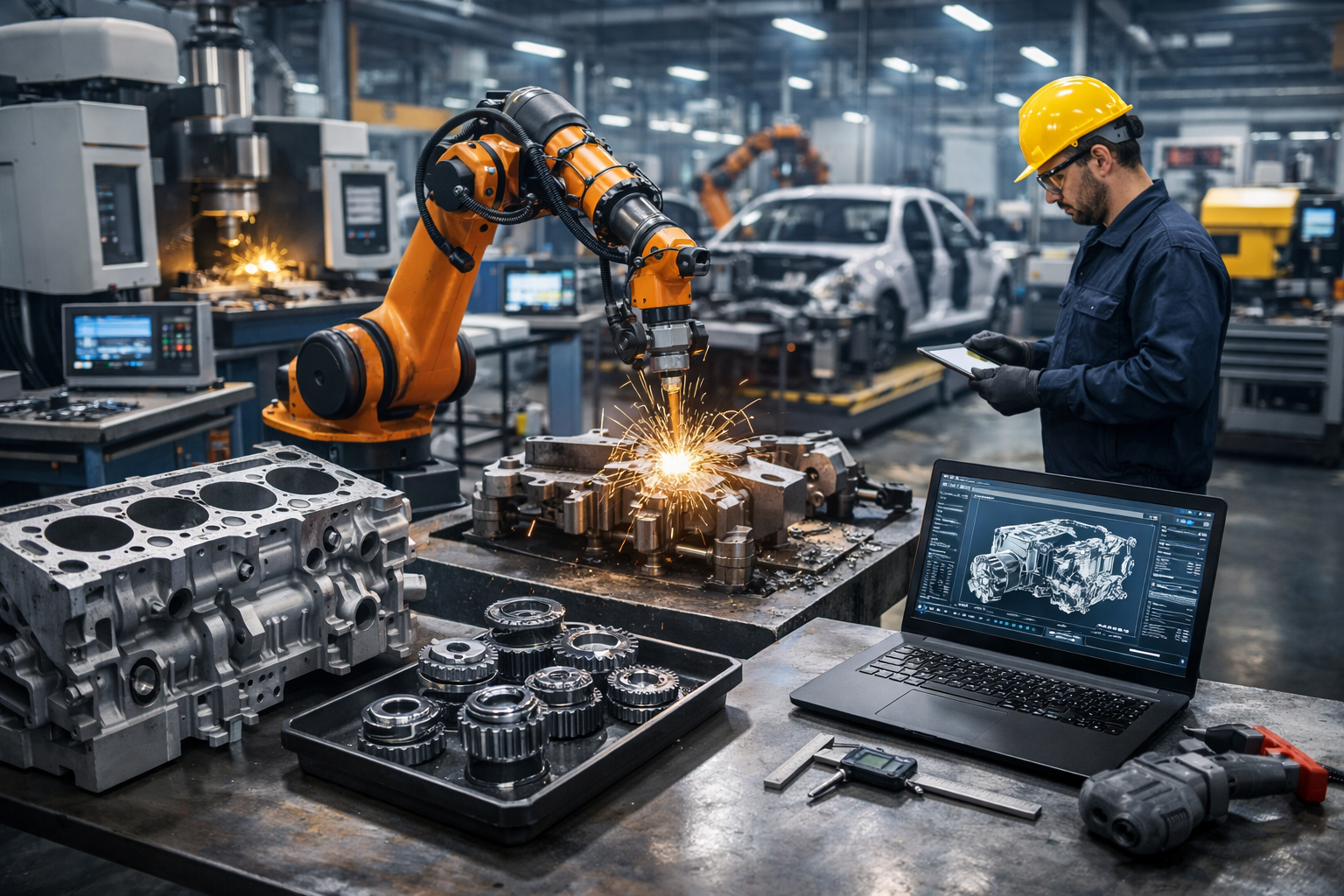
Automotive parts manufacturing is the backbone of the global transportation industry. Every vehicle on the road depends on thousands of precisely engineered components working together seamlessly. From engine parts to electronic systems, the auto parts manufacturing process ensures safety, durability, and performance.
Automotive parts manufacturing is a complex, multi-stage process that requires precision engineering and advanced technologies. According to this Automotive Manufacturing Process Guide, modern production integrates design, automation, and quality control to ensure efficiency and reliability.
As technology evolves, manufacturers are integrating automation, artificial intelligence, and advanced materials into production. This article provides a comprehensive, tech-driven overview of how automotive parts are manufactured, offering insights into each stage of the process.
What Is Automotive Parts Manufacturing?
Automotive parts manufacturing refers to the production of components used in vehicles, including:
- Engine components (pistons, crankshafts)
- Transmission systems
- Suspension and braking systems
- Electrical and electronic parts
- Body and interior components
This industry combines mechanical engineering, materials science, and digital manufacturing technologies to create high-performance parts at scale.
Overview of the Auto Parts Manufacturing Process
The auto parts manufacturing process typically follows these key stages:
- Product Design and Engineering
- Material Selection
- Prototyping
- Production (Machining, Casting, or Molding)
- Assembly
- Surface Finishing
- Quality Control and Testing
Each stage is critical to ensuring that the final product meets industry standards and customer expectations.
1. Product Design and Engineering
The process begins with computer-aided design (CAD) and engineering simulations.
Key Technologies Used:
- CAD software for 3D modeling
- Computer-aided engineering (CAE) for stress analysis
- Digital twins for real-time simulation
Engineers design parts based on performance requirements, durability, and cost efficiency. Simulation tools help predict how components will behave under real-world conditions, reducing errors before production begins.
2. Material Selection
Choosing the right material is essential for performance, weight, and cost.
Common Materials:
- Steel (strength and durability)
- Aluminum (lightweight and corrosion-resistant)
- Plastics and polymers (cost-effective and flexible)
- Composites (high strength-to-weight ratio)
Modern manufacturing increasingly focuses on lightweight materials to improve fuel efficiency and reduce emissions.
3. Prototyping and Testing
Before mass production, prototypes are created to validate the design.
Methods Used:
- 3D printing (additive manufacturing)
- CNC machining for precise prototypes
- Rapid prototyping technologies
Prototypes undergo rigorous testing for:
- Structural integrity
- Heat resistance
- Wear and tear
This stage minimizes production risks and ensures that the design is production-ready.
4. Core Manufacturing Processes
This is the most critical stage of automotive parts manufacturing. Different methods are used depending on the type of component.
A. Casting
Casting involves pouring molten material into a mold.
Types of Casting:
- Sand casting
- Die casting
- Investment casting
Used for:
- Engine blocks
- Cylinder heads
B. Machining
Machining removes material to achieve precise dimensions.
Techniques:
- CNC milling
- Turning
- Drilling
Benefits:
- High precision
- Consistent quality
C. Forming
Forming reshapes metal without removing material.
Examples:
- Stamping
- Forging
- Rolling
Used for:
- Body panels
- Structural components
D. Injection Molding
Primarily used for plastic parts.
Applications:
- Dashboard components
- Interior trims
- Electrical housings
E. Additive Manufacturing
Also known as 3D printing, this method builds parts layer by layer.
Advantages:
- Reduced waste
- Faster prototyping
- Customization capabilities
5. Assembly Process
Once individual components are manufactured, they are assembled into larger systems.
Assembly Methods:
- Manual assembly
- Robotic assembly lines
- Automated conveyor systems
Robotics play a major role in modern automotive manufacturing, improving:
- Speed
- Accuracy
- Worker safety
6. Surface Finishing
Surface finishing enhances durability, appearance, and performance.
Common Techniques:
- Painting and coating
- Electroplating
- Anodizing
- Polishing
These processes protect parts from:
- Corrosion
- Wear
- Environmental damage
7. Quality Control and Testing
Quality assurance is a non-negotiable part of the auto parts manufacturing process.
Testing Methods:
- Non-destructive testing (NDT)
- Dimensional inspection
- Fatigue testing
- Thermal testing
Standards Followed:
- ISO/TS 16949 (automotive quality management)
- Six Sigma methodologies
Advanced factories use AI-powered inspection systems and machine vision to detect defects in real time.
Role of Automation and AI in Modern Manufacturing
Technology is transforming automotive parts manufacturing.
Key Innovations:
1. Smart Factories
- IoT-enabled machines
- Real-time monitoring
- Predictive maintenance
2. Artificial Intelligence
- Defect detection
- Process optimization
- Demand forecasting
3. Robotics
- High-speed assembly
- Precision welding
- Automated material handling
These advancements reduce production costs and improve efficiency across the supply chain.
Sustainability in Auto Parts Manufacturing
Sustainability is becoming a top priority in the automotive industry.
Eco-Friendly Practices:
- Recycling materials
- Energy-efficient machinery
- Waste reduction strategies
- Use of biodegradable materials
Manufacturers are also adopting green manufacturing processes to comply with environmental regulations and reduce their carbon footprint.
Challenges in Automotive Parts Manufacturing
Despite technological advancements, manufacturers face several challenges:
1. Supply Chain Disruptions
Global events can impact raw material availability.
2. Rising Production Costs
Energy, labor, and material costs continue to increase.
3. Quality Consistency
Maintaining uniform quality across mass production is complex.
4. Rapid Technological Changes
Manufacturers must continuously invest in new technologies to stay competitive.
Future Trends in the Auto Parts Manufacturing Process
The future of automotive manufacturing is driven by innovation.
Emerging Trends:
- Electric vehicle (EV) components production
- Lightweight and smart materials
- Fully automated factories
- Digital manufacturing ecosystems
- Integration of blockchain for supply chain transparency
As vehicles become more advanced, the demand for precision-engineered parts will continue to grow.
Conclusion
Automotive parts manufacturing is a highly sophisticated process that combines engineering expertise, advanced materials, and cutting-edge technology. From design and prototyping to production and quality control, every step in the auto parts manufacturing process plays a vital role in delivering reliable and high-performance components.
With the integration of AI, automation, and sustainable practices, the industry is evolving rapidly. Manufacturers that embrace these innovations will be better positioned to meet future demands and remain competitive in the global market.