

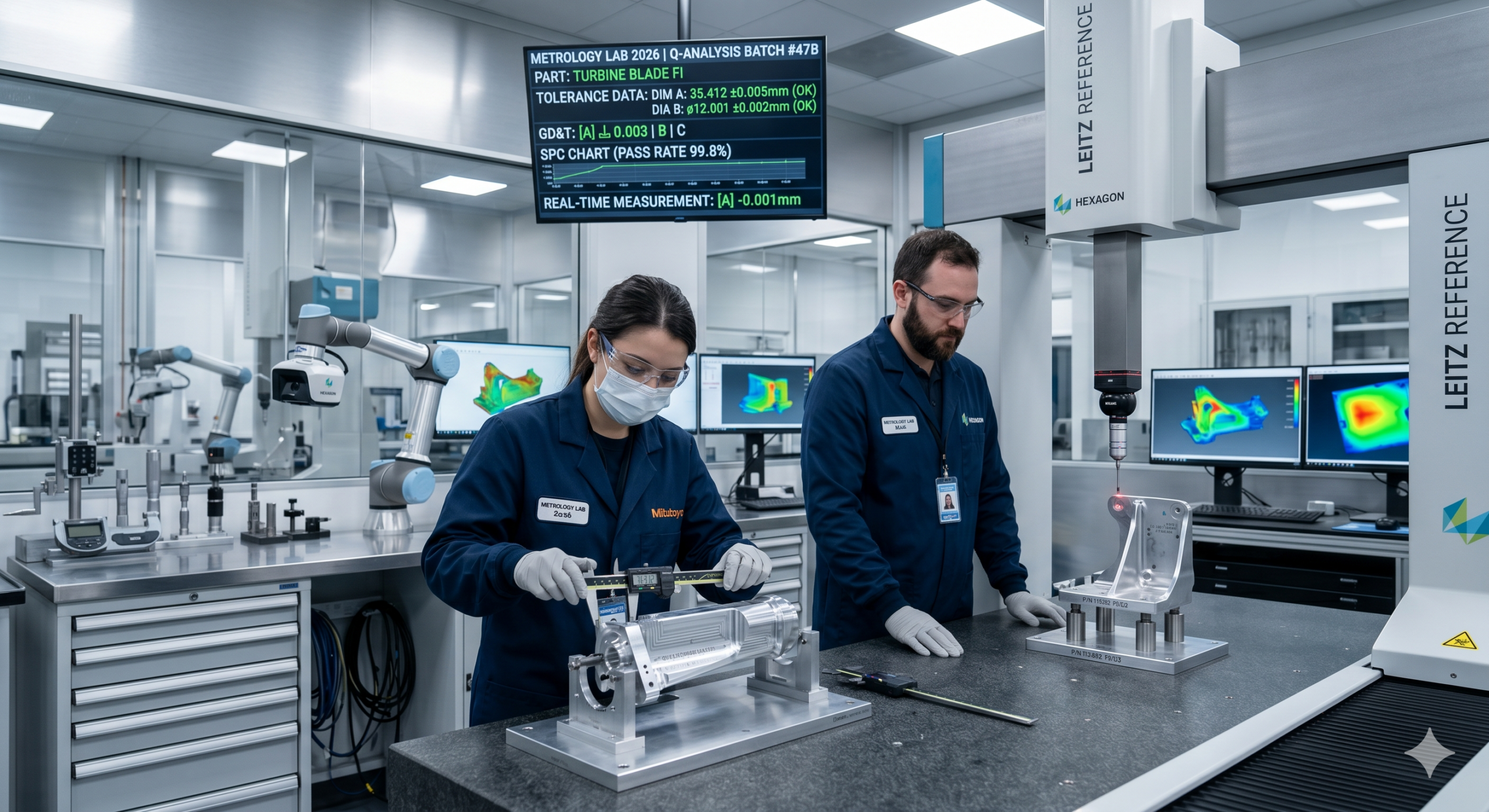
Tolerance measurement tools are essential in modern manufacturing, ensuring that components meet precise dimensional limits and functional requirements. In industries such as automotive, aerospace, and electronics, even the smallest deviation can lead to performance issues or product failure.
As manufacturing advances in 2026, tolerance measurement tools have evolved with digital technology, automation, and real-time data analysis. Therefore, understanding these tools is critical for engineers, machinists, and quality professionals who aim to maintain accuracy, improve efficiency, and meet strict quality standards.
What Are Tolerance Measurement Tools?
Tolerance measurement tools are instruments used to verify that a component’s dimensions fall within specified limits. In other words, they ensure that parts are neither too large nor too small for proper function.
Why Tolerance Measurement Matters
- Firstly, it ensures product functionality and fit
- Secondly, it reduces manufacturing defects
- Additionally, it improves consistency and quality
- Moreover, it supports compliance with industry standards
- Finally, it enhances customer satisfaction
As a result, accurate tolerance measurement is a key factor in achieving high-quality production.
Types of Tolerance Measurement Tools
1. Calipers
Calipers are versatile tools used to measure internal, external, and depth dimensions.
Types:
- Vernier calipers
- Dial calipers
- Digital calipers
Advantages:
- Easy to use
- Portable and cost-effective
However, they may not provide the highest precision compared to advanced tools.
2. Micrometers
Micrometers offer higher accuracy than calipers and are commonly used for precision measurements.
Types:
- Outside micrometers
- Inside micrometers
- Depth micrometers
Therefore, they are ideal for measuring small tolerances with high precision.
3. Dial Indicators
Dial indicators measure small deviations in surface flatness, roundness, and alignment.
Applications:
- Machine setup
- Alignment checks
- Runout measurement
As a result, they are widely used in machining and inspection processes.
4. Height Gauges
Height gauges are used to measure vertical dimensions and mark precise locations.
Features:
- Used on surface plates
- High accuracy for layout work
Consequently, they are essential in precision manufacturing.
5. Gauge Blocks
Gauge blocks are precision-ground blocks used as reference standards.
Benefits:
- Extremely high accuracy
- Used for calibration and setup
Therefore, they are fundamental in metrology labs.
6. Coordinate Measuring Machines (CMM)
CMMs are advanced tools that measure complex geometries with high precision.
Types:
- Bridge CMM
- Cantilever CMM
- Portable CMM
Advantages:
- High accuracy
- Automated measurement
- 3D data analysis
As a result, CMMs are widely used in modern manufacturing.
7. Optical Measurement Systems
Optical tools use light and cameras to measure dimensions without contact.
Examples:
- Profile projectors
- Vision systems
- Laser scanners
Therefore, they are ideal for delicate or complex components.
8. Go/No-Go Gauges
These gauges quickly determine whether a part meets tolerance limits.
Function:
- Go gauge checks maximum material condition
- No-Go gauge checks minimum material condition
Consequently, they provide fast and efficient inspection.
9. Laser Measurement Tools
Laser-based tools provide high-speed, non-contact measurements.
Applications:
- Large component measurement
- Real-time inspection
As a result, they improve efficiency and accuracy in production environments.
How Tolerance Measurement Tools Work Together
Tolerance measurement tools are often used in combination to ensure accuracy throughout production.
- Initial measurements are taken using calipers or micrometers
- Precision checks are performed with gauge blocks and dial indicators
- Complex geometries are measured using CMMs or optical systems
- Final verification is completed with Go/No-Go gauges
Therefore, using multiple tools ensures comprehensive quality control.
Advanced Tolerance Measurement Technologies (2026)
Modern manufacturing relies on advanced metrology systems to achieve high precision and efficiency. For a deeper look at industrial tools, explore precision measuring instruments in manufacturing.
1. Digital Measurement Systems
Digital tools provide instant readings and data storage.
Benefits:
- Improved accuracy
- Easy data recording
- Integration with software
2. AI-Powered Metrology
Artificial intelligence enhances measurement accuracy and analysis.
Applications:
- Automated defect detection
- Predictive quality control
As a result, AI reduces human error and improves efficiency.
3. 3D Scanning
3D scanners capture complete surface data of components.
Advantages:
- Fast measurement
- High precision
- Digital modeling
4. IoT-Connected Tools
IoT enables real-time monitoring and data sharing.
Therefore:
- Measurements are tracked continuously
- Quality control becomes more efficient
- Decision-making improves
Applications of Tolerance Measurement Tools
Automotive Industry
- Engine component measurement
- Assembly precision checks
- Quality control
Aerospace Industry
- High-precision component inspection
- Safety-critical measurements
Electronics Industry
- Micro-level tolerance measurement
- Circuit board inspection
Manufacturing Industry
- Process control
- Product verification
- Quality assurance
Benefits of Using Tolerance Measurement Tools
1. Improved Accuracy
Precise tools ensure measurements meet specifications.
2. Increased Efficiency
Advanced tools reduce inspection time.
3. Cost Reduction
Early detection of defects minimizes waste.
4. Better Compliance
Ensures adherence to standards and regulations.
5. Enhanced Product Quality
Consistent measurements lead to reliable products.
Challenges in Tolerance Measurement
1. Equipment Cost
Advanced tools can be expensive. However, they provide long-term value.
2. Skill Requirements
Proper training is necessary for accurate measurements.
3. Calibration Needs
Tools must be calibrated regularly to maintain accuracy.
4. Data Management
Handling large volumes of measurement data can be complex.
Best Practices for Accurate Tolerance Measurement
- Firstly, use the right tool for each measurement
- Secondly, calibrate tools regularly
- Additionally, maintain proper environmental conditions
- Moreover, train operators effectively
- Furthermore, document measurements accurately
- Finally, implement continuous improvement
Future Trends in Tolerance Measurement Tools
1. Increased Automation
Robotics will handle more inspection tasks.
2. Smart Factories
Measurement tools will integrate with Industry 4.0 systems.
3. Real-Time Data Analytics
Instant feedback will improve production quality.
4. Enhanced Precision Technologies
New tools will provide even greater accuracy.
Conclusion
Tolerance measurement tools are essential for ensuring precision, quality, and reliability in modern manufacturing. From basic calipers to advanced CMMs and AI-driven systems, these tools play a critical role in maintaining dimensional accuracy.
As technology continues to evolve in 2026, tolerance measurement tools are becoming more advanced, automated, and data-driven. Therefore, organizations that adopt these tools effectively will achieve higher quality standards and gain a competitive advantage.