

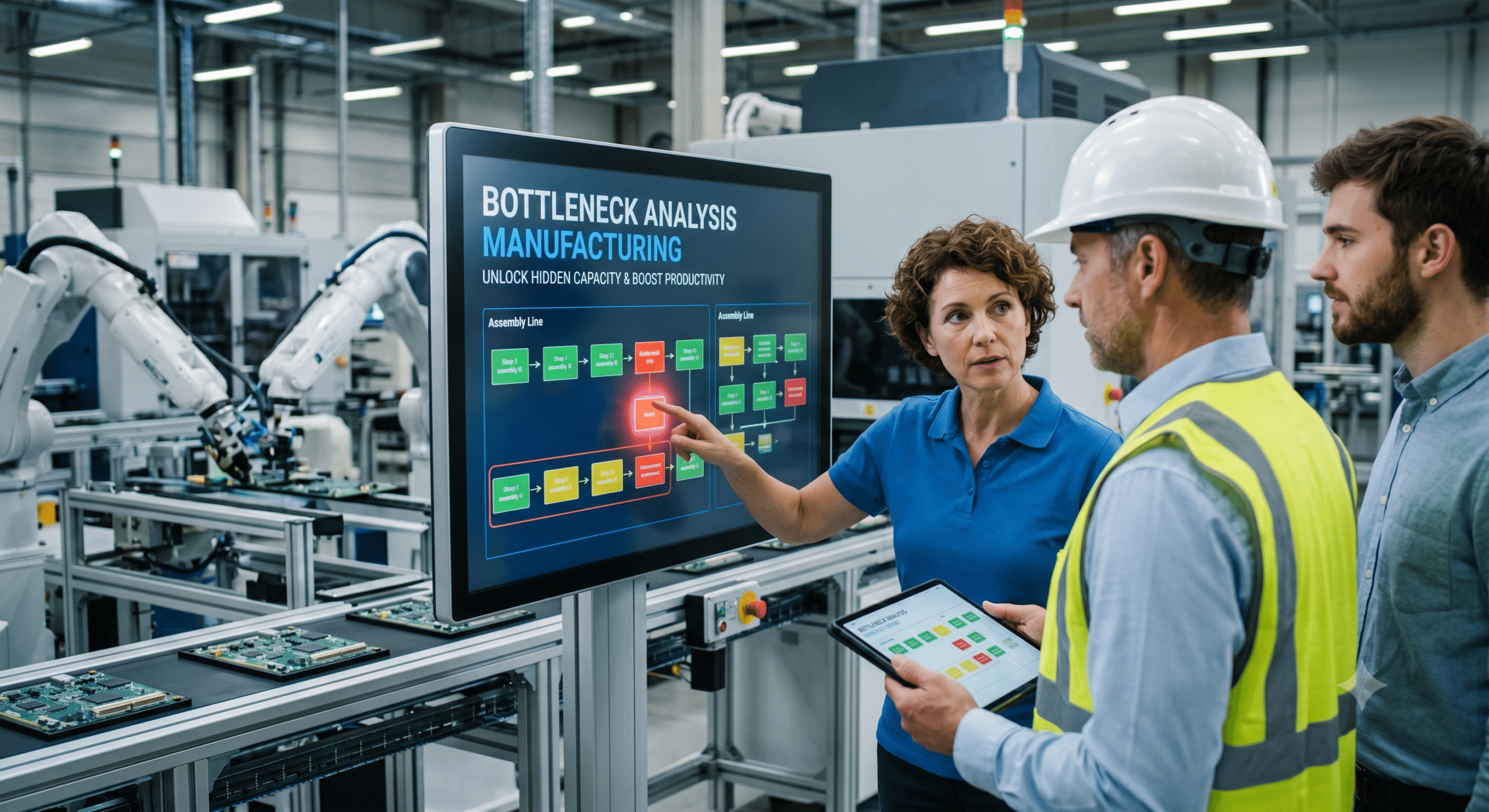
Every manufacturing leader wants the same thing: a production operation that runs smoothly, delivers products on time, minimizes waste, and consistently meets customer expectations. Yet despite investments in modern machinery, skilled labor, automation systems, and process improvements, many manufacturers continue to struggle with production delays, rising operating costs, inventory buildup, and missed output targets.
The reason is often surprisingly simple.
Most manufacturing challenges can be traced back to one critical issue: a bottleneck somewhere within the production process.
A bottleneck is the point in a manufacturing system where work accumulates because a particular resource cannot keep up with demand. It acts like a narrow section in a busy highway where traffic slows down, causing congestion that affects every vehicle behind it. In manufacturing, that congestion appears as delayed orders, idle workers, excessive work-in-progress inventory, overtime expenses, and frustrated customers.
This is why bottleneck analysis manufacturing has become one of the most valuable disciplines in modern operations management. Rather than making assumptions about where problems exist, bottleneck analysis provides a structured method for identifying the exact process, machine, workstation, department, or activity that limits overall production performance.
Organizations that master bottleneck analysis manufacturing often discover something remarkable. They realize they do not necessarily need more equipment, larger facilities, or additional labor to increase output. Instead, they simply need to identify and remove the constraint preventing their existing resources from performing at their full potential.
Whether you manage a small production facility or oversee a large manufacturing enterprise, understanding bottleneck analysis can help you uncover hidden capacity, improve operational efficiency, increase profitability, and create a stronger competitive advantage.
Understanding Bottleneck Analysis Manufacturing
At its core, bottleneck analysis manufacturing is the process of identifying and evaluating the resource that restricts the overall flow of production.
Manufacturing systems operate as interconnected chains. Every operation depends on the successful completion of previous processes before work can move forward. Because of this interconnected relationship, the speed of the entire production system is often determined by its slowest component.
Imagine a factory producing industrial equipment. Raw materials enter the facility and move through cutting, machining, welding, assembly, inspection, packaging, and shipping processes. If every department can process 500 units per day except welding, which can only process 350 units, the entire facility becomes limited to 350 units daily regardless of how much excess capacity exists elsewhere.
This simple concept explains why some manufacturers invest heavily in expanding operations without seeing meaningful improvements in output. They increase capacity in areas that were never restricting production while leaving the actual bottleneck untouched.
The goal of bottleneck analysis manufacturing is not merely to identify where delays occur. It is to understand why they occur, how they affect overall performance, and what actions can be taken to eliminate or reduce their impact.
Why Bottlenecks Have Such a Significant Impact on Manufacturing Performance
Many manufacturing leaders underestimate the influence a single bottleneck can have on overall operations.
When a bottleneck exists, its effects extend far beyond one workstation or department. The consequences often spread throughout the entire production environment, creating a chain reaction that affects productivity, quality, employee morale, customer satisfaction, and profitability.
One of the first consequences is reduced throughput. Throughput refers to the amount of product a manufacturing system can produce during a specific period. Since the bottleneck controls the pace of production, throughput becomes limited by the constraint rather than by total available resources.
Another consequence is the accumulation of work-in-progress inventory. Products begin piling up before the bottleneck because upstream operations continue producing faster than the bottleneck can process incoming work. This excess inventory consumes valuable floor space, increases handling requirements, and ties up working capital.
At the same time, downstream processes often experience idle time. Workers and equipment beyond the bottleneck may sit waiting for materials to arrive, resulting in poor resource utilization and lower productivity.
Customer service also suffers when bottlenecks remain unresolved. Longer production cycles frequently lead to missed delivery dates, delayed customer orders, and reduced customer satisfaction. In competitive markets, these issues can damage a company’s reputation and weaken long-term relationships with clients.
From a financial perspective, bottlenecks increase operational costs. Overtime expenses rise as teams attempt to compensate for delays. Inventory carrying costs increase as products wait in queues. Productivity declines because resources are not being utilized efficiently.
For these reasons, successful manufacturers view bottleneck analysis manufacturing as a strategic business practice rather than simply a production improvement tool.
Common Types of Manufacturing Bottlenecks
Not every bottleneck originates from equipment limitations. In fact, many production constraints emerge from less obvious sources.
Capacity bottlenecks occur when a process lacks sufficient output capability to meet production demand. This is perhaps the most recognizable form of bottleneck because it directly limits throughput.
Equipment bottlenecks result from machinery that cannot consistently support required production levels. Aging equipment, excessive downtime, mechanical failures, or insufficient maintenance often contribute to these constraints.
Labor bottlenecks have become increasingly common in modern manufacturing environments. Many organizations struggle to find skilled operators, technicians, welders, inspectors, and maintenance professionals. Even when equipment capacity exists, a shortage of qualified personnel can significantly restrict output.
Process bottlenecks arise when workflows contain unnecessary complexity, excessive approvals, inefficient layouts, or redundant activities. These bottlenecks often remain hidden because they develop gradually over time.
Quality bottlenecks occur when high defect rates generate excessive rework and inspection requirements. Instead of producing new products, valuable production capacity becomes dedicated to correcting errors.
Material bottlenecks emerge when supply chain disruptions, inventory shortages, or delayed deliveries prevent production from operating at full capacity.
Understanding the different forms of bottlenecks is essential because each type requires a different solution. An equipment bottleneck cannot be solved using the same approach applied to a labor bottleneck, and a process bottleneck may require workflow redesign rather than additional resources.
How to Identify Bottlenecks in a Manufacturing Environment
Identifying bottlenecks requires a combination of observation, data analysis, and operational expertise.
The first step involves mapping the entire production process from raw material receipt to finished product shipment. Process mapping creates visibility into how work flows through the organization and often reveals inefficiencies that were previously overlooked.
Once the process is documented, managers should examine cycle times across each operation. Cycle time measures the amount of time required to complete a specific task or process. Operations with significantly longer cycle times frequently indicate potential constraints.
Observation on the production floor provides additional insights. Areas where products consistently accumulate often signal bottleneck locations. Large queues, overflowing inventory racks, and crowded staging areas usually indicate that incoming work exceeds processing capacity.
Utilization analysis also plays an important role. Resources operating near maximum capacity for extended periods deserve closer examination because they may be limiting overall throughput.
Production reports, downtime records, maintenance logs, and quality metrics provide valuable supporting data. Frequent breakdowns, recurring quality issues, and excessive setup times often contribute to bottleneck formation.
Perhaps most importantly, manufacturers should seek input from frontline employees. Operators, supervisors, maintenance technicians, and quality personnel often possess practical knowledge that cannot be captured through reports alone. Their observations frequently reveal operational realities that data may overlook.
The most accurate bottleneck analysis manufacturing initiatives combine quantitative metrics with qualitative insights from the people closest to the work.
The Relationship Between Lean Manufacturing and Bottleneck Analysis
Lean manufacturing and bottleneck analysis share a common objective: improving flow.
Lean focuses on eliminating waste throughout the production process, while bottleneck analysis concentrates specifically on removing constraints that limit throughput.
When combined, these approaches create powerful opportunities for operational improvement.
For example, a lean initiative may reduce unnecessary movement, waiting, transportation, and inventory. However, if a major bottleneck remains unresolved, the overall impact may be limited.
Conversely, eliminating a bottleneck without addressing surrounding waste can create new inefficiencies elsewhere in the system.
The most successful manufacturing organizations integrate both methodologies. They continuously identify bottlenecks while simultaneously eliminating waste, improving standardization, reducing variation, and streamlining workflows.
This balanced approach helps create sustainable productivity gains rather than temporary improvements.
Applying the Theory of Constraints to Manufacturing Operations
One of the most influential frameworks related to bottleneck analysis manufacturing is the Theory of Constraints.
Developed by Eliyahu Goldratt, the Theory of Constraints proposes that every system contains at least one limiting factor that restricts overall performance.
Rather than attempting to improve every process simultaneously, organizations should focus on maximizing the performance of the primary constraint.
This approach follows a logical sequence.
First, identify the constraint.
Second, ensure the constraint operates as efficiently as possible.
Third, align all other processes to support the constraint.
Fourth, increase the constraint’s capacity when necessary.
Finally, repeat the process because removing one constraint often reveals another.
This methodology encourages organizations to focus resources where they generate the greatest impact rather than spreading improvement efforts too broadly.
How Technology Is Transforming Bottleneck Analysis Manufacturing
Manufacturing technology has dramatically improved the ability to identify and manage bottlenecks.
In the past, organizations relied heavily on manual observations, spreadsheets, and periodic performance reviews. While these methods remain valuable, modern digital tools provide deeper visibility and faster insights.
Manufacturing Execution Systems allow managers to monitor production performance in real time. Industrial Internet of Things sensors collect machine data continuously, enabling teams to detect emerging constraints before they become significant problems.
Advanced analytics platforms help identify patterns that may not be visible through traditional reporting methods. Artificial intelligence can analyze large volumes of production data and highlight bottlenecks with remarkable accuracy.
Digital twin technology allows organizations to simulate production scenarios and evaluate potential improvements before implementing changes on the factory floor.
Despite these technological advances, successful bottleneck analysis manufacturing still requires human judgment. Data can identify patterns and opportunities, but experienced leaders must interpret findings, evaluate risks, and make strategic decisions.
Technology should enhance operational expertise rather than replace it.
Real-World Example of Bottleneck Analysis Manufacturing
Consider a manufacturer producing custom metal components for industrial customers.
The company has invested heavily in automation and believes its production challenges stem from insufficient machine capacity. Management begins exploring options for purchasing additional equipment worth several hundred thousand dollars.
Before making the investment, the operations team conducts a detailed bottleneck analysis.
The assessment reveals that machining, assembly, and packaging departments possess excess capacity. However, the quality inspection area consistently struggles to keep pace with production.
Further investigation shows that inspectors spend significant time completing manual documentation and performing repetitive administrative tasks.
Rather than purchasing new equipment, the company implements digital inspection tools, simplifies reporting procedures, and cross-trains additional personnel.
Within three months, inspection throughput increases substantially, production delays decrease, and customer lead times improve.
Most importantly, the organization avoids a costly capital expenditure that would not have addressed the true constraint.
This example illustrates why bottleneck analysis manufacturing should always precede major operational investments.
Best Practices for Long-Term Bottleneck Management
Managing bottlenecks effectively requires more than occasional improvement projects.
Manufacturing leaders should establish a culture of continuous monitoring and ongoing optimization. Production performance should be reviewed regularly, with particular attention given to throughput, cycle times, utilization rates, inventory levels, and equipment effectiveness.
Cross-functional collaboration is essential because bottlenecks often involve multiple departments. Production teams, maintenance personnel, engineers, quality professionals, and supply chain specialists must work together to identify and resolve constraints.
Employee training also plays a critical role. Skilled workers can adapt more effectively to changing production demands, reducing the likelihood that labor shortages will become bottlenecks.
Preventive maintenance programs help ensure equipment reliability and minimize unexpected downtime. Similarly, continuous improvement initiatives support the ongoing elimination of waste and inefficiency.
Most importantly, leaders should recognize that bottlenecks are dynamic. As market demand changes, product mixes evolve, and production technologies advance, new constraints inevitably emerge.
The goal is not to eliminate bottlenecks forever. The goal is to develop an organizational capability for identifying and managing them quickly and effectively.
The Future of Bottleneck Analysis Manufacturing
The future of manufacturing operations management will be increasingly data-driven, connected, and predictive.
Instead of discovering bottlenecks after production performance declines, organizations will leverage predictive analytics to anticipate constraints before they occur.
Artificial intelligence will continue improving production visibility, enabling real-time decision-making and faster problem resolution.
Connected factories will provide unprecedented access to operational data, allowing leaders to understand exactly how resources interact and where constraints are likely to emerge.
As manufacturing becomes more competitive and customer expectations continue rising, organizations that excel at bottleneck analysis manufacturing will gain a significant advantage.
Their ability to optimize existing resources, improve responsiveness, and increase operational agility will position them for long-term success.
Final Thoughts
Every manufacturing operation contains hidden opportunities for improvement. In many cases, those opportunities are not found in new equipment, larger facilities, or increased staffing levels. They are found by identifying and addressing the constraints already limiting performance.
Bottleneck analysis manufacturing provides a practical, data-driven framework for uncovering these opportunities. By understanding where production slows, why delays occur, and how constraints affect the broader system, organizations can make smarter decisions and achieve meaningful improvements in productivity, efficiency, and profitability.
The most successful manufacturers are not necessarily those with the largest budgets or the newest technologies. They are the organizations that understand their operations deeply, focus improvement efforts strategically, and continuously adapt as conditions change.
When bottlenecks are managed effectively, manufacturing operations become more productive, more responsive, and better equipped to support sustainable growth in an increasingly competitive marketplace.
Frequently Asked Questions
What is bottleneck analysis manufacturing?
Bottleneck analysis manufacturing is the process of identifying, evaluating, and improving the operation, resource, machine, or process that limits overall production capacity and throughput.
How do bottlenecks affect manufacturing productivity?
Bottlenecks reduce throughput, increase production delays, create excess inventory, generate overtime costs, and lower overall operational efficiency.
What is the most common manufacturing bottleneck?
Common bottlenecks include machine downtime, labor shortages, long setup times, quality inspection delays, inefficient workflows, and inadequate production capacity.
How often should manufacturers perform bottleneck analysis?
Manufacturers should conduct bottleneck analysis regularly as part of continuous improvement efforts because constraints change as demand, products, and production processes evolve.
Can technology help identify bottlenecks?
Yes. Manufacturing Execution Systems, Industrial IoT devices, production analytics platforms, artificial intelligence, and digital twin technologies can significantly improve bottleneck detection and analysis.
References and Further Reading
1. Lean Enterprise Institute – What’s Your Company’s Bottleneck?
An excellent article explaining how bottlenecks influence value streams, operational performance, and continuous improvement initiatives across manufacturing organizations.
2. MachineMetrics – How to Conduct a Manufacturing Bottleneck Analysis
A practical guide covering bottleneck identification, common causes, real-world examples, and modern manufacturing analytics.
3. Manufacturing.net – Make Bottleneck Management Your Biggest Priority
Explores the role of digital transformation, manufacturing data, and operational visibility in identifying and eliminating production bottlenecks.
4. PTC – Bottlenecks in Manufacturing: Types, Causes, and How to Solve Them
A detailed overview of manufacturing constraints, root causes, and practical approaches to improving production flow and operational efficiency.
5. Applied Sciences (MDPI) – Comprehensive Review of Bottleneck Identification and Management in Manufacturing Systems
A peer-reviewed research paper that provides a comprehensive review of modern bottleneck identification methods and management techniques used in manufacturing systems.
6. SpringerOpen – Dynamic Bottleneck Elimination Using Theory of Constraints
A case study demonstrating how Theory of Constraints can significantly improve manufacturing throughput and production efficiency.
7. ASCM (Association for Supply Chain Management)
A leading source of operations management, production planning, supply chain, and manufacturing best practices.
8. IndustryWeek – Manufacturing Operations and Continuous Improvement Insights
Provides expert articles on plant management, operational excellence, lean manufacturing, and productivity improvement.
9. McKinsey Manufacturing Insights
Offers research-backed perspectives on manufacturing transformation, operational performance, digital factories, and productivity optimization.