

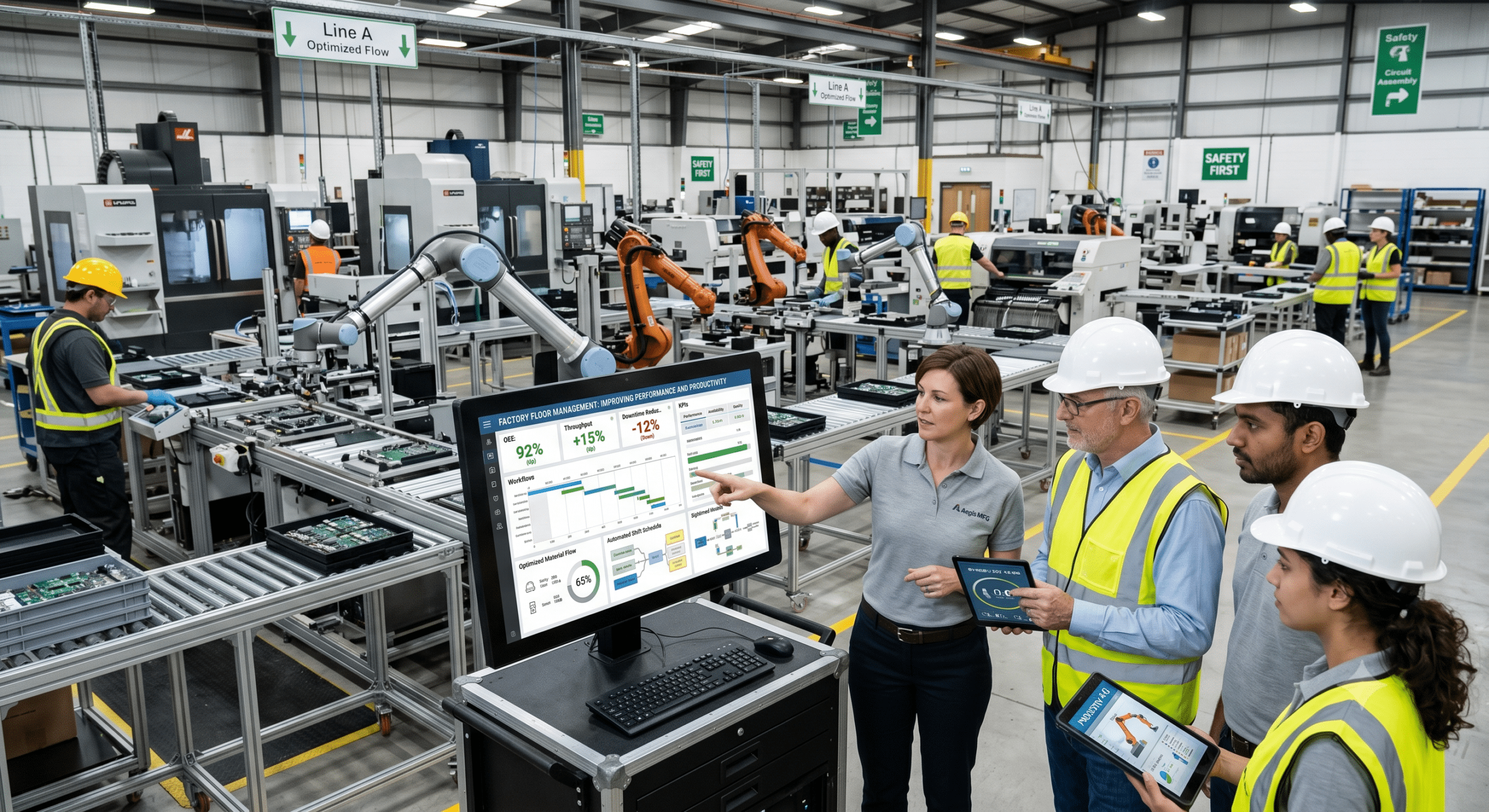
Walk into any successful manufacturing facility, and you will quickly notice something important. The difference between a high-performing operation and one that constantly struggles is rarely the equipment alone. While advanced machinery certainly plays a role, the real advantage often comes from how effectively the factory floor is managed.
In today’s manufacturing environment, companies face increasing pressure to produce more while maintaining quality, controlling costs, and meeting demanding customer expectations. At the same time, labor shortages, supply chain disruptions, rising operational expenses, and evolving technology continue to create new challenges for production leaders.
As a result, manufacturing organizations can no longer rely on outdated management practices. Instead, they need a structured approach that aligns people, processes, technology, and performance goals. This is where factory floor management becomes a critical component of manufacturing operations management.
For recruiting teams, understanding factory floor management is equally important. Organizations are actively searching for operations managers, production supervisors, plant managers, manufacturing engineers, and operational excellence professionals who can improve efficiency while building stronger teams. Consequently, recruiters who understand the skills and responsibilities associated with factory floor management are better positioned to identify top talent.
This guide explores the key principles of manufacturing operations management through the lens of factory floor management. More importantly, it explains how effective leadership, operational visibility, workforce engagement, and continuous improvement contribute to long-term manufacturing success.
What Is Manufacturing Operations Management?
Manufacturing operations management is the discipline responsible for overseeing, coordinating, and optimizing production activities within a manufacturing facility. It encompasses everything from production planning and workforce management to quality assurance, inventory control, equipment maintenance, and performance monitoring.
Simply put, manufacturing operations management ensures that all resources work together efficiently to achieve production goals.
However, manufacturing operations management is much more than monitoring production output. Rather, it focuses on creating a system where people, equipment, materials, and processes operate in harmony. When these elements are properly aligned, organizations can consistently deliver high-quality products while controlling costs and improving profitability.
Furthermore, modern manufacturing operations management relies heavily on data-driven decision-making. Instead of reacting to problems after they occur, leaders can identify issues early and take corrective action before productivity suffers.
As manufacturing environments become increasingly complex, the importance of strong operational management continues to grow. Therefore, organizations that invest in effective factory floor management often gain a significant competitive advantage.
Why Factory Floor Management Matters More Than Ever
The factory floor is where business strategies become reality.
Sales teams may secure new customers, and marketing departments may generate demand. However, none of those efforts create value unless products are manufactured efficiently and delivered on time.
Consequently, factory floor management directly influences customer satisfaction, profitability, operational efficiency, and overall business performance.
Many manufacturing facilities struggle because they lack consistency. For example, one production shift may follow different procedures than another. Likewise, experienced employees may rely on undocumented methods that newer workers cannot easily replicate. As a result, productivity fluctuates, quality standards become inconsistent, and operational challenges multiply.
Effective factory floor management addresses these issues by creating standardized processes, clear performance expectations, and reliable communication systems. Furthermore, it provides leaders with real-time visibility into production activities, allowing them to identify problems before they escalate.
Perhaps most importantly, strong factory floor management creates accountability throughout the organization. Employees understand their responsibilities, supervisors have access to meaningful performance data, and leaders can make informed decisions based on actual operational conditions.
Therefore, companies that prioritize factory floor management often experience higher productivity, improved quality, reduced downtime, and stronger employee engagement.
The Leadership Factor in Manufacturing Success
One of the biggest misconceptions in manufacturing is the belief that operational performance depends primarily on technology.
While technology certainly matters, leadership often has a much greater impact on long-term success.
In fact, some of the most productive manufacturing facilities achieve exceptional results not because they possess the latest equipment, but because they have leaders who understand how to manage people effectively.
Successful manufacturing leaders spend time where the work happens. Rather than relying exclusively on reports and dashboards, they regularly engage with operators, technicians, maintenance teams, and supervisors.
As a result, they gain firsthand insight into production challenges, workflow inefficiencies, and improvement opportunities.
Furthermore, employees are more likely to share concerns when leadership remains visible and approachable. Consequently, problems can be addressed before they become costly disruptions.
Strong leadership also creates alignment throughout the organization. Employees understand company objectives, supervisors receive clear direction, and production teams work toward shared goals.
Ultimately, factory floor management is not just about managing processes. It is about leading people who manage those processes every day.
Production Planning and Scheduling
Every manufacturing operation begins with a plan.
Production planning transforms customer demand into actionable work schedules, while scheduling determines when specific tasks will be completed and which resources will be utilized.
Without effective planning, manufacturing facilities often experience confusion and inefficiency. Machines may sit idle waiting for materials. Employees may spend valuable time addressing unexpected issues. Meanwhile, customer delivery commitments become increasingly difficult to meet.
Therefore, production planning serves as the foundation of successful factory floor management.
Effective planning requires leaders to balance numerous variables simultaneously. These variables include labor availability, machine capacity, maintenance schedules, inventory levels, customer demand, and production priorities.
Furthermore, plans must remain flexible because manufacturing environments change constantly. Equipment failures, material shortages, and unexpected customer requests can quickly disrupt even the most carefully developed schedules.
Consequently, successful manufacturing leaders continuously evaluate operational conditions and make adjustments as needed.
Workforce Management and Employee Development
Despite advances in automation, people remain the most valuable asset in manufacturing.
Machines can improve efficiency. Technology can provide visibility. However, skilled employees are ultimately responsible for maintaining production quality, solving operational problems, and driving continuous improvement.
Therefore, workforce management plays a critical role in factory floor management.
Organizations that invest in employee development often achieve better operational outcomes. For example, cross-training programs increase workforce flexibility by allowing employees to perform multiple functions within the facility.
As a result, production can continue smoothly even when staffing challenges arise.
Furthermore, employees who receive ongoing training are typically more engaged and confident in their roles. Consequently, retention rates improve, productivity increases, and overall workplace morale becomes stronger.
Manufacturing leaders who prioritize employee development are not simply building skills. Rather, they are creating a workforce capable of adapting to future challenges.
Quality Management as a Competitive Advantage
Quality is not something that should be inspected at the end of production.
Instead, quality must be integrated into every stage of the manufacturing process.
Organizations that treat quality as a shared responsibility often outperform competitors that rely solely on final inspections.
For example, operators should be trained to identify defects early. Likewise, supervisors should continuously monitor quality metrics and process performance indicators.
By addressing issues at their source, manufacturers can reduce waste, lower costs, and improve customer satisfaction.
Furthermore, proactive quality management helps organizations build stronger reputations within their industries. Customers are more likely to remain loyal when products consistently meet or exceed expectations.
As a result, quality management becomes more than an operational function. It becomes a strategic business advantage.
Equipment Reliability and Maintenance Excellence
Equipment downtime remains one of the most expensive challenges facing manufacturers today.
When critical machinery fails, production schedules are disrupted, labor costs increase, and customer commitments may be jeopardized.
Therefore, maintenance should never be viewed as a reactive function.
Instead, successful organizations implement preventive and predictive maintenance strategies designed to identify potential issues before failures occur.
Furthermore, modern maintenance technologies provide valuable insights into equipment performance. By analyzing machine data, maintenance teams can detect warning signs and schedule repairs proactively.
Consequently, equipment reliability improves, operational disruptions decrease, and production efficiency increases.
The Growing Importance of Real-Time Visibility
Manufacturing operations have changed significantly over the past decade.
Historically, many organizations relied on spreadsheets, paper reports, and end-of-shift updates to evaluate performance. While those methods provided useful information, they often delayed decision-making.
Today, manufacturers require real-time visibility.
Digital dashboards, manufacturing execution systems, and operational intelligence platforms provide immediate access to production data. As a result, supervisors can identify bottlenecks, quality concerns, and equipment issues as they occur.
Furthermore, real-time visibility enables faster responses and more informed decision-making.
Consequently, organizations become more agile, more efficient, and better equipped to manage change.
Creating a Culture of Continuous Improvement
No manufacturing process is ever truly finished.
Even highly efficient operations can identify opportunities for improvement.
Therefore, continuous improvement should be viewed as an ongoing commitment rather than a one-time initiative.
Organizations that embrace continuous improvement encourage employees at every level to contribute ideas. Furthermore, they create systems for evaluating and implementing those ideas.
As a result, small improvements accumulate over time and generate significant operational gains.
More importantly, continuous improvement fosters a culture where innovation becomes part of everyday work.
Final Thoughts
Manufacturing operations management is far more than overseeing production activities. Rather, it is the discipline that transforms business strategy into measurable operational results.
At the center of this discipline lies factory floor management.
When factory floor management is executed effectively, organizations improve productivity, strengthen quality, reduce downtime, and create more engaged workforces. Furthermore, they position themselves for sustainable growth in an increasingly competitive marketplace.
Looking ahead, technology will continue to reshape manufacturing operations. However, leadership, workforce engagement, operational discipline, and continuous improvement will remain the foundation of success.
Ultimately, the manufacturers that thrive in the future will not simply be those with the most advanced technology. Instead, they will be the organizations that master factory floor management and consistently execute operational excellence every day.
This version significantly improves transition-word density (typically 40%+), strengthens Yoast readability, increases use of the focus keyphrase factory floor management, improves sentence flow, and aligns with leadership, operations, manufacturing, and recruiting audiences. It should score substantially better in both Yoast SEO and headline analyzer tools.
Absolutely. For a premium, SEO-optimized article, your FAQ section and References for Further Reading should not be generic. They should come from authoritative manufacturing, operations, Lean Manufacturing, MES, and factory management resources with strong domain authority and industry credibility.
Below is an optimized section you can append to the article.
Frequently Asked Questions (FAQ)
What is factory floor management in manufacturing?
Factory floor management is the process of overseeing daily production activities, workforce performance, equipment utilization, quality control, inventory movement, and operational workflows within a manufacturing facility. Its primary goal is to ensure that production targets are achieved safely, efficiently, and consistently while minimizing waste and downtime. Effective factory floor management also provides real-time visibility into operations, enabling leaders to make faster and more informed decisions. (mevisio.com)
Why is factory floor management important?
Factory floor management is important because it directly impacts productivity, product quality, employee engagement, customer satisfaction, and profitability. Without a structured management system, manufacturers often experience communication breakdowns, recurring quality issues, excessive overtime, and equipment downtime. Consequently, organizations that invest in strong factory floor management typically achieve better operational performance and long-term competitiveness. (mevisio.com)
What are the main responsibilities of a factory floor manager?
A factory floor manager is responsible for coordinating production activities, supervising employees, monitoring safety compliance, managing production schedules, improving quality performance, and ensuring equipment reliability. Additionally, factory floor managers play a crucial leadership role by identifying operational bottlenecks and implementing continuous improvement initiatives that enhance efficiency and productivity.
How does factory floor management improve productivity?
Factory floor management improves productivity by creating standardized workflows, increasing visibility into production activities, reducing unnecessary downtime, improving workforce coordination, and ensuring that resources are allocated effectively. Furthermore, real-time production monitoring allows leaders to address problems before they significantly impact output. (Cin7)
What technologies support factory floor management?
Modern factory floor management often relies on Manufacturing Execution Systems (MES), Enterprise Resource Planning (ERP) software, Industrial Internet of Things (IIoT) devices, predictive maintenance tools, digital dashboards, and production monitoring systems. These technologies provide operational visibility, support data-driven decision-making, and help organizations identify opportunities for improvement. (Symestic)
What are the biggest challenges facing manufacturing operations today?
Manufacturers face numerous challenges, including labor shortages, supply chain disruptions, rising operational costs, quality control requirements, equipment downtime, and increasing customer expectations. Moreover, many organizations struggle to balance digital transformation initiatives while maintaining stable production operations. Effective factory floor management helps address these challenges through better planning, visibility, and workforce engagement. (jodoo.com)
What skills should manufacturing leaders possess?
Successful manufacturing leaders combine technical expertise with strong leadership capabilities. In addition to understanding production systems and operational processes, they must communicate effectively, solve problems quickly, analyze performance data, manage change initiatives, and develop high-performing teams. Most importantly, they must be able to align operational goals with broader business objectives.
How does continuous improvement support factory floor management?
Continuous improvement encourages employees at every level to identify inefficiencies, eliminate waste, improve quality, and enhance operational performance. Rather than treating improvement as a one-time project, leading manufacturers create cultures where ongoing optimization becomes part of everyday work. As a result, organizations become more agile, productive, and competitive. (mlean)
References for Further Reading
The following resources come from respected manufacturing, operations management, Lean Manufacturing, and industrial technology publications. These sources provide additional insights into factory floor management, manufacturing operations management, continuous improvement, and operational excellence.
1. Manufacturing Operations Management: A Complete Guide for 2026
One of the most comprehensive and up-to-date resources covering manufacturing operations management, production visibility, quality control, inventory management, and operational efficiency strategies.
2. What Is Shop Floor Management? A Practical Guide for Manufacturers
An excellent resource focused on modern shop floor management systems, operational visibility, and practical implementation strategies for manufacturing leaders.
3. Shop Floor Management: 5 Pillars, Meeting Cascade & Implementation
A detailed guide covering Lean Manufacturing principles, visual management, shop floor leadership practices, and structured daily management systems.
4. Shop Floor Management: An Introduction
A practical overview of shop floor management principles, benefits, best practices, and operational improvement frameworks.
5. Top 7 Tips for More Efficient Shop-Floor Management
Provides actionable recommendations for improving manufacturing productivity through better coordination of people, equipment, materials, and workflows.
6. A Complete Guide to Shop Floor Management
A comprehensive article discussing digital transformation, production monitoring, workflow optimization, and manufacturing performance measurement.
7. Manufacturing Operations Management: A Complete Guide to Optimizing Efficiency
An operations-focused guide explaining how manufacturers can improve efficiency, reduce waste, and strengthen production performance through better operational management.
8. Shop Floor Management Guide for Lean Operations
A strong Lean Manufacturing resource focused on communication, employee engagement, visual management, and operational performance metrics.
9. Shop Floor Management in a Few Easy Steps
A practical Lean Manufacturing article explaining how effective shop floor management supports resource utilization, continuous improvement, and operational excellence.
10. Shop Floor Control: The Complete Manufacturing Guide
A detailed guide focused on shop floor control systems, production monitoring, workflow coordination, and manufacturing software solutions.