

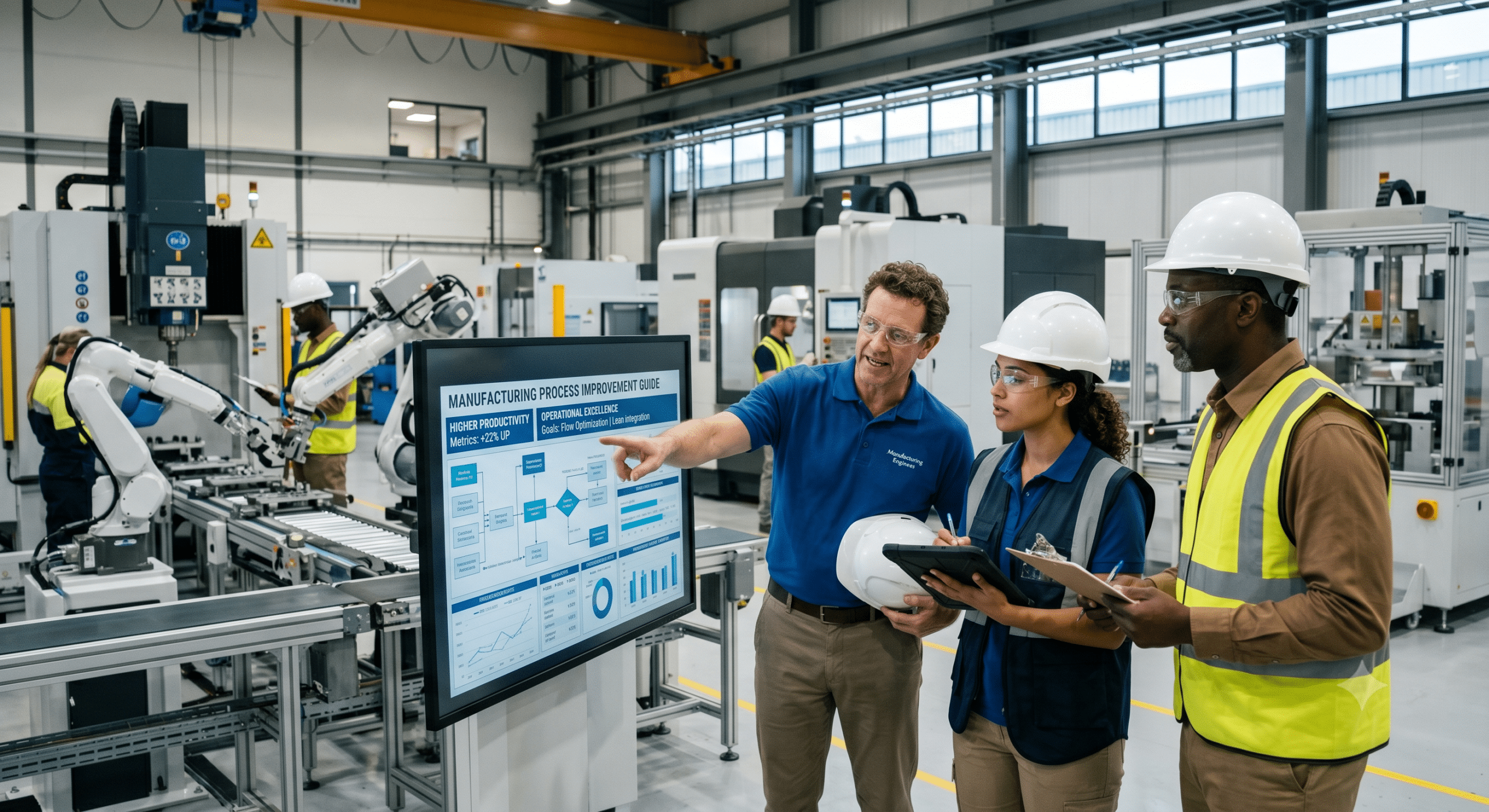
Manufacturing has changed dramatically over the past few decades. Companies no longer compete solely on the quality of their products. Today’s manufacturers must also compete on speed, efficiency, flexibility, customer satisfaction, operational costs, and their ability to adapt quickly to changing market demands. In this environment, organizations that continue using outdated production methods often struggle to maintain profitability, while those that embrace manufacturing process improvement consistently achieve better results.
Manufacturing process improvement is not simply about making production lines move faster. It is a strategic approach that focuses on identifying inefficiencies, eliminating waste, improving workflows, enhancing quality, and maximizing the use of resources across the entire manufacturing operation. When organizations implement process improvement correctly, they create a foundation for sustainable growth, stronger customer relationships, higher employee engagement, and increased profitability.
Many manufacturing leaders assume that operational improvement requires expensive automation systems or major facility upgrades. While technology can certainly help, the most successful improvement initiatives often begin by examining existing processes, understanding where bottlenecks occur, and finding smarter ways to perform daily tasks. Small improvements made consistently over time often generate greater long-term value than large, one-time projects.
This comprehensive guide explores the principles of manufacturing operations management and explains how manufacturing process improvement helps organizations increase productivity, reduce costs, improve quality, and remain competitive in a rapidly evolving industry.
Understanding Manufacturing Operations Management
Manufacturing operations management refers to the coordination and control of all activities involved in producing goods, from the moment raw materials arrive at a facility until finished products reach customers. It encompasses production planning, inventory management, workforce coordination, equipment maintenance, quality control, performance monitoring, and continuous improvement initiatives.
At its core, manufacturing operations management serves as the operational backbone of a manufacturing organization. It ensures that people, processes, machinery, materials, and information work together efficiently to achieve business objectives.
Successful operations management requires more than simply overseeing production schedules. Effective leaders continuously evaluate performance, identify opportunities for improvement, solve operational challenges, and align manufacturing activities with broader organizational goals.
The most successful manufacturers understand that every department influences operational performance. Purchasing teams affect material availability. Maintenance teams impact equipment reliability. Production teams influence output levels. Quality teams help maintain customer satisfaction. Leadership teams establish priorities and allocate resources. Because these functions are interconnected, improvements in one area often create positive results throughout the entire organization.
Why Manufacturing Process Improvement Matters
Manufacturing process improvement has become increasingly important as customer expectations continue to rise and competitive pressures intensify. Organizations that fail to improve often experience declining margins, reduced productivity, increased waste, and lower customer satisfaction.
Many manufacturing facilities operate with hidden inefficiencies that gradually erode profitability. Employees may spend excessive time searching for tools, waiting for materials, or correcting quality defects. Equipment may experience frequent breakdowns. Production schedules may constantly change due to poor planning. Inventory levels may increase unnecessarily while customer orders still experience delays.
These issues rarely appear overnight. Instead, they develop gradually and become accepted as part of normal operations. Over time, however, they create significant financial consequences.
Manufacturing process improvement addresses these challenges by systematically analyzing workflows and identifying opportunities to eliminate waste, reduce delays, improve quality, and increase efficiency. Rather than accepting inefficiencies as unavoidable, organizations actively seek ways to improve performance and create more value for customers.
Companies that embrace continuous improvement often achieve stronger financial performance because they reduce operational costs while simultaneously increasing productivity and customer satisfaction.
The Connection Between Productivity and Profitability
One of the most important reasons organizations invest in manufacturing process improvement is the direct relationship between productivity and profitability. When manufacturers produce more output using the same resources, they lower costs and improve margins.
However, productivity improvement does not necessarily mean employees must work harder or longer hours. In fact, many successful improvement initiatives focus on making work easier rather than more demanding.
For example, consider a production line where operators spend several minutes each hour walking to retrieve materials. By redesigning the workspace and placing materials closer to the point of use, the organization can eliminate unnecessary movement and increase productive work time without increasing employee effort.
Similarly, reducing machine downtime allows equipment to produce more products without requiring additional capital investment. Improving quality reduces rework and scrap, allowing resources to focus on value-creating activities rather than correcting mistakes.
These improvements may seem small individually, but when organizations implement dozens or even hundreds of improvements over time, the cumulative impact becomes substantial.
Identifying Common Sources of Manufacturing Inefficiency
Every manufacturing facility contains opportunities for improvement. The challenge lies in identifying where inefficiencies exist and understanding their root causes.
One common source of inefficiency involves production bottlenecks. A bottleneck occurs when one process operates more slowly than the processes surrounding it, limiting overall production capacity. Organizations often invest heavily in increasing output in multiple areas, only to discover that a single constraint continues to restrict performance.
Another common issue involves excessive inventory. While inventory serves an important purpose, excessive stock ties up capital, consumes valuable space, and often hides deeper operational problems. Organizations frequently discover that reducing inventory improves visibility and encourages process improvements.
Quality defects represent another major source of inefficiency. Defective products require rework, replacement, or disposal, all of which consume resources and increase costs. More importantly, recurring quality issues can damage customer relationships and reduce confidence in the organization.
Equipment downtime also creates significant operational challenges. When machines fail unexpectedly, production schedules become disrupted, delivery commitments become difficult to meet, and maintenance costs often increase. Organizations that implement proactive maintenance strategies frequently experience substantial improvements in reliability and productivity.
Communication breakdowns can create equally serious problems. Misunderstandings between departments often lead to delays, scheduling conflicts, material shortages, and production errors. Strong communication systems help ensure that teams remain aligned and informed.
The Role of Leadership in Manufacturing Process Improvement
Leadership plays a critical role in the success of any manufacturing process improvement initiative. While tools, technologies, and methodologies provide valuable support, leaders ultimately determine whether improvement efforts succeed or fail.
Effective manufacturing leaders create an environment where employees feel empowered to identify problems and propose solutions. They encourage collaboration, support innovation, and focus on learning rather than assigning blame.
Many organizations struggle with improvement efforts because employees fear negative consequences when reporting problems. In these environments, issues often remain hidden until they become major operational challenges.
Strong leaders take a different approach. They recognize that problems provide valuable opportunities for improvement. Rather than asking who caused a problem, they focus on understanding why it occurred and how the organization can prevent it from happening again.
This mindset encourages continuous learning and creates a culture where employees actively contribute to operational excellence.
Leadership commitment must also remain visible and consistent. Employees quickly recognize whether improvement initiatives represent genuine organizational priorities or temporary management programs. Leaders who actively participate in improvement activities send a clear message that continuous improvement matters.
Building a Culture of Continuous Improvement
Manufacturing process improvement should never function as a short-term project with a defined end date. Instead, organizations should view improvement as an ongoing journey that becomes part of everyday operations.
A culture of continuous improvement develops when employees at every level consistently seek ways to improve performance. This culture does not emerge automatically. Leaders must actively create and support it.
Organizations that successfully build improvement cultures encourage employees to share ideas, participate in problem-solving activities, and contribute to decision-making processes. They celebrate improvement successes and recognize employees who help drive positive change.
Continuous improvement cultures also embrace experimentation. Not every improvement idea produces the desired result, but organizations learn valuable lessons from both successes and failures. This willingness to test new approaches helps companies adapt quickly to changing circumstances and discover innovative solutions.
Most importantly, continuous improvement cultures focus on progress rather than perfection. Small improvements implemented consistently over time often generate remarkable results.
Using Data to Drive Better Operational Decisions
Modern manufacturing operations generate vast amounts of data. Production systems, quality monitoring tools, maintenance platforms, and inventory management systems all provide valuable information that can support improvement efforts.
However, collecting data alone does not improve performance.
Successful organizations use data to understand current conditions, identify trends, measure results, and make informed decisions. They focus on metrics that directly influence operational performance and business outcomes.
Key performance indicators often include production output, cycle time, equipment utilization, defect rates, downtime, inventory turnover, and on-time delivery performance.
When leaders regularly review these metrics and discuss them with their teams, they create greater visibility into operational performance and encourage accountability throughout the organization.
Lean Manufacturing and the Elimination of Waste
One of the most effective approaches to manufacturing process improvement is Lean manufacturing. Originally developed within the automotive industry, Lean focuses on maximizing customer value while minimizing waste. Although the concept has existed for decades, its principles remain highly relevant because every manufacturing organization faces some form of waste that reduces efficiency and profitability.
Waste does not always appear obvious. In many cases, it hides within daily activities that employees have performed for years. For example, workers may spend time waiting for materials, searching for tools, moving products between workstations, or correcting defects. While each activity may seem insignificant on its own, together they consume valuable time and resources that could otherwise contribute to productive work.
Lean manufacturing encourages organizations to examine every process and ask a simple but powerful question: does this activity create value for the customer? If the answer is no, leaders should determine whether they can eliminate, reduce, or simplify the activity.
Organizations that successfully apply Lean principles often experience significant improvements in productivity, quality, safety, and employee engagement. More importantly, Lean creates a mindset of continuous improvement that encourages employees to look for opportunities to make work easier, faster, and more efficient.
Manufacturers that embrace Lean often discover that they can increase output without purchasing additional equipment or hiring more employees simply by improving the way existing resources operate.
Reducing Downtime Through Proactive Maintenance
Equipment reliability plays a critical role in manufacturing operations management. Even the most efficient production process can experience significant disruptions when machinery fails unexpectedly.
Many organizations still rely heavily on reactive maintenance, meaning they repair equipment only after it breaks down. While this approach may seem cost-effective in the short term, it often creates higher long-term expenses because unexpected failures can stop production, delay customer orders, increase overtime costs, and damage equipment components.
Manufacturing process improvement efforts should include a strong focus on proactive maintenance strategies. Rather than waiting for equipment failures, maintenance teams should monitor machine performance, perform routine inspections, and address potential issues before they become serious problems.
Predictive maintenance technologies have made this process even more effective. Sensors can monitor vibration, temperature, pressure, and other indicators that help maintenance teams identify early warning signs of equipment failure. By addressing problems before breakdowns occur, manufacturers can significantly reduce downtime and improve overall equipment effectiveness.
Reliable equipment not only increases productivity but also creates a more stable and predictable operating environment for employees, supervisors, and customers.
Digital Transformation and Smart Manufacturing
Technology continues to transform manufacturing operations, creating new opportunities for process improvement and operational excellence.
Modern manufacturers increasingly use digital tools to collect data, monitor performance, automate workflows, and improve decision-making. Technologies such as Manufacturing Execution Systems (MES), Enterprise Resource Planning (ERP) software, Industrial Internet of Things (IIoT) devices, artificial intelligence, and advanced analytics provide unprecedented visibility into manufacturing operations.
However, successful digital transformation requires more than simply purchasing software or installing new technology. Organizations must first understand their existing processes and identify opportunities for improvement. Technology should support well-designed processes rather than compensate for poorly designed ones.
For example, automating an inefficient process often allows the organization to perform inefficient work faster. While productivity may increase temporarily, the underlying problem remains unresolved.
Manufacturing leaders should therefore view technology as an enabler of process improvement rather than a replacement for operational excellence. When organizations combine strong processes with effective technology solutions, they create powerful opportunities for growth, efficiency, and innovation.
Digital transformation also improves communication and collaboration by providing real-time access to operational information. Managers can monitor performance more effectively, employees can identify problems more quickly, and decision-makers can respond faster to changing business conditions.
Workforce Development as a Competitive Advantage
Despite rapid advancements in automation and technology, people remain one of the most important assets in manufacturing. Skilled employees operate equipment, solve problems, maintain quality standards, and drive continuous improvement efforts.
Unfortunately, many organizations underestimate the importance of workforce development. They invest heavily in equipment and technology while providing limited opportunities for employee growth and development.
Manufacturing process improvement requires knowledgeable, engaged, and capable employees who understand both the technical and operational aspects of their work. Training should therefore extend beyond basic job functions and include leadership development, problem-solving skills, communication techniques, and continuous improvement methodologies.
Organizations that invest in employee development often experience lower turnover rates, higher productivity levels, and stronger employee engagement. Workers who understand how their contributions affect organizational success are more likely to take ownership of their responsibilities and participate actively in improvement initiatives.
Additionally, manufacturing leaders should encourage cross-functional learning. When employees understand how different departments interact, they gain a broader perspective on operational performance and become better equipped to identify improvement opportunities.
The most successful manufacturers recognize that continuous improvement begins with continuous learning.
Quality Management and Manufacturing Excellence
Quality management represents one of the most important components of manufacturing operations management. Customers expect products that consistently meet specifications, perform reliably, and arrive on time. Failure to meet these expectations can quickly damage customer relationships and reduce profitability.
Many organizations treat quality as the responsibility of a dedicated quality department. However, world-class manufacturers understand that quality is everyone’s responsibility.
Manufacturing process improvement focuses on preventing defects rather than detecting them after production. This proactive approach reduces scrap, minimizes rework, lowers costs, and improves customer satisfaction.
Effective quality management begins with understanding customer requirements and designing processes capable of consistently meeting those requirements. Organizations should monitor performance closely, investigate quality issues thoroughly, and implement corrective actions promptly.
Root cause analysis plays a critical role in this process. Instead of addressing symptoms, teams should identify and eliminate the underlying causes of quality problems. This approach prevents recurring issues and supports long-term operational improvement.
When manufacturers consistently produce high-quality products, they strengthen their reputation, increase customer loyalty, and create sustainable competitive advantages.
Creating a Manufacturing Process Improvement Roadmap
Many organizations struggle with improvement initiatives because they lack a structured approach. Without clear direction, improvement efforts often become fragmented, inconsistent, and difficult to sustain.
A manufacturing process improvement roadmap provides a framework for identifying priorities, implementing solutions, and measuring results.
The first step involves assessing current performance. Organizations should gather data, observe workflows, interview employees, and identify areas where inefficiencies exist. This assessment provides valuable insight into operational strengths and weaknesses.
Next, leaders should establish clear improvement goals aligned with business objectives. These goals may focus on increasing productivity, reducing downtime, improving quality, lowering costs, or enhancing customer satisfaction.
Once priorities have been defined, improvement teams can analyze processes, identify root causes, develop solutions, and implement changes. Throughout this process, organizations should track performance metrics to measure progress and evaluate results.
Perhaps most importantly, successful improvements must become standardized. When organizations fail to document and reinforce new processes, employees often revert to previous habits and performance gains disappear.
Continuous monitoring, leadership support, and employee engagement help ensure that improvements remain sustainable over the long term.
Overcoming Common Challenges in Manufacturing Process Improvement
Although the benefits of manufacturing process improvement are substantial, organizations frequently encounter obstacles during implementation.
Resistance to change remains one of the most common challenges. Employees may feel uncertain about new processes, fear increased workloads, or question the need for change. Leaders must communicate clearly, involve employees in improvement efforts, and explain how proposed changes will benefit both the organization and its workforce.
Limited resources can also create difficulties. Many manufacturers operate under tight budgets and staffing constraints, making it challenging to dedicate time and resources to improvement initiatives. However, organizations should remember that many improvements require creativity and commitment rather than significant financial investment.
Another common challenge involves maintaining momentum. Improvement programs often begin with enthusiasm but gradually lose focus as daily operational demands take priority. Strong leadership, regular performance reviews, and visible success stories help sustain engagement and reinforce the importance of continuous improvement.
Organizations that anticipate these challenges and develop strategies to address them are more likely to achieve lasting success.
The Future of Manufacturing Operations Management
The manufacturing industry will continue to evolve as new technologies, market demands, and economic conditions reshape the competitive landscape. Artificial intelligence, machine learning, advanced robotics, predictive analytics, and connected manufacturing systems will create new opportunities for operational improvement.
However, the fundamental principles of manufacturing operations management will remain unchanged. Organizations will continue to succeed by improving processes, reducing waste, developing employees, maintaining quality, and focusing relentlessly on customer value.
Technology will enhance these capabilities, but leadership, culture, and disciplined execution will continue to drive long-term success.
Manufacturers that embrace continuous improvement today will position themselves to adapt more effectively to future challenges and opportunities.
Final Thoughts
Manufacturing operations management serves as the foundation of organizational performance, connecting people, processes, technology, and business objectives into a unified system that drives productivity and profitability.
At the center of this discipline lies manufacturing process improvement. Organizations that continuously improve workflows, eliminate inefficiencies, strengthen quality systems, and empower employees create significant advantages over competitors who rely on outdated methods or reactive management practices.
The most successful manufacturers do not wait for major problems to force change. Instead, they proactively seek opportunities to improve every aspect of their operations, no matter how small the improvement may seem at first.
Over time, these improvements compound and create remarkable results. Productivity increases. Costs decline. Quality improves. Customer satisfaction grows. Employee engagement strengthens. Profitability expands.
In today’s highly competitive manufacturing environment, manufacturing process improvement is not simply a best practice. It is a business necessity and one of the most reliable paths to sustainable growth, operational excellence, and long-term success.
Frequently Asked Questions (FAQ)
What is manufacturing process improvement?
Manufacturing process improvement is the ongoing effort to analyze, optimize, and enhance production processes to improve efficiency, reduce waste, increase productivity, improve quality, and lower operating costs.
Why is manufacturing process improvement important?
Manufacturing process improvement helps organizations reduce inefficiencies, increase output, improve product quality, lower costs, strengthen customer satisfaction, and maintain a competitive advantage.
What are the biggest barriers to process improvement?
Common barriers include resistance to change, lack of leadership support, insufficient employee engagement, poor communication, limited resources, and inconsistent follow-through.
How does Lean manufacturing support process improvement?
Lean manufacturing helps organizations identify and eliminate waste, streamline workflows, improve efficiency, reduce costs, and create more value for customers.
What metrics should manufacturers track?
Manufacturers should monitor productivity, cycle time, equipment utilization, downtime, defect rates, inventory turnover, scrap rates, on-time delivery performance, and customer satisfaction metrics.
How long does manufacturing process improvement take?
Manufacturing process improvement is an ongoing journey rather than a one-time project. While organizations may achieve quick wins within weeks or months, long-term success requires continuous improvement efforts over many years.
References and Further Reading
- SafetyCulture – Lean Process Improvement Guide
- HighGear – Manufacturing Process Improvement Guide
- JMCO – Manufacturing Process Improvement Guide
- LeanMap – Continuous Improvement Process
- Ease.io – Manufacturing Operations Management Overview
- Fabrico – Manufacturing Process Improvement Strategies
- Tulip – Manufacturing Operations Management Explained
- The Lean Suite – Lean Manufacturing Guide