

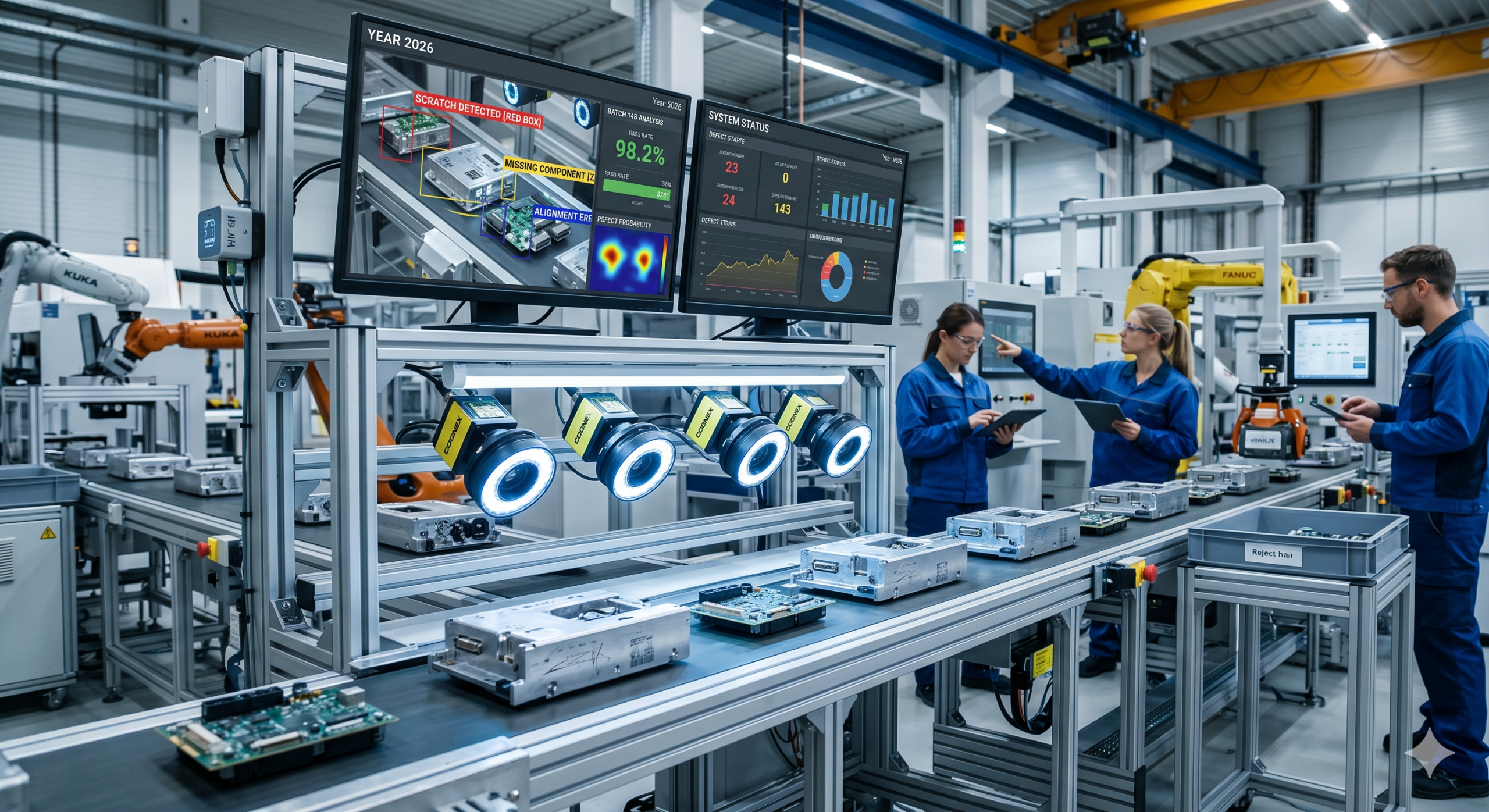
Defect detection in manufacturing is no longer a quality control afterthought—it is a core driver of operational excellence, customer satisfaction, and profitability. In today’s competitive industrial landscape, manufacturers must deliver near-perfect products at scale while minimizing waste, downtime, and rework. This is where modern defect detection systems play a critical role.
From traditional visual inspections to advanced AI-powered computer vision, defect detection manufacturing has evolved into a sophisticated, data-driven discipline. This guide explores the technologies, methods, benefits, and implementation strategies that define defect detection in 2026.
What Is Defect Detection in Manufacturing?
Defect detection manufacturing refers to the systematic identification of flaws, inconsistencies, or deviations in products during or after production. These defects can include:
- Surface imperfections (scratches, dents, cracks)
- Dimensional inaccuracies
- Material inconsistencies
- Assembly errors
- Functional failures
The goal is simple: detect defects early, reduce costs, and ensure consistent product quality.
Why Defect Detection Matters
1. Quality Assurance and Brand Reputation
Consistent product quality builds trust. A single defective batch can damage a brand’s reputation and lead to costly recalls.
2. Cost Reduction
Detecting defects early in the production process prevents:
- Expensive rework
- Material waste
- Product recalls
3. Regulatory Compliance
Industries like automotive, aerospace, and pharmaceuticals require strict compliance with quality standards.
4. Increased Efficiency
Automated defect detection reduces manual inspection time and human error.
Types of Defects in Manufacturing
Understanding defect categories is essential for implementing the right detection strategy.
Surface Defects
- Scratches
- Corrosion
- Paint inconsistencies
Structural Defects
- Cracks
- Porosity
- Warping
Dimensional Defects
- Incorrect measurements
- Tolerance violations
Functional Defects
- Electrical failures
- Mechanical malfunctions
Traditional Defect Detection Methods
1. Manual Inspection
Human inspectors visually examine products.
Pros:
- Flexible
- Low initial cost
Cons:
- Prone to fatigue and error
- Not scalable
2. Statistical Process Control (SPC)
Uses data sampling to monitor production quality.
Pros:
- Data-driven
- Predictive insights
Cons:
- May miss individual defects
3. Non-Destructive Testing (NDT)
Includes techniques like:
- Ultrasonic testing
- X-ray inspection
- Magnetic particle testing
Pros:
- Detects internal defects
- Preserves product integrity
Cons:
- Equipment can be expensive
Modern Defect Detection Technologies
1. Machine Vision Systems
Machine vision uses cameras and image processing algorithms to detect defects in real time.
Key Components:
- High-resolution cameras
- Lighting systems
- Image processing software
Applications:
- Surface inspection
- Assembly verification
- Label accuracy
2. Artificial Intelligence and Deep Learning
AI-driven defect detection is transforming manufacturing by enabling systems to learn from data.
Advantages:
- Detects complex patterns
- Improves over time
- Handles variability in products
Common Techniques:
- Convolutional Neural Networks (CNNs)
- Anomaly detection models
3. IoT and Smart Sensors
IoT devices monitor machines and processes continuously.
Benefits:
- Real-time data collection
- Predictive maintenance
- Early defect detection
4. 3D Inspection Systems
These systems capture depth information to detect dimensional defects.
Technologies Used:
- Laser scanning
- Structured light
- Time-of-flight sensors
5. Automated Optical Inspection (AOI)
Widely used in electronics manufacturing.
Capabilities:
- Detects soldering defects
- Identifies missing components
- Ensures PCB quality
AI-Powered Defect Detection: A Game Changer
AI-driven defect detection is transforming manufacturing by enabling systems to learn from data. Modern approaches rely heavily on advanced models such as convolutional neural networks and segmentation techniques, which are widely discussed in AI defect detection algorithms used for real-time industrial inspection.
.
How It Works
- Collect images of products
- Label defects
- Train AI models
- Deploy for real-time inspection
Key Benefits
- High accuracy (often above 95%)
- Reduced false positives
- Adaptability to new defect types
Challenges
- Requires large datasets
- Initial setup cost
- Model maintenance
Defect Detection in Different Industries
Automotive
- Paint inspection
- Weld quality analysis
- Component alignment
Electronics
- PCB inspection
- Micro-defect detection
- Solder joint analysis
Food and Beverage
- Contamination detection
- Packaging integrity
- Label verification
Pharmaceuticals
- Tablet inspection
- Packaging defects
- Compliance checks
Aerospace
- Structural integrity
- Composite material inspection
- Precision measurements
Key Metrics for Defect Detection
To evaluate effectiveness, manufacturers track:
- Defect Rate (DPMO) – Defects per million opportunities
- First Pass Yield (FPY) – Percentage of products without defects
- False Positive Rate – Incorrect defect identification
- Detection Accuracy – True defect identification rate
Implementation Strategy
Step 1: Define Objectives
- Reduce defect rate
- Improve inspection speed
- Ensure compliance
Step 2: Identify Critical Points
Focus on stages where defects are most likely to occur.
Step 3: Choose the Right Technology
- Manual for small-scale
- AI/vision for large-scale
Step 4: Data Collection
Gather high-quality images and production data.
Step 5: System Integration
Integrate with existing manufacturing systems (MES, ERP).
Step 6: Continuous Improvement
Use feedback loops to refine detection models.
Challenges in Defect Detection Manufacturing
1. Data Quality Issues
Poor data leads to inaccurate detection.
2. High Initial Investment
Advanced systems require significant upfront cost.
3. Integration Complexity
Combining new technologies with legacy systems can be difficult.
4. Skilled Workforce Requirement
AI and machine vision systems require trained personnel.
Best Practices for Effective Defect Detection
- Use high-quality imaging systems
- Maintain consistent lighting conditions
- Regularly update AI models
- Implement real-time monitoring
- Train staff on system usage
- Perform periodic audits
Future Trends in Defect Detection (2026 and Beyond)
1. Edge AI
Processing data directly on devices for faster decisions.
2. Digital Twins
Simulating production processes to predict defects.
3. Self-Learning Systems
AI models that adapt without human intervention.
4. Collaborative Robots (Cobots)
Working alongside humans for inspection tasks.
5. Blockchain for Quality Tracking
Ensuring transparency in supply chains.
Benefits of Advanced Defect Detection Systems
- Improved product quality
- Reduced waste and rework
- Faster production cycles
- Enhanced customer satisfaction
- Competitive advantage
Conclusion
Defect detection manufacturing has evolved into a critical component of modern industrial operations. With the integration of AI, machine vision, and smart sensors, manufacturers can achieve unprecedented levels of precision and efficiency.
Investing in advanced defect detection systems is no longer optional—it is essential for staying competitive in 2026 and beyond. By adopting the right technologies and strategies, manufacturers can reduce costs, improve quality, and build stronger customer trust.