

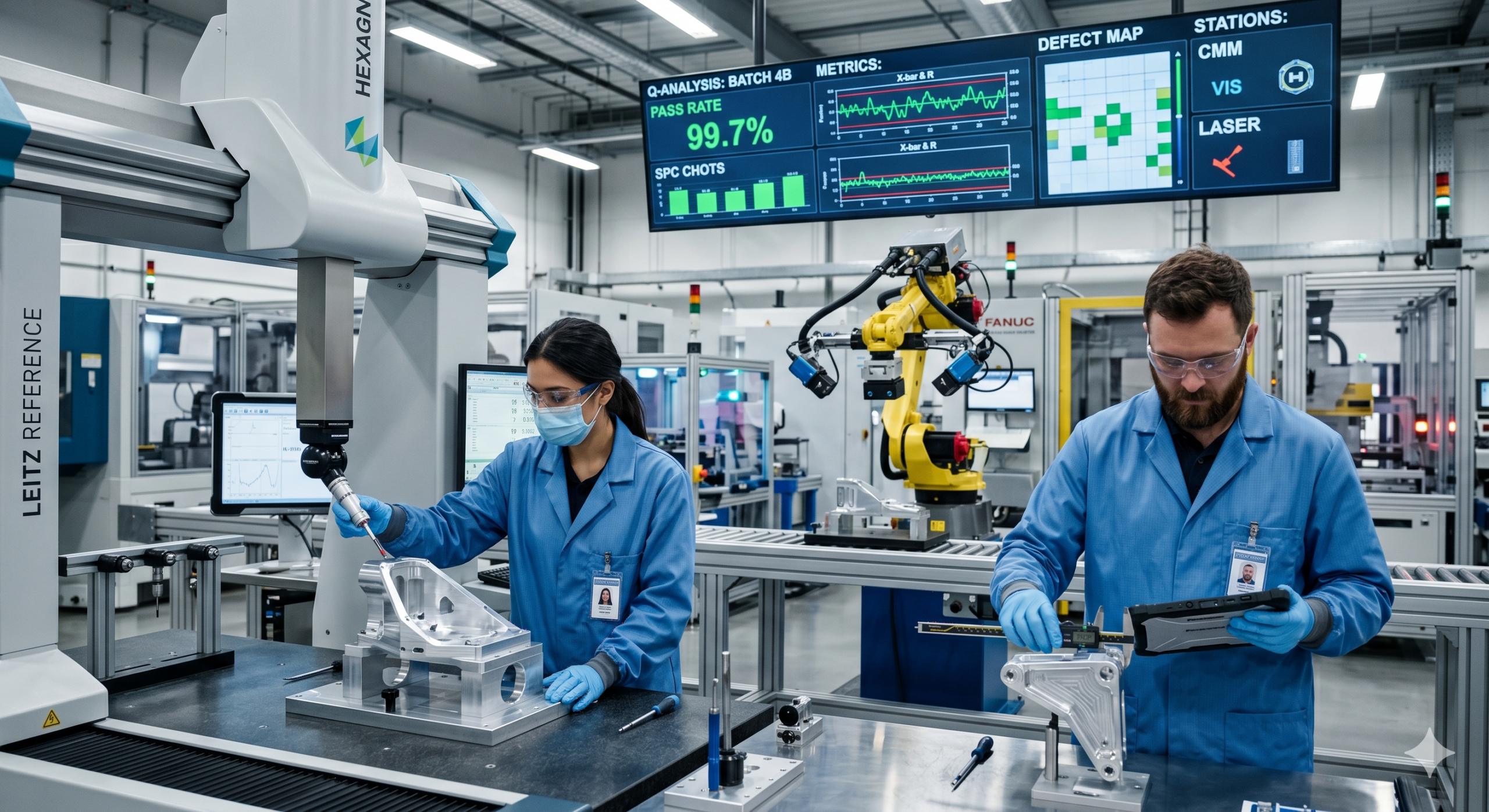
Quality inspection methods are essential for ensuring that products meet defined standards, specifications, and customer expectations. In modern manufacturing, inspection is not just a final checkpoint; instead, it is a continuous, data-driven process integrated across the entire production lifecycle.
As industries adopt automation, artificial intelligence, and smart manufacturing, quality inspection methods have evolved significantly. Therefore, understanding these methods is critical for engineers, manufacturers, and quality professionals who aim to improve accuracy, reduce defects, and maintain compliance.
What Are Quality Inspection Methods?
Quality inspection methods refer to systematic techniques used to evaluate products, materials, and processes. For a broader industry perspective, explore quality control in manufacturing. In other words, they help determine whether a product meets required standards before it reaches the customer.
Why Quality Inspection Matters
- Firstly, it ensures product reliability and performance
- Secondly, it reduces defects and rework costs
- Additionally, it improves customer satisfaction
- Moreover, it ensures compliance with industry standards
- Finally, it enhances brand reputation
As a result, effective inspection methods are a key component of any quality management system.
Types of Quality Inspection Methods
1. Visual Inspection
Visual inspection is the simplest and most widely used method. It involves examining products using the human eye or optical tools.
Applications:
- Surface defects detection
- Assembly verification
- Packaging inspection
Advantages:
- Quick and cost-effective
- Easy to implement
However, it may be less accurate for detecting microscopic defects.
2. Dimensional Inspection
Dimensional inspection measures the physical dimensions of a product to ensure it meets specifications.
Tools Used:
- Calipers and micrometers
- Coordinate Measuring Machines (CMM)
- Laser scanners
Therefore, this method is critical in precision manufacturing industries such as automotive and aerospace.
3. Non-Destructive Testing (NDT)
Non-destructive testing evaluates materials without damaging them. As a result, it is ideal for high-value components.
Common NDT Methods:
- Ultrasonic testing
- Radiographic (X-ray) testing
- Magnetic particle inspection
- Dye penetrant testing
Consequently, NDT ensures structural integrity and safety.
4. Destructive Testing
Destructive testing involves breaking or altering a product to assess its strength and performance.
Examples:
- Tensile testing
- Impact testing
- Fatigue testing
Although effective, this method is typically used for sampling rather than full inspection.
5. Statistical Quality Control (SQC)
Statistical quality control uses data analysis to monitor and control processes.
Key Techniques:
- Control charts
- Process capability analysis
- Sampling inspection
As a result, SQC helps identify trends and prevent defects before they occur.
6. Automated Inspection Systems
Modern industries increasingly rely on automation for inspection.
Technologies:
- Machine vision systems
- AI-powered defect detection
- Robotics
Therefore, automated inspection improves speed, accuracy, and consistency.
7. In-Process Inspection
In-process inspection occurs during manufacturing rather than after production.
Benefits:
- Early defect detection
- Reduced waste
- Improved efficiency
Consequently, it minimizes production errors and downtime.
8. Final Inspection
Final inspection is performed after production is complete.
Purpose:
- Verify product quality before delivery
- Ensure compliance with specifications
However, relying solely on final inspection can increase costs due to late defect detection.
Advanced Quality Inspection Technologies (2026)
1. Machine Vision Systems
Machine vision uses cameras and software to inspect products automatically.
Advantages:
- High-speed inspection
- Consistent accuracy
- Real-time analysis
2. Artificial Intelligence (AI)
AI enhances inspection by learning from data and identifying patterns.
Applications:
- Predictive quality analysis
- Automated defect detection
As a result, AI reduces human error and improves efficiency.
3. 3D Scanning and Metrology
3D scanning captures precise measurements of complex shapes.
Benefits:
- High accuracy
- Faster inspection
- Digital documentation
4. Internet of Things (IoT)
IoT connects inspection tools to a central system.
Therefore:
- Data is collected in real time
- Processes are monitored continuously
- Decision-making improves
Quality Inspection Methods in Different Industries
Automotive Industry
- Dimensional inspection for engine components
- NDT for structural safety
- Automated systems for assembly lines
Aerospace Industry
- Strict NDT requirements
- Precision dimensional inspection
- Advanced material testing
Electronics Industry
- Visual and automated inspection
- Micro-level defect detection
- Functional testing
Manufacturing Industry
- In-process inspection
- Statistical quality control
- Final product verification
Benefits of Modern Quality Inspection Methods
1. Improved Accuracy
Advanced tools provide precise measurements. As a result, product quality improves significantly.
2. Increased Efficiency
Automation reduces inspection time. Therefore, production speed increases.
3. Cost Reduction
Early defect detection minimizes rework and waste. Consequently, operational costs decrease.
4. Better Compliance
Inspection ensures adherence to industry standards and regulations.
5. Enhanced Customer Satisfaction
High-quality products lead to better customer trust and loyalty.
Challenges in Quality Inspection
1. High Implementation Costs
Advanced systems require significant investment. However, long-term benefits often outweigh the costs.
2. Complexity of Technology
Modern inspection tools can be complex. Therefore, proper training is essential.
3. Data Management
Large volumes of data must be analyzed and stored efficiently.
4. Integration with Existing Systems
Combining new technologies with legacy systems can be challenging.
Best Practices for Effective Quality Inspection
- Firstly, define clear quality standards
- Secondly, use appropriate inspection methods
- Additionally, train personnel regularly
- Moreover, implement automation where possible
- Furthermore, monitor and analyze data continuously
- Finally, focus on continuous improvement
Future Trends in Quality Inspection Methods
1. AI-Driven Inspection
AI will become more advanced, enabling predictive quality control.
2. Smart Factories
Inspection will be fully integrated into Industry 4.0 systems.
3. Real-Time Data Analytics
Instant feedback will improve decision-making.
4. Increased Automation
Robotics and machine vision will dominate inspection processes.
Conclusion
Quality inspection methods are essential for ensuring product reliability, efficiency, and compliance. From visual inspection to advanced AI-driven systems, these methods play a critical role in modern manufacturing.
As technology continues to evolve, inspection methods will become more automated, accurate, and data-driven. Therefore, organizations that adopt modern quality inspection techniques will gain a competitive advantage and deliver superior products.