

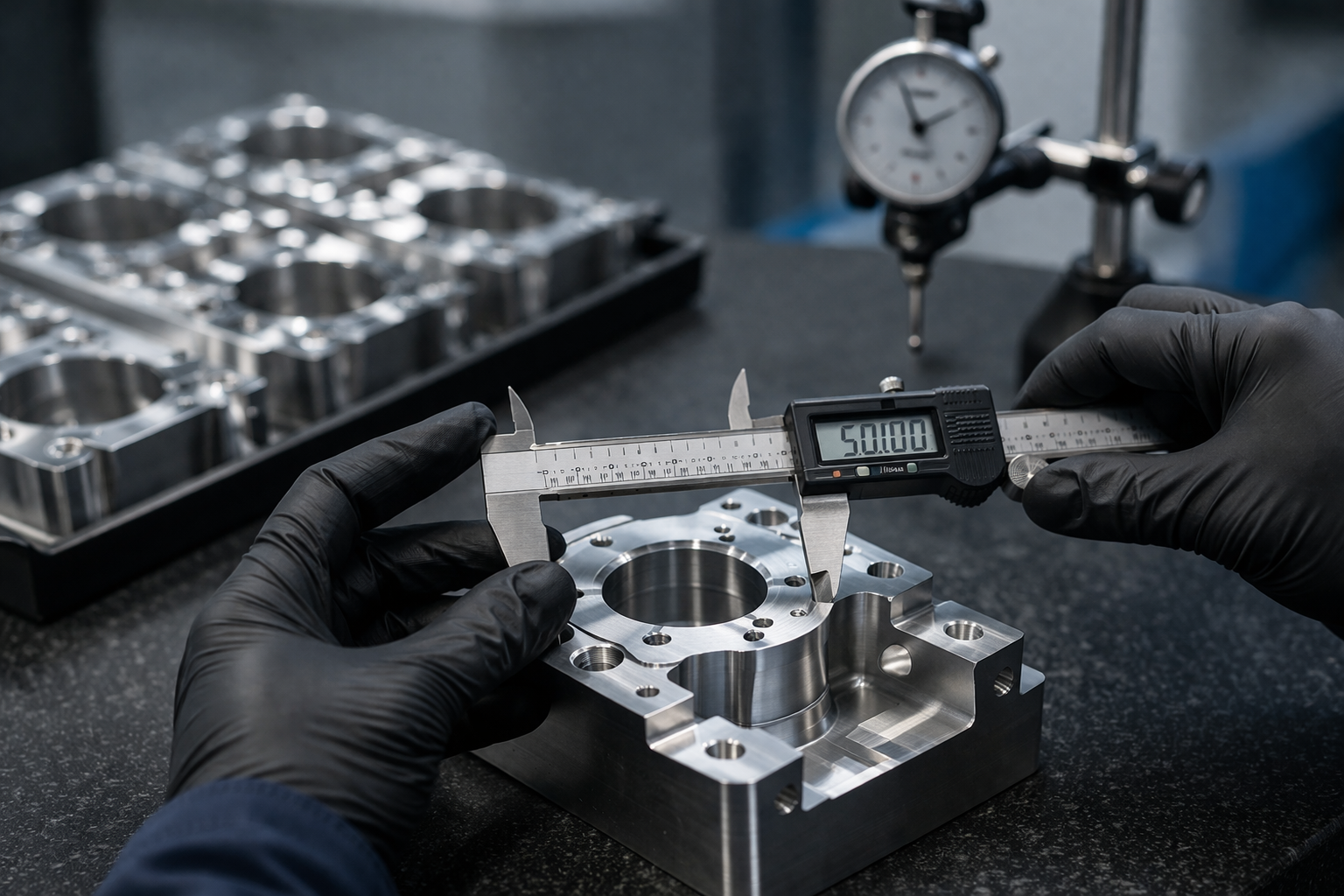
Understanding CNC tolerances explained is essential for achieving precision in modern manufacturing. From aerospace components to medical devices, even the smallest dimensional variation can impact performance and functionality.
This guide breaks down CNC machining tolerances in a clear, technical, and practical way. You’ll learn how tolerances work, why they matter, and how to apply them effectively in real-world production.
What Are CNC Tolerances?
CNC tolerances refer to the permissible variation in a part’s dimensions during machining. Since no process can produce exact measurements every time, tolerances define acceptable limits. According to this CNC tolerances explained guide, tolerances define the allowable variation between a part’s intended and actual dimensions.
For example, a dimension of 50 mm ± 0.01 mm means the final part can fall between 49.99 mm and 50.01 mm without affecting functionality.
These limits ensure consistency while allowing efficient production.
Why Tolerances Matter in CNC Machining
Tolerances are critical for both product performance and cost control.
Ensures Proper Fit
Components that interact—such as shafts and bearings—must meet specific dimensional limits to function correctly.
Improves Product Quality
Controlled variation leads to consistent, reliable parts across production runs.
Reduces Errors
Clear specifications help machinists avoid defects and rework.
Balances Cost and Precision
Tighter tolerances require more time and advanced equipment, increasing cost. Proper planning avoids unnecessary expense.
Standard CNC Tolerance Ranges
Tolerance levels vary depending on machine capability and application.
- General tolerance: ±0.1 mm (non-critical parts)
- Medium precision: ±0.01 mm (industrial components)
- High precision: ±0.001 mm or tighter (aerospace, medical)
Choosing the correct tolerance ensures both functionality and cost-efficiency.
Types of CNC Machining Tolerances
Different tolerance types are used depending on design requirements.
Linear Tolerances
Control variation in length, width, and height.
Geometric Tolerances (GD&T)
Define form, orientation, and position of features, including:
- Flatness
- Parallelism
- Concentricity
Bilateral Tolerances
Allow variation in both directions (± values).
Unilateral Tolerances
Allow variation in only one direction.
Limit Tolerances
Specify minimum and maximum allowable dimensions directly.
Factors That Affect Machining Tolerances
Several variables influence achievable precision in CNC machining.
Machine Capability
Advanced CNC machines provide higher accuracy and repeatability.
Material Properties
Different materials react differently to cutting forces and heat.
- Aluminum: easy to machine
- Plastics: prone to deformation
Tool Wear
Worn tools reduce accuracy over time and must be replaced regularly.
Temperature
Thermal expansion can slightly alter dimensions during machining.
Part Geometry
Complex designs, thin walls, and deep cavities are harder to machine accurately.
CNC Tolerances vs Precision
Tolerance and precision are related but distinct concepts.
- Tolerance: Acceptable dimensional variation
- Precision: Ability to consistently reproduce results
A machine can be highly repeatable but still produce parts outside acceptable limits if tolerances are not properly defined.
How to Specify Tolerances Correctly
Proper specification ensures both functionality and manufacturability.
Best Practices
- Use tight tolerances only where necessary
- Apply general tolerances for non-critical features
- Clearly define dimensions in engineering drawings
- Follow GD&T standards when required
This approach reduces cost while maintaining performance.
Design Tips for Better Tolerance Control
Avoid Overly Tight Requirements
Unnecessarily tight tolerances increase machining time and cost.
Use Standard Tool Sizes
Standardization simplifies production and improves accuracy.
Simplify Geometry
Complex shapes are more difficult to machine precisely.
Select Stable Materials
Materials with minimal thermal expansion improve consistency.
Collaborate with Machinists
Early consultation helps ensure realistic and achievable tolerances.
Applications of CNC Machining Tolerances
Precision tolerances are essential across industries:
Aerospace
Critical components require extremely tight dimensional control.
Medical
Implants and surgical tools demand high accuracy and reliability.
Automotive
Ensures efficiency and durability of engine components.
Electronics
Supports miniaturized and highly detailed parts.
Common Challenges in Maintaining Tolerances
Achieving tight tolerances can be difficult due to:
- Equipment limitations
- Material inconsistencies
- Environmental factors
- Human error
Modern solutions such as automation and real-time monitoring help address these challenges.
Future Trends in CNC Precision
Advancements in technology are improving tolerance control:
- AI-driven machining optimization
- Smart sensors for real-time adjustments
- Multi-axis machining capabilities
- Improved cutting tools and materials
These innovations are making high-precision manufacturing more efficient and scalable.
Conclusion
This CNC tolerances explained guide highlights the importance of managing dimensional variation in machining. By understanding tolerance types, influencing factors, and best practices, manufacturers can produce high-quality parts while controlling costs.
Applying the right tolerance strategy ensures optimal performance, reliability, and efficiency in any CNC machining project.