

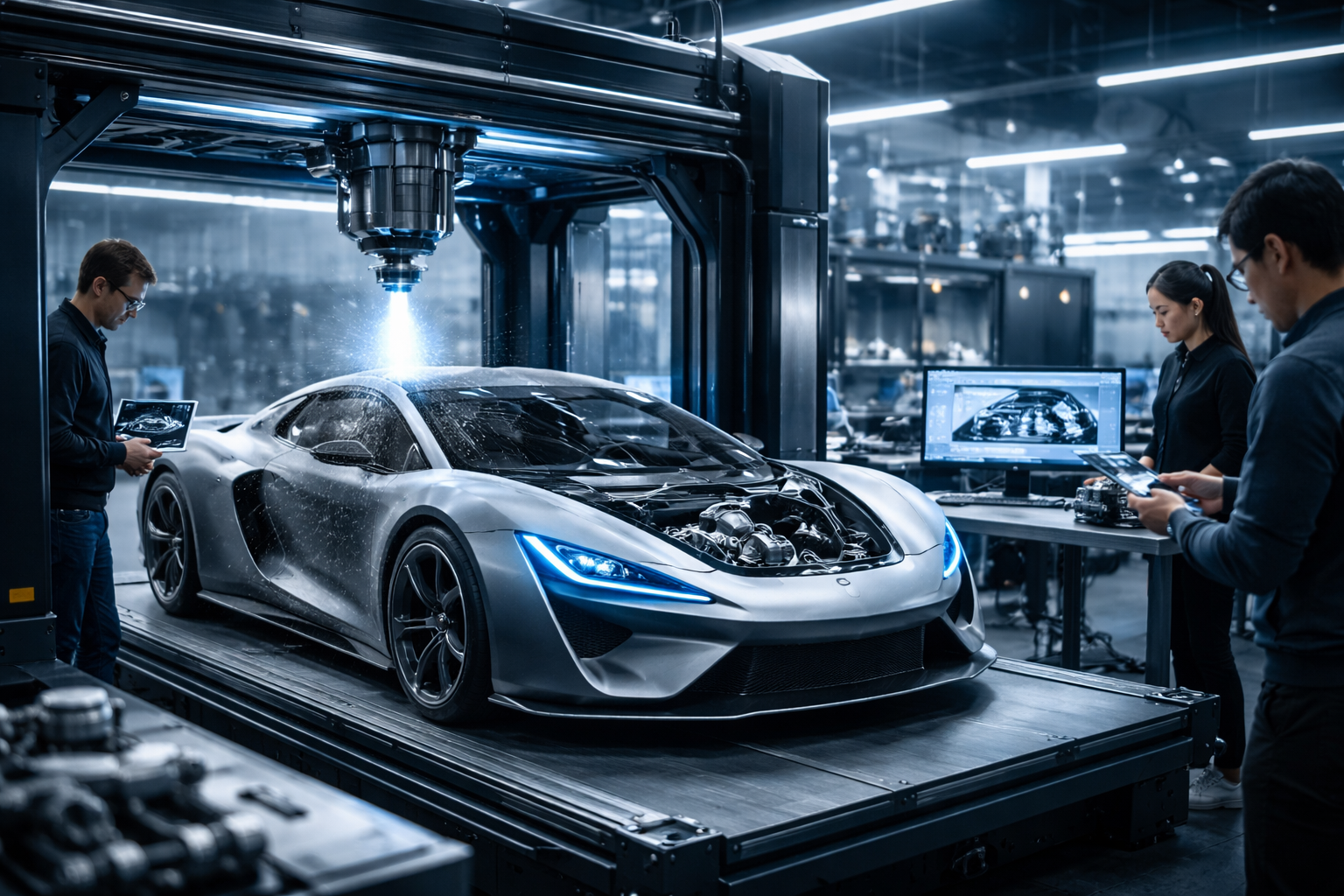
The automotive industry is undergoing a profound transformation driven by electrification, autonomous systems, connectivity, and sustainability. Rapid prototyping in automotive allows manufacturers to accelerate innovation, reduce development costs, and bring new vehicle concepts to market faster.
In this fast-evolving landscape, rapid prototyping in automotive has become a critical enabler of innovation. It allows manufacturers, engineers, and designers to quickly transform ideas into tangible models, test functionality, and refine designs before committing to full-scale production.
This article explores how rapid prototyping is reshaping the automotive sector, the technologies involved, its benefits, real-world applications, and best practices for implementation.
What Is Rapid Prototyping in Automotive?
Rapid prototyping in automotive refers to the use of advanced manufacturing technologies to quickly create physical or digital models of vehicle components, systems, or entire designs. These prototypes are used for design validation, performance testing, and iterative development.
Unlike traditional prototyping methods, which can take weeks or months, rapid prototyping leverages tools such as:
- 3D printing (additive manufacturing)
- CNC machining
- Laser cutting
- Injection molding (for low-volume runs)
- Digital simulation and virtual prototyping
The goal is simple: reduce development time while improving product quality and innovation.
Why Rapid Prototyping Matters in the Automotive Industry
The automotive sector faces increasing pressure to deliver high-performance, safe, and sustainable vehicles faster than ever before. Rapid prototyping addresses these challenges in several key ways:
1. Faster Time-to-Market
Automotive companies can compress development cycles by quickly producing and testing prototypes. This speed is essential in a competitive market where innovation timelines are shrinking.
2. Cost Efficiency
Early detection of design flaws reduces expensive revisions during later production stages. Prototypes help identify issues before tooling and mass manufacturing begin.
3. Enhanced Design Flexibility
Engineers can experiment with multiple design iterations without significant cost penalties. This encourages creativity and innovation.
4. Improved Collaboration
Cross-functional teams—design, engineering, and manufacturing—can work together more effectively using physical prototypes and digital models.
5. Better Product Quality
Continuous testing and iteration lead to more refined, reliable, and high-performing automotive components.
Key Technologies Used in Rapid Prototyping
1. 3D Printing (Additive Manufacturing)
3D printing is the backbone of modern rapid prototyping. It allows the creation of complex geometries that would be difficult or impossible with traditional manufacturing.
Common 3D printing technologies:
- Fused Deposition Modeling (FDM)
- Stereolithography (SLA)
- Selective Laser Sintering (SLS)
- Direct Metal Laser Sintering (DMLS)
Applications:
- Interior components (dashboards, knobs)
- Engine parts
- Custom brackets and housings
- Concept models
2. CNC Machining
CNC machining is used for high-precision prototypes, especially when metal parts are required. It provides excellent surface finish and dimensional accuracy.
Applications:
- Transmission components
- Engine blocks
- Structural parts
- Functional testing prototypes
3. Injection Molding (Rapid Tooling)
Rapid tooling allows manufacturers to produce small batches of parts using injection molding without investing in full-scale tooling.
Applications:
- Plastic components
- Clips, connectors, and enclosures
- Pre-production validation
4. Virtual Prototyping and Simulation
Digital tools enable engineers to simulate real-world conditions without building physical prototypes.
Technologies include:
- CAD (Computer-Aided Design)
- CAE (Computer-Aided Engineering)
- CFD (Computational Fluid Dynamics)
- Finite Element Analysis (FEA)
Benefits:
- Reduced need for physical prototypes
- Faster testing cycles
- Improved accuracy in performance predictions
Applications of Rapid Prototyping in Automotive
1. Concept Development
Rapid prototyping enables designers to bring early-stage ideas to life. Concept cars and innovative designs can be evaluated quickly, allowing stakeholders to visualize and refine concepts.
2. Functional Testing
Prototypes are used to test mechanical performance, aerodynamics, thermal behavior, and structural integrity.
Examples:
- Crash test components
- Engine airflow systems
- Suspension systems
3. Customization and Personalization
Automotive manufacturers are increasingly offering personalized features. Rapid prototyping allows the production of custom parts without significant cost increases.
Examples:
- Custom interiors
- Personalized trims
- Unique design elements
4. Electric Vehicles (EVs)
The rise of electric vehicles has increased the need for rapid prototyping in areas such as:
- Battery housings
- Thermal management systems
- Lightweight structures
5. Autonomous Vehicle Development
Autonomous systems require extensive testing and iteration. Rapid prototyping supports the development of:
- Sensor housings
- Lidar and radar mounts
- Control system enclosures
Benefits of Rapid Prototyping in Automotive
Reduced Development Time
Rapid prototyping significantly shortens product development cycles, allowing companies to move from concept to production faster.
Lower Risk
Early testing helps identify design flaws, reducing the risk of costly failures during production or after market release.
Increased Innovation
Engineers can explore unconventional designs and materials without high financial risk.
Better Communication
Physical prototypes improve communication among teams and stakeholders, ensuring alignment throughout the development process.
Sustainability
Rapid prototyping reduces material waste and supports the development of eco-friendly designs.
Challenges and Limitations
While rapid prototyping offers numerous advantages, it also comes with challenges:
Material Limitations
Some prototyping materials may not fully replicate the properties of final production materials.
Cost of Advanced Equipment
High-end 3D printers and CNC machines can be expensive, especially for smaller manufacturers.
Scalability Issues
Prototypes are not always suitable for mass production, requiring additional adjustments.
Skill Requirements
Advanced tools require skilled engineers and technicians to operate effectively.
Best Practices for Implementing Rapid Prototyping
1. Define Clear Objectives
Determine whether the prototype is for visual validation, functional testing, or performance analysis.
2. Choose the Right Technology
Select the appropriate prototyping method based on material, complexity, and intended use.
3. Iterate Frequently
Adopt an iterative approach to continuously refine designs and improve performance.
4. Integrate Digital and Physical Prototyping
Combine simulation tools with physical prototypes for more accurate and efficient development.
5. Collaborate Across Teams
Encourage communication between design, engineering, and manufacturing teams.
Future Trends in Automotive Rapid Prototyping
1. Advanced Materials
The development of new materials, including composites and metal alloys, will enhance the capabilities of rapid prototyping.
2. AI-Driven Design
Artificial intelligence will optimize designs based on performance data, reducing the need for multiple iterations.
3. Hybrid Manufacturing
Combining additive and subtractive manufacturing methods will improve efficiency and precision.
4. Digital Twins
Digital twins will allow real-time monitoring and simulation of vehicle performance, enhancing the prototyping process.
5. On-Demand Manufacturing
Rapid prototyping will evolve into on-demand production, enabling just-in-time manufacturing of automotive components.
Conclusion
Rapid prototyping in automotive is no longer a luxury—it is a necessity. As the industry continues to evolve, the ability to quickly design, test, and refine components will determine which companies lead and which fall behind.
By leveraging technologies such as 3D printing, CNC machining, and digital simulation, automotive manufacturers can accelerate innovation, reduce costs, and deliver high-quality vehicles that meet the demands of modern consumers.
The future of automotive development lies in speed, flexibility, and precision, and rapid prototyping is at the heart of this transformation. Companies that embrace this approach will not only improve their development processes but also gain a competitive edge in an increasingly dynamic market.