
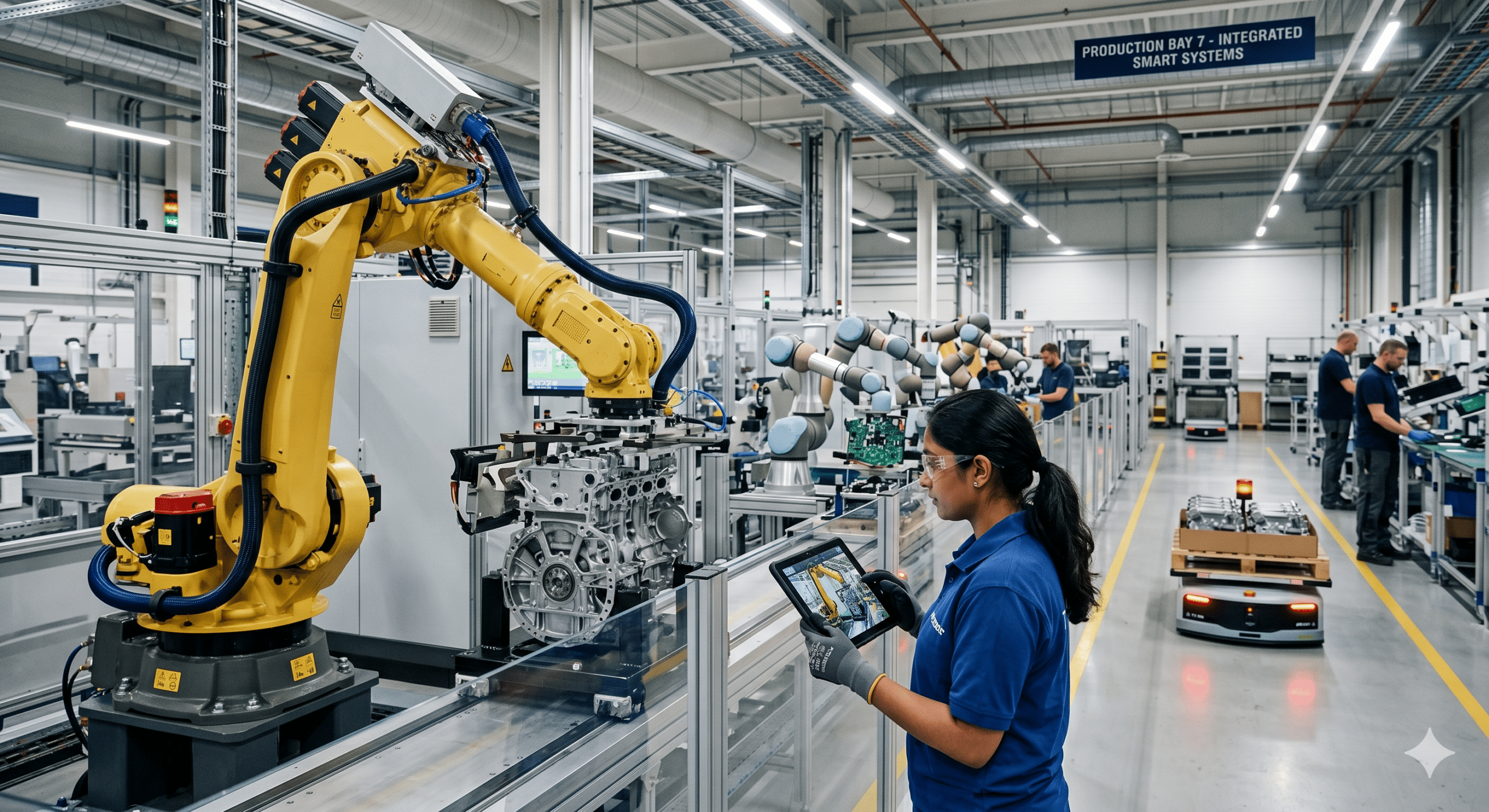
Walk into a modern production facility today and you’ll notice something different immediately. The noise is still there. Conveyor systems still move products from one station to another. Operators still monitor machines. But now, robotic arms weld with perfect consistency, automated guided vehicles move materials across the floor without drivers, and machine vision systems inspect products faster than the human eye ever could.
As someone who has spent years around manufacturing systems, PLC programming, production lines, and industrial automation projects, I’ve seen firsthand how robotics has evolved from being a luxury reserved for giant automotive plants into a practical tool for manufacturers of every size.
What’s interesting is that robotics in production is no longer just about replacing manual labor. That conversation is outdated. Today, robotics is about improving consistency, reducing downtime, increasing safety, and helping manufacturers survive in an increasingly competitive global market.
Factories are under pressure from every direction. Customers want faster delivery. Product quality standards keep getting tighter. Skilled labor shortages continue growing. Energy costs are unpredictable. At the same time, manufacturers are expected to produce more while keeping costs under control.
That’s exactly why robotics has become one of the biggest drivers of change in modern manufacturing.
According to recent manufacturing automation research, robotics and automation continue to improve production efficiency, consistency, workplace safety, and operational flexibility across industries. (QAD)
What Robotics in Production Really Means
A lot of people imagine humanoid robots walking around factories when they hear the word robotics. In reality, industrial robotics is much more practical than science fiction.
In manufacturing, robotics simply refers to programmable machines designed to perform production tasks automatically with high precision and repeatability.
These robots may handle:
- Welding
- Packaging
- Pick-and-place operations
- Material handling
- Inspection
- Assembly
- Palletizing
- Painting
- CNC machine loading
- Quality control
The biggest advantage of robots is not intelligence. It’s consistency.
A skilled operator may perform a task perfectly most of the time. A properly programmed robot performs it the same way every single cycle.
That level of repeatability matters tremendously in production environments where small variations can lead to defects, customer complaints, recalls, or wasted material.
Modern manufacturing robotics also integrates closely with:
- SCADA systems
- PLC controls
- MES platforms
- Industrial sensors
- Vision systems
- AI-driven analytics
- Predictive maintenance systems
This integration is what transforms ordinary automation into smart manufacturing.
The Shift From Traditional Automation to Smart Robotics
Years ago, automation systems were rigid. They were built for one task only.
If a manufacturer wanted to change product dimensions or production flow, engineering teams often had to redesign entire systems. That created downtime and massive costs.
Today’s robotic systems are much more flexible.
Collaborative robots, often called cobots, can now work safely alongside people and can be reprogrammed quickly for different tasks. Recent industry reports highlight how cobots are lowering the barrier to automation for small and mid-sized manufacturers. (Financial Times)
That flexibility is changing everything.
A production line that once required dedicated hard automation can now adapt to smaller production runs and changing customer demand much faster.
This is especially important because manufacturing is no longer dominated by massive single-product production.
Customers want customization.
Manufacturers now produce more product variants, shorter runs, and faster design updates than ever before. Robotics helps make that possible without destroying efficiency.
Why Manufacturers Are Investing in Robotics
From my experience in industrial automation environments, manufacturers usually invest in robotics for five major reasons.
1. Labor Shortages
One of the biggest challenges in manufacturing today is finding skilled workers.
Many factories struggle to hire operators willing to perform repetitive or physically demanding tasks. Robotics helps manufacturers maintain output even when labor availability becomes unpredictable.
This does not necessarily eliminate jobs. In many cases, it changes the nature of the work.
Operators transition into:
- Robot supervision
- Maintenance
- Process optimization
- Programming
- Quality assurance
- Data analysis
Research on manufacturing automation shows that robotics often creates demand for technical and support roles even as repetitive tasks become automated. (QAD)
2. Consistent Product Quality
Humans naturally experience fatigue, distraction, and inconsistency during repetitive work.
Robots do not.
That matters enormously in industries like:
- Automotive
- Electronics
- Medical devices
- Aerospace
- Food manufacturing
Machine vision systems combined with robotics can inspect thousands of parts with precision that exceeds manual inspection in many cases.
This reduces:
- Scrap
- Rework
- Customer returns
- Warranty claims
3. Increased Production Speed
Robots can operate continuously with minimal interruption.
Unlike manual production systems, robotic cells can:
- Run multiple shifts
- Maintain faster cycle times
- Reduce bottlenecks
- Improve takt time stability
Some production environments now operate nearly 24/7 with robotic systems handling high-volume repetitive tasks.
4. Improved Workplace Safety
Some manufacturing tasks are simply dangerous.
Heavy lifting, welding fumes, extreme temperatures, repetitive motion injuries, and hazardous chemicals all create risks for workers.
Robotics allows manufacturers to remove operators from unsafe environments while maintaining productivity.
This is one of the most overlooked benefits of automation.
A safer workplace often leads to:
- Lower injury rates
- Reduced compensation costs
- Better employee morale
- Improved compliance
5. Better Production Data
Modern robotics generates valuable production data in real time.
Manufacturers can now monitor:
- Downtime
- OEE performance
- Cycle times
- Reject rates
- Machine utilization
- Predictive maintenance indicators
That data helps engineering teams continuously improve processes instead of relying on guesswork.
The Real Difference Between Automation and Robotics
People often use automation and robotics interchangeably, but they are not exactly the same thing.
Automation refers broadly to systems performing tasks with minimal human intervention.
Robotics is a specific type of automation involving programmable machines capable of movement and task execution.
For example:
- A conveyor system with sensors is automation.
- A robotic arm performing welding is robotics.
Many factories combine both.
An automated production line may include:
- PLC-controlled conveyors
- Servo systems
- Industrial robots
- Vision inspection
- MES integration
- SCADA monitoring
The real power comes from integration.
When robotics communicates seamlessly with production software and machine controls, manufacturers gain visibility and efficiency across the entire operation.
Industry experts continue emphasizing the growing role of connected manufacturing systems and Industry 4.0 technologies in modern production environments. (QAD)
How Robotics Is Used Across Different Industries
Robotics looks different depending on the manufacturing environment.
Automotive Manufacturing
The automotive industry remains one of the largest users of robotics.
Robots handle:
- Welding
- Painting
- Assembly
- Material handling
- Inspection
Automotive production demands extremely high precision and repeatability, making robotics essential.
Food and Beverage Production
Food manufacturing increasingly uses robotics for:
- Packaging
- Sorting
- Palletizing
- Pick-and-place operations
Robotics helps improve hygiene while maintaining fast production speeds.
Electronics Manufacturing
Electronics production involves tiny components requiring precision beyond manual capability.
Robotic systems assist with:
- PCB assembly
- Soldering
- Inspection
- Component placement
Pharmaceutical and Medical Device Manufacturing
In medical production, contamination control is critical.
Robotics helps minimize human contact while improving precision and traceability.
Flexible automation is becoming especially important in pharmaceutical manufacturing environments. (Essert)
Warehousing and Logistics
Production does not end at the assembly line.
Automated guided vehicles, robotic palletizers, and autonomous systems now support:
- Inventory movement
- Warehouse operations
- Shipping preparation
- Material staging
Factories are becoming increasingly interconnected from raw material intake to final shipment.
The Rise of Collaborative Robots
One of the biggest changes in recent years has been the growth of collaborative robotics.
Traditional industrial robots usually operate inside safety cages because they move fast and generate significant force.
Cobots are different.
They are designed with:
- Force-limiting features
- Advanced sensors
- Safer operating parameters
This allows people and robots to work together more safely.
Cobots are especially useful for:
- Small manufacturers
- Flexible production
- Low-volume manufacturing
- Semi-automated processes
They are also easier to program compared to traditional industrial robots.
This matters because many manufacturers lack large engineering departments.
Cobots make automation accessible to businesses that previously could not justify the complexity or cost of robotics.
Challenges Manufacturers Face With Robotics
Despite the advantages, robotics implementation is not always easy.
I’ve seen automation projects fail because companies focused too much on the machine and not enough on the process.
A robot cannot fix a broken production system.
If the workflow is inefficient, automating it may simply produce defects faster.
Here are some common challenges.
High Initial Investment
Robotic systems require capital.
Costs may include:
- Hardware
- Integration
- Safety systems
- Programming
- Engineering
- Operator training
Smaller companies sometimes struggle to justify the upfront expense.
However, long-term ROI often comes through:
- Reduced labor costs
- Improved quality
- Higher throughput
- Lower scrap
- Reduced downtime
Integration Complexity
Modern factories contain equipment from different generations.
Integrating robotics with legacy PLCs, MES platforms, and older production equipment can become complicated.
Successful projects require strong planning and experienced automation engineers.
Workforce Resistance
Employees sometimes fear automation.
Manufacturers must communicate clearly that robotics often supports workers rather than replacing them entirely.
The best automation projects involve operators early in the implementation process.
When employees understand the benefits, adoption becomes much smoother.
Maintenance and Technical Skills
Robotics requires skilled support teams.
Factories need technicians capable of:
- Troubleshooting
- PLC programming
- Robot programming
- Network diagnostics
- Preventive maintenance
This growing skills gap is one of the biggest concerns in industrial automation today.
AI and the Future of Robotics in Production
Artificial intelligence is beginning to transform industrial robotics.
Traditionally, robots followed fixed programming.
Now, AI-driven systems can:
- Adapt to variations
- Improve quality inspection
- Predict failures
- Optimize production flow
- Learn from production data
Recent real-world manufacturing research demonstrated learning-based robotic automation operating successfully on live production lines with high pass rates and near-human cycle times. (arXiv)
This is a major shift.
Instead of rigid automation, factories are moving toward adaptive manufacturing systems.
Machine vision combined with AI is especially powerful.
Robots can now recognize:
- Part orientation
- Defects
- Surface variations
- Product inconsistencies
This creates more flexible automation systems capable of handling real-world production variability.
Will Robots Replace Human Workers?
This question comes up constantly.
The answer is more nuanced than many people think.
Yes, robotics reduces demand for some repetitive manual jobs.
But it also creates new opportunities in:
- Engineering
- Programming
- Maintenance
- System integration
- Data analysis
- Robotics support
The factories that succeed are usually the ones that combine skilled people with smart automation.
Humans still excel at:
- Decision-making
- Creativity
- Troubleshooting
- Process improvement
- Complex problem solving
Robots excel at:
- Repetition
- Precision
- Speed
- Endurance
The future of manufacturing is not humans versus robots.
It’s humans working with robotics to achieve higher productivity and better quality.
What Small Manufacturers Need to Understand
Many smaller manufacturers assume robotics is only for giant corporations.
That’s no longer true.
Automation technology has become more affordable, scalable, and accessible.
In fact, many smaller facilities gain enormous advantages from targeted automation investments.
The key is starting small.
Instead of automating everything at once, successful manufacturers often begin with:
- One repetitive task
- One bottleneck
- One inspection process
- One packaging operation
Then they expand gradually.
This approach lowers risk while allowing teams to build experience with robotics integration.
The Global Race for Manufacturing Automation
Globally, robotics adoption is accelerating rapidly.
China alone installed hundreds of thousands of industrial robots recently, far outpacing many other countries in factory automation investment. (New York Post)
Manufacturing competitiveness increasingly depends on automation capability.
Countries investing heavily in robotics are positioning themselves for:
- Faster production
- Lower manufacturing costs
- Higher consistency
- Better scalability
This global shift means manufacturers cannot afford to ignore automation trends.
Final Thoughts
Robotics in production is no longer optional for many manufacturers.
It has become part of the foundation of modern industrial operations.
From automotive plants to food processing facilities, robotics continues reshaping how products are made, inspected, packaged, and delivered.
But successful automation is not just about buying robots.
It requires:
- Smart engineering
- Process understanding
- Skilled integration
- Workforce development
- Long-term planning
The factories that thrive in the coming years will not necessarily be the ones with the most robots.
They will be the ones that use robotics intelligently to support efficiency, quality, flexibility, and people.
As manufacturing continues evolving through Industry 4.0, AI integration, and connected automation systems, robotics will remain one of the most important tools driving the future of production.
And honestly, from an engineering perspective, we are only getting started.
Further Reading From High-Authority Manufacturing and Automation Sources
- QAD Manufacturing Automation Insights
- Made Smarter Robotics and Manufacturing Blog
- HighGear Manufacturing Automation Guide
- Cyngn Factory Automation and Industrial Robotics Overview
- ESSERT Robotics Manufacturing Insights Blog