

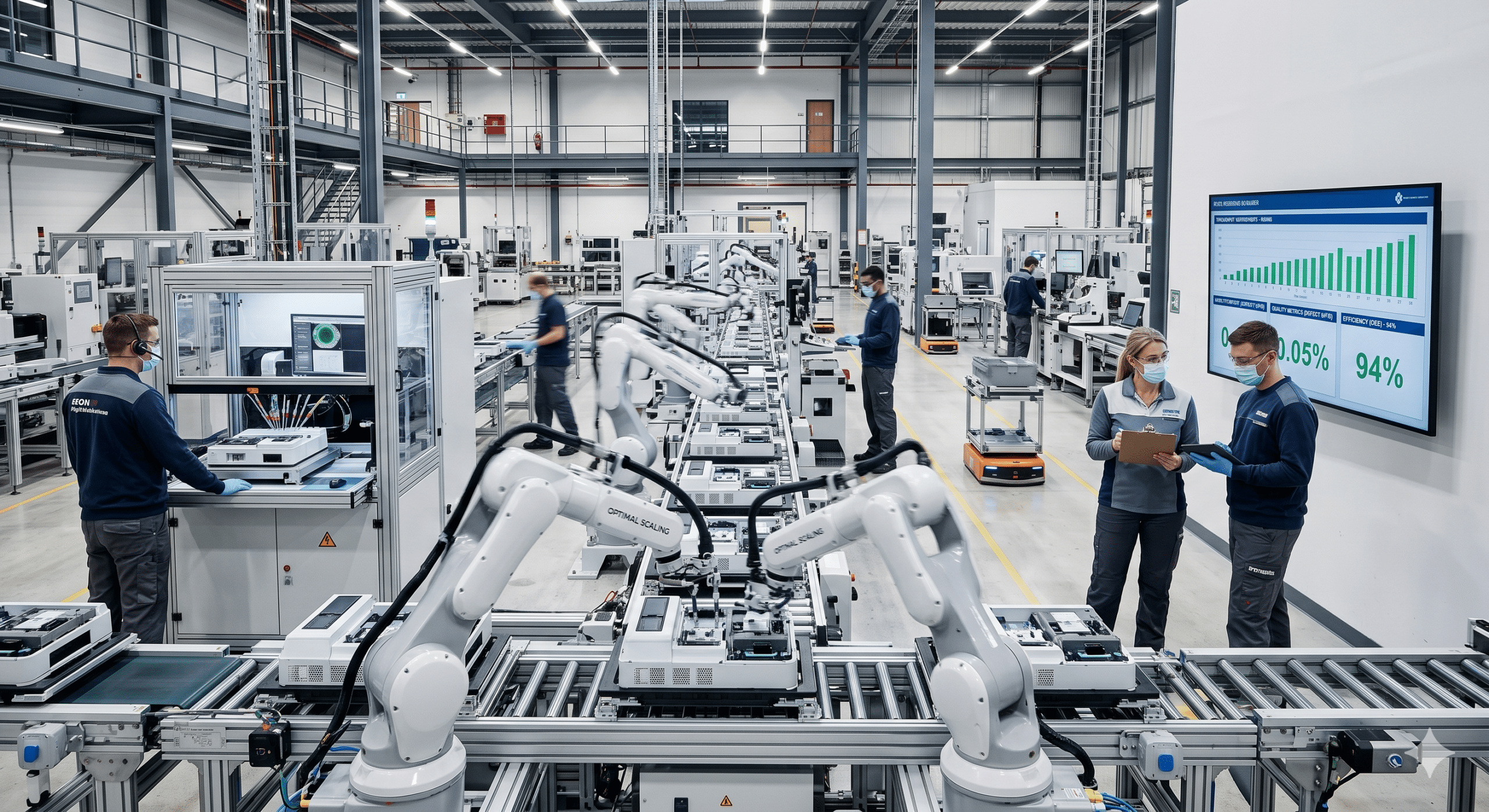
Growth is exciting in manufacturing. New customers start calling, production schedules get fuller, and revenue opportunities begin to increase. However, scaling production operations is not as simple as adding another machine or hiring more workers. In reality, many manufacturers discover that rapid growth can expose weaknesses they never noticed before.
A production system that performs well at low volume may suddenly struggle when demand doubles. Consequently, delays increase, quality problems appear, and operational costs start rising faster than expected. This is why scaling production operations requires more than expansion alone. Instead, it requires structure, planning, operational discipline, and smart decision-making.
From my experience in manufacturing and automation environments, the companies that scale successfully are not always the largest factories. Rather, they are the businesses that build efficient systems early, improve continuously, and stay flexible as production demands evolve.
Today, manufacturers face increasing pressure to deliver faster, maintain quality, reduce waste, and stay competitive. Therefore, scalable operations have become one of the most important long-term business strategies in modern manufacturing.
According to manufacturing industry insights, companies that scale effectively focus heavily on process standardization, automation, workforce development, supply chain coordination, and operational visibility instead of simply increasing output blindly. (rfgen.com)
Why Scaling Production Operations Becomes Challenging
At first, growth appears positive and manageable. However, as production volume increases, small operational inefficiencies become larger problems very quickly.
For example, minor machine downtime that once seemed insignificant may suddenly disrupt an entire production schedule. Likewise, one delayed shipment from a supplier can affect multiple customer orders simultaneously.
In many manufacturing environments, scaling challenges usually include:
- Production bottlenecks
- Labor shortages
- Inventory inaccuracies
- Equipment downtime
- Communication gaps
- Quality inconsistencies
- Supply chain disruptions
- Scheduling conflicts
As a result, manufacturers often feel like they are constantly reacting to problems instead of controlling operations strategically.
The reality is simple: scaling does not create operational weaknesses. Instead, it exposes weaknesses that already existed inside the system.
Therefore, manufacturers that want sustainable growth must strengthen their operational foundation before production demand reaches critical levels.
The Difference Between Growing and Scaling
Many people use the terms “growth” and “scaling” interchangeably. However, in manufacturing, they are very different concepts.
Growth often means increasing resources at the same rate as output. For instance, companies may hire more employees, buy more equipment, or add additional shifts to keep up with demand.
Scaling, on the other hand, focuses on increasing output more efficiently without increasing operational complexity at the same pace.
In other words, scalable manufacturing systems improve productivity, streamline workflows, and increase efficiency while supporting higher production volume.
That distinction matters because uncontrolled growth can quickly create operational chaos. Meanwhile, strategic scaling creates long-term sustainability and profitability.
Process Standardization Creates Stability
Before manufacturers invest heavily in automation or advanced software, they must first stabilize their processes.
Simply put, you cannot scale inconsistent operations.
Standardized processes create repeatability. Furthermore, repeatability improves efficiency, quality, training, and operational control.
Every production environment should have clearly documented procedures that define:
- Work instructions
- Production cycle times
- Quality checkpoints
- Equipment setup processes
- Safety requirements
- Escalation procedures
Without process standardization, employees often rely on personal habits instead of consistent systems. Consequently, production quality becomes unpredictable.
Additionally, standardization simplifies employee training because workers follow structured procedures instead of informal practices.
Lean manufacturing principles continue to play a major role in scalable operations because they focus on eliminating waste, improving flow, and increasing consistency across production environments. (en.wikipedia.org)
Identifying Bottlenecks Before They Become Expensive
Every production system has constraints. Unfortunately, many manufacturers do not identify bottlenecks until delivery delays start affecting customers.
A bottleneck is any process that limits overall production capacity. Therefore, improving non-bottleneck areas without addressing the main constraint usually produces limited results.
In manufacturing environments, bottlenecks commonly appear in:
- Assembly stations
- Packaging departments
- CNC machining
- Material handling
- Quality inspection
- Painting processes
- Shipping operations
One of the easiest ways to identify bottlenecks is by observing where work-in-progress inventory continuously accumulates.
If materials repeatedly wait at one production stage longer than others, that area is likely restricting operational flow.
The Theory of Constraints emphasizes improving the system’s primary limiting factor first because doing so creates the greatest operational impact. (en.wikipedia.org)
Consequently, manufacturers that solve bottlenecks early often scale more smoothly and avoid costly operational slowdowns later.
Smart Automation Supports Scalable Operations
Automation has transformed modern manufacturing. However, automation alone does not guarantee efficiency.
In fact, automating unstable processes can sometimes create even larger operational problems.
Therefore, manufacturers should approach automation strategically rather than emotionally.
Good automation removes repetitive, time-consuming, and error-prone tasks. More importantly, effective automation improves operational flow and production consistency.
Before investing in automation, manufacturers should evaluate:
- Repetitive labor-intensive tasks
- High-error production areas
- Production delays
- Downtime causes
- Inspection challenges
- Material handling inefficiencies
Today’s manufacturing automation technologies may include:
- Robotic assembly systems
- Automated packaging equipment
- Conveyor systems
- Barcode inventory tracking
- Vision inspection systems
- Industrial IoT sensors
- Predictive maintenance tools
- Manufacturing execution systems
At the same time, successful automation still depends heavily on operational discipline and workforce readiness.
Industrial automation and IIoT systems are increasingly helping manufacturers improve machine visibility, predictive maintenance, and operational efficiency. (arxiv.org)
Ultimately, the best manufacturing environments balance technology, people, and process improvement together.
Workforce Development Is Critical for Scaling
One of the most overlooked aspects of scaling production operations is workforce capability.
Although manufacturers can purchase new machines quickly, building skilled and adaptable production teams takes much longer.
As production demand increases, employees must handle more complex workflows, tighter schedules, and faster decision-making requirements.
Therefore, workforce development becomes essential for sustainable operational growth.
Cross-training employees offers several important advantages:
- Greater labor flexibility
- Reduced production disruptions
- Faster problem-solving
- Improved scheduling adaptability
- Better operational continuity
Additionally, scalable manufacturing operations rely heavily on strong workplace culture.
Employees who understand quality expectations and operational goals contribute far more effectively than workers who simply perform repetitive tasks mechanically.
Consequently, companies that invest in training and employee engagement often scale more efficiently than competitors focused only on equipment expansion.
Real-Time Data Improves Manufacturing Decisions
As manufacturing operations grow, visibility becomes increasingly important.
Smaller factories sometimes rely heavily on spreadsheets, manual reporting, or verbal updates. Initially, that may work at lower production volumes. However, those methods become unreliable as operations become more complex.
Real-time production data allows manufacturers to respond faster, reduce waste, and improve operational decision-making.
Manufacturers need visibility into:
- Machine uptime
- Scrap rates
- Inventory levels
- Labor efficiency
- Production throughput
- Maintenance schedules
- Downtime causes
- Customer order status
Without accurate data, management teams often make reactive decisions. In contrast, manufacturers with strong operational visibility can identify problems early and improve performance proactively.
Manufacturing Execution Systems and ERP platforms help centralize operational information while improving communication between departments. (rootstock.com)
More importantly, real-time visibility supports faster and more confident operational decisions during periods of rapid growth.
Inventory Management Becomes More Complex During Growth
Inventory management becomes significantly more challenging as production operations expand.
Too little inventory can stop production completely. Meanwhile, too much inventory increases storage costs and negatively affects cash flow.
Therefore, manufacturers must carefully balance inventory availability with operational efficiency.
During scaling phases, manufacturers must consider:
- Supplier lead times
- Demand fluctuations
- Warehouse capacity
- Material shortages
- Safety stock levels
- Forecast accuracy
Additionally, global supply chain disruptions have forced many manufacturers to rethink inventory strategies in recent years.
Some companies continue using lean inventory models, while others maintain higher inventory reserves for critical components.
In reality, most manufacturers benefit from a balanced approach that combines operational efficiency with supply chain resilience.
Supply Chain Stability Supports Scalable Growth
Many manufacturers focus heavily on internal production capacity while overlooking supplier readiness.
Unfortunately, scaling production without scalable suppliers creates serious operational risks.
A strong supply chain must support increasing demand consistently. Otherwise, production schedules quickly become unstable.
Manufacturers should regularly communicate with suppliers regarding:
- Capacity limitations
- Lead time expectations
- Material availability
- Backup sourcing options
- Logistics challenges
- Production forecasts
Additionally, supplier diversification reduces dependency risks.
Relying too heavily on one supplier may create operational vulnerability if disruptions occur unexpectedly.
Consequently, resilient supply chains have become a major competitive advantage in modern manufacturing environments.
Quality Control Must Scale With Production
As production volume increases, quality control becomes even more important.
At lower volumes, minor defects may seem manageable. However, defect rates become far more expensive when thousands of units are involved.
Therefore, scalable manufacturing systems prioritize quality management from the beginning.
Effective quality systems typically include:
- Standardized inspections
- Statistical process control
- Preventive maintenance
- Root cause analysis
- Operator training
- Automated inspection technology
- Continuous process validation
Good Manufacturing Practice principles emphasize process consistency, controlled procedures, and operational reliability. (en.wikipedia.org)
More importantly, scalable manufacturers focus on preventing defects rather than simply identifying them afterward.
That proactive mindset significantly improves customer satisfaction and operational profitability over time.
Production Scheduling Requires Greater Flexibility
As operations expand, production scheduling becomes far more complicated.
Manufacturers must coordinate:
- Multiple production lines
- Labor schedules
- Material availability
- Maintenance activities
- Customer priorities
- Shipping deadlines
Consequently, scheduling flexibility becomes extremely valuable.
Rigid production systems struggle during disruptions, especially when demand changes unexpectedly.
Manufacturing operations research consistently shows that operational flexibility improves responsiveness and production performance during uncertain market conditions. (arxiv.org)
Therefore, manufacturers should develop scheduling systems capable of adapting quickly without creating unnecessary operational stress.
Continuous Improvement Sustains Long-Term Growth
Scaling production operations is not a one-time project. Instead, it is an ongoing operational strategy.
The most successful manufacturers continuously improve processes even when production appears stable.
Continuous improvement efforts often focus on:
- Downtime reduction
- Waste elimination
- Machine utilization
- Workflow optimization
- Employee engagement
- Quality improvement
- Operational efficiency
Additionally, lean manufacturing, Kaizen, Six Sigma, and cellular manufacturing strategies continue helping companies improve operational performance long-term. (en.wikipedia.org)
Factories that stop improving eventually fall behind because manufacturing environments continue evolving rapidly.
Therefore, continuous improvement is no longer optional. Instead, it is necessary for long-term competitiveness.
Leadership Determines Whether Scaling Succeeds
Technology and equipment matter. However, leadership often determines whether scaling succeeds or fails.
Strong manufacturing leaders maintain operational visibility while keeping departments aligned around common goals.
That includes collaboration between:
- Engineering
- Production
- Maintenance
- Procurement
- Logistics
- Quality assurance
- Finance
When departments operate independently without communication, operational problems multiply quickly.
Additionally, strong leaders stay connected to the production floor instead of relying only on reports and meetings.
In manufacturing, some of the best operational insights come directly from observing workflows, listening to operators, and understanding real production challenges firsthand.
Final Thoughts
Scaling production operations successfully requires far more than increasing output.
It requires operational discipline, process stability, workforce development, quality management, automation strategy, and continuous improvement.
Most importantly, scalable manufacturing systems must remain flexible as customer expectations and market conditions continue changing.
The manufacturers that succeed long-term are not simply producing more products. Instead, they are building smarter, stronger, and more resilient operations.
They standardize processes early.
They strengthen supply chains.
They improve visibility through data.
They eliminate bottlenecks proactively.
They invest in workforce development.
And above all, they continuously improve every part of the operation.
In today’s competitive manufacturing environment, sustainable scaling is no longer optional. It is essential for long-term growth and operational success.
Further Reading and Industry References
For additional insights into scalable manufacturing operations, automation, and operational efficiency, explore these resources:
- RFgen Manufacturing Blog
- MRPeasy Manufacturing Articles
- GE Vernova Manufacturing Software Insights
- Rootstock Manufacturing ERP Blog
- Deskera Manufacturing Operations Guide