

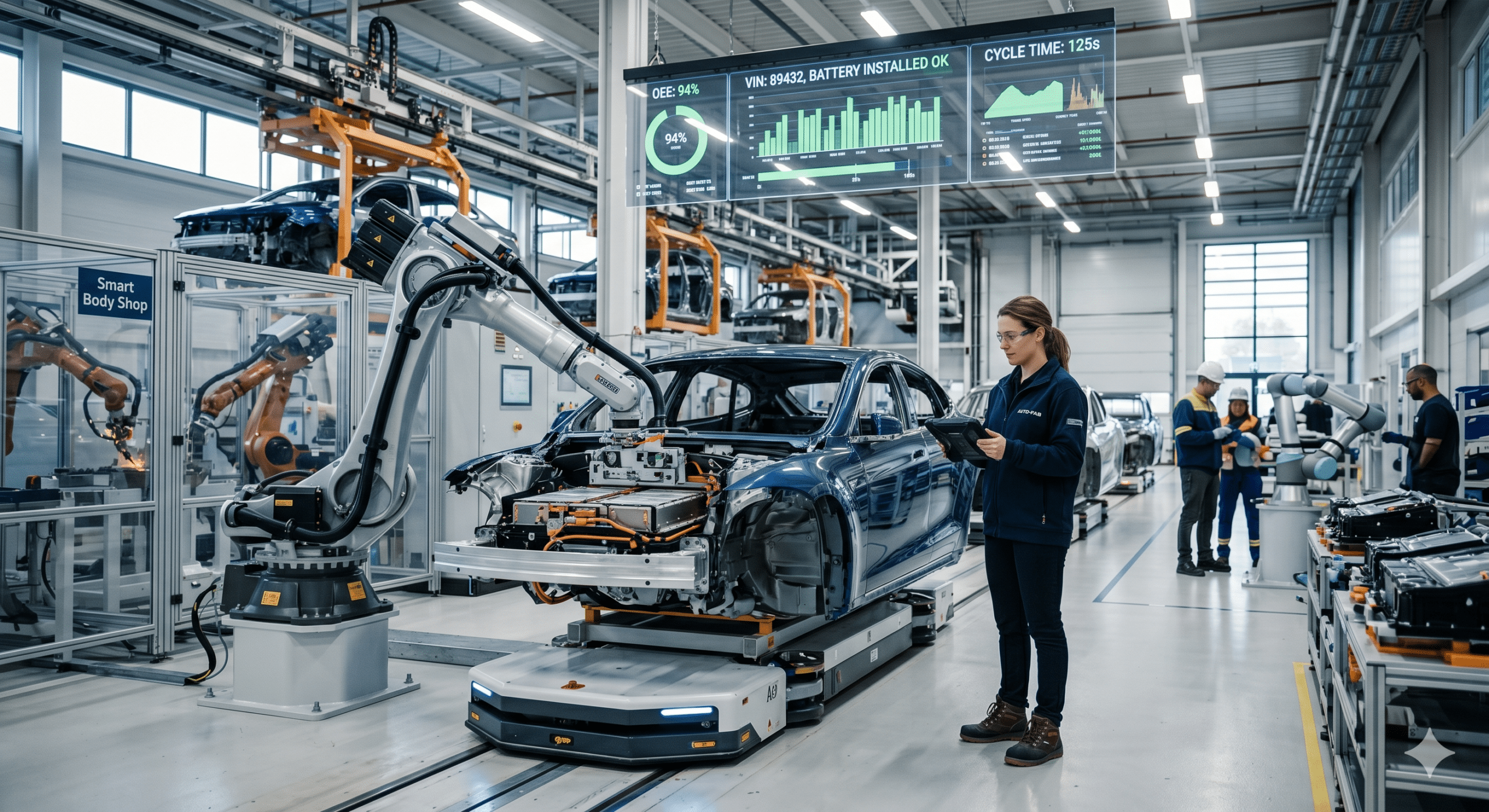
The automotive manufacturing business has never stood still. From Henry Ford’s moving assembly line to today’s AI-powered smart factories, the industry keeps reinventing itself. However, what’s happening right now feels different. Modern automotive manufacturing is no longer just about building cars faster. Instead, it’s about building them smarter, cleaner, safer, and more efficiently than ever before.
At the same time, customer expectations are changing rapidly. Buyers now expect advanced technology, better fuel efficiency, electric vehicle options, and higher quality standards. Meanwhile, manufacturers face rising labor costs, supply chain disruptions, cybersecurity risks, and pressure to reduce environmental impact. Because of this, automotive companies are investing heavily in automation, robotics, artificial intelligence, digital twins, and data-driven manufacturing systems.
From a business and engineering perspective, automotive manufacturing has become a balancing act between operational efficiency and innovation. Companies that fail to modernize risk falling behind. On the other hand, manufacturers that embrace lean operations, flexible production systems, and advanced automation are positioning themselves for long-term growth.
Understanding the Automotive Manufacturing Business
The automotive manufacturing business involves designing, producing, assembling, and distributing motor vehicles and automotive components. This includes passenger cars, trucks, buses, electric vehicles, motorcycles, and specialized commercial vehicles.
The industry operates through a massive global supply chain that includes:
- Raw material suppliers
- Parts manufacturers
- Electronics providers
- Battery manufacturers
- Automation companies
- Logistics providers
- Vehicle assembly plants
- Dealership networks
Unlike many industries, automotive manufacturing requires extreme precision. Even a small defect in a brake system, sensor, or steering component can create serious safety issues. Therefore, manufacturers invest heavily in quality control systems and process consistency.
Today’s automotive plants are highly integrated environments where engineering, software, automation, and business strategy work together in real time.
Why the Automotive Industry Is Changing So Fast
Several major trends are reshaping the automotive manufacturing business.
The Rise of Electric Vehicles
Electric vehicles have pushed manufacturers to redesign traditional production systems. EV manufacturing requires different components, battery assembly processes, thermal management systems, and software integration.
Battery manufacturing alone has become one of the most important investments in the automotive sector. At the same time, manufacturers are now under pressure to improve battery repairability and long-term sustainability. Industry experts warn that EVs with difficult-to-repair batteries could hurt resale value and customer confidence. (TechRadar)
Because of this shift, automakers are redesigning factories to support both traditional internal combustion vehicles and EV platforms simultaneously.
Smart Factory Adoption
Modern automotive plants are becoming “smart factories.” These facilities use sensors, machine learning, automation, and real-time analytics to improve production performance.
For example, companies like Hyundai are building AI-powered facilities using robotics, digital twins, and autonomous systems to improve efficiency and quality control. (Business Insider)
Smart factories provide several advantages:
- Reduced downtime
- Faster production
- Better quality consistency
- Predictive maintenance
- Improved worker safety
- Lower operating costs
Most importantly, smart manufacturing gives management real-time visibility into operations.
Supply Chain Challenges
The automotive industry learned painful lessons during global supply chain disruptions over the past few years. Shortages in semiconductors, batteries, wiring harnesses, and shipping capacity forced production shutdowns worldwide.
Even today, geopolitical tensions continue to create supply risks for automotive manufacturers. (Reuters)
As a result, many automotive companies are diversifying suppliers, regionalizing production, and investing in supply chain visibility software.
The Role of Automation in Automotive Manufacturing
Automation is now the backbone of modern automotive production.
Robots have been part of automotive plants for decades, especially in welding and painting operations. However, today’s automation systems are far more intelligent and connected.
Modern automotive automation includes:
- Robotic welding systems
- Automated guided vehicles (AGVs)
- Collaborative robots (cobots)
- Machine vision inspection systems
- Automated material handling
- AI-driven quality control
- Real-time production monitoring
Automation helps manufacturers improve consistency while reducing human error.
In high-volume production environments, even a small efficiency gain can save millions of dollars annually.
Quality Control Is More Important Than Ever
Vehicle quality directly affects brand reputation, warranty costs, customer satisfaction, and safety compliance. Because of this, automotive manufacturers are investing heavily in advanced quality control technologies.
Modern inspection systems use:
- AI-powered cameras
- 3D scanning
- Machine vision systems
- Automated defect detection
- Real-time data analysis
These systems can identify paint defects, weld inconsistencies, missing parts, dimensional variations, and assembly errors within seconds.
Research shows that automated inspection systems significantly improve consistency while reducing false detections and manual inspection time. (arXiv)
In many factories, inspection systems now communicate directly with PLCs and SCADA systems to automatically adjust process parameters before defects spread across production lines. (Pacific Blue Engineering)
That level of integration is transforming how manufacturers approach quality assurance.
Lean Manufacturing Still Matters
Even with AI and advanced robotics, lean manufacturing principles remain critical in automotive production.
Many people assume lean manufacturing is outdated because factories now rely heavily on automation. In reality, lean principles are more relevant than ever.
Lean manufacturing focuses on:
- Eliminating waste
- Improving workflow
- Reducing downtime
- Standardizing processes
- Maximizing efficiency
- Supporting continuous improvement
Automotive companies that combine lean systems with digital technology often achieve the best operational performance.
Interestingly, recent research shows that AI-driven 5S audits can reduce operating costs dramatically while improving consistency in automotive facilities. (arXiv)
This shows how traditional lean methods and modern AI systems can work together rather than compete against each other.
The Business Side of Automotive Manufacturing
Running an automotive manufacturing business is not only an engineering challenge. It is also a massive business operation that requires strategic planning, financial discipline, and risk management.
Capital Investment
Automotive plants are extremely expensive to build and maintain.
Manufacturers must invest in:
- Factory infrastructure
- Robotics
- Tooling
- Production lines
- Safety systems
- Energy management
- Software platforms
- Workforce training
A single production line can cost hundreds of millions of dollars.
Because of this, manufacturers focus heavily on operational efficiency and production uptime.
Workforce Development
Automation does not eliminate the need for skilled workers. Instead, it changes the type of skills manufacturers require.
Modern automotive plants need workers who understand:
- Robotics
- PLC programming
- Data analysis
- Automation systems
- Industrial networking
- Preventive maintenance
- Manufacturing software
In many facilities, technicians now work alongside collaborative robots and AI systems daily.
Companies that invest in workforce training usually experience smoother digital transformation projects and lower turnover rates.
Sustainability and Environmental Pressure
Sustainability has become a major business priority in automotive manufacturing.
Governments, investors, and customers expect manufacturers to reduce emissions and improve environmental performance.
As a result, many automotive companies now focus on:
- Renewable energy
- Waste reduction
- Water recycling
- Energy-efficient equipment
- Sustainable materials
- Battery recycling
- Carbon reduction strategies
Manufacturers that fail to improve sustainability may face regulatory penalties and reputational damage.
Cybersecurity Is Becoming a Major Risk
As automotive factories become more connected, cybersecurity risks continue to grow.
Modern plants rely on:
- Cloud systems
- Industrial networks
- IoT devices
- Connected machinery
- Production databases
- Remote monitoring systems
Unfortunately, cyberattacks on manufacturing operations are increasing.
A recent attack involving Jaguar Land Rover reportedly disrupted factory operations and supply chains significantly. (The Guardian)
For automotive manufacturers, cybersecurity is no longer just an IT issue. It is now an operational risk that can shut down production entirely.
Because of this, many manufacturers are investing heavily in industrial cybersecurity systems and employee awareness training.
Digital Twins Are Changing Factory Operations
One of the most exciting developments in automotive manufacturing is the use of digital twins.
A digital twin is a virtual model of a factory, production line, or machine that mirrors real-world operations in real time.
This technology allows manufacturers to:
- Simulate production changes
- Monitor equipment performance
- Predict maintenance needs
- Optimize workflows
- Reduce downtime
- Improve decision-making
Companies like Hyundai are already using digital twin systems in advanced manufacturing facilities. (Business Insider)
From an engineering standpoint, digital twins help manufacturers solve problems faster before they affect actual production.
From a business standpoint, they improve efficiency and reduce operational risk.
The Growing Role of Artificial Intelligence
Artificial intelligence is becoming deeply integrated into automotive manufacturing operations.
AI systems now support:
- Predictive maintenance
- Automated inspection
- Production forecasting
- Supply chain planning
- Energy optimization
- Process improvement
- Inventory management
For example, Magna International is using AI to improve quality control, factory safety, equipment maintenance, and supply chain forecasting across its global operations. (Business Insider)
The biggest advantage of AI is not replacing people. Instead, it helps workers make better decisions faster.
In manufacturing, even a small improvement in downtime reduction or defect prevention can create enormous cost savings.
Challenges Facing Automotive Manufacturers
Despite major technological advancements, the automotive manufacturing business still faces several serious challenges.
Rising Costs
Raw materials, labor, energy, and transportation costs continue to rise globally.
Manufacturers must improve efficiency constantly to protect profitability.
EV Transition Complexity
Building electric vehicles requires entirely different manufacturing strategies compared to traditional vehicles.
Battery sourcing, thermal systems, software integration, and charging infrastructure all add complexity.
Software Reliability
Modern vehicles rely heavily on software.
Unfortunately, software issues continue to create problems for many automakers transitioning to EV platforms. (Axios)
Manufacturers now need strong software engineering capabilities alongside traditional mechanical expertise.
Skilled Labor Shortages
Many manufacturers struggle to find workers with automation and digital manufacturing experience.
This skills gap is becoming a serious operational issue across the industry.
Opportunities in the Automotive Manufacturing Business
Despite the challenges, the automotive sector still offers tremendous opportunities.
EV Component Manufacturing
Battery systems, charging systems, sensors, and power electronics are creating new supplier opportunities worldwide.
Smart Factory Integration
Companies that provide automation, robotics, AI software, industrial networking, and digital transformation services are seeing strong demand.
Aftermarket and Service Parts
Vehicle maintenance, repair parts, diagnostics, and aftermarket technology continue to grow globally.
Sustainable Manufacturing Solutions
Businesses focused on energy efficiency, recycling, and green manufacturing technologies are gaining attention from automotive companies.
What Successful Automotive Manufacturers Do Differently
From both engineering and business perspectives, successful manufacturers usually share several characteristics.
They Invest in Long-Term Technology
Leading manufacturers understand that modernization is not optional.
They invest steadily in:
- Automation
- AI systems
- Smart manufacturing
- Workforce development
- Cybersecurity
- Data analytics
They Focus on Operational Discipline
Technology alone cannot fix poor management practices.
Strong manufacturers maintain:
- Standardized procedures
- Lean operations
- Preventive maintenance
- Production accountability
- Continuous improvement culture
They Build Flexible Operations
Modern automotive plants must adapt quickly to market changes.
Flexible production systems allow manufacturers to switch models, scale production, and respond to customer demand faster.
They Use Data Effectively
Today’s factories generate massive amounts of data.
Successful companies use that information to improve decision-making, reduce downtime, and increase productivity.
The Future of Automotive Manufacturing
The future of automotive manufacturing will likely be defined by connectivity, intelligence, sustainability, and flexibility.
Factories will continue becoming more automated, data-driven, and digitally connected.
At the same time, vehicles themselves are evolving into software-driven platforms with advanced sensors, autonomous features, and connected ecosystems.
This means the automotive manufacturing business will increasingly require collaboration between:
- Mechanical engineers
- Software developers
- Automation specialists
- Data analysts
- Supply chain experts
- Cybersecurity professionals
The industry is no longer just about building cars. It is about building integrated mobility systems.
Manufacturers that embrace innovation while maintaining operational discipline will remain competitive in the years ahead.
Final Thoughts
The automotive manufacturing business is entering one of the biggest transformations in its history. Electrification, automation, artificial intelligence, smart factories, and digital engineering are changing how vehicles are designed and produced.
However, success in this industry still depends on fundamentals.
Manufacturers must balance quality, efficiency, safety, profitability, and innovation simultaneously. That is not easy in an industry with intense competition and rapidly changing technology.
From my perspective as someone who understands both manufacturing operations and business strategy, the companies that will lead the future are not necessarily the ones with the biggest factories. Instead, they will be the ones that adapt fastest, invest wisely, develop skilled teams, and build resilient operations.
Technology matters. Yet operational discipline, leadership, and continuous improvement still make the biggest difference inside any manufacturing plant.
The automotive industry may be evolving quickly, but one thing remains true: great manufacturing businesses are built on consistency, innovation, and the ability to solve problems better than everyone else.
Further Reading
Here are several high-authority automotive and manufacturing industry resources worth following:
- Automotive World
- Automotive Manufacturing Solutions
- IndustryWeek
- SME Manufacturing
- McKinsey Automotive Insights
- Deloitte Automotive Industry Insights
- Reuters Autos & Transportation
Sources
Industry trends, smart factory adoption, quality control automation, AI manufacturing systems, EV manufacturing challenges, and supply chain developments referenced throughout this article were supported by the following sources. (Reuters)