

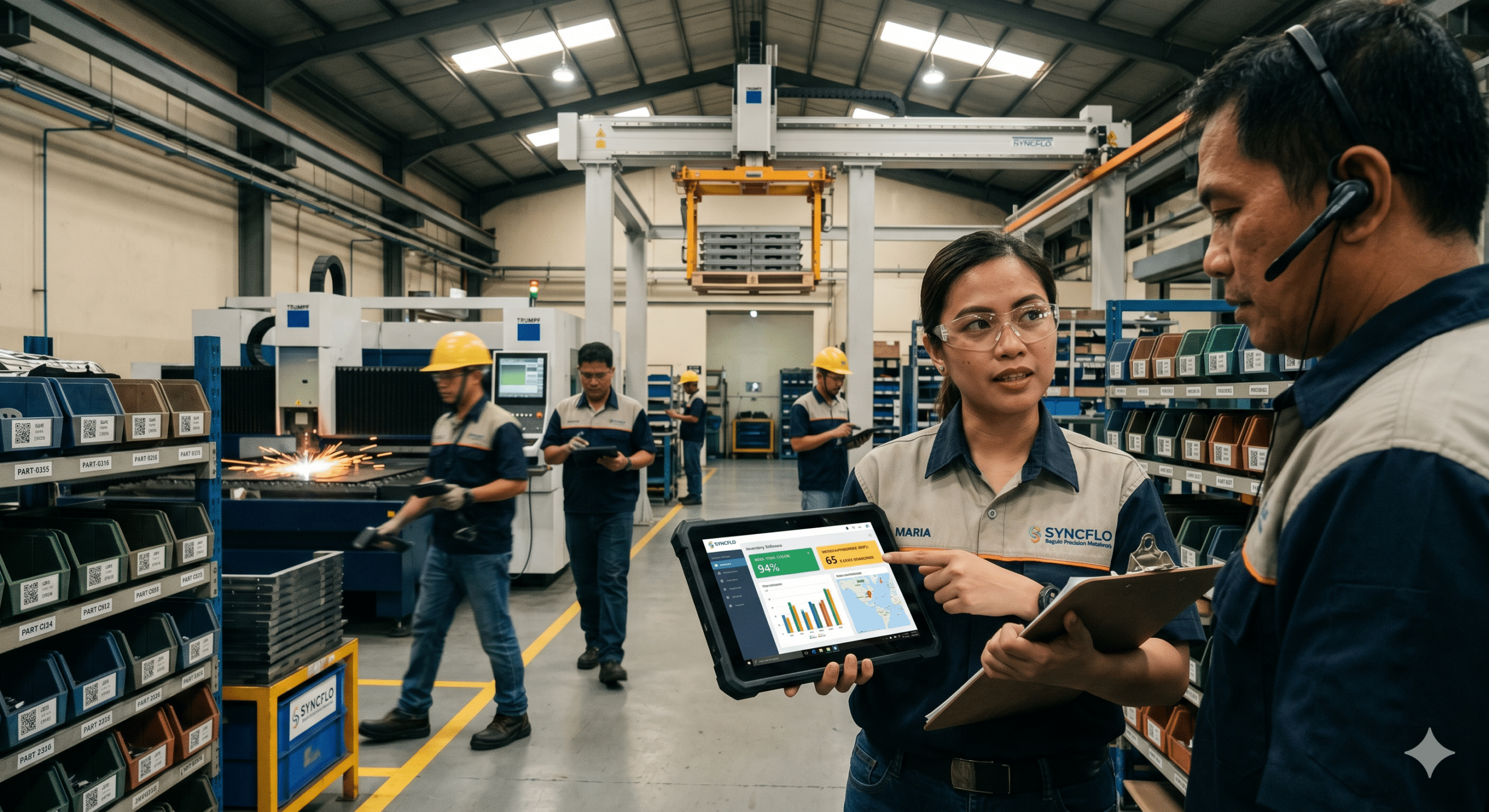
Inventory software manufacturing solutions have become one of the most important technologies in modern factories. From tracking raw materials to improving warehouse accuracy and production planning, manufacturers now rely on smarter inventory systems to reduce waste, avoid costly downtime, and keep operations running efficiently. As manufacturing becomes more automated and data-driven, inventory management is no longer just a warehouse task — it is a core part of business strategy.
Most manufacturing problems do not begin on the production floor. They begin in the stockroom.
A missing bearing can stop an entire production line. Excess raw materials can tie up millions in cash flow. Incorrect inventory data can delay shipments, frustrate customers, and damage supplier relationships. In many factories, inventory is either the biggest operational advantage or the biggest hidden problem.
That is why inventory software manufacturing solutions have become essential for modern operations. Manufacturers no longer see inventory systems as simple stock trackers. Instead, they view them as business intelligence tools that connect purchasing, production, warehousing, finance, maintenance, and supply chain planning into one coordinated system.
Over the years, I’ve seen manufacturers move from clipboards and spreadsheets into fully digital operations. The difference is dramatic. Teams stop reacting to problems and start preventing them. Production planners gain confidence. Warehouse staff work faster. Managers make decisions using live data instead of guesswork.
Most importantly, companies become more profitable.
Why Inventory Management Is So Important in Manufacturing
Manufacturing inventory is very different from retail inventory.
Retail businesses mainly track finished products. Manufacturers, however, manage several inventory layers at the same time:
- Raw materials
- Components and spare parts
- Work-in-progress (WIP)
- Packaging materials
- Finished goods
- Maintenance and repair inventory
That complexity grows quickly.
A single automotive manufacturer might track thousands of components daily. Food manufacturers deal with expiration dates and batch tracking. Electronics companies manage sensitive parts with short product lifecycles. Meanwhile, custom manufacturers constantly adjust materials based on changing customer specifications.
Without reliable inventory software, operations become chaotic.
According to industry reports, many manufacturers still struggle with disconnected spreadsheets, manual stock counting, and outdated systems that create costly inventory inaccuracies. (MSDynamicsWorld.com)
The result usually looks like this:
- Overstocking because teams fear shortages
- Production delays caused by missing materials
- Excess warehouse costs
- Slow inventory reconciliation
- Purchasing mistakes
- Poor forecasting
- Shipping delays
- Cash flow problems
Good inventory software solves these issues by giving manufacturers real-time visibility into what is happening across the operation.
What Inventory Software Manufacturing Systems Actually Do
Many people assume inventory software simply counts products. Modern manufacturing systems do far more than that.
Today’s inventory platforms act like a digital nervous system for the factory.
They track materials from the moment they arrive at the warehouse until the finished product reaches the customer.
A strong manufacturing inventory system typically handles:
Real-Time Inventory Tracking
This is the foundation.
Manufacturers need live visibility into stock quantities, locations, movements, and usage rates. Modern systems update inventory automatically whenever materials are received, transferred, consumed, or shipped.
That means production teams no longer rely on yesterday’s numbers.
Real-time tracking helps prevent stockouts, overordering, and production interruptions. Industry experts consistently identify visibility as one of the most critical features manufacturers should prioritize. (DOSS | Adaptive ERP and Operations Cloud)
Bill of Materials (BOM) Management
BOM management connects inventory directly to manufacturing.
The software understands exactly which components are required to build each product. Once a production order is released, the system automatically allocates materials and adjusts inventory levels.
This becomes extremely valuable in make-to-order environments where every customer order may require different configurations.
Warehouse Management
Modern inventory software often includes warehouse management functions such as:
- Barcode scanning
- Bin location tracking
- Picking optimization
- Receiving workflows
- Cycle counting
- Lot and serial tracking
Warehouse efficiency improves dramatically when workers no longer search for materials manually.
Production Planning Integration
Inventory systems now connect directly with manufacturing schedules.
When production demand changes, material requirements automatically adjust. Purchasing teams receive alerts before shortages occur.
This alignment between inventory and production planning helps manufacturers maintain smoother operations with lower inventory carrying costs.
Forecasting and Demand Planning
Advanced inventory platforms use historical data and forecasting tools to help manufacturers predict future inventory needs.
Instead of relying entirely on instinct, planners use data-driven projections to prepare for seasonal demand, supplier lead times, and production trends.
Supplier and Purchasing Management
Inventory software also supports procurement.
The system can automatically trigger reorder points, generate purchase requests, and track supplier performance.
That reduces human error while improving purchasing consistency.
The Real Cost of Poor Inventory Control
Many manufacturers underestimate how expensive inventory problems really are.
The obvious costs are easy to see:
- Overstocked warehouses
- Rush shipping fees
- Production downtime
However, the hidden costs are often worse.
For example, excess inventory locks up working capital. That money could have been invested into automation, hiring, expansion, or new equipment.
Meanwhile, inventory inaccuracies create operational stress throughout the business.
Production managers lose confidence in stock data. Warehouse teams perform repeated manual counts. Purchasing departments overcompensate by ordering extra materials “just in case.”
Eventually, inefficiency becomes part of company culture.
I’ve seen factories where employees spend hours daily searching for parts that technically exist in the system but cannot be located physically. That is not a technology problem alone. It becomes a productivity problem, a morale problem, and ultimately a profitability problem.
This is why manufacturers increasingly invest in smarter inventory systems that integrate warehouse operations, ERP platforms, automation, and analytics into one environment. (Concentrus)
How Automation Is Changing Inventory Management
Inventory software has evolved rapidly over the last decade.
Previously, inventory systems were mostly reactive. Today, they are becoming predictive and increasingly automated.
Factories now combine inventory software with technologies such as:
- IoT sensors
- RFID tracking
- Barcode systems
- Automated guided vehicles (AGVs)
- Robotics
- AI forecasting
- Machine learning analytics
The goal is simple: reduce human intervention while improving accuracy.
For example, barcode scanning alone can significantly reduce manual entry errors while improving inventory accuracy and warehouse speed. (Instawork)
Some advanced operations even use AI-powered systems that visually verify inventory conditions directly on the production floor. (Jidoka Tech)
Meanwhile, warehouse automation continues expanding.
Modern facilities now use automated storage systems, smart conveyors, and robotics to manage inventory movement faster than traditional manual processes.
This shift matters because labor shortages continue affecting manufacturing worldwide.
Automation helps companies scale operations without increasing workforce pressure at the same rate.
Cloud-Based vs On-Premise Inventory Software
One major decision manufacturers face is whether to use cloud-based or on-premise systems.
Both approaches have strengths.
Cloud-Based Systems
Cloud inventory software has become extremely popular because it offers:
- Faster implementation
- Lower upfront cost
- Remote accessibility
- Easier software updates
- Better scalability
Small and midsize manufacturers especially benefit from cloud systems because they avoid massive infrastructure investments.
Cloud platforms also improve collaboration across multiple locations.
On-Premise Systems
Some manufacturers still prefer on-premise solutions, particularly in industries with strict security or compliance requirements.
On-premise systems offer:
- Greater internal control
- Customization flexibility
- Internal server management
- Reduced external dependency
Large enterprise manufacturers sometimes choose hybrid models that combine both approaches.
The right choice depends on operational complexity, budget, IT capabilities, and long-term growth strategy.
Key Features Manufacturers Should Look For
Not all inventory software is designed for manufacturing.
That distinction matters.
Retail-focused inventory platforms may struggle with production workflows, BOM structures, and WIP tracking.
Manufacturers should prioritize software with these capabilities:
| Feature | Why It Matters |
|---|---|
| Real-time inventory visibility | Prevents shortages and overstock |
| BOM management | Supports accurate production planning |
| Multi-location tracking | Improves warehouse coordination |
| Barcode/RFID support | Reduces manual errors |
| Lot and serial traceability | Essential for quality control |
| ERP integration | Connects operations and finance |
| Forecasting tools | Improves purchasing decisions |
| Production scheduling integration | Aligns materials with manufacturing demand |
| Reporting dashboards | Supports data-driven decisions |
| Mobile accessibility | Improves warehouse productivity |
The best systems are not necessarily the most expensive.
Instead, the best software is the one that aligns with the manufacturer’s operational reality.
Inventory Software for Small Manufacturers
Small manufacturers often assume advanced inventory systems are only for large enterprises.
That is no longer true.
Modern cloud platforms have made inventory software far more accessible.
Even small fabrication shops, food producers, furniture makers, and contract manufacturers can now implement affordable systems with features like:
- Barcode scanning
- Production tracking
- Purchase management
- Inventory forecasting
- Warehouse visibility
Several modern platforms now target SMB manufacturers specifically because smaller operations need scalability without enterprise-level complexity. (Jidoka Tech)
The biggest mistake small manufacturers make is waiting too long before digitizing inventory operations.
Once production volume increases, fixing inventory problems becomes much harder.
ERP and Inventory Software: Why Integration Matters
Inventory cannot operate in isolation.
The strongest manufacturing systems integrate inventory management with:
- ERP platforms
- Accounting
- Purchasing
- CRM
- Maintenance systems
- Production planning
- Shipping software
This integration creates a connected operation.
For example:
A customer order enters the ERP system. The inventory software checks material availability. Production planning schedules the job. Purchasing orders missing components automatically. Warehouse teams receive picking instructions. Finance updates inventory valuation in real time.
Everything works together.
Disconnected systems create information gaps that lead to delays, errors, and duplicated work.
That is why many manufacturers now prefer unified ERP-driven inventory environments rather than standalone tools.
The Rise of Smart Factories and Digital Inventory
Manufacturing is entering a new phase.
Smart factories are becoming increasingly data-driven, automated, and interconnected.
Inventory software plays a central role in this transformation.
Today’s systems no longer simply record transactions. They actively support operational intelligence.
For example, modern platforms can:
- Predict shortages before they occur
- Recommend purchasing quantities
- Optimize warehouse layouts
- Analyze supplier reliability
- Detect abnormal inventory movement
- Support predictive maintenance
- Improve production scheduling
Some facilities even use digital twins and advanced analytics to model warehouse behavior and optimize material flow. (ERP Software Blog)
As AI continues advancing, inventory systems will become even more proactive.
Instead of managers constantly reacting to problems, software will increasingly guide operational decisions automatically.
Common Inventory Mistakes Manufacturers Still Make
Despite better technology, many manufacturers continue repeating the same mistakes.
Relying Too Heavily on Spreadsheets
Spreadsheets work temporarily.
However, once operations grow, manual tracking becomes risky and inefficient.
Ignoring Data Accuracy
Inventory software is only as good as the data inside it.
Poor scanning discipline, inconsistent receiving practices, and inaccurate counts create unreliable reporting.
Buying Software That Is Too Complex
Some companies purchase enterprise systems far beyond their operational needs.
Complexity can slow adoption and frustrate employees.
Treating Inventory as a Warehouse Problem Only
Inventory impacts the entire business:
- Production
- Finance
- Sales
- Purchasing
- Customer service
Successful manufacturers manage inventory strategically, not just operationally.
Underestimating Training
Even the best software fails if teams are not properly trained.
Implementation success depends heavily on user adoption.
What the Future Looks Like
Inventory software manufacturing solutions will continue evolving rapidly over the next few years.
Several trends are already shaping the future:
AI-Driven Forecasting
Systems will become better at predicting demand fluctuations and purchasing needs.
Autonomous Warehouses
Robotics and automation will increasingly manage inventory movement with minimal human intervention.
Greater Mobile Usage
Warehouse teams will rely more heavily on mobile devices and wearable technology.
Real-Time Supply Chain Visibility
Manufacturers will gain deeper visibility into supplier inventory and logistics networks.
Smarter Analytics
Inventory systems will provide more predictive insights instead of historical reporting alone.
Sustainability Tracking
Manufacturers will increasingly monitor inventory waste, energy usage, and environmental impact.
The factories that adapt early will gain major competitive advantages.
Final Thoughts
Inventory software may not be the most glamorous part of manufacturing, but it is one of the most important.
A factory can have advanced robotics, expensive machinery, and highly skilled workers, yet still struggle because of poor inventory control.
The opposite is also true.
Well-managed inventory creates operational stability. It improves cash flow, supports production efficiency, reduces stress, and strengthens customer satisfaction.
Modern manufacturing is no longer about simply producing more. It is about producing smarter.
That requires visibility, coordination, automation, and accurate data.
Inventory software sits at the center of all four.
For manufacturers trying to scale operations, improve efficiency, and stay competitive in a rapidly changing industry, investing in the right inventory system is no longer optional. It is a strategic necessity.
Further Reading
Here are several high-authority resources and industry articles worth exploring for deeper insights into manufacturing inventory software and warehouse management:
- ERP Software Blog – Warehouse Management Systems Guide
- MS Dynamics World – Best Warehouse Inventory Systems
- Concentrus – Manufacturing Inventory Software Comparison
- Jidoka Tech – AI Inventory Management in Manufacturing
- Lean Transition Solutions – Manufacturing Inventory Management Guide
- DOSS – ERP Systems for Inventory Management