

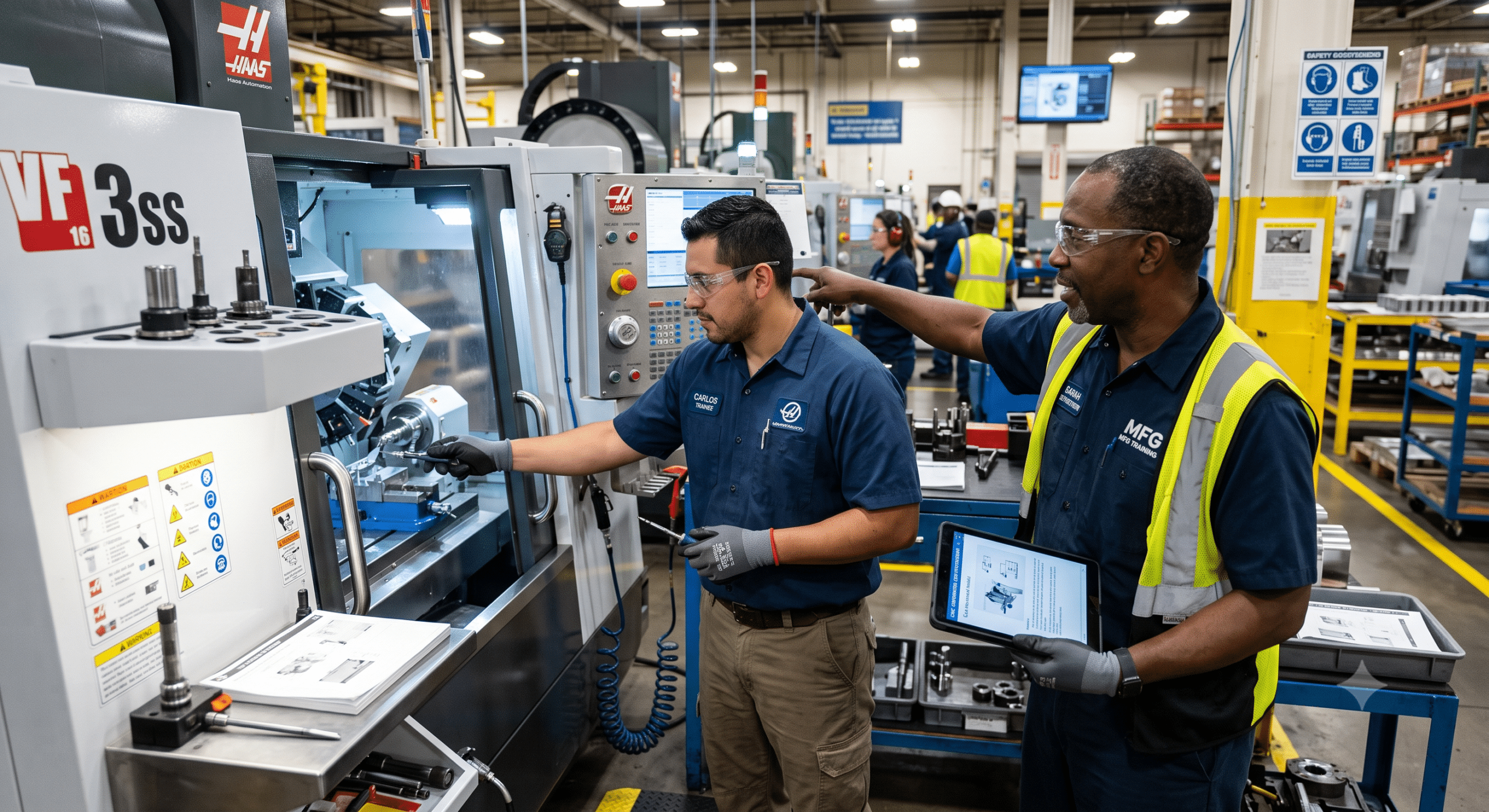
Developing robust operator certification programs is essential for manufacturing companies that invest millions of dollars in equipment, automation, and production technology. Yet, despite heavy tech investments, one factor continues to have the biggest influence on productivity, quality, and safety—namely, the people operating those systems.
From my perspective as an Instructional Systems Designer (ISD) and Learning Architect, the most successful factories are not simply the ones with the newest machines. On the contrary, they are the ones that build consistent learning systems. To that end, they don’t merely train operators once and hope for the best. Instead, they establish structured operator certification programs that help employees demonstrate real competence before they work independently.
This is precisely where a strong Training Systems Authority becomes essential.
To begin with, a Training Systems Authority creates standards for learning, verifies employee competency, and ensures every operator follows the same proven process regardless of shift, supervisor, or location. Consequently, rather than depending on tribal knowledge or “watch and learn” methods, companies establish measurable learning pathways that can be improved over time.
What Is a Training Systems Authority?
Fundamentally, a Training Systems Authority is the group, department, or governance model responsible for ensuring employee training remains accurate, standardized, measurable, and aligned with business objectives.
Specifically, instead of every department creating its own training materials, the authority establishes company-wide standards that define:
-
learning objectives
-
competency requirements
-
certification rules
-
assessment methods
-
retraining schedules
-
document control
-
continuous improvement
In essence, think of it as the quality department—however, focused entirely on workforce capability. Just as Quality Assurance protects products, so too does the Training Systems Authority protect employee performance.
Why Modern Manufacturing Depends on Structured Learning
Without a doubt, manufacturing has changed dramatically over the last decade. For instance, today’s operator may work directly with:
-
collaborative robots
-
CNC machines
-
automated inspection systems
-
Industrial IoT devices
-
vision systems
-
automated packaging
-
digital work instructions
-
Manufacturing Execution Systems (MES)
Because each new technology adds operational complexity, operators no longer memorize a few machine controls. Instead, they now make real-time decisions using digital dashboards, alarms, production data, quality checkpoints, and standardized work procedures.
As a direct result of this complexity, informal mentoring is no longer enough. Indeed, the National Institute of Standards and Technology (NIST) notes that modern manufacturers increasingly require structured workforce development, technical skills training, leadership development, and competency-based learning to remain competitive.
What Are Operator Certification Programs?
In brief, operator certification programs are structured learning systems that verify an employee can safely and consistently perform a specific job. However, true certification means much more than simply completing basic training.
Above all, a complete certification program requires employees to demonstrate:
-
knowledge
-
practical skills
-
safe work habits
-
quality awareness
-
troubleshooting ability
-
equipment inspection
-
emergency response
Ultimately, the core goal is simple: Every certified operator should perform work the same safe, efficient way regardless of experience level.
Why Attendance Does Not Equal Competence
Regrettably, one of the biggest mistakes I see in manufacturing training is confusing mere attendance with genuine competency.
Typically, many companies record:
-
completed orientation
-
watched safety video
-
signed training sheet
Then, based on those checks, they assume the employee is qualified. Unfortunately, that assumption often creates hidden operational risks.
To prevent this, a true certification program systematically answers critical questions like:
-
Can the operator start the machine safely?
-
Can they recognize abnormal conditions?
-
Can they respond correctly to alarms?
-
Can they inspect equipment?
-
Can they maintain product quality?
-
Can they explain why each step matters?
If the answer cannot be demonstrated empirically, certification is incomplete. Accordingly, OSHA guidance similarly stresses that employers must evaluate operator performance and maintain documentation showing employees have been trained and evaluated, rather than relying only on classroom participation.
The ISD Approach to Operator Certification Programs
In practice, Instructional Systems Designers approach training differently from traditional instructors. Specifically, instead of asking, “What should we teach?”, we first ask, “What should employees be able to do after training?”
Thus, everything begins with measurable performance outcomes. To illustrate:
-
Traditional Objective: Understand machine safety.
-
ISD Objective: Perform complete pre-operation inspection with 100% accuracy before machine startup.
Notice the difference: One objective is vague, whereas the other can be clearly observed, measured, and certified.
The ADDIE Model Creates Better Certification Programs
Generally speaking, most professional learning systems follow the ADDIE instructional design process. Moreover, OSHA officially recognizes ADDIE as a systematic approach for developing effective training programs.
In sequence, ADDIE includes five structured phases:
1. Analysis
Initially, the team must determine current performance, business needs, job requirements, learner experience, equipment used, and safety risks. Otherwise, without thorough analysis, companies often teach information employees already know while ignoring critical skill gaps.
2. Design
Next, the design phase converts business requirements into actionable learning objectives. Here, the team defines certification criteria, lesson sequences, assessments, practical exercises, and performance standards. In turn, this stage ensures everyone learns the same standardized process.
3. Development
Subsequently, all learning materials are created. For example, these include digital work instructions, SOPs, videos, simulations, quizzes, instructor guides, checklists, and machine demonstrations. Crucially, every document should support real workplace performance rather than theoretical knowledge.
4. Implementation
After development, training is actively delivered to learners. Depending on the context, this can include instructor-led learning, eLearning, job shadowing, coaching, simulation, machine practice, and supervised production. In addition, implementation should strictly follow standardized instructor guidelines.
5. Evaluation
Finally, the organization measures total impact by asking:
-
Did employees learn?
-
Can they perform?
-
Has quality improved?
-
Have safety incidents decreased?
-
Has downtime improved?
-
Are supervisors seeing better consistency?
Ultimately, certification is valuable only if real-world performance improves measurable outcomes.
The 13 Essential Components of Strong Operator Certification Programs
As a Learning Architect, I recommend including these 13 elements in every certification framework:
-
Job Analysis: Understand exactly what the operator does every day.
-
Skill Matrix: Document required competencies for each role.
-
Standard Work: Ensure everyone follows the same approved process.
-
Learning Objectives: Define clear, measurable outcomes.
-
Digital Learning Resources: Use videos, simulations, and interactive content.
-
Hands-on Practice: Allow employees to learn best by performing real work under supervision.
-
Safety Validation: Verify understanding of hazards prior to independent operation.
-
Practical Assessment: Observe actual job performance in real-time.
-
Knowledge Assessment: Confirm underlying understanding through quizzes or oral questioning.
-
Supervisor Sign-off: Ensure managers confirm readiness using objective criteria.
-
Certification Documentation: Maintain accurate, audit-ready training records.
-
Periodic Recertification: Address skill fade over time through regular reassessment.
-
Continuous Improvement: Review certification data regularly to improve content, reduce errors, and adapt to operational changes.
Therefore, a strong Training Systems Authority treats certification as an ongoing living process—rather than a static, one-time event.
How a Training Systems Authority Builds Operator Certification Programs That Scale
Undoubtedly, one of the biggest challenges manufacturers face is operational consistency. For example, a new operator might receive excellent training on the day shift, whereas a night shift worker might receive very different instruction. Similarly, one employee may learn from a mentor who follows best practices, while another is taught unapproved shortcuts. Over time, these discrepancies inevitably create quality issues, safety risks, and inconsistent production results.
Fortunately, a well-designed Training Systems Authority solves this problem by creating operator certification programs that deliver the exact same learning experience, no matter who teaches it or where it is delivered.
Start with Competencies, Not Courses
Frequently, many organizations begin by asking: “What training classes should we offer?” Instead, we should start with a different question: “What must an operator be able to do independently?”
In practice, this mindset shift changes everything. For instance, consider a packaging line operator. Rather than assigning several random training modules, define the specific competencies required for success:
-
Perform machine startup safely
-
Complete lockout/tagout verification
-
Load materials correctly
-
Monitor production output
-
Identify quality defects
-
Respond to alarms
-
Complete changeovers
-
Record production data
-
Perform basic preventive maintenance
-
Shut down equipment correctly
As a result, every lesson, assessment, and certification activity directly supports one or more of these core competencies.
Build Learning Paths Instead of Individual Courses
Because one standalone course rarely prepares someone for independent work, a learning path provides a logical sequence that builds knowledge and skills progressively over time.
To illustrate, an example learning path for a new operator includes:
-
Phase 1: Company Orientation (Policies, expectations, safety culture, emergency procedures)
-
Phase 2: Manufacturing Fundamentals (Lean principles, GMP, product quality basics, communication)
-
Phase 3: Equipment Knowledge (Machine components, control panels, sensors, limits, indicators)
-
Phase 4: Guided Practice (Performing tasks with an experienced coach while receiving immediate feedback)
-
Phase 5: Performance Evaluation (Demonstrating every required competency under observation)
-
Phase 6: Certification (Awarded only after successfully meeting all performance standards)
Modern Tools: Work Instructions and LMS Infrastructure
The Role of Digital Work Instructions
Historically, printed binders served manufacturers for decades; however, they can quickly become outdated. Conversely, digital work instructions make it far easier to keep procedures accurate and accessible.
Specifically, modern digital work instructions can include:
-
Step-by-step guidance
-
Photos of correct procedures
-
Short instructional videos
-
Safety reminders
-
Interactive checklists
-
Links to equipment manuals
-
QR codes on machines for instant access
Whenever work instructions are updated, operators immediately see the latest approved version. Consequently, this supports operational consistency and reduces the chance of employees following obsolete procedures.
Why an LMS Strengthens Operator Certification Programs
Furthermore, a Learning Management System (LMS) becomes the operational backbone of a Training Systems Authority. Rather than tracking training in fragmented spreadsheets, an LMS can automatically assign learning, deliver modules, schedule sessions, track completion, store scores, and maintain certification records.
Thus, instead of asking supervisors who still needs training, managers can quickly view dashboards showing real-time certification status across departments.
Certification Should Measure Performance
While written knowledge tests are important, manufacturing is ultimately a hands-on environment. In fact, someone may score 100% on a written quiz, and yet struggle to operate physical equipment safely.
That is precisely why effective operator certification programs balance knowledge with practical evaluation:
| Assessment Method | Operational Purpose | Key Evaluation Criteria |
| Written Assessment | Measures theoretical knowledge | Safety rules, SOPs, equipment functions, quality standards |
| Observation Checklist | Evaluates real-time compliance | Proper PPE use, pre-inspections, safe operation, quality checks |
| Practical Demonstration | Confirms hands-on skill | Execution of actual production tasks under evaluator observation |
| Scenario-Based Questions | Tests critical thinking under pressure | Correct responses to sensor failures, emergency stops, or defect spikes |
Common Mistakes That Weaken Certification Programs
Even organizations with good intentions can build programs that fail to improve performance. In particular, watch out for these five common pitfalls:
-
Mistake 1: Training Everyone the Same Way. Not every learner has the same experience level. Therefore, flexible learning paths reduce unnecessary training while maintaining strict certification standards.
-
Mistake 2: Lacking Practical Evaluation. Watching a video does not prove competence. For this reason, every certification must include observed performance.
-
Mistake 3: Using Outdated Training Materials. Procedures change frequently. Unless training content has strict document control, employees may unknowingly follow obsolete practices.
-
Mistake 4: Weak Supervisor Involvement. Supervisors are critical to learning. Without ongoing supervisor coaching and feedback, even excellent training programs lose effectiveness.
-
Mistake 5: Treating Certification as Permanent. Skills naturally decline over time. Hence, regular recertification helps maintain consistent performance across an employee’s career.
Using Competency Matrices to Track Workforce Readiness
In addition, a competency matrix gives managers a clear visual overview of employee capabilities. Specifically, instead of asking who has been trained, leaders can immediately identify certifications, expiration dates, skill gaps, and backup coverage for critical roles.
Sample Competency Matrix
| Operator | Filler Operation | Packaging Line | Palletizer | Forklift Safe | Quality Inspection |
| Sarah | ✔ | ✔ | ✔ | ✖ | ✔ |
| James | ✔ | ✖ | ✔ | ✔ | ✖ |
| Maria | ✔ | ✔ | ✔ | ✔ | ✔ |
As demonstrated above, this type of matrix helps managers plan production schedules while systematically reducing operational risk.
Measuring Success Beyond Training Completion
Importantly, completion rates alone do not show whether learning has improved business performance. Therefore, a Training Systems Authority should track meaningful operational performance indicators, such as:
-
Reduced safety incidents and lower scrap rates
-
Fewer customer complaints and higher first-pass yield
-
Faster onboarding and reduced machine downtime
-
Greater employee confidence and lower new-hire turnover
When learning metrics align directly with business outcomes, leadership can clearly see the return on investment in structured operator certification programs.
Creating a Culture of Continuous Learning
Above all, the strongest manufacturers view certification as the beginning of an employee’s development—not the end. Consequently, after initial certification, operators should continue expanding their skills through:
-
Cross-training on additional equipment
-
Advanced troubleshooting workshops
-
Leadership development and Lean manufacturing initiatives
-
Safety refreshers and mentoring newer employees
Ultimately, this ongoing development creates a flexible workforce that adapts seamlessly as production demands change. In short, a mature Training Systems Authority supports this journey by ensuring certification standards evolve alongside technology.
The Future of Training Systems Authority
As we look ahead, manufacturing is evolving faster than ever. Modern automation, robotics, AI, Industrial Internet of Things (IIoT), and connected production systems are changing how work gets done. While technology continues to advance, one fundamental truth remains constant: Machines do not create quality—trained people do.
Furthermore, recent research into smart manufacturing shows that digital guidance tools and intelligent training systems significantly enhance learning in complex production environments.
Roadmap for Building a Sustainable Certification Program
[ Step 1: Identify Critical Roles ]
               │
               ▼
[ Step 2: Job Task Analysis ]
               │
               ▼
[ Step 3: Define Measurable Competencies ]
               │
               ▼
[ Step 4: Create Standardized Materials ]
               │
               ▼
[ Step 5: Verify Performance Practically ]
               │
               ▼
[ Step 6: Track & Audit via LMS ]
               │
               ▼
[ Step 7: Continuous Improvement & Recertification ]
Ultimately, technology alone cannot create an effective learning culture; rather, leadership determines whether training becomes a compliance exercise or a strategic business advantage.
Frequently Asked Questions (FAQ)
What are operator certification programs?
In brief, operator certification programs are structured training and assessment systems that verify employees have the knowledge, practical skills, and safety awareness required to operate equipment independently.
Why are operator certification programs important?
Primarily, they help organizations improve workplace safety, reduce production errors, maintain consistent quality, and ensure employees can demonstrate competency before working without supervision.
What is a Training Systems Authority?
In simple terms, a Training Systems Authority is the governance function responsible for creating, maintaining, and improving an organization’s learning standards, certification requirements, and training documentation.
How often should operators be recertified?
Generally, recertification timing depends on company policy, regulatory standards, and job complexity. Additionally, retraining is recommended after incidents, equipment updates, or extended periods away from a specific task.
How do competency-based programs differ from traditional training?
Traditional training often measures attendance or course completion. In contrast, competency-based certification focuses on whether employees can consistently perform required tasks to established standards in the workplace.
Conclusion
In summary, the future of manufacturing depends on skilled people just as much as advanced technology. By establishing a strong Training Systems Authority and investing in structured operator certification programs, companies build safer workplaces and stronger quality systems.
Ultimately, combining instructional design principles, standardized learning paths, practical evaluations, and continuous improvement transforms training from a routine compliance requirement into a powerful strategic advantage.
References
-
Occupational Safety and Health Administration (OSHA). Operator Training, Certification, and Evaluation (29 CFR 1926.1427). OSHA Standard
-
Occupational Safety and Health Administration (OSHA). Compliance Assistance for the Powered Industrial Truck Operator Training Standards. OSHA Directive
-
National Institute of Standards and Technology (NIST). Analysis of the Manufacturing USA Occupation and Competency Framework. NIST Publication
-
National Institute of Standards and Technology (NIST MEP). How One Company Is Closing the Skills Gap Through a Competency-Based Apprenticeship Program. NIST Blog
-
National Institute of Standards and Technology (NIST MEP). MEP Workforce Programs, Services and Trainings. NIST MEP