
I spent the first part of my career chasing ghosts in the network. A stamping press would hiccup for a fraction of a second. Then the historian would show a gap in the data. By the time anyone in IT pulled logs from the cloud dashboard, operators had already scrapped the batch. That’s the moment most controls engineers I know start caring about edge computing manufacturing strategies. Not because a vendor pitched it to them, but because the plant floor forced the issue.
So I write this from that side of the fence. I’m not a cloud architect and I don’t sell platforms. Instead, I’m the person who gets paged when a PLC drops communication at 2 a.m. I’ve spent close to 10 years designing control architectures that have to survive contact with an actual production line. What follows is a practical walkthrough of edge computing architecture for smart factories. First, I’ll cover why edge computing manufacturing decisions matter more than most IT teams assume. Then I’ll cover where cloud still earns its place.
What Edge Computing In Manufacturing Actually Means
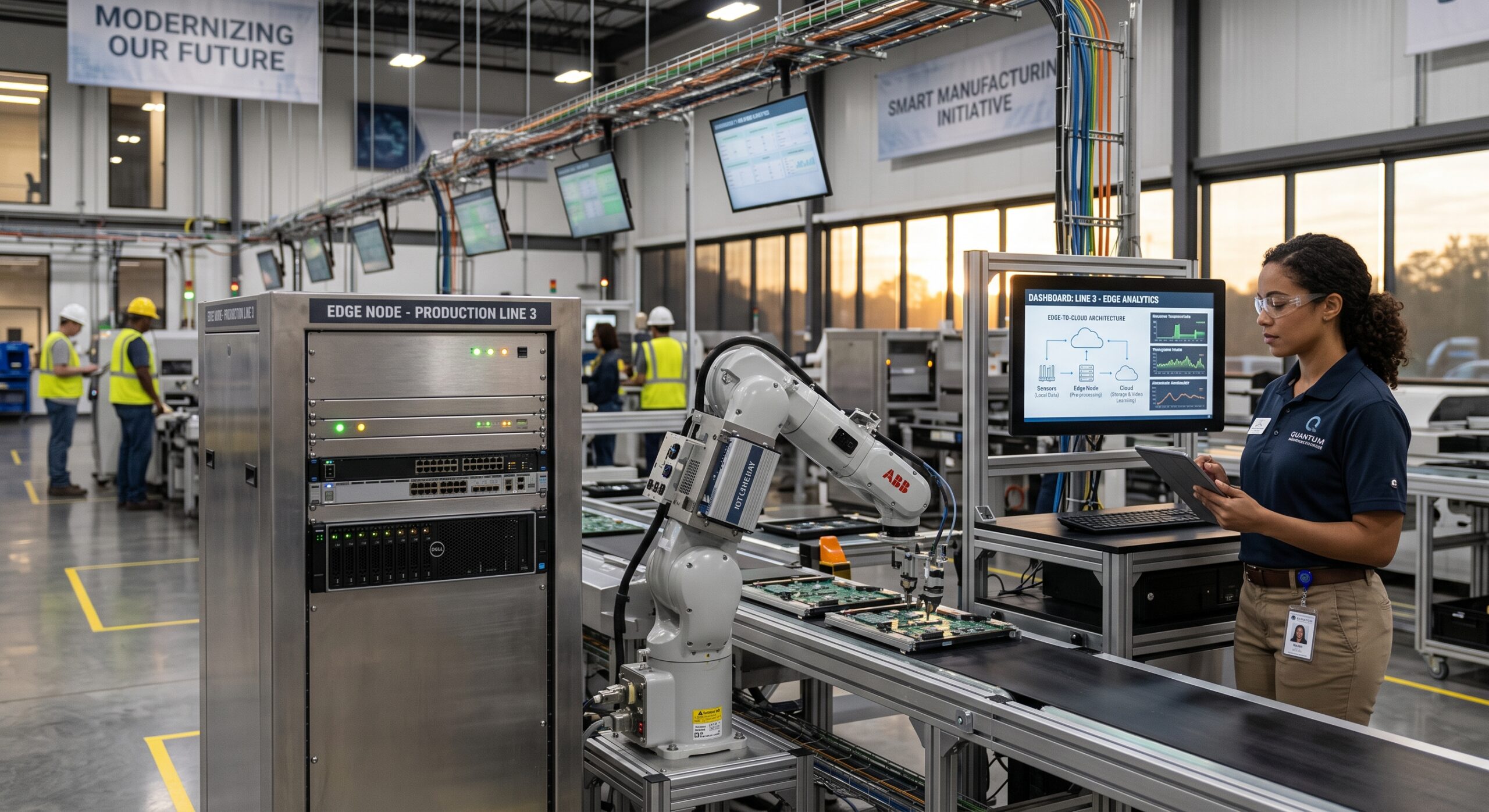
Strip away the marketing language, and edge computing manufacturing simply means one thing. You process data close to where it’s generated. That could be on the machine, in the control cabinet, or on a gateway a few feet from the line. In other words, it’s the opposite of shipping every tag value to a data center or public cloud for analysis. The edge is whatever compute sits between the sensor and the wide area network. Think an industrial PC, a smart PLC, or a ruggedized gateway. Sometimes it’s compute built right into a drive or a vision camera.
For those of us who came up through automation and controls rather than IT, this isn’t new. It’s just an old idea dressed in new clothes. PID loops have always run locally. That’s because a control loop can’t wait on a round trip to a server room, let alone a data center three states away. What’s changed is the scope of what now runs at that same local layer. Predictive maintenance models, quality vision inspection, OEE calculation, and anomaly detection now run right at the machine. So do small AI inference models that used to require a GPU cluster somewhere off site.
As a result, the shop floor now has its own tier of intelligence. It doesn’t wait for permission from the cloud to catch a defect. It doesn’t wait to stop a line, or to flag a bearing that’s about to fail.
Why The Shop Floor Broke The Cloud First Model
Around 2018 through 2022, a lot of digital transformation programs assumed a cloud first pattern borrowed straight from IT. Collect everything, send it up, analyze it centrally, push insights back down. That model works fine for a retail dashboard. But it falls apart on a production line, and I’ve run into three reasons why.
First, machine control can’t tolerate variable latency. A conveyor interlock or a robot collision avoidance routine needs a response measured in single digit milliseconds. By contrast, a round trip to a cloud region typically costs 100 to 400 milliseconds once you account for network jitter. Second, plant networks aren’t always reliable. Rural or industrial sites often run on cellular backhaul or older WAN links, so a dropped connection shouldn’t mean a stopped line. Third, a modern line produces a huge volume of data. Vibration readings sample thousands of times a second. Vision frames come in at high resolution. Meanwhile, every motor reports its current draw. Moving all of it to a data center is expensive, and often pointless. After all, roughly 95 percent of it is normal operating noise.
Manufacturers noticed. Industry surveys now regularly cite figures north of 80 percent of manufacturers who have deployed cloud solutions or committed capital budgets toward them. Still, the more interesting trend sits underneath that number. Those same manufacturers are pushing real time workloads back down to the edge, and reserving the cloud for what it’s actually good at.
Edge Vs Cloud: The Tradeoffs That Matter On The Floor
This is the part most articles gloss over with a generic pros and cons list. Instead, I want to walk through it the way I’d explain it to a plant manager. The question is usually the same: why aren’t we just putting it all in the cloud?
Latency and Control Response
Edge wins here, decisively, when the application involves closed loop control or safety. Independent benchmark testing compared inference approaches head to head. Edge based inference came in at roughly 63 milliseconds, while cloud based inference came in at roughly 442 milliseconds for the same task. That gap matters enormously when you’re trying to catch a defect before the next part moves down the line. In particular, a servo loop, a safety interlock, or a vision guided pick and place often needs a response window under 10 milliseconds. No public cloud connection can guarantee that consistently across a WAN link, however fast the backbone. So cloud latency isn’t just slower. It’s variable, and variability is what actually breaks control loops.
Bandwidth and Cost
Sending raw sensor data to the cloud at industrial sampling rates gets expensive fast, both in network cost and in storage. For example, a single vibration sensor sampling at high frequency, multiplied across dozens of machines, generates far more data than any WAN pipe can carry. Processing at the edge changes the math. Instead, you forward only summarized results: alarms, trends, or flagged anomalies. That approach cuts network traffic by around 40 percent in hybrid deployments. As a result, you keep the analytical value that matters to the business without paying to move the noise.
Reliability When The Network Goes Down
This is the tradeoff that convinces most plant managers. A pure cloud dependent architecture means a WAN outage can stall production, even a short one. That’s because control decisions end up waiting on a connection that no longer exists. Architectures that keep production logic running locally tell a different story. They sync to the cloud opportunistically, and they show availability figures around 99.2 percent during WAN outages. Cloud only setups, meanwhile, show roughly 5.8 percent under the same conditions. That’s not a rounding error. It’s the difference between a shift that keeps running and one that stops cold.
Security and Data Ownership
Edge computing keeps sensitive process data inside the plant’s own walls. So recipes, cycle times, and proprietary quality thresholds stay off the public network. Nothing sits exposed on a third party’s servers. For manufacturers in regulated or competitive industries, that’s not a minor point. In fact, it’s often the deciding factor in a build versus buy conversation with the security team.
Scale, Training, and Cross Site Learning
Here’s where cloud genuinely wins and edge can’t compete. Training a machine learning model needs far more data and compute than any edge device can offer. That’s especially true for a model meant to generalize across a fleet of machines or multiple plants. Here’s an example I keep coming back to. Reliably recognizing a rare failure pattern might require learning from something like ten thousand failure events, pulled from a global fleet of similar equipment. No single plant, let alone a single edge gateway, will ever see that volume of examples. So cloud is where models get smart. Edge, on the other hand, is where they get fast.
A Reference Architecture That Actually Holds Up
Most of the frameworks I’ve implemented map loosely to the ISA-95 model that automation engineers already know, extended to include AI and analytics workloads. Specifically, I think about it in five layers, moving from the machine outward.
The device layer sits at the bottom. Sensors, actuators, drives, and field instrumentation generate the raw signals. Above that is the control layer, where PLCs and safety controllers run deterministic logic, executing in real time no matter what else is happening on the network. Next comes the true edge compute layer. An industrial PC or gateway runs local analytics, vision inference, OEE calculation, and short term historian functions there. After that is the plant or site layer, where a local server typically handles MES functions, work order management, and aggregation across the whole facility. Finally, the fifth and outermost layer is the enterprise cloud. It handles multi site analytics, long term data retention, ERP integration, and the heavy lifting of model training.
Data generally flows upward for aggregation and learning, while model updates and configuration changes flow back down. The key design principle is simple: each layer should keep doing its job even if the layer above it goes offline. A control loop shouldn’t care whether the enterprise cloud is reachable. Likewise, a plant server shouldn’t care whether the enterprise network is congested. That separation of concerns is what makes the architecture resilient rather than just fast.
Building The Edge Layer Without Reinventing Your Network
On the protocol side, most modern edge deployments lean on OPC UA, which handles structured, secure data exchange between controllers and edge applications. Many teams also pair it with MQTT for lightweight publish and subscribe messaging up to higher layers. Where deterministic timing really matters, engineers increasingly add Time Sensitive Networking, or TSN, underneath OPC UA. This guarantees delivery windows on standard Ethernet infrastructure, and it removes the need for proprietary fieldbus hardware.
Still, hardware choices matter less than people assume. I’ve seen successful edge deployments on a fanless industrial PC bolted into an existing cabinet. I’ve also seen compute built directly into a smart camera or drive. What matters more is picking hardware rated for the actual environment: vibration, temperature swings, electrical noise. A data center rack pretending to be industrial simply won’t cut it. In fact, I’ve replaced more than one edge device that failed within its first year. The cause was almost always the same: someone specified commercial grade hardware for an environment running well above 100 degrees Fahrenheit, next to a furnace line.
Fortunately, containerization has made edge deployment far less painful than it used to be. Teams can develop the same analytics or inference application once, then deploy it consistently across dozens of sites. Version control and rollback now work the way they should. That’s a big step up from the custom scripts a lot of us were running a decade ago.
A Practical Hybrid Architecture
The manufacturers getting this right aren’t choosing edge or cloud. Instead, they’re deliberately splitting workloads based on what each layer does well. Take a line I worked on last year, for example. Vision based defect detection ran entirely at the edge there. It inspected parts within milliseconds and triggered a reject mechanism before the part reached the next station. The system also sent every flagged defect, along with a compressed image, up to the cloud. There, it joined data from other plants to retrain the detection model quarterly. From there, the system pushed the improved model back down to every site’s edge device automatically.
That pattern, local inference for speed and cloud aggregation for learning, is becoming the default rather than the exception. So it gives you sub-10-millisecond response on the floor, along with fleet-wide intelligence at the enterprise level. Neither layer, in other words, has to do a job it’s poorly suited for.
Common Mistakes I See Engineers Make
The most common failure I see is treating edge computing manufacturing projects as a pure IT initiative. Someone bolts it onto existing controls infrastructure, and nobody involves the people who actually own the PLC logic and safety systems. As a result, if change management and backup procedures don’t cover edge devices the way they cover a PLC program, those devices become orphaned within a year.
A second mistake is over-collecting data at the edge with no clear plan for what to forward and why. That just recreates the bandwidth problem one layer down. A third mistake is skipping cybersecurity segmentation between the edge layer and the broader IT network. Some teams assume a device “on the floor” is automatically safe from enterprise threats. It isn’t. In fact, industrial control systems remain an attractive target precisely because they’re often under-patched.
A fourth mistake, and probably the one I see most in facilities newer to this, is sizing edge hardware for today’s workload with no headroom for tomorrow’s. I’ve watched teams spec a gateway that just barely handles the current vision inspection task. Then, six months later, there’s no capacity left for the vibration monitoring project that was already on the roadmap. Building in even 30 to 40 percent extra compute headroom costs very little upfront. It also avoids a full hardware replacement cycle a year down the line.
What This Changes For The Controls Engineer’s Day To Day
I’ll be honest. When edge computing manufacturing projects first showed up on my desk, I treated them as an IT problem wearing a factory badge. That was a mistake. The skill set that makes someone good at PLC programming translates directly into good edge deployment practice. Sequential logic, deterministic thinking, and careful change control all apply here. So controls engineers who lean into that, instead of handing the whole project to IT, end up with far more resilient systems.
In practice, that means controls engineers now write acceptance criteria for edge gateways. They also decide what data actually needs to leave the cabinet, and they set the failover behavior when a network link drops. Ten years ago that conversation didn’t exist on most plant floors. Now it’s a standard part of any new line commissioning, right alongside I/O checkout and safety validation. Personally, I’d rather hand that responsibility to someone who understands what happens physically when a motor misses its stop command. That beats handing it to someone who’s only ever worked from a server room.
It also changes how you think about maintenance. An edge device isn’t a PLC. Like any computer, it needs patching, firmware updates, and lifecycle management. But it also can’t go down for a routine update in the middle of a production run. So I now build that maintenance window into the same schedule as electrical and mechanical PM work, instead of treating it as a separate IT cycle. That single change alone has saved me more than one weekend of emergency troubleshooting.
Where This Is Headed
The next phase of edge computing manufacturing isn’t just faster inference. It’s agentic behavior at the edge. Picture systems that don’t just detect an anomaly, but decide how to respond within defined guardrails. That might mean adjusting a setpoint, throttling a line, or triggering a work order, all without waiting for a human or a cloud round trip. Of course, that requires more trust in the edge layer than most organizations have today. Getting the architecture right now is what builds that trust, since clear separation between control, edge analytics, and cloud learning is what makes it possible. So plants that build that foundation well can layer in more autonomy safely as the technology matures. The alternative, bolting it on later and hoping it holds, tends not to end well.
Frequently Asked Questions
What is edge computing in manufacturing?
It’s the practice of processing sensor and machine data locally, on or near the equipment that generates it. Instead of sending everything to a centralized cloud data center first, the plant handles it on site. As a result, real time decisions, like quality inspection or safety interlocks, can happen in milliseconds. For a deeper technical breakdown, Shoplogix has a solid explainer on where edge fits versus cloud on the shop floor: Edge Computing vs Cloud in Manufacturing.
Is edge computing replacing cloud computing in factories?
No. The two are complementary rather than competing. Edge handles time sensitive, local processing, while cloud handles cross site analytics, long term storage, and model training. Belden’s write-up on hybrid edge and cloud AI deployments covers the performance data behind this well: Cloud AI vs Edge AI in Manufacturing.
How much latency does edge computing actually save compared to cloud?
In documented hybrid deployment testing, edge based inference ran at roughly 63 milliseconds, while cloud based inference on the same task ran at about 442 milliseconds. That difference matters most for closed loop control and real time quality inspection. See FlowFuse’s breakdown of edge versus cloud AI placement using the ISA-95 hierarchy: Edge AI vs Cloud AI in Manufacturing.
What happens to production if the internet connection at a plant goes down?
With an edge first architecture, local control and inference keep running independently of the WAN connection. Data then syncs to the cloud once the connection comes back. So facilities without local edge processing risk stalled production during outages. Smart Industry covers the resiliency case for edge to cloud architectures in more depth: Why Manufacturing Is Moving to Edge to Cloud Architectures.
What protocols are typically used to build an edge computing architecture on the plant floor?
OPC UA is the most common standard for structured, secure communication between controllers and edge applications. Teams frequently pair it with MQTT for lightweight messaging, and many also add Time Sensitive Networking for deterministic timing over standard Ethernet. Semiconductor Engineering has a useful technical discussion of the underlying tradeoffs engineers weigh when designing these systems: Tradeoffs Between Edge vs Cloud.
References
Belden. Cloud AI vs Edge AI: Why Manufacturers Don’t Have to Choose. Retrieved from https://www.belden.com/blog/cloud-ai-vs-edge-ai-why-manufacturers-dont-have-to-choose
FlowFuse. Edge AI vs Cloud AI in Manufacturing: Where Each Actually Belongs. Retrieved from https://flowfuse.com/blog/2026/03/edge-ai-vs-cloud-ai-in-iiot/
Semiconductor Engineering. Tradeoffs Between Edge vs. Cloud. Retrieved from https://semiengineering.com/tradeoffs-between-edge-vs-cloud/
Shoplogix. Edge Computing vs Cloud in Manufacturing: Which Belongs on Your Shop Floor. Retrieved from https://shoplogix.com/blog/edge-computing-vs-cloud-in-manufacturing/
Smart Industry. Why Manufacturing Is Moving to Edge to Cloud Architectures for Resiliency. Retrieved from https://www.smartindustry.com/tools-of-transformation/cloud/article/55381984/why-manufacturing-is-moving-to-edge-to-cloud-architectures-for-resiliency
SUSE. Edge Computing in Manufacturing: Future Factories. Retrieved from https://www.suse.com/c/how-edge-computing-optimizes-manufacturing-operations/