

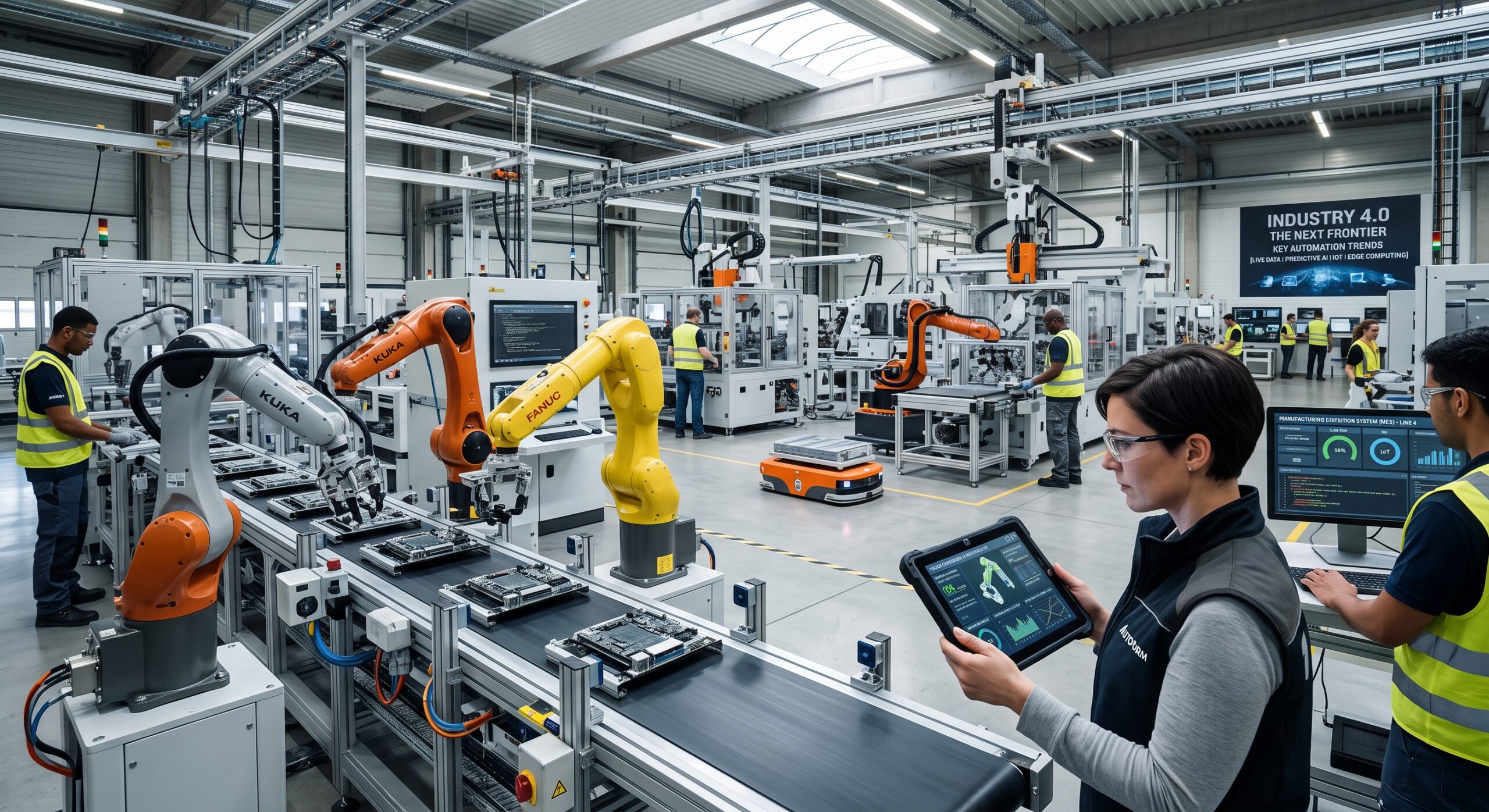
I still remember the first time a plant manager handed me a USB stick full of PLC logs and asked why line 4 kept stopping on Thursdays. That was eleven years ago, and it is more or less how I ended up sitting between the data science team and the shop floor. Over that decade, I’ve watched industrial automation trends evolve from abstract trade show keynotes into daily coffee-break conversations about which tools actually deliver ROI.
This year feels different, though. While the marketing hasn’t gotten any more honest, three core technologies—physical AI, edge computing, and digital twins—are finally starting to talk to each other. That convergence drives the most important industrial automation trends worth your attention right now. Let’s walk through what’s actually changing versus what just got a new coat of paint.
Why the Shop Floor Finally Has Data Worth Acting On
For most of my career, manufacturing data had a shelf life measured in days or weeks. You’d pull historian data, clean it up, and build a model. By the time you validated it, the line configuration had already changed. Digital transformation projects stalled for a simple reason: the feedback loop between sensing and acting moved too slowly and required too much manual work.
What changed is less about any single flashy technology. It’s mostly about plumbing. Sensors got cheaper. Networking got more reliable. And critically, the software layer between raw machine data and anything useful, historians, MES, SCADA, ERP, started changing too. It began forming a real data foundation instead of a pile of disconnected exports. This quiet shift in plumbing sits behind most of the industrial automation trends getting attention today.
Industrial DataOps platforms are having a real moment for exactly this reason. They take the mess of PLC tags, MES records, and ERP fields and turn it into structured knowledge instead of a swamp of spreadsheets nobody trusts. That foundation matters more than people give it credit for. None of the three trends below work without it.
Physical AI: When Robots Stop Just Repeating and Start Reasoning
Ask ten people in manufacturing what “physical AI” means, and you’ll get ten slightly different answers. The core idea stays simple, though.
From Rule Based to Goal Based Automation
Physical AI doesn’t just live in a chatbot or a dashboard. It operates in and interacts with the physical world through sensors, actuators, and control systems. A traditional industrial robot repeats the same weld on the same seam thousands of times. It has no understanding of what it’s actually doing.
A physical AI system works differently. It perceives its environment. Then it reasons about that environment using both general and specialized training. From there, it acts on physical equipment and learns from the outcome to do better next time.
I saw a real version of this earlier in the year. A collaborative robot handled soft, irregular textile items without a single pre-programmed trajectory. It adjusted its grip in real time based on what the camera and force sensors told it. That’s a genuinely different category of automation compared to the rigid, rule-based robots most plants have run for the last thirty years. An automation engineer summed it up well at a recent trade show: you’re moving from rule-based automation to goal-based automation. That distinction changes almost everything about how you deploy and maintain these systems.
The Adoption Numbers Behind the Hype
The adoption numbers back up what I’m seeing in the field. Manufacturing Leadership Council survey data puts current physical AI adoption at roughly 9 percent. Nearly 22 percent of manufacturers plan to deploy it within the next two years, more than double where things stand today. That’s a meaningful jump for an industry that usually moves at a deliberate, sometimes frustrating pace. Numbers like these explain why physical AI leads almost every roundup of industrial automation trends this year.
Humanoid Robots Move From Booth to Purchase Order
Humanoid robots offer the most visible evidence of this shift. At the most recent Hannover Messe, roughly twenty two robot makers showed off humanoid platforms on the floor. A year earlier, that number sat at essentially zero.
Schaeffler didn’t just watch a demo booth and nod politely, either. The company committed to purchasing a thousand units of one humanoid platform over a seven year period. That’s not a pilot project anymore. That’s a procurement decision, and procurement decisions signal where an industry is actually headed better than any keynote slide.
A Word of Caution
I want to be careful here. I’ve seen plenty of automation hype cycles come and go. Physical AI will not replace your maintenance technicians next quarter, and anyone telling you otherwise is selling something.
What it does change is the category of tasks worth automating. Unstructured, variable work used to require a human’s adaptability: sorting mixed materials, handling irregular parts, adjusting to small variations on a line. Automation can finally reach that kind of work without needing constant reprogramming every time something changes.
Edge Computing: The Infrastructure Everyone Underestimates
Physical AI gets the flashy headlines. Edge computing gets almost none of the attention it deserves, and that’s a mistake. Edge computing means processing data close to where it’s generated, right on the plant floor or inside a machine controller. That beats sending everything up to a centralized cloud and waiting for a response.
Why Milliseconds Matter on the Line
The difference matters enormously for anything involving real time control. Say a vision system needs to catch a defect and reject a part before it travels three feet down a conveyor. You cannot afford the round trip latency of sending that image to a distant data center, waiting for inference, and getting an answer back. You need decisions in single digit milliseconds, and only compute sitting right there on the line delivers that.
A Real Example From a Packaging Plant
I worked with a food packaging plant a couple of years back. The team had built a genuinely good defect detection model in the cloud and validated it thoroughly. Then, in production, they discovered a problem. Network jitter alone caused enough delay to miss the rejection window on a meaningful fraction of defective units.
Moving the same model to an edge device inside the control cabinet fixed the problem completely. The model didn’t get smarter. The physics of data transmission finally matched the physics of the conveyor belt.
Edge and Cloud Are Not Rivals
This isn’t an argument against the cloud. Cloud infrastructure still handles model training, cross site data aggregation, and heavier analytics that don’t need millisecond response times. The pattern that actually works in practice divides labor cleanly: edge for anything time sensitive and safety critical, cloud for training, fleet level analytics, and long term storage.
Getting that split right ranks among the more underrated skills in industrial automation today. It’s also a big reason edge computing keeps showing up on every serious list of industrial automation trends for this year and next.
Digital Twins Grow Up
Digital twins have existed as a concept for well over a decade. For most of that time, they looked closer to fancy 3D visualizations than anything a plant manager would trust with a real decision. That’s changing, and fast.
From Pretty Picture to Active Engine
The shift moves digital twins from static representations to active computational engines. An older generation gave you a pretty model to look at after the fact. A newer generation fuses physics based simulation with live sensor data and AI. This combination predicts what’s about to happen and, in the more advanced deployments, triggers adjustments in SCADA systems automatically. That closes the loop between sensing, simulating, and acting without a human sitting in the middle every time.
What the Adoption Data Shows
The adoption data on this one genuinely surprised me. In one widely cited industry survey, 86 percent of manufacturing respondents called a digital twin applicable to their organization. Forty four percent had already implemented one, and another 15 percent were actively planning deployment. That’s not a niche technology anymore. That’s approaching mainstream. Digital twins now anchor nearly every serious conversation about industrial automation trends I have with plant leaders.
The Results That Actually Convinced Me
Adoption percentages tell part of the story. The specific results convince me more.
One industrial manufacturer used a digital twin to redesign production scheduling. The company cut costs by 5 to 7 percent monthly just by reducing unnecessary overtime. A metal fabrication plant used AI based sequencing within a twin environment to optimize scheduling across thousands of product combinations. Yield stability improved in a way that manual calculation could never have achieved. Another deployment shaved roughly 4 percent off total processing time simply by identifying hidden bottleneck idle time scattered across dozens of small delays.
Those numbers might sound modest next to some of the breathless claims floating around. But 5 to 7 percent in monthly costs on a large manufacturing operation adds up to real money, and it compounds. I’d rather show a plant manager a believable 5 percent than an unbelievable 40 percent. The 5 percent actually shows up in next quarter’s numbers.
Where Digital Twins Still Get Stuck
The obstacles to wider adoption stay fairly consistent across the plants I talk to. Teams cite limited internal awareness of what digital twins can actually do. They cite data too fragmented across systems to feed a twin properly. And they cite a shortage of people who understand both the physics of the process and the software needed to model it. That last gap eats up most of my actual working hours.
Where the Three Trends Actually Converge
Here’s the part most coverage of industrial automation trends misses: physical AI, edge computing, and digital twins aren’t three separate initiatives competing for budget. They’re increasingly one system.
One System, Not Three Projects
A digital twin needs live, contextualized data to stay accurate. That data has to get processed close to the source to prove useful in real time, which is exactly what edge computing provides. A physical AI system making autonomous decisions on the floor benefits enormously from a digital twin. The twin can simulate the consequences of an action before the robot actually takes it. That catches a bad move in simulation instead of on a real production line. The edge infrastructure that makes low latency control possible helps in another way too. It makes physical AI inference feasible without shipping every video frame to a data center.
What This Looked Like at a Recent Trade Show
At the technology events I attended over the past year, this convergence showed up concretely. Vendors like Dell and NVIDIA built executable digital environments. These twins don’t just display what’s happening. They actively predict outcomes and adjust SCADA parameters in a closed loop. No human needs to review a dashboard and manually push a change.
Vendors also raced to build agentic AI layers on top of this stack. One analysis identified 29 distinct industrial agentic AI solutions on display at a single trade show, with maintenance and troubleshooting as the leading use case. Whoever ends up owning the orchestration layer that coordinates these agents across a plant may capture more value than the robotics vendors themselves.
A Healthy Dose of Skepticism
I’ll admit some skepticism here. A lot of what people call “agentic AI” in manufacturing right now looks closer to a well designed alert system than genuine autonomous decision making. But the direction stays clear enough to justify building your data infrastructure now, before you find yourself scrambling to retrofit it in two years once the tooling matures.
What This Actually Means for Your Plant
If you run operations at a mid sized manufacturer, you might wonder where to start. I’d push back gently on the instinct to buy a humanoid robot or commission a flashy twin visualization first. The plants that get real value out of these trends almost always started somewhere less glamorous. Turning industrial automation trends into real results starts with unglamorous groundwork, not headline technology.
Start With Your Data Layer
Look at your data layer first. Say your PLC tags, MES records, and quality data can’t join together without a week of manual cleanup. No amount of physical AI or digital twin investment will save you then. Both technologies work only as well as the data feeding them. This work stays unglamorous, and it rarely makes it into a trade show demo. But it makes the difference between a pilot that scales and a pilot that quietly dies after six months.
Pick One Narrow Problem First
Pick a narrow, well bounded problem for your first real deployment. Don’t try to twin the entire plant on day one. Pick one line, one bottleneck, one recurring quality issue. Build a twin or an edge based inference system around that specific problem. I’ve seen far more success from a team that spent 11 focused weeks nailing a single use case. Compare that to a team that spent a year building a platform meant to do everything at once.
Budget for People, Not Just Technology
Budget for the people, not just the technology. Deloitte’s most recent manufacturing outlook found that 80 percent of manufacturing executives plan to invest 20 percent or more of their budgets in smart manufacturing initiatives. More than a third of them named workforce skills as their top concern, ahead of the technology itself. And despite all the automation headlines, that same research estimates 81 percent of manufacturing task hours will stay human driven for the foreseeable future.
These technologies augment the workforce. They don’t replace it wholesale. Plants that plan for that reality tend to get better adoption from the floor than plants that treat automation as a headcount reduction exercise dressed up in innovation language.
A Few Honest Cautions
I’d do you a disservice if I wrapped this up without naming the failure modes I keep seeing repeat themselves.
The first mistake chases the technology before defining the problem. I’ve sat through more meetings than I can count that opened with “how do we use AI here” instead of “what’s actually costing us money or time right now.” Flip that order. Your project gains a far better chance of surviving contact with the actual plant floor.
The second mistake underestimates the data engineering work. Every vendor demo makes data integration look trivial. In practice, it usually eats up 70 percent of total project effort. Skipping past it to reach the exciting modeling work stalls projects at the pilot stage indefinitely.
The third mistake treats edge, twin, and physical AI investments as separate budget lines owned by separate teams. Given how tightly these trends converge, that kind of organizational silo will become a real competitive disadvantage over the next few years. I’d bet on the plants that put one team, or at least one accountable owner, in charge of the whole data and automation stack.
Closing Thoughts
The industrial automation trends worth watching this year aren’t really about any single shiny piece of hardware. They’re about the plumbing finally getting good enough for physical AI, edge computing, and digital twins to function as one connected system instead of three separate science projects. That’s a less exciting headline than “robots are taking over factories,” but it’s the accurate one, and it’s the version that actually shows up in a plant’s quarterly numbers.
Eleven years on the shop floor taught me one thing above all else. The plants that win aren’t the ones with the most impressive demo. They’re the ones that nail the boring parts, the data foundation, the team structure, the narrow first use case, before they go chasing the exciting parts.
Frequently Asked Questions
What is physical AI, and how is it different from a traditional industrial robot?
Physical AI refers to AI systems that perceive, reason about, and act within the physical world using sensors, actuators, and control systems, rather than existing purely in software. A traditional robot repeats a fixed, pre-programmed motion regardless of context. A physical AI system adapts its behavior based on what it senses in real time. IBM breaks down the concept and its industrial applications clearly: What is Physical AI? | IBM.
How is edge computing different from cloud computing on a factory floor?
Edge computing processes data physically close to where it’s generated, such as inside a machine controller or on a local server on the plant floor. This setup allows extremely low latency decisions. Cloud computing centralizes processing in a remote data center, which suits training models, aggregating data across sites, and running less time sensitive analytics. Siemens offers a practical overview of how the two work together in an industrial setting: Smarter manufacturing with Industrial Edge computing | Siemens.
What exactly is a digital twin, and how is it different from a simulation?
A simulation typically models a process using assumptions set at a point in time. A digital twin works as a living virtual representation that continuously ingests real time data from the physical system it mirrors. It stays accurate as conditions change, and teams can use it for ongoing decision support rather than a one time analysis. McKinsey’s research on the topic includes concrete factory optimization results: Transforming manufacturing with digital twins | McKinsey.
How much can a digital twin realistically save a manufacturing plant?
Results vary significantly by use case. Documented examples include monthly cost reductions of 5 to 7 percent from optimized production scheduling. Other cases show processing time reductions of roughly 4 percent from identifying hidden bottleneck idle time. These figures come from the same McKinsey findings referenced above.
What’s the biggest barrier manufacturers face in adopting these technologies?
Recent industry surveys point to three recurring barriers. The first is fragmented data systems. A second barrier is limited internal awareness of what the technology can actually do. Rounding out the list is a shortage of workers who combine process knowledge with software skills. Deloitte’s 2026 outlook covers workforce and investment trends in detail: 2026 Manufacturing Industry Outlook | Deloitte Insights.
Which industrial automation trends should a mid sized manufacturer prioritize first?
Prioritize your data foundation before anything else on this list. Clean, connected data from PLCs, MES, and ERP systems comes first. It makes every other investment, physical AI, edge computing, or digital twins, actually pay off. Without it, even the most promising industrial automation trends stall at the pilot stage.
Will physical AI and automation eliminate manufacturing jobs?
The data doesn’t support a wholesale replacement narrative. Deloitte’s 2026 outlook estimates that 81 percent of manufacturing task hours will stay human driven. Automation mainly augments workers on unstructured or physically demanding tasks rather than replacing the workforce outright. The same report is linked above.
References
- Deloitte Insights, “2026 Manufacturing Industry Outlook,” Deloitte. https://www.deloitte.com/us/en/insights/industry/manufacturing-industrial-products/manufacturing-industry-outlook.html
- McKinsey & Company, “Transforming manufacturing with digital twins,” McKinsey Operations Insights. https://www.mckinsey.com/capabilities/operations/our-insights/digital-twins-the-next-frontier-of-factory-optimization
- IBM, “What is Physical AI?” IBM Think. https://www.ibm.com/think/topics/physical-ai
- IoT Analytics, “Top 12 industrial technology trends, as seen at Hannover Messe 2026.” https://iot-analytics.com/top-industrial-technology-trends/
- Roland Berger, “Industrial automation update 2026.” https://www.rolandberger.com/en/Insights/Publications/Industrial-automation-update-2026.html
- Siemens, “Smarter manufacturing with Industrial Edge computing.” https://www.siemens.com/en-us/products/industrial-edge/
- NVIDIA, “What is Physical AI?” NVIDIA Glossary. https://www.nvidia.com/en-us/glossary/generative-physical-ai/