
5 Lean Manufacturing Principles Every Plant Manager Should Apply

I have walked a lot of production floors over the years, and in almost every one of them, lean manufacturing principles either made the plant or exposed its weak spots. For example, I have worked in stamping plants, food and beverage lines, injection molding shops, and small job shops with eleven people and a single CNC cell. Of course, the equipment changes and the products change. However, what almost never changes is the conversation I have with the plant manager during the first hour.
It usually goes something like this. “We tried lean a few years ago. We did 5S, we put tape on the floor, and we hung some boards. Still, it only lasted about six months.”
Why So Many Lean Efforts Fade
Then, when I ask what the plant was trying to fix, the answer is often vague. Better efficiency. Less waste. More throughput. In other words, those are outcomes, not a plan. That is exactly why so many lean efforts fade. Teams grab the tools without first understanding the thinking underneath them.
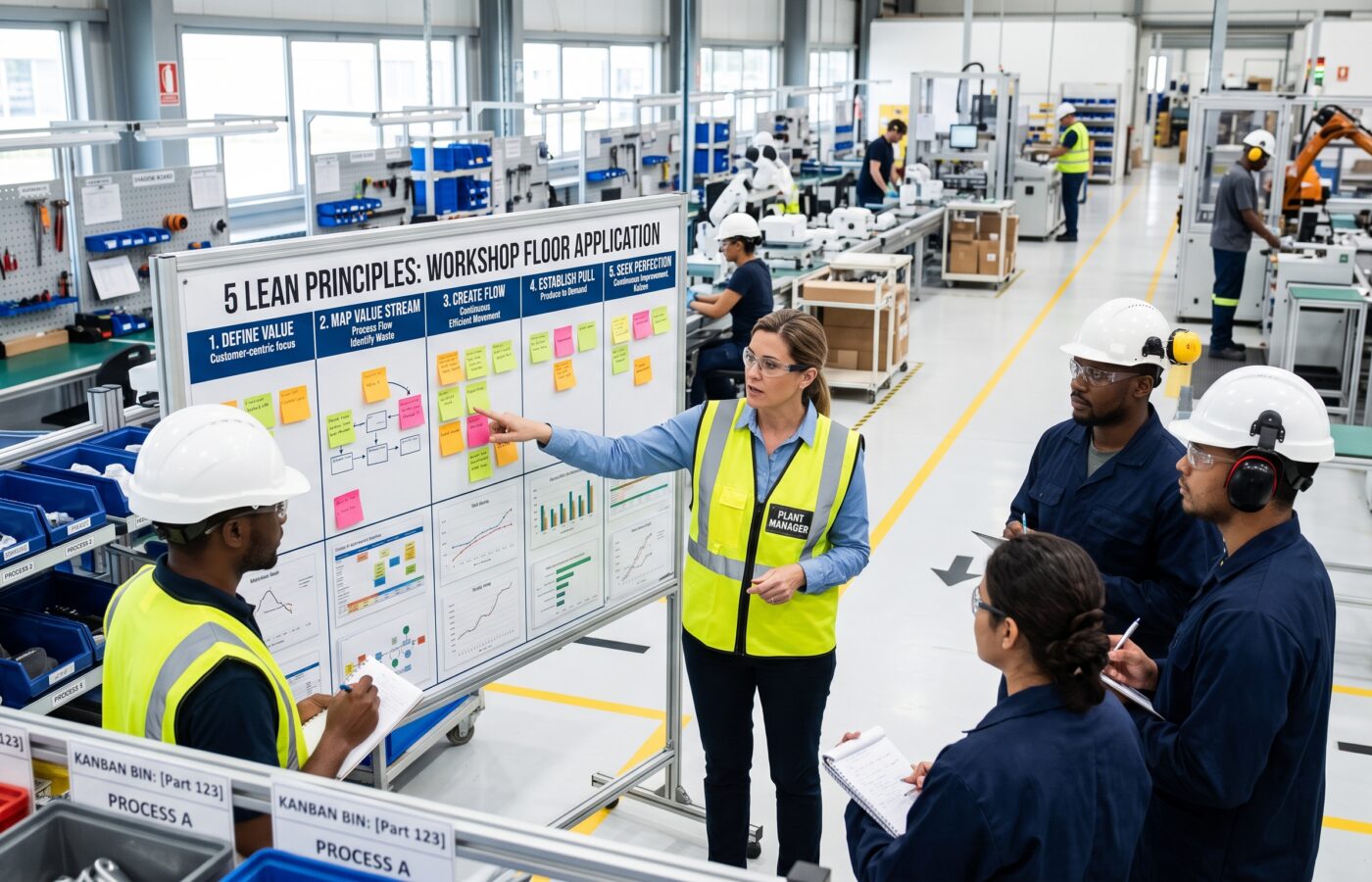
Fortunately, the thinking is not complicated. James Womack and Daniel Jones, who founded the Lean Enterprise Institute in 1997, boiled it down to five core ideas: value, value stream, flow, pull, and perfection. These lean manufacturing principles came out of years studying Toyota’s vehicle plants. As a result, they remain the most useful framework I know for running a plant that gets better every month instead of just busier.
Moreover, lean is hardly a niche practice anymore. In fact, a census of manufacturers by IndustryWeek found that close to 70 percent of U.S. plants had adopted lean as their improvement approach. But adoption is not the same as results. Indeed, plenty of those plants have the vocabulary and none of the discipline.
So let me walk you through each principle the way I would explain it to a plant manager standing next to me on the floor. There will be no theory for the sake of theory. Instead, I will cover what each principle means, what it looks like when it is done well, and where I see managers go wrong.
Why Lean Manufacturing Principles Still Matter for Plant Managers
Before we get into the five, it helps to be clear about what lean is really for.
First of all, lean is not a cost cutting program. If your people believe it is, they will quietly resist it, and frankly, they will be right to. After all, nobody wants to help design their own layoff.
Rather, lean is a way of seeing. It trains you and your team to separate the work a customer would gladly pay for from everything else that happens around it. Once you can see that difference clearly, the improvements become obvious. Better still, most of them cost very little.
In addition, the plant manager sits in the perfect spot to make this happen. You have authority over the floor, the budget, the schedule, and most importantly, the tone. Consequently, your supervisors watch what you pay attention to. For instance, if you walk the floor asking about output numbers only, they will chase output. On the other hand, if you walk the floor asking where the work is waiting and why, they will start looking for waiting. That shift in attention is where lean begins.
Principle 1: Define Value From the Customer’s Point of View
All the other lean manufacturing principles start here. Unfortunately, it is also the principle most plants skip.
The Lean Enterprise Institute describes this first step as defining value through the eyes of the end customer, expressed as a specific product that meets their needs at a specific price and time. Read that carefully. In short, value is not what your engineers think is impressive. Likewise, it is not what your sales team promised last quarter. Instead, it is what the customer will actually pay for.
A simple exercise for your management team
Here is a simple exercise I run with management teams. First, pick one product family. Next, ask each person in the room to write down what the customer values most about it. As a rule, you will get a surprising spread of answers. For example, the quality manager writes “zero defects.” Meanwhile, the scheduler writes “on time delivery.” Similarly, the sales lead writes “price,” while the engineer writes “tight tolerances.”
Let the customer break the tie
All of those might matter. Even so, you need the customer to break the tie. Therefore, pull your top five customers’ complaints, returns, and scorecards from the past year. Automotive OEMs, for example, score their parts suppliers on exactly these measures. Also talk to their buyers and their receiving docks. For instance, in one metal fabrication plant I supported, leadership was convinced customers cared most about finish quality. However, the data told a different story. The top complaint by a wide margin was inconsistent lead times. In other words, customers could live with a minor cosmetic flaw. Yet they could not live with not knowing when parts would arrive.
As a result, that single insight changed where the plant invested its improvement effort for the next two years.
What this looks like in practice
Once you know what the customer values, you can then start classifying the work in your plant into three buckets:
- Value added work. This transforms the product in a way the customer cares about and would pay for, such as machining, welding, assembly, and painting.
- Necessary but non value added work. The customer would not pay for it; however, you cannot eliminate it today. Examples include regulatory inspection, certain changeovers, and required documentation.
- Pure waste. Here, nobody benefits. Typical examples are waiting, excess motion, overproduction, rework, and searching for tools.
Accordingly, the goal is to protect the first bucket, shrink the second over time, and attack the third relentlessly.
Where plant managers go wrong
The most common mistake is defining value internally. For example, I see plants optimize machine utilization because it looks good on a report. Meanwhile, customers wait weeks for orders sitting in finished goods behind the wrong products. After all, a machine running at full speed making things nobody ordered is not creating value. Instead, it is creating inventory.
Principle 2: Map the Value Stream
Once value is defined, you then need to see every step that delivers it. That is the value stream. Of all the lean manufacturing principles, this is the one that opens eyes the fastest.
Essentially, the idea is to identify every step in the value stream for each product family and eliminate the steps that do not create value wherever you can. The tool for this is value stream mapping. Admittedly, if you have never done one properly, it will change how you look at your operation.
What a good value stream map captures
To begin with, a good value stream map follows the product and the information from the moment an order arrives until the finished part ships. It captures cycle times, changeover times, inventory between steps, uptime and overall equipment effectiveness, and how many people touch the product. Just as importantly, it also maps how information flows. For example, how does the order get to the floor? Who schedules each department? And how many times does someone re enter the same data?
Walk it, do not draw it from the office
I cannot stress this enough. Above all, go to the floor. Walk the path of the product with a pencil, a stopwatch, and a clipboard. Then count the inventory in front of each process yourself. Finally, ask the operators what they are waiting on.
The first time I mapped a value stream with a team at a plastics plant, the total processing time for a finished part was about eleven minutes. By contrast, the total lead time from raw material to shipment was nineteen days. In other words, the product was actually being worked on for a tiny fraction of the time it spent in the building. The rest of the time it simply sat in queues, in racks, and on pallets, waiting for the next department to be ready.
That ratio is common. In fact, I rarely see a plant where value added time is more than a small percentage of total lead time on the first map. It is humbling; nevertheless, it is exactly the point. The map shows you that your biggest opportunities are not in making machines faster. Instead, they are in reducing the waiting between them.
Current state and future state
First, map the current state honestly, including the ugly parts. Then, with your team, draw a future state that you could realistically reach in six to twelve months. As a result, the future state becomes your improvement plan. From then on, every kaizen event, every project, and every capital request should connect back to closing the gap between those two maps.
Where plant managers go wrong
There are two traps here. The first is mapping the entire plant at once. Instead, pick one product family that represents meaningful volume and start there. The second is treating the map as a deliverable. For example, a value stream map framed on the conference room wall is decoration. In contrast, a map that gets updated and argued over every month is a management tool.
Principle 3: Create Flow
With waste identified, the next of the lean manufacturing principles is making the remaining steps flow smoothly, one after another, without stops.
Specifically, LEI frames this as making the remaining value stream steps flow, breaking down barriers between functions, and organizing around products to sharply cut lead time. Put simply, the product should move steadily from one value added step to the next without piling up.
Traditional plants, however, are organized by function. For instance, all the presses sit in one area, all the welders in another, and all the paint lines at the far end of the building. As a result, every part travels back and forth, gets batched, gets stored, and waits for the next department. That design certainly feels efficient to each department manager. Yet it is terribly inefficient for the product.
Reduce batch sizes
Large batches create large queues. For example, if your welding cell processes parts in batches of 500, every part in the batch waits for the other 499. Consequently, if you cut the batch, the wait shrinks with it. Where you can, therefore, work toward one piece flow.
Attack changeover time
The main reason plants run big batches is that changeovers take too long. Single Minute Exchange of Die, usually called SMED, is the discipline of separating what must happen while the machine is stopped from what can be prepared while it is still running. For instance, I have seen press changeovers drop from ninety minutes to under fifteen with nothing more than organized tooling carts, standardized heights, and a checklist. In turn, shorter changeovers make smaller batches economical, and smaller batches create flow.
Rethink your layout
Lean layouts tend to favor smaller equipment dedicated to a single product family over large machines that are hard to move. Likewise, moving equipment into cells arranged in process order can eliminate enormous amounts of transport and handling. One of the more memorable goals I have heard from a plant manager was simply “no forklifts on the production floor.” As it turned out, it forced a complete rethink of how material moved. In the end, the plant was safer and faster for it.
Balance the work to takt time
Takt time is your available production time divided by customer demand. In effect, it tells you how often you need to complete a unit to keep pace with the customer. So when each station’s work is balanced close to takt, the line moves together. Otherwise, some stations starve while others drown.
Where plant managers go wrong
Flow exposes problems. Once you remove the inventory buffers, every machine breakdown, every quality issue, and every missing part suddenly stops the line. Understandably, many managers panic at this point and add the inventory back. Nevertheless, resist that urge. The inventory was hiding problems, not solving them. Flow, on the other hand, makes problems visible so you can fix them for good. This is also why reliable equipment and solid preventive maintenance are prerequisites for flow rather than afterthoughts.
Principle 4: Establish Pull
Flow moves the product smoothly. Pull, meanwhile, makes sure you are only moving what the customer actually needs. In my experience, it is also the most misunderstood of the lean manufacturing principles.
In a push system, you build to a forecast and a schedule. Then you push product downstream whether or not the next process is ready for it. Since forecasts are always wrong to some degree, push systems create overproduction. Moreover, overproduction is the most dangerous waste of all because it hides every other waste.
By contrast, a pull system supports just in time production, where products are made when they are needed and only in the quantities needed. In this case, downstream processes signal upstream processes when they need more. Thus, nothing is made until there is a signal.
How pull works on a real floor
The classic tool is kanban. Basically, a kanban is a signal, often a card, a bin, or a marked space on the floor, that tells the upstream process to replenish. For example, when a bin of components empties at the assembly line, it goes back to the supplying cell. That empty bin is then the authorization to make more. In short, no bin means no production.
Personally, I like to start teams with a simple two bin system on a handful of high use parts. After all, it is easy to understand and easy to maintain. Plus, it teaches the logic of pull faster than any classroom session.
Additionally, for processes that cannot be linked directly, use supermarkets, which are controlled inventory locations with a set maximum. Alternatively, use first in, first out lanes that cap how much work can sit between two processes.
Level the schedule
Pull works best when demand on the floor is steady. That is where heijunka, or production leveling, comes in. For instance, instead of running all of product A on Monday and all of product B on Thursday, you mix production in smaller increments. As a result, the upstream processes see a steady, predictable signal. Admittedly, this takes discipline from your scheduling team and sometimes a hard conversation with sales. Even so, it smooths out the entire operation.
Where plant managers go wrong
Pull cannot be installed on top of chaos. In fact, pull performs well only when the earlier lean foundations are already reasonably solid. For example, if your changeovers are long, your equipment is unreliable, and your quality is unstable, a kanban system will simply stop the line over and over. Therefore, build flow and stability first. Only then should you introduce pull, one loop at a time.
Principle 5: Pursue Perfection Through Continuous Improvement
The fifth of the lean manufacturing principles is the one that separates plants that “did lean” from plants that are lean.
Once value is defined, value streams are mapped, waste is removed, and flow and pull are in place, you start the cycle again. Then you keep going, working toward a state where value is created with no waste. Of course, perfection is never reached. That, however, is the point. It is a direction, not a destination.
As ASME has noted, finishing the first four steps is a great start. Still, the fifth is arguably the most important because it makes lean thinking part of company culture. I agree completely. In my experience, every lean transformation I have seen fail had decent tools and weak culture. Conversely, every one I have seen succeed had leadership that treated improvement as part of the daily job rather than a special project.
Go to the gemba every day
Gemba means the actual place where work happens. So block time on your calendar for a floor walk and protect it like a customer meeting. However, do not walk to inspect. Instead, walk to learn. For instance, ask operators what got in their way yesterday. Then do something about it, and afterward, tell them what you did.
Run tiered daily huddles
Hold a short stand up meeting at the start of each shift, first at the cell level, then the department level, and finally the plant level. During it, review safety, quality, delivery, and cost. That way, you surface problems quickly and escalate what the team cannot solve. Ideally, it takes fifteen minutes, standing, at a visual board, rather than an hour in a conference room.
Standardize the work
You cannot improve a process that is done differently by every shift. For this reason, standard work captures the current best known method. It is not meant to be permanent, though. Rather, it is the baseline you improve from. So when someone finds a better way, you update the standard.
Use a structured problem solving method
Plan, Do, Check, Act is the backbone. In addition, A3 problem solving is a great format for making thinking visible on a single sheet of paper. Most importantly, problems get solved at the root cause instead of being patched.
Engage everyone on the floor
The operator who runs the machine eight hours a day knows things about it that no engineer will ever learn from a spreadsheet. Consequently, a good suggestion system, one that responds quickly and implements small ideas without bureaucracy, is one of the most powerful tools you have. For example, I have watched simple operator ideas, like relocating a tool holder or adding a guide pin to a fixture, eliminate problems that had frustrated engineering for months.
Where plant managers go wrong
The biggest mistake is delegating culture. In other words, you cannot hire a continuous improvement manager, hand them lean, and walk away. Your team watches what you do far more than what you say. So if you skip the floor walks when things get busy, ignore the huddle board, or reward firefighting over prevention, the culture will follow your example.
The second mistake is measuring the wrong things. For instance, if your scorecard celebrates tons produced and machine utilization, people will overproduce. Instead, measure lead time, first pass yield, on time delivery, and inventory turns. Unlike utilization, those numbers reward flow.
Putting the Five Principles Together
These lean manufacturing principles are not a menu where you pick your favorite. On the contrary, they build on one another in sequence.
First, value tells you what matters. Next, the value stream shows you where it is being lost. Then flow removes the stops. After that, pull keeps you from making the wrong things. Finally, perfection keeps the whole cycle turning.
A twelve month roadmap for lean manufacturing principles
If I were starting fresh in a plant tomorrow, here is roughly how I would approach it:
- Month one. First, pick one product family. Then talk to customers and define value. Also walk and map the current state value stream with a small team drawn from production, maintenance, quality, and scheduling.
- Months two and three. Next, draw the future state. Then launch focused improvement events on the biggest sources of waiting, which are usually changeovers and batch sizes. At the same time, start daily huddles in the pilot area.
- Months four through six. After that, rearrange the pilot area toward flow. Meanwhile, stabilize equipment with basic preventive maintenance. Likewise, write standard work for key operations.
- Months six through twelve. Then introduce pull loops between the stabilized processes. Afterward, begin leveling the schedule. Finally, update the value stream map and start the next cycle.
- Every day throughout. Above all, walk the floor. Keep asking questions. Remove obstacles. And recognize people who find problems.
Once the pilot works, take what you learned and spread it to the next product family. Toyota, for its part, calls this yokoten, which means sharing what works horizontally across the organization. In practice, that is how lean manufacturing principles move from one cell to an entire plant.
Final Thoughts
Ultimately, lean is not about tape on the floor or boards on the wall. Those are merely artifacts. Rather, lean is a way of thinking about work that puts the customer first, makes problems visible, and treats every person in the building as someone capable of making it better.
In my experience, the plant managers who get the most from lean are not the ones with the biggest budgets or the fanciest software. Instead, they are the ones who show up on the floor every day, curious and patient, asking why. So start with value. Next, map what you actually do. Then make it flow. After that, let the customer pull. And above all, never stop improving.
In the end, if you apply these five lean manufacturing principles with discipline and humility, your plant will not just run more efficiently. Beyond that, it will become a place where people want to solve problems. That, in turn, is the real competitive advantage, and nobody can copy it from you.
Frequently Asked Questions
What are the five lean manufacturing principles?
The five principles are value, value stream, flow, pull, and perfection. Originally, they were popularized by James Womack and Daniel Jones in Lean Thinking, and today they are taught by the Lean Enterprise Institute. Learn more at Lean Enterprise Institute.
Which lean principle should a plant manager start with?
Always start with value. After all, if you do not know what the customer is paying for, you cannot tell value added work from waste. See ASME’s overview of lean principles.
How long does it take to see results from lean manufacturing principles?
Focused improvements such as changeover reduction can show results within weeks. However, a true lean culture takes years and never really finishes. Read more at L2L.
What is the difference between a push and a pull system?
A push system builds to a forecast and moves product downstream regardless of need. In contrast, a pull system produces only when a downstream process signals it needs more, usually through kanban. See The Lean Way.
Do lean manufacturing principles work for small plants?
Yes. In fact, small shops often move faster because decisions reach the floor quickly. Moreover, most lean improvements cost little and rely on people rather than capital. See US EPA’s guide to lean.
How does plant layout support lean principles?
Arranging equipment into cells in process order cuts transport, handling, and inventory between steps. As a result, it directly supports flow. See TXM’s guide to lean plant layout.
References
- Lean Enterprise Institute. The Five Steps of Lean Implementation.
- ASME. 5 Lean Principles Every Engineer Should Know.
- US Environmental Protection Agency. Environmental Professional’s Guide to Lean and Six Sigma: Chapter 2.
- The Lean Way. The Five Principles of Lean.
- L2L. The 5 Lean Manufacturing Principles Explained Simply.
- TXM Lean Solutions. The Ultimate Guide to Lean Plant Layout.
- Jodoo. The 5 Lean Manufacturing Principles Explained.
- Lean Six Sigma Definition. 5 Lean Principles.