

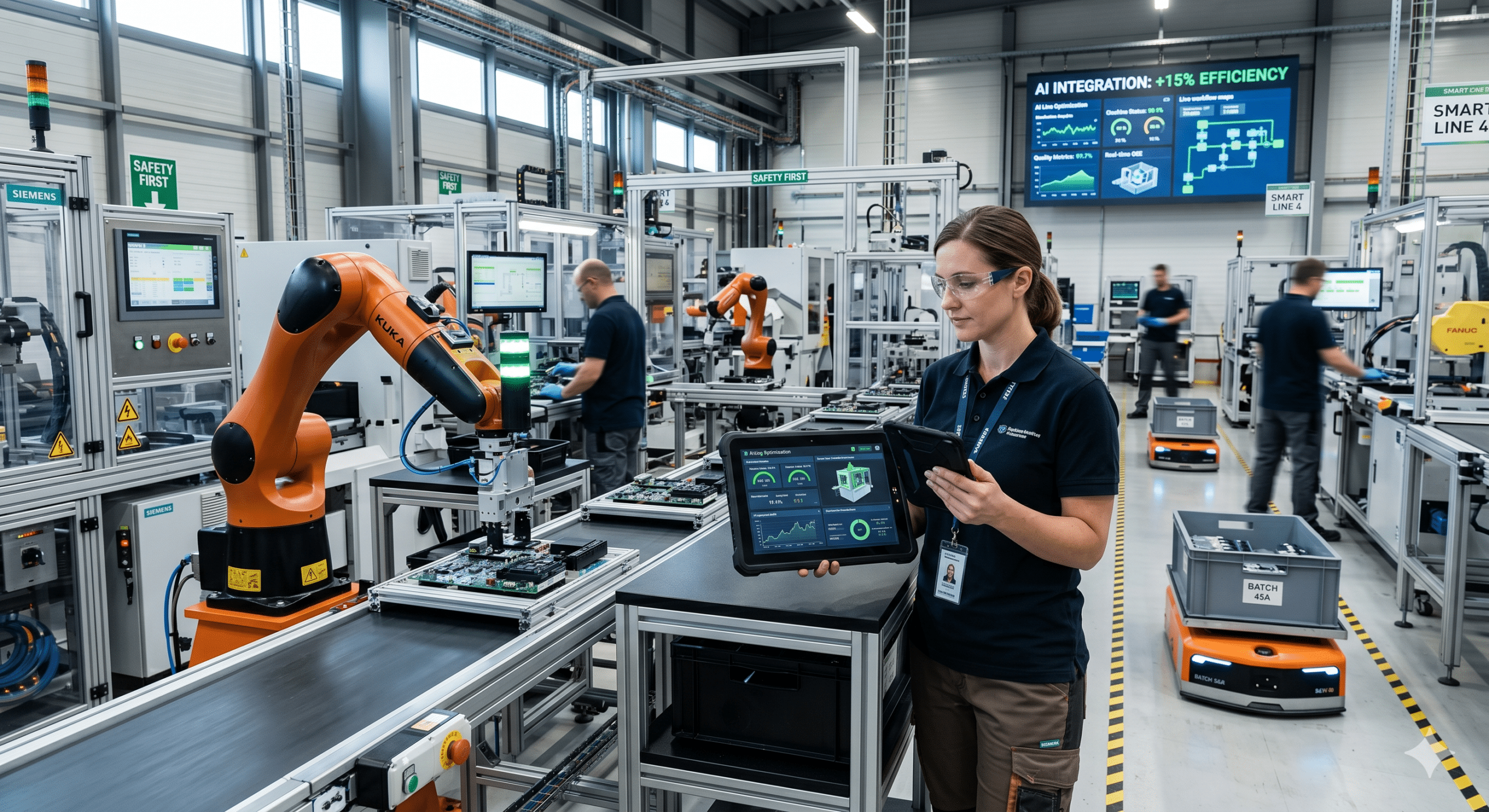
Manufacturing has always been about solving problems. For decades, factories have worked hard to improve production speed, reduce downtime, maintain product quality, and control operational costs. Engineers, operators, maintenance teams, and production managers constantly look for ways to make operations smoother and more reliable. However, as global competition becomes tougher, traditional manufacturing methods are no longer enough on their own.
That is where AI in manufacturing operations is changing the game.
Artificial Intelligence is no longer limited to tech companies or futuristic concepts shown in movies. Today, AI is becoming a practical tool inside factories, warehouses, and production facilities around the world. From predictive maintenance and quality inspection to inventory planning and production scheduling, AI is helping manufacturers make smarter decisions faster than ever before.
More importantly, AI is helping manufacturers move away from reactive operations and toward predictive, data-driven manufacturing environments.
As someone with a background in manufacturing and automation, I have seen how daily operational challenges can affect productivity. Unexpected machine breakdowns, recurring quality issues, inefficient scheduling, and rising operational costs can quickly impact an entire production line. In many facilities, teams spend countless hours solving problems after they happen. However, AI allows manufacturers to identify patterns early and take action before those problems become expensive disruptions.
That is one of the biggest reasons AI adoption in manufacturing continues to grow rapidly.
According to industrial technology reports and research from companies like Siemens and IBM, manufacturers are increasingly investing in AI technologies to improve operational efficiency, equipment reliability, and production visibility.
In this article, we will explore how AI in manufacturing operations works, where it delivers the biggest impact, the challenges manufacturers face during implementation, and why smart factories are becoming the future of industrial production.
What AI Means in Manufacturing Operations
When many people hear the term AI, they immediately think about humanoid robots or machines replacing workers. In reality, industrial AI is much more practical and focused on operational improvement.
In manufacturing operations, AI refers to systems that can analyze large amounts of production data, detect patterns, make predictions, and support faster decision-making.
Instead of relying only on manual monitoring, AI systems continuously study factory conditions and operational behavior.
For example, AI can help manufacturers:
- Predict machine failures before they happen
- Detect product defects automatically
- Improve production scheduling
- Optimize inventory levels
- Reduce energy consumption
- Monitor equipment performance in real time
- Improve overall operational efficiency
Think of AI as an intelligent layer added to factory operations.
The system constantly collects and analyzes data from sensors, machines, PLCs, SCADA systems, MES platforms, and production software. Then, it identifies patterns that humans may overlook.
For instance, a slight increase in vibration on a motor may indicate an upcoming bearing failure. Likewise, unusual temperature fluctuations may signal a developing process problem that could affect product quality.
Instead of reacting after problems occur, AI helps manufacturers prevent issues before they disrupt production.
That shift from reactive operations to predictive operations is one of the most important transformations happening in modern manufacturing today.
Why AI Is Becoming Essential in Manufacturing
Manufacturing facilities today face enormous pressure from every direction.
Customers expect faster deliveries, better quality, and lower prices. Meanwhile, manufacturers continue dealing with rising labor costs, supply chain disruptions, equipment downtime, and energy expenses.
As a result, operational efficiency has become more important than ever.
AI helps manufacturers improve efficiency in multiple areas at the same time.
Reducing Unplanned Downtime
Unexpected machine failures are among the most expensive problems in manufacturing.
One major breakdown can stop production lines, delay shipments, increase overtime costs, and damage customer relationships.
Traditionally, maintenance teams relied on scheduled maintenance or reactive repairs. However, both methods have limitations.
AI-powered predictive maintenance changes this approach completely.
Using sensors and real-time monitoring, AI systems analyze machine conditions continuously. They track vibration, temperature, pressure, motor current, lubrication performance, and other operational data.
Then, the AI system predicts when equipment may fail.
This allows maintenance teams to repair or replace components before serious breakdowns occur.
As a result, manufacturers reduce:
- Emergency downtime
- Maintenance costs
- Spare parts waste
- Production interruptions
In many factories, predictive maintenance alone can justify the investment in AI technology.
Improving Product Quality
Quality control is another major area where AI is delivering impressive results.
Traditional inspection methods often rely heavily on human operators. While experienced inspectors are valuable, manual inspections can become inconsistent over long shifts.
Fatigue, distractions, and repetitive tasks increase the risk of missed defects.
AI-powered vision systems help solve this problem.
Using cameras and machine learning algorithms, these systems inspect products automatically at high speed and with remarkable consistency.
AI inspection systems can detect:
- Surface scratches
- Assembly defects
- Missing components
- Packaging errors
- Dimensional inconsistencies
- Incorrect labeling
In electronics manufacturing, AI systems can identify tiny soldering issues that may be difficult for the human eye to catch consistently.
Meanwhile, in food manufacturing, AI can monitor packaging quality and detect contamination risks more effectively.
Because of this, manufacturers reduce scrap, improve product consistency, and strengthen customer satisfaction.
Optimizing Production Scheduling
Production scheduling is far more complex than many people realize.
Manufacturers must constantly balance:
- Machine availability
- Production targets
- Material supply
- Labor scheduling
- Maintenance activities
- Product changeovers
- Delivery deadlines
Manually adjusting schedules takes significant time, especially in facilities with multiple production lines.
AI helps production planners make faster and more informed decisions.
By analyzing real-time operational data, AI systems can recommend optimized schedules that improve throughput while minimizing bottlenecks and delays.
For example, AI may identify:
- Inefficient production sequences
- Hidden bottlenecks
- Underutilized equipment
- Scheduling conflicts
- Excessive changeover times
As a result, manufacturers improve productivity while reducing operational waste.
Common Applications of AI in Manufacturing Operations
AI is now being used across many areas of industrial operations. However, some applications provide faster returns and clearer operational improvements than others.
Let us explore the most impactful examples.
Predictive Maintenance
Predictive maintenance remains one of the most successful AI applications in manufacturing.
Traditional preventive maintenance often replaces parts based on fixed schedules, even when those parts are still functioning properly.
Meanwhile, reactive maintenance waits until equipment fails before taking action.
AI introduces a much smarter approach.
By monitoring equipment conditions continuously, AI systems predict maintenance needs based on actual machine behavior rather than assumptions.
This allows factories to:
- Prevent unexpected failures
- Extend equipment life
- Improve maintenance planning
- Reduce maintenance labor
- Lower spare parts inventory
For manufacturers running critical production equipment, these benefits can create significant long-term savings.
AI-Based Quality Inspection
AI-powered quality inspection systems are becoming increasingly common across many industries.
Unlike traditional rule-based inspection systems, AI continuously improves by learning from defect patterns over time.
This allows manufacturers to detect defects more accurately and consistently.
Industries using AI inspection include:
- Automotive manufacturing
- Electronics production
- Food processing
- Pharmaceutical manufacturing
- Packaging operations
- Consumer goods production
In high-speed manufacturing environments, AI inspection systems can analyze thousands of products quickly without sacrificing accuracy.
That level of consistency is difficult to achieve through manual inspection alone.
Smart Inventory and Supply Chain Management
Supply chain disruptions have become one of the biggest operational challenges for manufacturers worldwide.
AI helps improve forecasting and inventory planning by analyzing historical trends, supplier performance, customer demand, and logistics data.
As a result, manufacturers can better predict:
- Material shortages
- Inventory demand
- Supplier delays
- Seasonal fluctuations
- Production requirements
This allows companies to reduce excess inventory while maintaining better operational stability.
Lean manufacturing becomes more effective when supported by intelligent forecasting systems.
AI and Industrial Robotics
Industrial robots have existed for decades. However, AI is making robotics far more flexible and intelligent.
Traditional robots follow strict programming instructions and repetitive movement patterns.
AI-powered robots can adapt to changing conditions more effectively.
For example, AI-enabled robotic systems can:
- Detect unexpected obstacles
- Improve movement efficiency
- Learn repetitive tasks faster
- Adjust positioning automatically
- Work safely alongside human operators
Collaborative robots, also called cobots, are becoming increasingly popular because they allow safer human-machine interaction inside production environments.
This creates greater flexibility in modern manufacturing operations.
The Importance of Data in AI Manufacturing Systems
One important reality many manufacturers quickly discover is this:
AI depends heavily on reliable data.
Factories generate enormous amounts of operational information every day through:
- Sensors
- PLC systems
- SCADA platforms
- MES software
- ERP systems
- Production databases
However, many facilities still struggle with disconnected systems and inconsistent data collection.
Why Clean Data Matters
Before AI systems can provide accurate insights, manufacturers must improve:
- Data accuracy
- Connectivity
- Sensor integration
- Data standardization
- System communication
Without high-quality data, AI systems cannot deliver reliable predictions or recommendations.
That is why digital transformation and AI implementation usually go hand in hand.
Many manufacturers begin by modernizing their data infrastructure before scaling AI projects across operations.
Will AI Replace Manufacturing Workers?
This is one of the most common concerns surrounding AI adoption.
The reality is much more balanced than many people assume.
Manufacturing Still Needs Skilled People
AI will automate certain repetitive tasks, but manufacturing operations still rely heavily on skilled workers, engineers, technicians, and supervisors.
In fact, AI often enhances human decision-making rather than replacing it entirely.
Factories still need experienced people for:
- Troubleshooting
- Process optimization
- Maintenance strategy
- Safety management
- Engineering analysis
- Production leadership
- Continuous improvement initiatives
What changes is the nature of the work itself.
Instead of manually collecting production data, engineers can focus more on solving operational problems and improving performance.
Maintenance teams can shift from reactive repairs to predictive maintenance strategies.
Operators can focus more on process control and quality monitoring instead of repetitive inspection tasks.
As manufacturing evolves, workforce training becomes increasingly important.
Companies that invest in employee development alongside AI technology often achieve the best long-term results.
Challenges of Implementing AI in Manufacturing
Although AI offers significant benefits, implementation is not always simple.
Many manufacturers underestimate the complexity involved in integrating AI into existing operations.
Common Obstacles During AI Adoption
Several challenges frequently appear during AI implementation projects.
Legacy Equipment Integration
Many factories still operate older equipment that was never designed for modern connectivity.
Adding AI capabilities may require:
- Additional sensors
- Communication gateways
- Network upgrades
- Retrofit solutions
This can increase project costs and implementation time.
Cybersecurity Concerns
Connected manufacturing systems create new cybersecurity risks.
As factories become more digital, manufacturers must strengthen:
- Industrial network security
- Access control systems
- Data protection policies
- Operational cybersecurity strategies
Cybersecurity is now a critical part of smart manufacturing planning.
Employee Resistance
Some workers worry that AI may eventually replace jobs.
Because of this, communication and training are extremely important during implementation.
Companies that involve employees early in the process usually experience better adoption and stronger operational support.
Initial Investment Costs
AI implementation often requires investment in:
- Sensors
- Software platforms
- Cloud infrastructure
- Data systems
- Industrial networking
- Workforce training
However, many manufacturers recover these costs through long-term operational savings and improved productivity.
How Smaller Manufacturers Can Start Using AI
Many smaller manufacturers believe AI is only for massive global corporations with huge technology budgets.
That is no longer true.
Today, AI solutions are becoming more affordable and scalable for smaller facilities.
Manufacturers do not need to transform the entire factory overnight.
Instead, the best strategy is starting with one operational challenge.
Practical Starting Points for Small Manufacturers
Smaller manufacturers often begin with:
- Predictive maintenance on critical machines
- AI-based energy monitoring
- Automated quality inspection
- Production analytics dashboards
- Inventory forecasting systems
Starting small allows manufacturers to measure results, reduce risk, and build confidence before expanding AI adoption further.
Over time, these smaller projects can grow into larger smart manufacturing initiatives.
The Rise of Smart Factories
AI is becoming a major foundation of the modern smart factory.
Smart factories combine:
- Artificial Intelligence
- Industrial IoT
- Automation systems
- Real-time analytics
- Cloud computing
- Connected equipment
- Digital manufacturing platforms
Inside these facilities, machines, systems, and people communicate continuously.
This creates greater operational visibility and faster decision-making.
For example, smart factories can:
- Automatically adjust production parameters
- Detect quality issues instantly
- Monitor equipment remotely
- Optimize energy consumption
- Improve production scheduling dynamically
This level of operational intelligence was difficult to achieve just a decade ago.
Today, it is becoming increasingly common across modern manufacturing environments.
The Future of AI in Manufacturing Operations
AI adoption in manufacturing is still growing rapidly.
Over the next several years, factories will likely become even more intelligent, connected, and automated.
Future developments may include:
- Self-optimizing production systems
- AI-generated maintenance recommendations
- Advanced digital twins
- Autonomous process adjustments
- AI-assisted engineering design
- Real-time supply chain coordination
At the same time, manufacturers will place greater focus on explainable AI systems that engineers and operators can trust and understand.
Human expertise will remain essential.
The most successful factories will combine skilled people with intelligent systems rather than relying on technology alone.
Final Thoughts
AI in manufacturing operations is no longer just a future concept.
It is already transforming factories, improving operational efficiency, reducing downtime, enhancing product quality, and helping manufacturers compete in a rapidly changing industrial landscape.
Still, successful AI adoption requires more than simply installing new software or connecting machines.
Manufacturers need:
- Clear operational goals
- Reliable production data
- Strong leadership support
- Employee involvement
- Long-term improvement strategies
Most importantly, AI works best when combined with experienced manufacturing professionals who understand real-world factory operations.
Technology alone cannot solve every operational challenge.
However, when intelligent systems support skilled engineers, operators, and maintenance teams, manufacturing becomes more efficient, more reliable, and far more competitive.
The future of manufacturing will not depend on AI replacing people.
Instead, it will depend on how effectively manufacturers combine human expertise with smart industrial technology.