

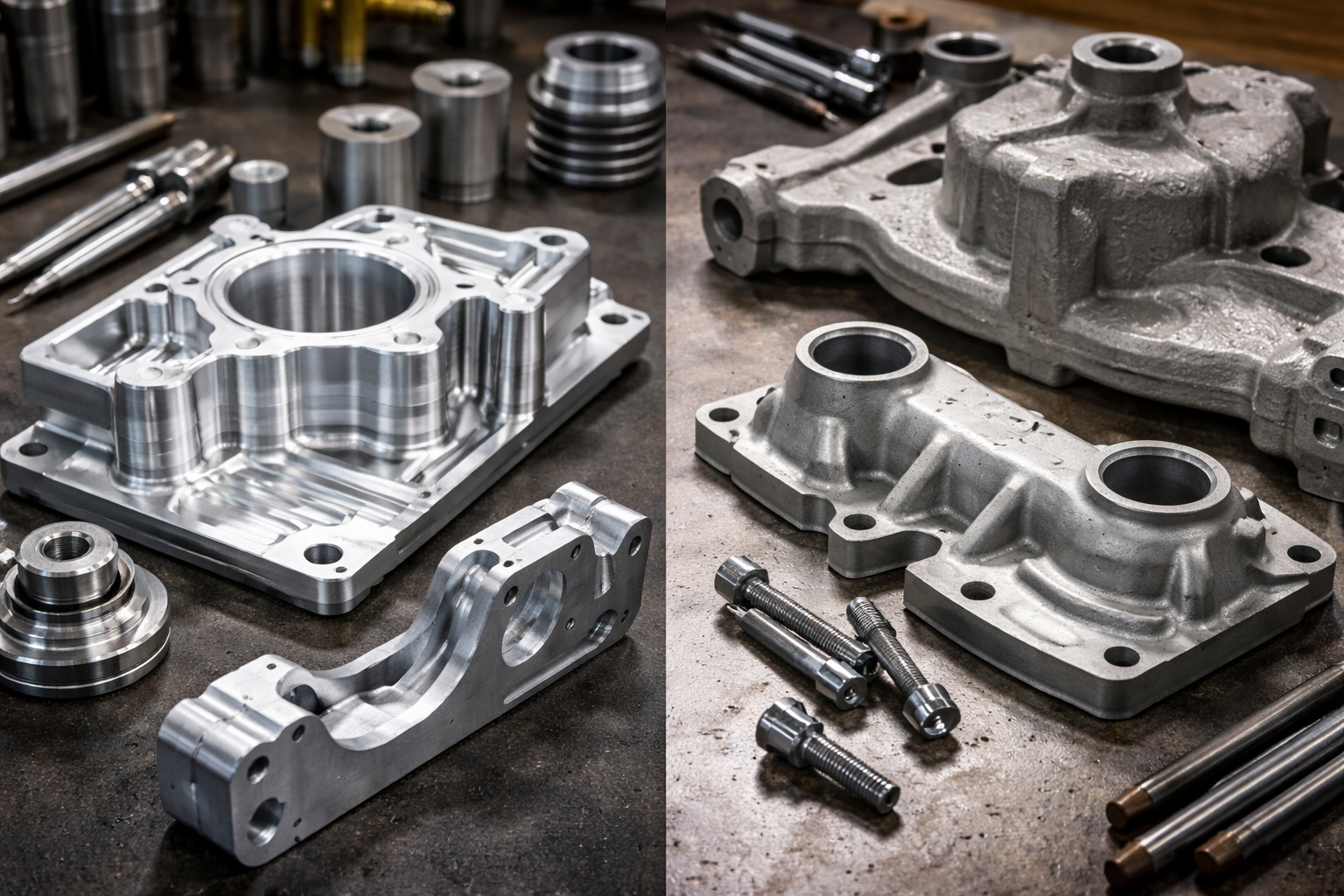
When comparing billet vs cast parts, engineers and manufacturers must understand how each method affects performance and production. These two approaches dominate industries like automotive and aerospace; however, they produce components with very different characteristics.
Therefore, choosing the right option directly impacts strength, durability, cost, and efficiency. In this guide, we explain how each method works, highlight their differences, and help you select the best solution for your needs.
What Are Billet Parts?
Manufacturers create billet parts by machining a solid block of metal into a finished component using CNC equipment. Instead of shaping molten material, they remove excess material to achieve precise dimensions.
How Billet Components Are Produced
First, manufacturers select a solid metal block. Next, CNC machines cut and shape the material. Finally, operators refine the part to meet exact tolerances.
As a result, this process produces components with a consistent internal structure and high accuracy.
What Are Cast Parts?
Manufacturers produce cast parts by pouring molten metal into a mold, allowing it to cool and form the desired shape. In contrast to machining, this method enables efficient production of complex designs.
How Casting Works
Initially, technicians heat metal until it melts. Then, they pour the liquid metal into a mold. After that, the material cools and solidifies. Finally, workers remove and finish the part.
Consequently, this approach supports large-scale manufacturing with consistent results.
Billet vs Cast Parts: Key Differences
| Feature | Billet Components | Cast Components |
|---|---|---|
| Process | CNC machining | Mold casting |
| Strength | High | Moderate to high |
| Accuracy | Excellent | Good |
| Cost | Higher | Lower (high volume) |
| Production Volume | Low to medium | High |
| Internal Structure | Uniform | May vary |
Overall, these differences influence performance, durability, and cost.
Benefits of Billet Parts
Higher Strength
Billet components deliver superior strength because manufacturers machine them from a solid block without internal voids. Therefore, they perform well under high stress.
Precision and Accuracy
CNC machining allows engineers to achieve tight tolerances. In addition, it ensures consistent dimensions across parts.
Reliable Material Structure
The uniform grain structure ensures predictable performance. As a result, billet parts maintain reliability in demanding environments.
Ideal for Custom Applications
Engineers often choose billet parts for custom builds. For example, racing components frequently rely on billet machining.
Benefits of Cast Parts
Lower Production Cost
Manufacturers reduce costs by producing large volumes using molds. Therefore, casting becomes more economical for mass production.
Complex Design Capability
Casting allows engineers to create intricate shapes. In contrast, machining alone may struggle with such complexity.
Efficient Material Usage
The process minimizes waste. As a result, manufacturers improve material efficiency.
Scalable Production
Once manufacturers create molds, they can scale production quickly. Consequently, casting supports high-volume manufacturing.
Performance Comparison
Strength and Durability
Billet parts handle stress more effectively due to their solid structure. However, modern casting techniques also produce durable components for many applications.
Weight Optimization
Engineers can remove material precisely during machining. Therefore, billet components allow better weight optimization.
Long-Term Reliability
Billet components often last longer in high-stress environments. Meanwhile, cast parts perform reliably in standard conditions.
Applications of Billet Components
Manufacturers use billet parts in several industries. For example:
- High-performance automotive systems
- Aerospace components
- Custom-engineered parts
- Racing applications
These industries require precision and strength; therefore, billet machining becomes the preferred choice.
Applications of Cast Components
Manufacturers rely on cast parts for many applications. For instance:
- Engine blocks
- Transmission housings
- Structural automotive components
- Industrial machinery
In these cases, cost efficiency and scalability matter most.
Manufacturing Considerations
When evaluating production methods, this production method comparison explains how machining, casting, and forging differ in cost, precision, and scalability.
Production Time
Machining billet parts takes longer because operators remove material step by step. However, casting allows faster production once molds are ready.
Tooling Requirements
Billet machining requires minimal setup. On the other hand, casting requires mold creation before production begins.
Design Flexibility
Engineers can quickly modify billet designs. In contrast, changing cast components requires new molds.
Cost Analysis
Cost plays a major role in material selection. Generally:
- Billet parts cost more due to machining time and waste
- Cast parts reduce unit cost in large production runs
Therefore, manufacturers must balance performance and budget when choosing between the two.
Quality and Material Integrity
Billet Components
Billet parts maintain consistent material properties. In addition, they avoid internal defects and deliver reliable performance.
Cast Components
Cast parts may develop porosity or air pockets. However, advanced casting methods significantly reduce these issues.
Choosing Between Billet and Cast Parts
Choose Billet Parts When:
- You need high precision
- Strength is critical
- Production volume is low
- Customization is required
Choose Cast Parts When:
- You need large-scale production
- Cost efficiency is important
- Complex shapes are required
- Moderate strength is acceptable
Hybrid Manufacturing Approach
Many manufacturers combine both methods. For example, they cast a base structure and machine critical areas for precision.
As a result, this approach balances cost, strength, and scalability.
Future Trends in Manufacturing
Manufacturers continue to improve both processes. For instance:
- Faster CNC machining technologies
- Advanced casting techniques
- Stronger and lighter alloys
- Automation and smart systems
Consequently, these innovations improve quality and reduce production costs.
Conclusion
The comparison of billet vs cast parts depends on performance needs, budget, and production scale. Billet components offer superior strength and precision. In contrast, cast parts provide cost-effective solutions for large-scale manufacturing.
Ultimately, by understanding these differences, you can select the best method—or combine both—to achieve optimal results.