

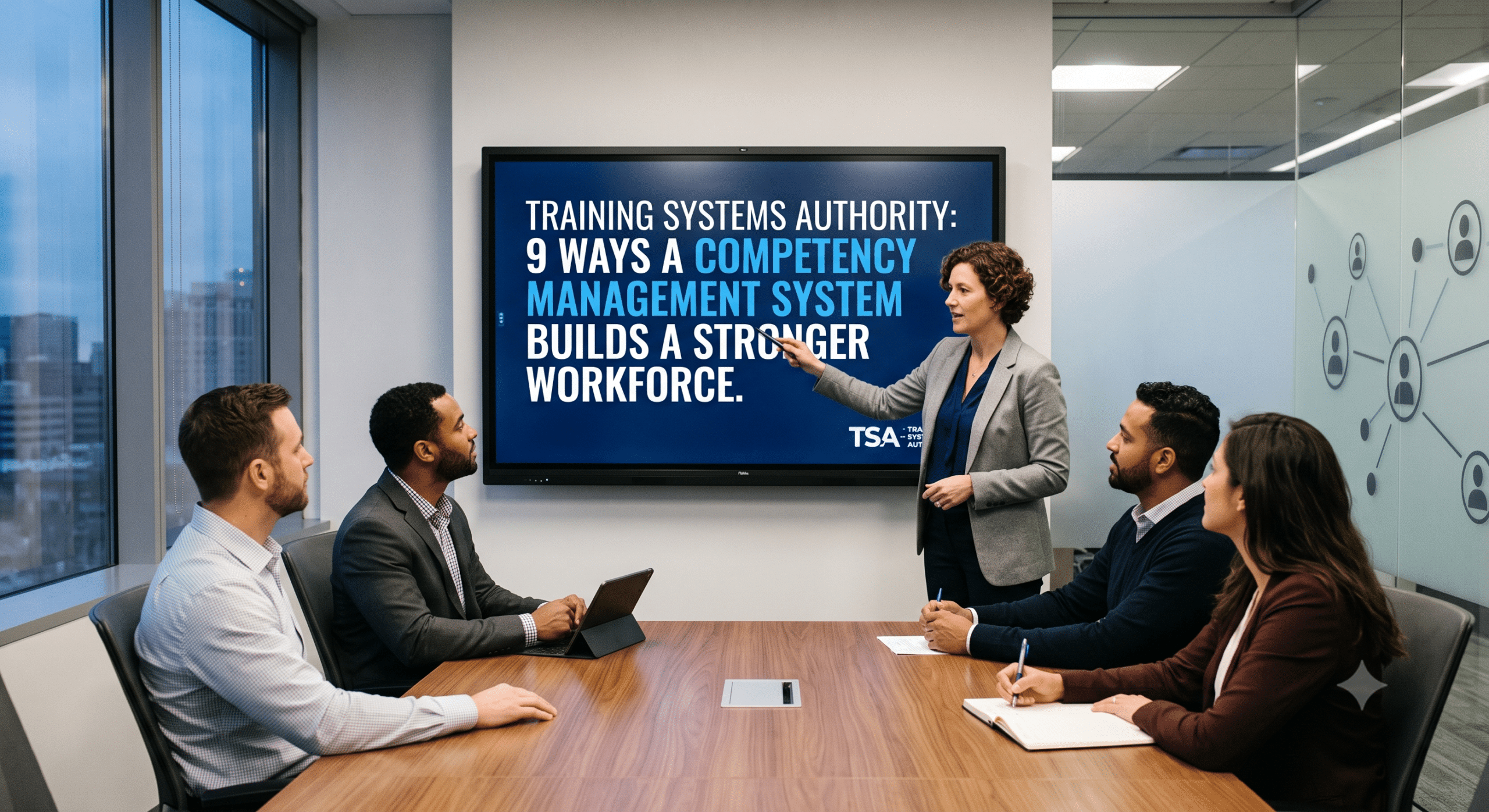
Modern organizations invest thousands of dollars in employee training every year, yet without a robust competency management system, many leaders still ask the same question: “Are our people actually becoming more capable?”
As an Instructional Systems Designer (ISD) and Learning Architect, I’ve learned that training alone doesn’t improve performance. Instead, employees become better when learning is connected to measurable skills, job expectations, and business outcomes.
This is precisely how focusing on demonstrated ability changes everything.
Specifically, instead of tracking only completed courses, a competency management system measures whether employees can perform their jobs successfully. Consequently, it gives organizations a clear picture of workforce capabilities, identifies skill gaps, and helps training teams create learning that produces real results.
Furthermore, a Training Systems Authority should never operate as a mere course administrator. Rather, it should serve as the organization’s engine for workforce capability, ensuring every learning initiative supports operational excellence, compliance, and future growth.
In this guide, I’ll explain exactly how instructional designers can use a competency management system to build better training programs, improve employee performance, and ultimately prepare organizations for long-term success.
What Is a Training Systems Authority?
A Training Systems Authority is the function responsible for planning, governing, improving, and evaluating an organization’s learning ecosystem.
Rather than simply delivering training sessions, this team establishes standards for:
-
Learning design
-
Skills validation
-
Competency assessment
-
Employee development
-
Certification pathways
-
Performance improvement
-
Compliance training
-
Workforce readiness
-
Continuous learning
Ultimately, the goal isn’t to create more training. Conversely, the goal is to create more capable employees. Undoubtedly, that is an important difference.
For instance, when organizations focus only on training completion, employees may finish dozens of courses without improving performance. However, when organizations focus on competencies, learning becomes measurable, practical, and business-driven.
As a result, competency-based learning has become the foundation of many workforce development frameworks because it measures demonstrated ability rather than seat time. Moreover, government agencies and workforce organizations increasingly emphasize competency standards as the basis for training, assessment, and certification. (Civil Service Commission)
What Is a Competency Management System?
A competency management system is a structured process—or software platform—that helps organizations define, measure, develop, and monitor employee competencies.
Essentially, think of it as a GPS for workforce capability.
Instead of asking, “Which course did this employee complete?” it asks: “Can this employee consistently perform the job to the required standard?”
Typically, a competency management system includes:
-
Competency frameworks
-
Job profiles
-
Skill libraries
-
Role expectations
-
Assessment tools
-
Learning recommendations
-
Certification tracking
-
Performance dashboards
-
Development plans
Thereby, the system connects learning directly to workplace performance, helping organizations identify strengths, close skill gaps, and support succession planning. (HashMicro)
Why Traditional Training Often Falls Short
Many organizations still evaluate training using simple metrics like:
-
Number of attendees
-
Completion rates
-
Course satisfaction
-
Hours of learning
-
Training budget
Admittedly, these numbers are easy to collect. Unfortunately, they don’t tell us whether employees became better at their jobs.
To illustrate, consider a maintenance technician who completes:
-
Electrical Safety
-
Equipment Inspection
-
Lockout/Tagout
-
PLC Basics
The employee receives four certificates. Yet, can they diagnose a machine failure safely and independently? Clearly, traditional reporting can’t answer that. A competency management system, however, can.
The Shift Toward Competency-Based Learning
Across industries, organizations are moving away from training-hour requirements and instead leaning toward demonstrated competence.
Accordingly, this approach focuses on:
-
Observable behaviors
-
Practical skills
-
Decision-making
-
Knowledge application
-
Workplace performance
Instead of measuring learning by time spent in class, competency-based learning measures what employees can actually do on the job.
Consequently, this shift aligns training with operational performance and supports more reliable workforce development. Furthermore, recent competency-based training initiatives in regulated industries, including aviation, emphasize demonstrating knowledge, skills, and behaviors in real-world settings rather than simply completing prescribed training hours. (Philippine News Agency)
Why Instructional Designers Should Lead This Change
Many people assume competency management belongs only to Human Resources. However, I disagree.
Instructional Systems Designers inherently understand:
-
Learning objectives
-
Assessment design
-
Performance analysis
-
Adult learning principles
-
Curriculum mapping
-
Evaluation strategies
Indeed, these are exactly the skills needed to build an effective competency management system. While HR defines talent needs and Operations defines performance expectations, Learning architects ultimately connect both worlds.
The Relationship Between Training and Competencies
Training is only one part of employee development. Meanwhile, competencies are the destination.
Imagine, for example, driving across the country. Training is the vehicle. Competencies are the destination. Obviously, without knowing the destination, the journey has little value.
Likewise, organizations shouldn’t create courses until they understand which competencies employees must master. Therefore, this is why modern instructional design begins with competency analysis—not content creation.
9 Reasons Every Organization Needs a Competency Management System
1. It Aligns Learning With Business Goals
The best training programs support business objectives.
For example, if the business goal is to reduce manufacturing defects by 25%, the required competencies might include:
-
Equipment calibration
-
Process inspection
-
Root cause analysis
-
Quality documentation
Consequently, instead of creating random learning courses, instructional designers develop targeted learning experiences that strengthen these competencies. Thus, every course now supports measurable business improvement.
2. It Identifies Real Skill Gaps
Managers often rely on assumptions when identifying training needs. In contrast, a competency management system replaces assumptions with evidence.
Specifically, it compares:
-
Required competency
-
Current competency
-
Desired proficiency
Thereby, this creates accurate development plans. Rather than sending everyone to the same training, organizations invest exactly where improvement is truly needed.
3. It Creates Consistent Standards
Different supervisors often evaluate employees differently. For instance, one supervisor says an employee is excellent, whereas another says they’re average.
Therefore, a competency framework reduces subjectivity by defining expected behaviors and proficiency levels for every role, helping create more consistent evaluations across the organization. (Civil Service Commission)
4. It Improves Learning Design
Instructional designers no longer create courses based on opinions. Instead, they design learning around measurable competencies.
Consequently, every module answers one important question: “Which competency does this improve?” Undeniably, this simple shift dramatically increases learning effectiveness.
5. It Supports Better Performance Reviews
Performance reviews often become difficult because managers rely on memory instead of evidence. However, a competency management system provides measurable data that supports fair, consistent evaluations. Instead of discussing vague impressions, managers can review demonstrated competencies and documented progress.
For example, a customer service representative might be evaluated in areas such as:
-
Product knowledge
-
Communication
-
Conflict resolution
-
Customer empathy
-
Problem-solving
-
CRM system proficiency
Because each competency has clear performance indicators and proficiency levels, this approach turns annual reviews into ongoing coaching conversations rather than one-time judgment sessions. Additionally, employees also know exactly what is expected of them, making career growth more transparent.
6. It Makes Learning Personal
No two employees have the same strengths or development needs. Yet, traditional training often places everyone in the same classroom, regardless of experience.
Conversely, a competency management system allows organizations to personalize learning.
To illustrate:
-
Employee A has excellent technical skills but needs leadership development. Thus, their learning path includes Coaching Skills, Team Communication, and Performance Feedback.
-
Employee B has strong leadership but limited technical knowledge. Accordingly, their learning path includes Equipment Operation, Safety Procedures, and Quality Standards.
Instead of wasting time on unnecessary training, employees focus on the competencies they actually need. As a result, personalized learning increases engagement because employees see immediate value in what they are learning.
7. It Strengthens Compliance Training
Compliance training is essential in industries such as healthcare, manufacturing, construction, energy, aviation, and food production. Nevertheless, completing compliance courses does not always mean employees can perform safely.
Therefore, a competency-based approach verifies that employees can apply required procedures in real work situations.
For instance, after completing lockout/tagout training, employees may need to demonstrate they can:
-
Identify hazardous energy sources
-
Follow isolation procedures
-
Verify zero energy
-
Complete required documentation
-
Restore equipment safely
Ultimately, this practical verification reduces workplace risk and supports stronger compliance programs. In fact, many regulatory agencies encourage organizations to verify employee competence, not just attendance records.
8. It Improves Succession Planning
One of the biggest challenges organizations face is preparing future leaders. Often, businesses discover too late that experienced employees are retiring or leaving without trained replacements.
Fortunately, a competency management system helps identify future talent early. Specifically, managers can compare current competencies against those required for leadership positions.
For instance, if a Production Supervisor is moving toward an Operations Manager role, they must bridge the gap between their current skills (Scheduling, Quality Oversight) and new requirements (Strategic Planning, Budget Management).
Consequently, employees can gradually develop these competencies through structured learning, mentoring, stretch assignments, and coaching. Thus, succession planning becomes a continuous process instead of an emergency response.
9. It Creates a Culture of Continuous Improvement
Organizations that rely on annual training often experience slow improvement. In contrast, organizations using competency management encourage learning every day.
Regularly, employees assess their progress, managers provide coaching, and learning teams update competency requirements as technology changes. As a result, the organization becomes more adaptable because learning never stops.
Moreover, this mindset is especially important as automation, artificial intelligence, and digital transformation continue to reshape nearly every industry. Ultimately, continuous improvement is no longer optional—it is a competitive advantage.
Building a Competency Management System: A Learning Architect’s Framework
Designing an effective competency management system requires careful planning. Accordingly, as an Instructional Systems Designer, I recommend following a structured framework.
Phase 1: Foundation and Alignment
Step 1: Identify Business Goals
Everything starts with organizational priorities. For example, examples include improving product quality, reducing workplace incidents, or expanding production capacity. Ultimately, training should always connect to measurable business outcomes.
Step 2: Define Job Competencies
Next, each role should have a clearly documented competency profile. Typically, these profiles include:
-
Knowledge: What employees need to understand.
-
Skills: What employees need to perform.
-
Behaviors: How employees should demonstrate competence.
-
Attitudes: Professional expectations that support organizational culture.
Crucially, competency definitions should be simple, observable, and measurable.
Phase 2: Assessment and Gap Analysis
Step 3: Establish Proficiency Levels
Not every employee needs expert-level performance. Therefore, most organizations define multiple proficiency levels, ranging from Beginner (requires supervision) to Expert (defines standards). Consequently, these levels create consistency across departments.
Step 4: Measure Current Competencies
Assessment methods may include practical demonstrations, written knowledge tests, or supervisor observations. Furthermore, using multiple assessment methods provides a more accurate picture of employee capability than relying on tests alone.
Step 5: Identify Skill Gaps
Gap analysis compares current competency against required competency. Subsequently, the difference becomes the employee’s development priority. Rather than assigning generic training, organizations can focus resources where they will have the greatest impact.
Phase 3: Learning Design and Validation
Step 6: Design Learning Experiences
This is exactly where Instructional Systems Designers add tremendous value. Depending on the need, learning solutions may include eLearning modules, job aids, or virtual reality simulations. After all, different competencies require different learning strategies.
Step 7: Validate Competence
Training completion should never be the final step. Instead, organizations should confirm that employees can consistently perform required tasks in the workplace. Namely, competence is demonstrated through performance—not simply by attending a course.
Step 8: Monitor and Improve
Competencies evolve as technology, regulations, and business priorities change. Therefore, a competency management system should be reviewed regularly to ensure it remains aligned with organizational goals. In short, continuous review keeps the system effective over time.
Common Mistakes Organizations Make
Even well-intentioned organizations can struggle when implementing a competency management system. Below are several common mistakes to avoid.
-
Building Competencies That Are Too Broad: Statements such as “Good communication” are difficult to measure. Instead, define observable behaviors like “Facilitates productive meetings.”
-
Confusing Training with Competence: Completing a course is an activity, whereas demonstrating a skill is an outcome.
-
Ignoring Manager Involvement: Managers play a critical role. Without their active participation, competency programs often lose momentum.
-
Failing to Update Competency Models: Industries change quickly. Consequently, competency frameworks should be reviewed periodically.
-
Measuring Too Many Competencies: Trying to track hundreds of competencies can overwhelm everyone. Instead, focus first on the competencies that have the greatest impact.
Technology Trends Shaping Competency Management
The future of the competency management system is being heavily influenced by digital transformation. As a result, learning is becoming smarter, faster, and more connected to everyday work. Here are several trends that every Training Systems Authority should watch.
-
Artificial Intelligence: AI is making competency management more efficient. However, AI does not replace instructional designers; rather, it gives them better data for making informed decisions.
-
Skills-Based Hiring: Many organizations are shifting away from hiring based only on degrees. Instead, they evaluate demonstrated competencies.
-
Learning Experience Platforms (LXPs): Modern LXPs recommend learning content based on competency gaps. Consequently, employees receive targeted recommendations.
-
Microlearning: Employees rarely have time for multi-hour training. Therefore, organizations increasingly deliver five-minute videos or quick reference guides.
-
Digital Credentials: Digital badges provide evidence that employees have achieved specific competencies. Unlike simple certificates, these represent verified workplace capability.
Measuring Success
Implementing a competency management system is only valuable if it produces measurable improvements. Therefore, as an Instructional Systems Designer, I encourage organizations to establish meaningful metrics before launching the system.
Specifically, examples include:
-
Employee Performance: Measure whether employees demonstrate improved job performance.
-
Skill Gap Reduction: Track how quickly identified competency gaps are closed. Thereby, this information helps prioritize future learning investments.
-
Training Effectiveness: Instead of measuring only completion rates, evaluate whether learning transfers to the workplace.
-
Employee Engagement: Employees are more engaged when they understand how learning supports their career goals.
-
Business Impact: Ultimately, every learning initiative should support organizational success. When competency management aligns with business strategy, learning becomes a strategic investment rather than an administrative expense.
Frequently Asked Questions
What is a competency management system?
A competency management system is a structured framework or software solution that helps organizations define, assess, develop, and monitor employee competencies. Essentially, it connects learning activities with measurable job performance instead of simply tracking completed training.
How is a competency management system different from a Learning Management System (LMS)?
A Learning Management System primarily delivers and tracks courses. In contrast, a competency management system focuses on whether employees can successfully perform required job tasks.
Who should own a competency management system?
While Human Resources often manages talent processes, the strongest results come from collaboration among HR, operational leaders, and the Training Systems Authority.
What industries benefit from competency management?
Almost every industry can benefit. In fact, any organization that depends on skilled employees can improve performance through competency management.
How often should competencies be reviewed?
Organizations should review competency frameworks at least once a year. However, industries experiencing rapid technological changes may need more frequent updates.
Can small businesses use a competency management system?
Absolutely. Initially, small businesses can begin with simple competency matrices before investing in dedicated software.
Final Thoughts
A Training Systems Authority has the opportunity to move beyond managing courses and become a strategic partner in organizational success. By implementing a competency management system, learning teams can ensure that every training initiative supports measurable performance, business objectives, and employee growth.
From an Instructional Systems Designer’s perspective, competency management shifts the conversation from “What training did employees complete?” to “What can employees do now that they couldn’t do before?” Undeniably, that change in mindset leads to stronger learning programs and a workforce that is prepared for future challenges.
Ultimately, the most successful organizations do not treat training as an isolated event. Instead, they build learning ecosystems where competencies are clearly defined, regularly assessed, and continuously developed. Whether your organization is just beginning its competency journey or refining an existing program, investing in a competency management system is one of the most practical ways to create a culture of continuous improvement and long-term workforce excellence.