

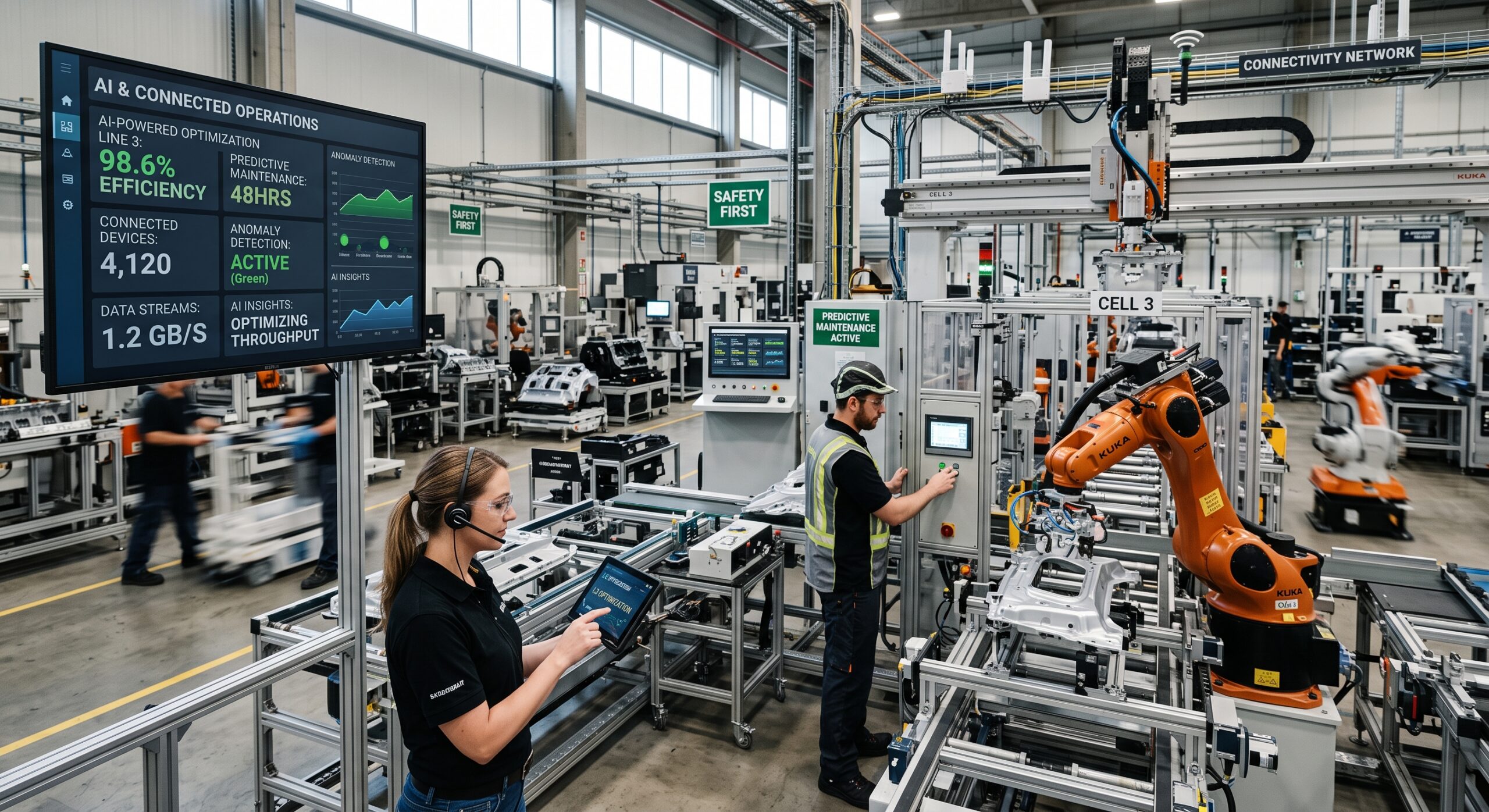
I’ve spent most of my career walking plant floors. I started as a controls engineer. Later I became an architect designing the digital backbone that ties machines, sensors, and software together. Twenty years ago I would have laughed at the idea. A stamping press, a vision camera, and a cloud dashboard, all holding a continuous conversation with each other? Not a chance. Today that conversation is the whole point. Connected factory systems are no longer a pilot project tucked away in a corner of the plant. They are becoming the operating layer that everything else runs on.
I’m writing from that vantage point, as someone who has designed these architectures and lived with the consequences of getting them right or wrong. I want to cover three things here. First, what connected factory systems actually are. Second, why pairing them with artificial intelligence changes the math on modern production lines. Third, what it takes to make that shift without breaking what already works.
What We Actually Mean by Connected Factory Systems
People throw the phrase around loosely, so let me be precise about it. Connected factory systems combine sensors, programmable controllers, edge gateways, industrial networks, and software platforms. Together, these let equipment, people, and enterprise systems share data in something close to real time. That last part matters. A plant that dumps machine logs into a spreadsheet once a shift is not connected in any meaningful sense. Compare that to a plant where a torque sensor on a fastening tool can trigger a quality hold, notify a supervisor’s tablet, and log the event to a historian within a couple of seconds. That’s connected.
The Building Blocks
The building blocks are not exotic. Most facilities already have programmable logic controllers, human machine interfaces, and some form of manufacturing execution system. What changes with a truly connected architecture is the plumbing between those pieces. It also takes a willingness to treat data as a product rather than a byproduct. I’ve walked into plants with genuinely impressive automation on individual lines. Nobody could tell me what yesterday’s scrap rate was by shift, not without pulling three people into a room. The equipment was smart. What surrounded it wasn’t.
Connected factory systems fix that by standardizing how data moves. Data travels from field devices through edge computing nodes, across an industrial network, and up into whatever combination of on premise servers and cloud services a company has chosen. Protocols like OPC UA and MQTT have done a lot of the heavy lifting here. They give engineers a common language, so a Siemens PLC, a Rockwell drive, and a third party vision system can all speak to the same historian. Nobody needs a custom translator for every pair of devices.
Why AI Needs This Layer, and Why AI Makes It Worth Building
Artificial intelligence gets most of the attention in trade press. But here’s the plain truth. The machine learning models that predict a bearing failure or spot a hairline crack in a weld need a steady, trustworthy stream of data underneath them. Without it, none of them actually work. A model is only as good as what it’s fed. On a factory floor, that feed comes from the connected layer. This is why I tell clients that the AI conversation and the connectivity conversation are the same conversation. You cannot buy a predictive maintenance algorithm off a shelf and bolt it onto a plant with no consistent way of capturing data. Vibration, temperature, and cycle time readings all need to flow reliably across every machine first.
The Return Once the Data Layer Exists
Once that data layer exists, though, the return on adding AI is substantial. Vision systems trained on thousands of images of good and bad parts can catch defects a tired human inspector misses at two in the morning. Scheduling algorithms that ingest live machine status, material availability, and order priority can resequence a line in seconds. A planner might not notice that same bottleneck for an hour. Energy management systems can shift non critical loads to off peak windows automatically. That used to require a facilities manager staring at a utility bill after the fact.
What the Numbers Show
The research backs up what I see in the field. Roughly 95 percent of manufacturers are now using or actively evaluating smart manufacturing technology, meaning some combination of IoT and AI tools. That’s a jump of about 12 percentage points in a single year. Separately, around 86 percent of manufacturers now call smart factory initiatives central to their competitive strategy, not a side experiment. That’s a meaningful shift in tone. Just three or four years ago, people often framed these projects as innovation theater rather than core operating strategy.
The economics are not subtle either. Predictive maintenance programs built on connected sensor data have shown real results. Unplanned downtime drops in the range of 35 to 50 percent, and overall equipment effectiveness gains commonly land between 20 and 25 percent. Payback periods for these projects tend to land somewhere between six and 18 months. That’s fast by the standards of most capital equipment decisions. And on the workforce side, the fear that automation guts headcount hasn’t matched what actually happened in recent years. The United States added nearly 800,000 manufacturing jobs between 2021 and 2023. That period coincided with heavy investment in smart factory technology, not despite it.
Where AI and IoT Meet on the Production Line
Integrating AI and IoT into modern production lines is really about building connected factory systems at a few distinct layers. It helps to separate them rather than treating “AI on the floor” as one big blob.
From Sensors to the Network
The sensor and edge layer carries the raw signal: current draw on a motor, pressure in a hydraulic line, images from a camera watching a conveyor. Edge computing matters here because sending every video frame to the cloud for analysis is neither fast nor cheap. Instead, a lot of inference now happens right at the machine, on a small industrial computer that can flag an anomaly in milliseconds and send only the summary, or the exception, upstream.
Next comes the network layer, where industrial protocols carry that data reliably even in an environment full of electrical noise, vibration, and heat. This is the least glamorous part of the whole stack, and also the part most likely to sink a project if it’s rushed. I’ve seen more AI pilots die from a flaky wireless bridge than from a bad model.
From Platform to Decision
The platform layer is where data lands in a historian or a manufacturing execution system and gets contextualized: this temperature reading belongs to this asset, on this line, during this shift, making this part number. Context turns a number into information.
Models do their actual reasoning at the intelligence layer: forecasting a failure, classifying a defect, recommending a schedule change, or adjusting a setpoint. This is the layer most people picture when they hear “AI in manufacturing,” but it’s the smallest piece of the actual engineering effort. Most of the work, honestly, sits in the three layers underneath it.
Finally, at the decision layer, a human or a downstream system acts on what the model produced. Vendor pitches skip this part a lot, but it’s where the value actually gets captured. A brilliant prediction that never reaches a maintenance technician’s work order queue accomplishes nothing.
A Concrete Example
Here’s a concrete example to make this easier to picture. On a packaging line, a vision system watching label placement might catch a misalignment that a human inspector would miss nine times out of ten at full line speed. That catch is worthless on its own. What makes it valuable is the chain behind it: the system timestamps the camera’s finding, ties it to a specific roll of label stock, checks whether other units from that same roll have shipped already, and automatically issues a quality hold before three pallets of mislabeled product reach a customer.
Every layer I described above had to work for that one save to happen. Skip the edge inference, and the catch happens too late to matter. Remove the context from the platform layer, and nobody can tell which roll of stock caused the problem. Cut out the decision layer, and the information just sits in a log nobody reads until the customer complaint arrives.
Eight Pillars That Hold Up a Connected, AI Ready Plant
When clients ask me to assess whether a facility is ready to move from isolated automation to genuinely connected factory systems, I check the same eight things every time. None of them are glamorous, and that’s rather the point.
- Consistent asset naming across every system, so a machine the PLC program calls Line 3 Press doesn’t turn into Press 03 in the historian and something else again in the ERP.
- A reliable industrial network with enough bandwidth and redundancy that a single switch failure doesn’t take down data collection for an entire cell.
- Edge computing capacity close to the machines, so time sensitive decisions don’t depend on a round trip to a data center that might be having a bad day.
- A common data model, using something like the ISA-95 hierarchy, so information from different vendors and different eras of equipment can sit side by side.
- Clean historical data, because training or validating any model on a year of garbage readings just produces a confident, garbage model.
- Clear ownership between operational technology and information technology teams, since ambiguity here is where most security incidents and most stalled projects come from.
- A cybersecurity posture built for the plant floor specifically, not a copy paste of corporate IT policy that assumes every device can tolerate a patch reboot at 2am.
- Feedback loops back to the people doing the work, so operators and maintenance technicians see the benefit of the system rather than feeling like the system is watching them.
Get those eight things right and the AI layer on top becomes almost the easy part. Skip even two or three of them and you end up with an expensive dashboard nobody trusts.
The Practical Challenges Nobody Puts in the Brochure
I want to be honest about where these projects actually get hard. The marketing around Industry 4.0 tends to gloss over this part.
Legacy Equipment and Data Quality
Legacy equipment is the first wall most teams hit. Nobody designed a press built in the early 2000s with a network port in mind. Retrofitting sensors onto it is a real engineering exercise, not a software configuration task. Retrofit kits exist and they work, but budgeting for them properly matters more than most project plans account for.
Data quality is the second wall. It’s sneakier because it looks solved on paper. A sensor can sit online, reporting a value every second, and still be wrong. Someone may have miscalibrated it, mounted it in the wrong spot, or aimed it at something slightly different from what the model assumes it’s measuring. I’ve debugged more than one “failing model” that turned out to be a perfectly good model fed a slowly drifting sensor.
Organizational Friction and Security
Organizational friction is the third wall, and honestly, the hardest one. Operational technology teams and information technology teams often report through different chains and use different vocabulary. Historically, both sides have had good reasons not to trust each other with access to “their” systems. A connected factory forces those two groups to share a network and share data. They often end up sharing blame too, when something goes wrong. Getting that relationship right is less about technology and more about clear agreements on who owns what. Teams need to settle that before the project starts, not argue about it after an outage.
Security deserves its own mention. Connecting equipment that used to sit on an isolated network expands the attack surface. Industrial systems also can’t always tolerate the same patching cadence as office laptops. Segmenting the network properly, using dedicated industrial firewalls, and monitoring for unusual traffic patterns on the plant floor are not optional extras. They are part of the base design, the same way a fire suppression system is part of the base design for a chemical storage area.
The Human Factor and Measuring Return
And then there’s the plain human factor. Operators who’ve spent fifteen years running a line by feel now have to trust a recommendation from a model they didn’t build and can’t fully explain. That skepticism is earned, not irrational, and the fix isn’t a training video. The fix is involving those people early. Show them the reasoning behind a recommendation, not just the output, and let the system prove itself on low stakes decisions before it gets anywhere near a safety critical one.
One more thing worth saying plainly. Measuring return on investment for these projects is harder than the vendor slide decks make it look. Downtime avoided is easy to track once you have a baseline. But a lot of the value from connected systems shows up in things that are harder to put a dollar figure on. Faster root cause investigations. Better audit trails for regulated industries. Engineers spending less time hunting for data and more time acting on it. I’d rather see a plant pick two or three measurable outcomes up front. Track them honestly for a full year, and resist the urge to declare victory after a good first quarter. The projects that lose executive support tend to be the ones that promised a number nobody defined carefully at the start.
Where This Is Heading
Connected factory systems will keep evolving over the next few years, less as a single big leap and more as several trends converging at once. Digital twins, virtual replicas of a line or a whole plant, are moving from expensive showcase projects to something mid sized manufacturers can actually justify. That’s largely because the underlying connected data that feeds a twin already exists, once the sensor and network layers are in place. Generative AI is starting to show up too, though not in the flashy customer facing way people expect. Instead, it’s doing quieter jobs: drafting maintenance procedures from historical repair logs, or summarizing a shift’s worth of alarms into something a supervisor can actually read in two minutes.
The Infrastructure Catching Up
Edge computing keeps getting more capable. That means more of the AI inference that used to require a cloud connection can now run on hardware sitting a few feet from the machine, cutting both latency and bandwidth cost. The market itself reflects how seriously companies now take this as core infrastructure rather than an experiment. Industrial IoT spending reached roughly 514 billion dollars in 2025, and analysts expect it to grow substantially over the next decade as more of this becomes standard practice rather than differentiation.
None of this replaces the fundamentals I described earlier. A digital twin built on inconsistent asset names and unreliable networks will just be a beautiful visualization of bad data. The plants that will benefit most from what’s coming are the ones doing the unglamorous groundwork now.
Bringing It Together
Connected factory systems are not a single product you purchase and switch on. They are an architecture, a discipline, and increasingly the baseline expectation for a competitive manufacturing operation. Artificial intelligence gets the headlines, but it depends entirely on the quality and consistency of the connected layer underneath it. Get the sensors, the network, the data model, and the organizational agreements right, and the AI applications tend to work about as well as the case studies promise. That’s true whether you’re talking about predictive maintenance, automated quality inspection, or dynamic scheduling. Skip that groundwork and no amount of algorithmic sophistication will save the project.
If there’s one thing I’d want a plant manager or an operations executive to take from this: the order of operations matters. Build the connected foundation first. Prove it with something boring and measurable, like downtime reduction or scrap rate. Only then, layer on the more ambitious AI use cases. That sequence is less exciting to announce in a press release, but it’s the one that actually holds up on the floor.
Frequently Asked Questions
What is the difference between IoT in manufacturing and a connected factory system?
IoT typically refers to individual sensors and devices that collect and transmit data. A connected factory system is the broader architecture, including networks, edge computing, and software platforms. It’s what lets that IoT data actually reach the people and systems that need it, in a usable form. For a deeper look at the IoT side specifically, see the manufacturing IoT statistics roundup from Modularis.
Do I need to replace my existing equipment to build a connected factory?
No. Most connected factory projects layer sensors, gateways, and edge devices onto existing equipment rather than replacing it outright. Retrofitting older assets is common and often more cost effective than a full equipment refresh. Deloitte’s overview of smart factory and connected manufacturing covers this transition well.
How long does it take to see a return on predictive maintenance investments?
Based on current industry data, payback periods commonly fall between six and 18 months. It depends on the complexity of the equipment and how mature the underlying data collection already is. Details on this and related return on investment figures are available through the manufacturing IoT statistics report.
Will connected factory systems and AI reduce manufacturing jobs?
The data so far suggests otherwise. In fact, the United States added nearly 800,000 manufacturing jobs between 2021 and 2023, a period of heavy investment in smart factory technology. Most of these systems are shifting the nature of the work toward oversight, exception handling, and higher skill tasks. They’re not eliminating headcount outright. See Epicor’s analysis of AI and IoT in smart factories for more on this trend.
What should a plant prioritize first when starting this kind of project?
Start with consistent asset naming, a reliable network, and clean historical data before investing heavily in AI models. The models are only as good as the data layer supporting them. For a good practitioner level starting point, see the MESA blog on IoT and AI in manufacturing quality and compliance.
References
Deloitte Insights. Industry 4.0, smart factory, and connected manufacturing. https://www.deloitte.com/us/en/insights/industry/manufacturing-industrial-products/industry-4-0/smart-factory-connected-manufacturing.html
Deloitte Insights. Industry 4.0 and the digital twin technology. https://www2.deloitte.com/global/en/insights/focus/industry-4-0/digital-twin-technology-smart-factory.html
Epicor. Unleashing next generation manufacturing: smart factories driven by AI and IoT. https://www.epicor.com/en-us/blog/industries/smart-factories-ai-iot-manufacturing/
RT Insights. Smart manufacturing trends 2026: how AI, IoT, and automation are driving efficiency and resilience. https://www.rtinsights.com/smart-manufacturing-trends-2026-how-ai-iot-and-automation-are-driving-efficiency-and-resilience/
Manufacturing Lead Generation. IoT statistics and trends in manufacturing. https://manufacturingleadgeneration.com/manufacturing-iot-statistics/
Manufacturing Lead Generation. Digital transformation statistics for manufacturing, 2026. https://manufacturingleadgeneration.com/manufacturing-digital-transformation-statistics/
Modularis. IoT in manufacturing statistics and trends for 2026. https://www.modularis.com/modblog/iot-in-manufacturing-statistics-trends/
MESA International. IoT and AI: revolutionizing manufacturing quality and compliance. https://blog.mesa.org/2025/07/iot-ai-revolutionizing-manufacturing.html