

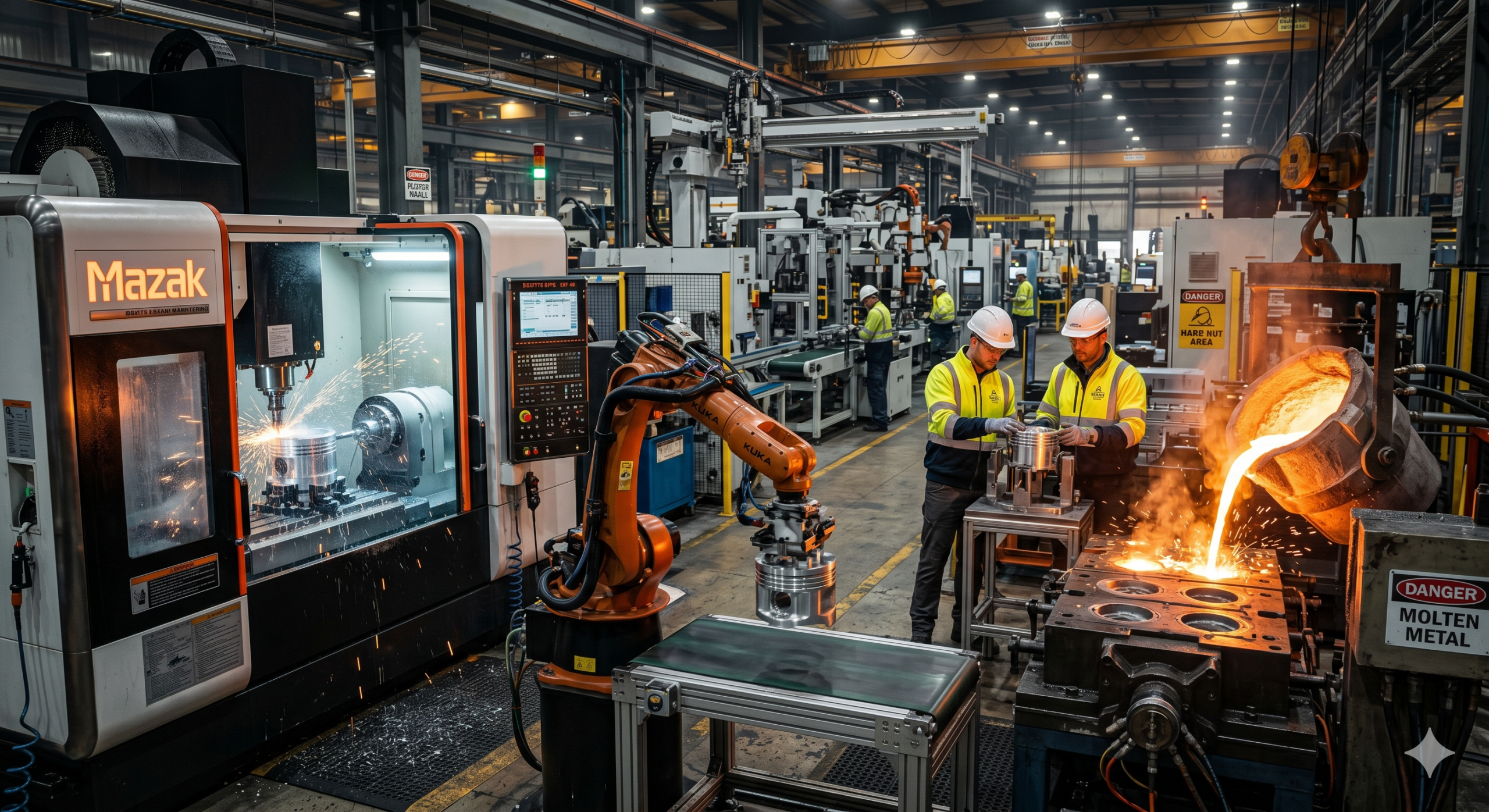
Crankshaft manufacturing is one of the most critical processes in engine production, directly influencing performance, durability, and efficiency. Whether in automotive engines, marine systems, or industrial machinery, the crankshaft converts linear piston motion into rotational force. This mechanical transformation must be executed with extreme precision, as even minor defects can lead to catastrophic engine failure.
In 2026, crankshaft production has evolved with advanced materials, CNC automation, and smart manufacturing technologies. This guide provides a comprehensive, technical, and SEO-optimized overview of crankshaft manufacturing, covering materials, processes, quality control, and future innovations.
What Is a Crankshaft?
A crankshaft is a rotating mechanical component designed to convert reciprocating motion into rotational motion. It consists of several key parts:
- Main journals – rotate within engine bearings
- Crankpins – connect to connecting rods
- Counterweights – balance the rotating assembly
- Crank webs – link journals and crankpins
The design must withstand high cyclic loads, torsional stress, and extreme temperatures.
Materials Used in Crankshaft Manufacturing
Material selection plays a crucial role in crankshaft strength and longevity. The two most commonly used materials are:
1. Forged Steel
- High strength and fatigue resistance
- Ideal for high-performance and heavy-duty engines
- Common alloys: 4140, 4340 steel
2. Cast Iron
- Cost-effective for mass production
- Good wear resistance
- Typically used in standard passenger vehicles
Advanced Materials (2026 Trends)
- Micro-alloyed steels for improved machinability
- Hybrid composites for weight reduction
- Nanostructured metals for enhanced durability
Crankshaft Manufacturing Process: Step-by-Step
1. Material Preparation
The process begins with raw material selection in the form of billets or castings. Steel billets are heated to high temperatures (around 1200°C) for forging, while cast iron is melted and poured into molds.
2. Forging or Casting
Forging Process
- Heated billet is shaped using high-pressure dies
- Produces superior grain structure and strength
- Common methods: open-die forging, closed-die forging
Casting Process
- Molten metal is poured into pre-designed molds
- More economical for large-scale production
- Less strength compared to forged crankshafts
3. Heat Treatment
Heat treatment enhances mechanical properties:
- Annealing – improves machinability
- Quenching and tempering – increases hardness and strength
- Induction hardening – hardens specific areas like journals
This stage ensures the crankshaft can withstand fatigue and wear.
4. Rough Machining
CNC machines remove excess material to form the basic crankshaft shape:
- Turning of journals and crankpins
- Milling of counterweights
- Drilling oil holes for lubrication
Precision begins here, but tolerances are still relatively loose.
5. Finish Machining
This step achieves high precision and tight tolerances:
- Grinding journals to micron-level accuracy
- Polishing surfaces for reduced friction
- Fillet rolling to improve fatigue strength
Modern CNC grinding machines ensure consistent quality across batches.
6. Surface Treatment
To further enhance durability:
- Nitriding – increases surface hardness and wear resistance
- Shot peening – introduces compressive stress to prevent cracks
- Coating technologies – reduce friction and corrosion
7. Balancing
Dynamic balancing ensures smooth rotation:
- Removal or addition of material to counterweights
- Use of computerized balancing machines
- Critical for minimizing vibration and engine wear
8. Inspection and Quality Control
Strict quality checks are essential:
- Dimensional inspection using CMM (Coordinate Measuring Machines)
- Ultrasonic testing for internal defects
- Magnetic particle inspection for surface cracks
Only crankshafts meeting exact specifications proceed to assembly.
Precision Engineering and Tolerances
Crankshaft manufacturing demands extremely tight tolerances:
- Journal roundness: within microns
- Surface finish: typically Ra < 0.4 µm
- Alignment accuracy: critical for engine performance
Advanced metrology tools and AI-driven inspection systems now ensure near-zero defect rates.
Role of CNC and Automation
Modern crankshaft production relies heavily on automation:
- CNC machining centers for multi-axis precision
- Robotic handling systems for consistency
- Smart sensors for real-time monitoring
- AI-driven predictive maintenance
These technologies reduce human error, improve efficiency, and lower production costs.
Challenges in Crankshaft Manufacturing
Crankshaft production involves complex engineering constraints, including material defects, thermal distortion, and precision machining limitations. For a deeper technical breakdown, explore this production process and challenges of crankshafts resource. Despite advancements, manufacturers face several challenges:
1. Material Defects
Inclusions or impurities can weaken the structure.
2. Thermal Distortion
Heat treatment can cause warping if not controlled properly.
3. Machining Complexity
Irregular geometry makes precision machining difficult.
4. Cost vs. Performance Trade-offs
Balancing affordability with durability remains a constant challenge.
Innovations in 2026
The crankshaft manufacturing industry is undergoing rapid transformation:
1. Additive Manufacturing (Hybrid)
- Used for prototyping and complex geometries
- Reduces material waste
2. Digital Twin Technology
- Virtual simulation of crankshaft performance
- Predicts stress and failure points before production
3. AI and Machine Learning
- Optimizes machining parameters
- Enhances defect detection
4. Sustainable Manufacturing
- Energy-efficient furnaces
- Recycling of metal waste
- Reduced carbon footprint processes
Applications of Crankshafts
Crankshafts are used across multiple industries:
- Automotive engines – cars, trucks, motorcycles
- Marine engines – ships and boats
- Aerospace systems – specialized engines
- Industrial machinery – compressors, generators
Each application requires tailored design and manufacturing processes.
Quality Standards and Certifications
Manufacturers must adhere to global standards:
- ISO 9001 – Quality management systems
- ISO/TS 16949 – Automotive quality standards
- ASTM standards – Material specifications
Compliance ensures reliability and global market acceptance.
Maintenance and Lifecycle Considerations
Even the best-manufactured crankshaft requires proper maintenance:
- Regular lubrication to reduce wear
- Monitoring for vibrations or unusual noise
- Periodic inspection for cracks or deformation
A well-maintained crankshaft can last the entire lifespan of an engine.
Future Outlook
The future of crankshaft manufacturing is driven by:
- Electrification (though EVs reduce demand, hybrids still rely on crankshafts)
- Lightweight materials for fuel efficiency
- Increased automation and Industry 4.0 integration
Manufacturers who embrace innovation will remain competitive in this evolving landscape.
Conclusion
Crankshaft manufacturing is a sophisticated blend of metallurgy, precision engineering, and advanced technology. From material selection to final inspection, every step plays a vital role in ensuring performance, reliability, and longevity.
As we move further into 2026, the integration of AI, automation, and sustainable practices is redefining how crankshafts are produced. For engineers, manufacturers, and industry professionals, understanding these processes is essential for staying ahead in a highly competitive market.