

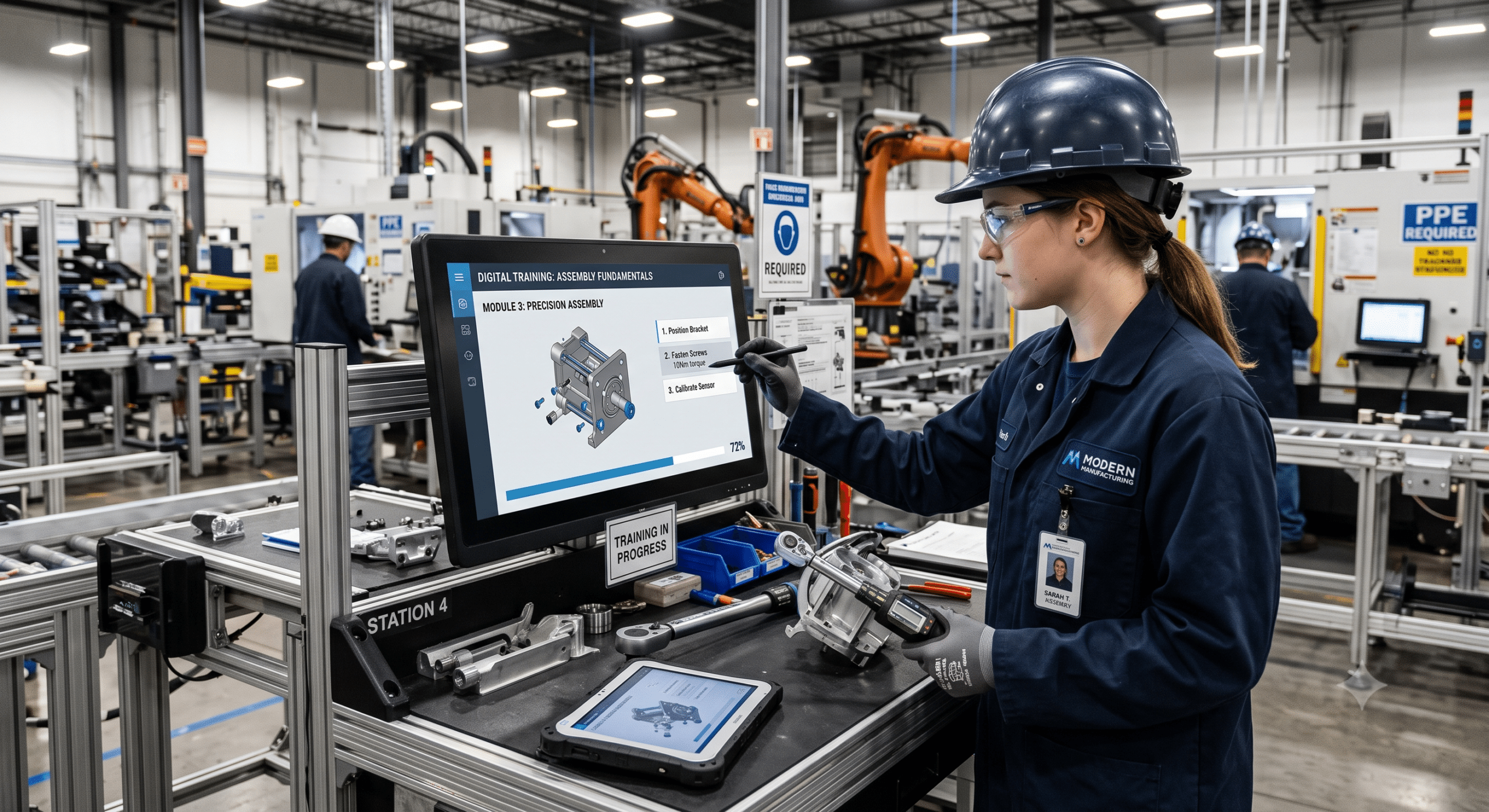
Undeniably, manufacturing has changed more in the last decade than it did in many years before. Consequently, smart factories, connected machines, automation, robotics, digital work instructions, and real-time production data are now common in many facilities. However, while technology continues to improve, one core challenge undoubtedly remains the same: people still need effective training, which is why digital training manufacturing has become essential for modern operations.
Furthermore, throughout my experience as an Instructional Systems Designer (ISD), I’ve learned that successful manufacturing organizations don’t simply purchase new technology. Instead, they intentionally build learning systems that help employees use that technology correctly, safely, and consistently. Additionally, digital learning isn’t about replacing experienced trainers. Rather, it effectively provides workers with better tools to learn faster, remember longer, and perform more confidently.
Ultimately, organizations that invest in structured manufacturing training often experience shorter onboarding periods, improved consistency, lower rework, stronger employee engagement, and better knowledge retention. For instance, programs such as Training Within Industry (TWI) clearly continue to demonstrate the value of standardized instruction and structured job training in manufacturing environments.
Accordingly, the article below explains exactly how digital training fits into modern manufacturing, why it matters, and the practical strategies every manufacturer should explicitly consider when building a future-ready workforce.
What Is Digital Training Manufacturing?
Fundamentally, digital training manufacturing is the use of digital technologies to deliver, manage, measure, and improve workforce learning across operations. Instead of relying exclusively on classroom sessions or paper manuals, modern manufacturers actively leverage various digital platforms.
Specifically, Core Digital Platforms include:
-
Learning Management Systems (LMS)
-
Interactive work instructions
-
Video-based learning and microlearning
-
Mobile learning and digital checklists
-
Virtual Reality (VR) and Augmented Reality (AR)
-
Skills tracking and competency management systems
Overall, the primary goal is simple: Train employees consistently while simultaneously making learning available anytime and anywhere.
Why Manufacturing Needs Digital Learning
Presently, manufacturing moves incredibly fast. As a result, companies frequently introduce new equipment, updated SOPs, automation, AI-assisted production, and strict compliance requirements.
Unfortunately, traditional classroom training consistently struggles to keep pace with these constant operational changes. In contrast, digital learning allows organizations to update content immediately, thereby ensuring employees always receive current information. In fact, according to workforce development guidance from NIST’s Manufacturing Extension Partnership, structured training significantly improves workforce capability while simultaneously supporting engagement, retention, and productivity.
From an ISD Perspective: Focus on Performance
Undoubtedly, one major mistake many companies make is measuring training solely by completion rates. However, completing a course certainly does not guarantee better performance. Consequently, as Learning Architects, we focus heavily on performance outcomes instead.
Initially, instead of asking:
Did employees finish the course?
We must instead logically ask:
Can they perform the task safely and meet quality standards? Moreover, can they solve problems independently and naturally adapt to new equipment?
Ultimately, digital learning should actively support actual job performance, rather than simply satisfying baseline compliance requirements.
The Evolution of Manufacturing Training
Historically, training relied heavily on passive observation. Today, conversely, modern learning combines multiple active modalities to proactively enhance, rather than purely replace, hands-on experience.
| Traditional Training Approach | Modern Digital Learning Approach |
| Read a static paper manual | Engage directly with interactive digital modules |
| Watch another operator | Practice thoroughly via job simulations and VR |
| Perform once and hope for the best | Rely continuously on digital work instructions |
| Occasional classroom instruction | Benefit from continuous coaching and mobile learning |
11 Ways Digital Training Improves Workforce Performance
Accelerating Onboarding and Standardization
1. Faster Employee Onboarding
Typically, hiring continues throughout the entire year. Consequently, without standardized training, every trainer inherently teaches differently. Fortunately, digital onboarding creates immediate consistency by providing identical learning experiences to everyone. As a result, companies predictably see faster readiness, lower training costs, and significantly fewer early mistakes.
2. Consistent Standard Operating Procedures (SOPs)
Crucially, manufacturing depends heavily on absolute consistency. Therefore, digital SOPs strictly ensure every employee follows identical procedures. Additionally, interactive work instructions often include images, videos, and quality checkpoints, which subsequently reduces variation across shifts.
3. Better Safety Training
Obviously, workplace safety cannot depend on memory alone. To successfully address this, digital safety learning continuously supports Lockout/Tagout, PPE requirements, and hazard identification. Furthermore, OSHA officially recommends practical, accurate, and learner-focused training that applies directly to daily workplace tasks.
Enhancing Accessibility and Engagement
4. Easier Skills Tracking
Frequently, managers struggle to track who is certified or who desperately needs retraining. Conversely, digital competency systems brilliantly answer these exact questions instantly. Thus, this actively supports highly efficient workforce planning and constant audit readiness.
5. Mobile Learning on the Shop Floor
Generally, workers rarely have access to desktop computers on the floor. Because of this specific limitation, modern training robustly supports tablets, smartphones, and industrial touchscreens. Consequently, employees instantly receive training exactly where they actually perform the work.
6. Real-Time Training Updates
Inevitably, manufacturing processes constantly change, meaning traditional paper manuals quickly become outdated. Alternatively, digital systems allow organizations to smoothly update one document and publish it instantly. Thereby, everyone receives the absolute newest version immediately.
7. Better Knowledge Retention
Naturally, people forget information quickly when training occurs only once a year. To actively combat this, microlearning vastly improves retention through short lessons, daily reinforcement, and interactive quizzes. Instead of attending one eight-hour class, employees learn continuously.
Driving Quality, Flexibility, and Compliance
8. Reduced Human Error
Remarkably, digital work instructions drastically decrease critical assembly mistakes and missed inspection steps. Moreover, recent research around TWI consistently shows major reductions in scrap and rework whenever jobs are deliberately taught using structured, standardized methods.
9. Improved Cross-Training
Essentially, manufacturing flexibility depends entirely on multi-skilled employees. Accordingly, digital learning makes cross-training much easier precisely because standardized learning paths already exist for new machines and inspection procedures.
10. Better Compliance Documentation
Routinely, auditors frequently ask for highly detailed training records. Thankfully, digital systems automatically record exact completion dates, assessment results, and strict version history. As a result, compliance documentation instantly becomes effortless.
11. Continuous Learning Culture
Ultimately, the strongest manufacturers deliberately never stop learning. In the end, digital platforms effectively encourage continuous improvement by officially making education a seamless part of everyday work, rather than just an isolated yearly event.
Designing Effective Manufacturing Training
As ISDs, we typically follow highly structured instructional design principles to explicitly ensure success. Specifically, a common functional framework normally includes the following distinct phases:
| Phase | Action Items |
| Analyze | First, understand business goals, performance gaps, and job requirements. |
| Design | Next, create targeted learning objectives, practice activities, and job aids. |
| Develop | Then, build videos, simulations, and interactive digital work instructions. |
| Implement | Subsequently, launch learning through an LMS, mobile devices, or on-the-job coaching. |
| Evaluate | Finally, measure learning retention, behavior change, and actual business impact. |
Importantly, this continuous cycle actively supports constant improvement and perfectly aligns with established instructional design models widely used in industrial e-learning.
Common Mistakes to Avoid
Admittedly, many digital learning projects fail simply because organizations focus entirely on the technology instead of the actual learning. To proactively ensure success, completely avoid these common pitfalls:
-
Buying software before clearly defining learning goals
-
Creating excessively long courses that instantly overwhelm learners
-
Ignoring the absolute need for hands-on practice
-
Measuring only basic course completion
-
Failing to continuously update training materials
Always Remember: Digital tools exist purely to support learning; they absolutely do not replace good instructional design.
Measuring Success
Fundamentally, manufacturers must critically evaluate training using tangible business metrics. Specifically, when internal learning metrics tangibly improve alongside broader operational metrics, the training program is undeniably delivering real value.
Particularly useful KPIs to regularly track include:
-
Time-to-competency
-
First-pass yield and subsequent scrap reduction
-
Safety incident rates
-
Employee retention and overall cross-training coverage
Conclusion
In conclusion, digital transformation is indeed radically changing manufacturing, but the technology alone simply does not improve performance; the people do. Therefore, highly successful organizations strategically combine modern technology with thoughtful instructional design, structured job instruction, and continuous learning.
From an ISD’s perspective, the primary objective is never just to create engaging courses. Rather, it is to methodically create genuinely measurable performance improvement. When digital learning seamlessly aligns with strategic business goals, employees gain real confidence, supervisors spend far less time correcting mistakes, and manufacturers build a workforce completely ready for continuous change. Looking forward, companies that officially treat learning as a core strategic capability will undoubtedly be the ones best positioned to fiercely compete, confidently innovate, and consistently grow.
Frequently Asked Questions (FAQ)
What is digital training manufacturing?
Simply put, it is explicitly the use of digital tools—such as learning management systems, mobile apps, simulations, and digital work instructions—to train manufacturing employees much more efficiently and consistently.
Why is digital training important in manufacturing?
Primarily, it immediately helps reduce training time, drastically improve safety, standardize work procedures, and effectively prepare employees for modern technologies exactly like automation and robotics.
Can digital learning replace hands-on manufacturing training?
No, definitely not. Digital learning clearly works best when strategically combined with supervised, hands-on practice. Specifically, it thoroughly prepares employees with solid foundational knowledge and subsequently reinforces optimal performance on the actual job.
How does digital training improve quality?
By consistently providing standardized digital content, absolutely every employee definitively receives the exact same instructions. Consequently, this noticeably reduces human variation, dramatically improves process consistency, and significantly lowers both defects and rework.
References
-
National Institute of Standards and Technology (NIST). Training Within Industry (TWI). https://www.nist.gov/mep/training-within-industry-twi
-
National Institute of Standards and Technology (NIST). Manufacturing Workforce Development. https://www.nist.gov/mep/manufacturing-workforce-development
-
National Institute of Standards and Technology (NIST). Five Simple Digital Applications That Are Changing Manufacturing. https://www.nist.gov/blogs/manufacturing-innovation-blog/five-simple-digital-applications-are-changing-manufacturing
-
National Institute of Standards and Technology (NIST) / Manufacturing USA. Analysis of the Manufacturing USA Occupation and Competency Framework. https://www.manufacturingusa.com/reports/analysis-manufacturing-usa-occupation-competency-framework
-
Occupational Safety and Health Administration (OSHA). Best Practices for the Development, Delivery, and Evaluation of Training Programs. https://www.osha.gov/sites/default/files/publications/OSHA3824.pdf
-
Sharpen Manufacturing. How to Build a Manufacturing Training Program (Beyond One-on-One Shadowing). https://sharpen.com/ (Note: General URL provided for Sharpen Manufacturing)