

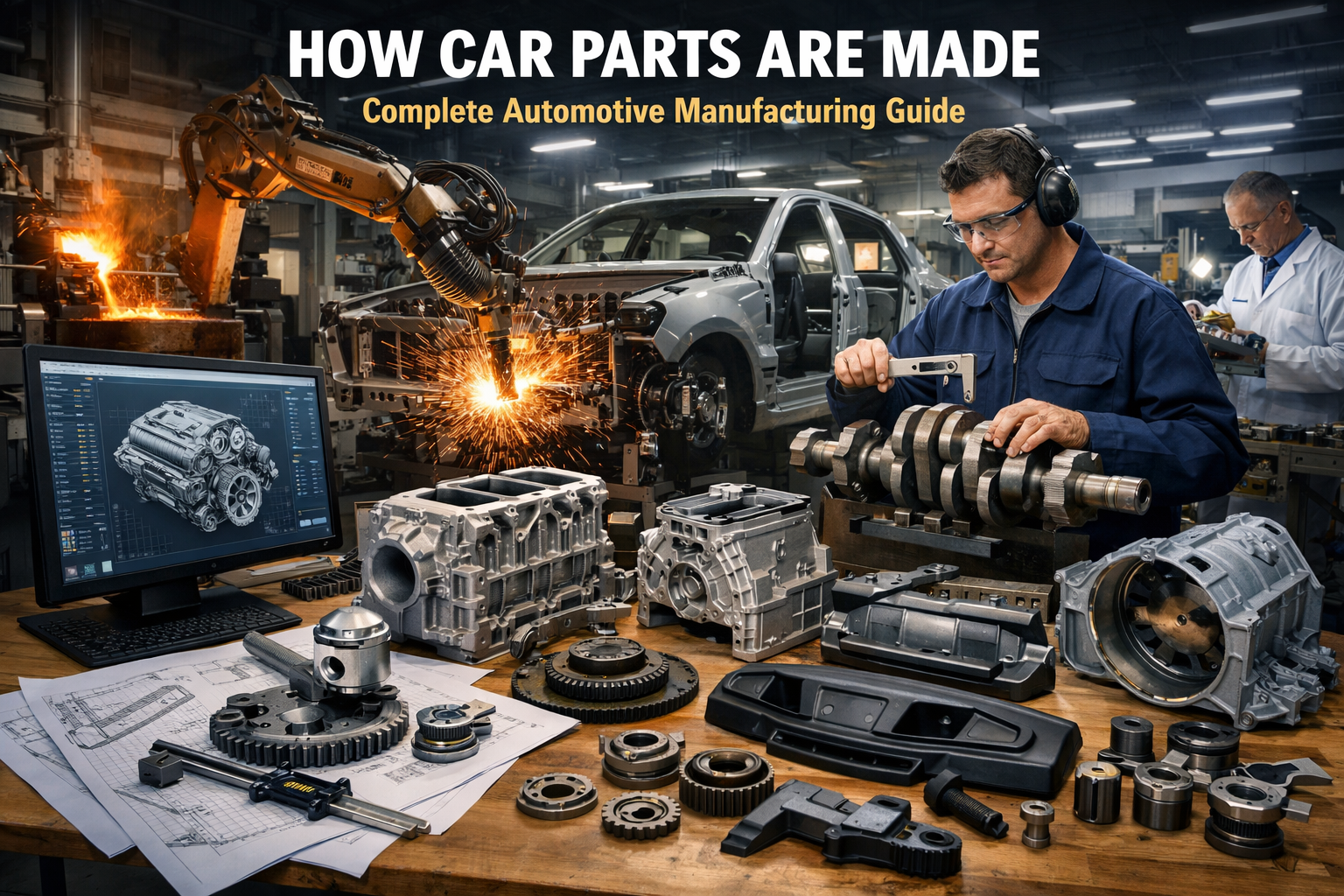
Automotive parts manufacturing combines precision, advanced technology, and scalable production systems. How car parts are made involves a structured workflow that transforms raw materials into high-performance components. In simple terms, manufacturers follow detailed processes to ensure every part meets strict safety, durability, and efficiency standards. As a result, modern vehicles rely on highly engineered components built through consistent and optimized production methods.
In this guide, you will learn how car parts are made step by step. Along the way, you will also discover the technologies, processes, and innovations that power modern automotive production. More importantly, you will understand how each stage connects to the next in a seamless manufacturing cycle.
1. Design and Engineering: Where It All Begins
To begin with, engineers create each automotive part as a digital model. They use CAD (Computer-Aided Design) and CAE (Computer-Aided Engineering) tools to build precise 3D designs.
Moreover, engineers run simulations before production starts. For example, they test stress levels, thermal resistance, and load capacity. In addition, they refine designs to improve strength while reducing weight.
Key Technologies Used:
- CAD software for 3D modeling
- Simulation tools for testing
- Digital twins for real-world replication
As a result, engineers identify potential flaws early. Therefore, they prevent costly production errors. In other words, digital engineering improves both speed and accuracy.
2. Material Selection: Choosing the Right Foundation
Once engineers finalize the design, they move on to material selection. At this stage, choosing the right material becomes critical.
Common Materials:
- Steel for structural strength
- Aluminum for lightweight applications
- Plastics and polymers for flexibility
- Composites for high-performance parts
In addition, manufacturers increasingly focus on sustainability. For instance, they use recycled metals and eco-friendly polymers. As a result, material selection now influences both performance and environmental impact. Ultimately, the right material ensures long-term reliability.
3. Manufacturing Processes: Transforming Raw Materials
After selecting materials, manufacturers begin production. At this point, they choose specific processes based on the part design. In general, each method offers unique advantages.
A. Casting
First, manufacturers use casting to form complex shapes. They pour molten metal into molds and allow it to cool and solidify.
Typically, they produce:
- Engine blocks
- Cylinder heads
- Transmission housings
As a result, casting enables efficient production of detailed components. In particular, it works well for intricate designs. Therefore, many manufacturers rely on this method for large metal parts.
B. Forging
Next, manufacturers use forging to shape metal under high pressure. Unlike casting, this process strengthens the internal grain structure.
For example, they produce:
- Crankshafts
- Gears
- Connecting rods
Consequently, forged parts offer superior strength. As a result, they perform better under stress. For this reason, manufacturers prefer forging for critical components.
C. Machining
After that, technicians refine parts through machining. They use CNC machines to remove excess material and achieve exact dimensions.
Common Machining Processes:
- Milling
- Turning
- Drilling
- Grinding
As a result, machining delivers exceptional precision. In fact, it ensures tight tolerances required for high-performance parts. Therefore, it remains essential in modern manufacturing.
D. Stamping
Meanwhile, manufacturers use stamping to shape sheet metal. They apply high-pressure presses to form parts quickly and efficiently.
Common applications include:
- Body panels
- Structural components
- Brackets
Therefore, stamping supports mass production. At the same time, it ensures uniformity across large volumes. In addition, it reduces production time significantly.
E. Injection Molding
Finally, manufacturers produce plastic components through injection molding. They inject molten plastic into molds and allow it to cool.
For instance, they create:
- Dashboards
- Bumpers
- Interior trims
In addition, automated systems increase production speed. As a result, manufacturers achieve consistent quality. Furthermore, they reduce material waste.
4. Heat Treatment and Surface Finishing
After forming the parts, manufacturers enhance their properties through heat treatment. Specifically, they adjust hardness, strength, and flexibility.
Common Techniques:
- Annealing to improve ductility
- Quenching to increase hardness
- Tempering to balance strength
Furthermore, manufacturers apply surface finishing techniques. In particular, these methods protect parts from wear and corrosion.
Finishing Methods:
- Powder coating
- Electroplating
- Anodizing
- Polishing
As a result, parts last longer. In addition, they maintain a high-quality appearance. Therefore, finishing plays both a functional and aesthetic role.
5. Assembly: Bringing Components Together
Once manufacturers complete individual parts, assembly teams combine them into systems. In modern factories, robots perform most of these tasks.
Assembly Methods:
- Robotic assembly lines
- Manual precision assembly
- Automated welding and fastening
Additionally, manufacturers integrate smart technologies. For example, IoT sensors monitor performance in real time. As a result, teams detect inefficiencies quickly. Therefore, they improve productivity and reduce errors.
6. Quality Control and Testing
Equally important, quality control teams inspect every component. Before parts leave the facility, they must meet strict standards.
Testing Methods:
- Non-destructive testing (NDT)
- Dimensional inspection
- Performance testing
Moreover, AI systems analyze data instantly. As a result, teams detect defects early. In turn, manufacturers maintain consistent product quality.
7. Automation and Smart Manufacturing
Today, automation drives automotive production. In fact, many factories operate as fully connected smart systems.
Key Innovations:
- Robotics for precision and speed
- AI-driven inspection systems
- Predictive maintenance tools
- Digital manufacturing platforms
Consequently, companies reduce downtime. At the same time, they increase efficiency. Furthermore, they improve overall production output.
8. Sustainability in Automotive Parts Manufacturing
At the same time, manufacturers adopt sustainable practices. In response to environmental challenges, they focus on reducing waste and energy use.
Green Practices:
- Recycling raw materials
- Lowering energy consumption
- Using eco-friendly materials
- Conserving water resources
Therefore, companies reduce their environmental footprint. In addition, they align with global sustainability goals. Ultimately, they create a more responsible manufacturing process.
9. Supply Chain and Logistics
After production, logistics teams distribute parts globally. To ensure efficiency, they rely on advanced tracking and inventory systems. In addition, the automotive ecosystem depends on a network of suppliers, OEMs, and manufacturers working together efficiently, as explained in this automotive components manufacturing industry.
Key Elements:
- Just-in-time delivery
- Automated warehousing
- Real-time tracking
As a result, supply chains remain efficient. In addition, companies respond quickly to demand changes. Therefore, logistics plays a crucial role in overall success.
10. Future Trends in Automotive Parts Manufacturing
Looking ahead, the industry continues to evolve rapidly. As technology advances, manufacturers adopt new production methods.
Emerging Trends:
- 3D printing for rapid prototyping
- AI-driven design optimization
- Autonomous production systems
- Blockchain for transparency
In addition, electric vehicles shift manufacturing priorities. For example, manufacturers focus more on batteries and lightweight components. Therefore, the industry continues to adapt to new demands.
Conclusion
In conclusion, manufacturers follow a structured, technology-driven process to produce automotive parts. From initial design to final delivery, each stage plays a critical role.
Ultimately, innovation continues to transform how car parts are made. As a result, manufacturers improve efficiency, sustainability, and performance. In the long run, these advancements will shape the future of automotive production.