

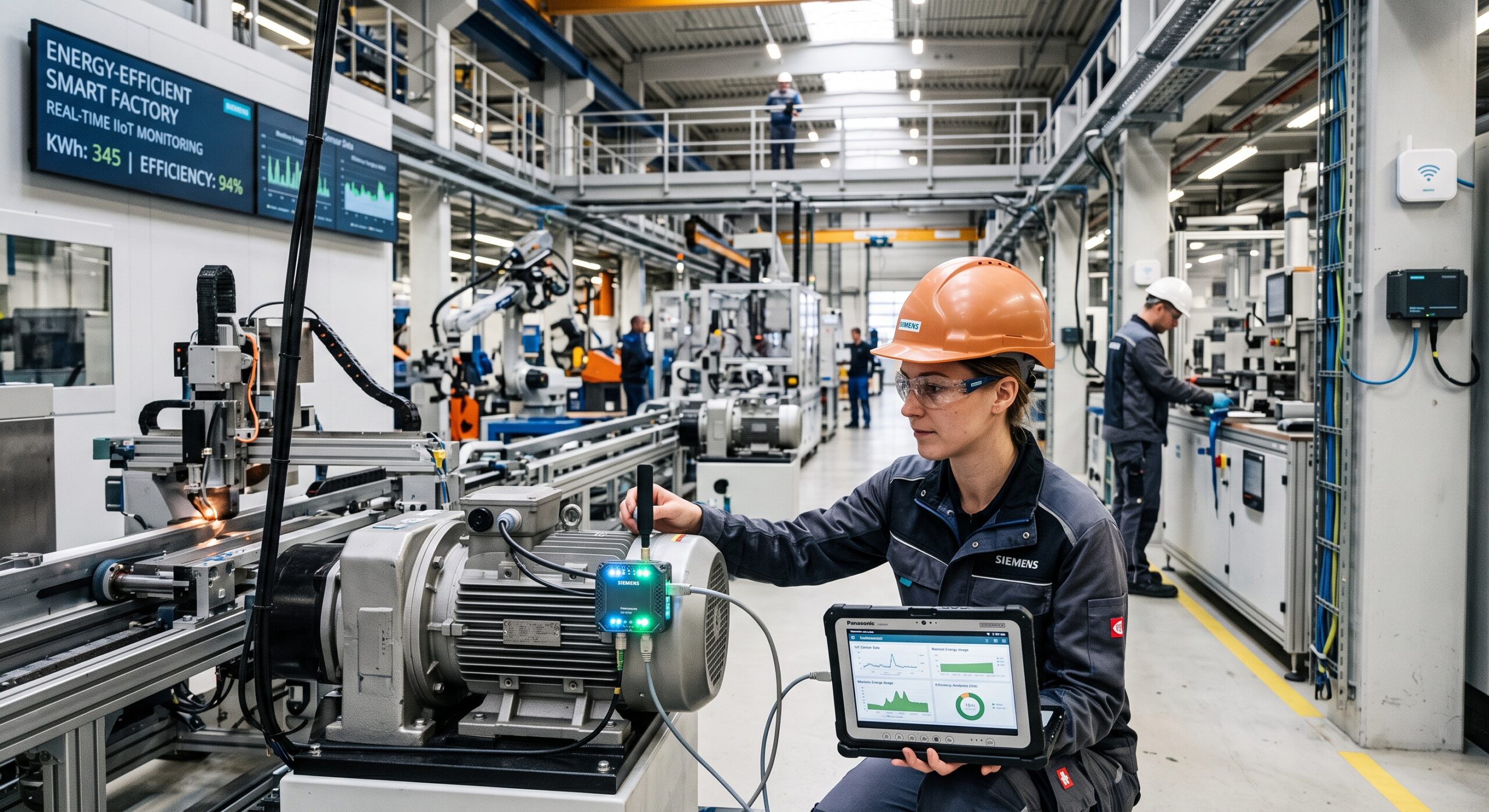
Deploying industrial IoT sensors across a plant floor is the fastest way to turn hidden energy waste into a line item you can actually manage. I have spent most of my career designing IIoT architectures for plants that usually wanted two things at once: more visibility into what their machines were actually doing, and energy bills that stopped climbing every quarter. Those two goals turned out to be the exact same project. Once you instrument a facility, energy waste stops being invisible, and operations become predictably efficient.
I have spent most of my career designing IIoT architectures for plants. Those plants usually wanted two things at once. They wanted more visibility into what their machines were actually doing. And they wanted their energy bills to stop climbing every quarter.
Those two goals turned out to be the same project. Once you instrument a factory floor with the right sensors, energy waste stops being invisible. It becomes a line item you can actually manage.
That is what this article is about. Not the marketing version of Industry 4.0, with glossy renderings of robot arms. This is the practical, sensor by sensor reality of how industrial IoT sensors change a factory. It uses less power, wastes less material, and runs with far fewer surprises.
Why Energy Efficiency Became a Manufacturing Priority
Manufacturing consumes roughly a third of total industrial energy in the United States. Plant managers rarely have a clear picture of where that energy actually goes, machine by machine, shift by shift.
For decades, plants treated energy use as a fixed cost. You paid the bill at the end of the month and hoped it stayed flat. Compressors ran overnight because nobody wanted to be the one who shut them off before a shift change. Ovens preheated an hour before they needed to. Motors idled between batches, because restarting them felt riskier than leaving them on.
Sensors Changed the Calculus
Once you can measure consumption at the machine level in near real time, idle waste becomes visible. And visible waste gets fixed.
I have watched plant managers discover this within the first week of a sensor rollout. A single stamping press was drawing power on weekends, when the building sat empty. Nobody had noticed, because nobody had a reason to look. The meter on the wall told them the total bill, not the story behind it.
What Industrial IoT Sensors Actually Do on the Plant Floor
An industrial IoT sensor is a small, often unglamorous device. It measures a physical condition, current, temperature, vibration, pressure, humidity, or light, and converts that reading into a digital signal a network can carry.
On its own, one sensor is just a data point. Wire a few hundred of them into a coherent network with the right gateways, and you have a nervous system for the plant.
The value is not the sensor itself. It is what the data enables. A maintenance team can replace a bearing before it fails instead of after. An energy manager can see which line draws more current than its rated load. An operations director can finally answer the question of where the plant’s energy actually goes, with a real number instead of a guess.
5 Sensor Types Every Energy-Efficient Factory Relies On
Every architecture I have deployed leans on a core set of sensor categories. No single sensor solves energy efficiency by itself. The combination is what matters.
Current and power meters. These clamp onto supply lines and measure real time electrical draw at the machine or circuit level. I usually recommend this sensor type first. It answers the most basic question a plant has never been able to answer on its own: which equipment actually uses the power.
Temperature sensors. Thermal sensors on motors, ovens, chillers, and compressors catch inefficiency before it becomes downtime. A motor running hotter than its baseline is usually working harder than it should. That almost always means it burns more electricity than the process requires.
Vibration sensors. Bearings, pumps, and rotating equipment change their vibration signature long before they fail outright. Catching that drift early prevents the kind of emergency repair that forces a plant to run backup equipment at poor efficiency, just to keep production moving.
Pressure sensors. Compressed air systems are notorious energy wasters. Pressure sensors placed along the distribution network find leaks that would otherwise go undetected for months. A single unaddressed leak in a compressed air line can waste thousands of dollars a year in wasted compression work.
Environmental and occupancy sensors. Humidity, light, and occupancy sensors tie HVAC and lighting systems to actual building use, rather than a fixed schedule. That matters more than people expect in facilities that run partial shifts or seasonal production.
Put those 5 categories together and wire them into a common data layer. That combination forms the foundation nearly every energy-efficient smart factory relies on, regardless of what industry it serves.
From Raw Data to Real Decisions
Sensors alone do not save energy. Data without context is just noise on a dashboard. I have seen plenty of expensive sensor deployments that never moved a single efficiency metric, because nobody built the analytics layer to make the data useful.
How the Pattern Actually Works
Sensor data streams into an edge gateway that filters and aggregates it locally. Sending every raw reading to the cloud is both expensive and unnecessary. The gateway forwards meaningful signals, thresholds crossed, patterns shifted, to a platform that compares the data against historical baselines.
Most plants skip that step. It is also the step that actually produces savings. A raw kilowatt reading tells you almost nothing on its own. A kilowatt reading that runs 20 percent above that machine’s normal baseline is different. Match it to the time of day, the product run, and the ambient temperature, and it tells you something is wrong right now.
Closing the Loop
From there, the decision loop closes in one of two ways. Either a human gets an alert and acts on it, shutting down idle equipment, dispatching a technician, adjusting a setpoint. Or the system acts automatically through a control loop that trims energy use without waiting for a person to notice.
Mature deployments lean toward the second model wherever the risk profile allows it. Human attention is the scarcest resource on any plant floor.
What This Looks Like in Practice
The numbers from the field back this up consistently. Continuous energy monitoring programs built around IoT sensors typically deliver energy reductions in the 10 to 15 percent range at the machine level. They do this simply by exposing waste that used to stay invisible.
One European monitoring provider works with large manufacturers, including major food and consumer goods producers. It reports an average energy reduction near 10 percent once continuous monitoring is in place. Most of that gain comes from catching equipment left running outside production hours and flagging underperforming older machines.
The Predictive Maintenance Connection
Predictive maintenance programs built on vibration and thermal sensors show a similar pattern from a different angle. Plants using sensor-driven predictive maintenance report unplanned downtime reductions between 35 and 50 percent, along with meaningful gains in overall equipment effectiveness.
That matters for energy in a way people often overlook. Think about a machine running in a degraded state. A bearing loses lubrication, or a motor draws extra current to compensate for misalignment. That machine consumes more energy per unit of output than a properly maintained one. Fix the mechanical problem, and you fix the energy problem at the same time.
The Financial Case
The financial case tends to close quickly. Predictive maintenance initiatives commonly pay back their sensor and platform investment within 6 to 18 months. Avoided downtime and reduced emergency repairs alone cover that payback, before anyone even counts energy savings separately.
I have seen individual facilities report six and seven figure savings in a single year after moving from reactive to planned maintenance. Catching failures early, rather than after the fact, drives most of that number.
The Network Layer Nobody Talks About Enough
There is a part of this work that rarely makes it into vendor presentations. It is the part that determines whether a sensor deployment actually survives past the pilot phase. That part is the network, the layer that connects all those devices back to something a human or a system can act on.
Why Plant Floors Fight Wireless Signals
Nobody designed most plant floors with a data network in mind. Steel structures, thick concrete walls, and dense machinery create interference that home Wi-Fi planning never has to account for.
I have walked plants where a signal tested fine in an empty conference room, then dropped constantly once the production line ran at full load. The metal skin of the machines themselves acted as a shield. Getting this right usually means running a site survey before a single sensor goes up. That survey maps where gateways need to sit and how many hops a signal needs to travel.
Protocol and Security Choices
Protocol choice matters more than most first-time buyers expect. Some sensors talk over low-power wireless protocols built for years of battery life and short, infrequent data bursts. Others need a wired or higher-bandwidth connection, because they stream continuous vibration waveforms rather than periodic readings. Mixing protocols within one deployment is normal, but the gateway and integration layer needs that mix planned in from day one.
Security deserves a direct mention here too. Too many teams treat it as an afterthought. A sensor network that touches production equipment is part of the plant’s operational technology environment. Segment it from the general corporate network, monitor it, and patch it like any other critical system. I have seen deployments where a team, chasing a quick win, connected sensors directly to the same network as office computers. That kind of shortcut turns a minor vulnerability into a plant-wide incident.
A Realistic Look at Implementation
None of this happens by bolting a few sensors onto old equipment and hoping for the best. The projects that succeed follow a similar sequence, and the ones that struggle usually skipped a step.
Start With a Baseline
Before installing a single sensor, you need to know what current energy use actually looks like. Break it down by shift, by line, and by piece of equipment where possible. Without a baseline, you have no way to prove the sensors made a difference, and executives will ask for that proof.
Prioritize the Biggest Energy Consumers
Compressors, HVAC systems, ovens, and large motors are almost always the highest-value targets. They run continuously, so their inefficiencies compound over every hour of operation. I generally advise clients to instrument their five or six largest energy consumers first, rather than spreading a thin layer of sensors across the entire floor. A concentrated deployment on the biggest offenders proves value fast.
Plan the Network Before the Sensors
Wireless sensor networks are the norm on plant floors now, largely because retrofitting wired sensors into an existing facility is disruptive and expensive. Battery life, interference from heavy machinery, and gateway placement all need engineering attention before installation day, not after.
Build the Integration Layer Early
Sensor data is only as useful as the systems it connects to. If the energy data cannot talk to the maintenance management system, the SCADA layer, or the building automation system, you end up with another isolated dashboard nobody checks. Teams usually underestimate this integration work, and that is where most project delays happen.
Expect Resistance, and Plan for It
Operators who have run a line the same way for fifteen years do not automatically trust a sensor telling them to change a habit. The rollouts that stick involve plant staff early, show them the data themselves, and give them credit when the numbers improve.
What Good Looks Like a Year Later
Most published case studies stop at the pilot stage. They rarely show what a mature deployment actually looks like once the initial installation work is behind you.
The Dashboard Becomes a Habit
A year into a well-run program, the plant manager does not check the energy dashboard once a month during a budget review. It has become part of the daily operating rhythm, the same way production output and quality metrics already were.
Shift supervisors glance at machine-level consumption the way they glance at throughput numbers. An unusual spike prompts a question that same day, not a discovery three weeks later on a utility bill. That shift in habit, more than any single sensor, locks in the savings long term. Technology creates the visibility, but people create the discipline that keeps waste from creeping back in once a new dashboard stops feeling new.
Teams and Budgets Start to Merge
The maintenance and energy teams that started out reading separate reports usually share one dashboard by this point. New equipment purchases start factoring in sensor compatibility from the outset, instead of adding sensors as a retrofit later. And the plant usually keeps a short list of the next five or six machines it wants to instrument. The return on the first wave already made the case for expanding the program.
None of that happens automatically. Someone has to keep the data visible and accurate. And someone has to keep using it to make real operating decisions, instead of letting it become another report that nobody reads.
Predictive Maintenance and Energy Efficiency Are the Same Discipline
I want to push back gently on a framing I hear a lot. Many teams treat predictive maintenance and energy management as separate initiatives with separate budgets. On the sensor level, they are nearly identical.
A vibration sensor watching for bearing wear and a current sensor watching for abnormal power draw look for the same underlying signal: equipment operating outside its healthy range. Whether you call the resulting alert a maintenance issue or an energy issue depends on which team reads the dashboard, not on what the sensor actually measured.
Plants that get the most value from their IIoT investment stop separating those budgets. One integrated sensor network feeds both the maintenance team and the energy management team. Both teams end up making better decisions, because they look at the same real-time picture instead of two disconnected reports produced weeks apart.
Where Smart Factory Sensor Networks Are Heading
A few shifts are worth watching if you are planning a deployment now, rather than reacting to one that already exists.
Sensors Keep Getting Cheaper and Smarter
Basic industrial sensors that cost well over a hundred dollars a few years ago now sell for a fraction of that price. Many also handle basic edge processing on the device itself, instead of sending raw data upstream. That changes the economics of dense deployment. You can now realistically instrument far more of a facility than you could even five years ago, without the network and cloud costs scaling in the same proportion.
Energy Data Feeds Sustainability Reporting
More manufacturers face pressure to report emissions and energy intensity per unit produced. The same sensor infrastructure built for operational efficiency increasingly feeds compliance and sustainability reports directly. That removes a manual reporting step that used to take someone days to compile by hand.
AI Catches Patterns Humans Miss
A modern plant generates far more sensor data than any person can review manually. Machine learning models trained on historical sensor patterns increasingly handle the first pass of anomaly detection. Out of the millions of readings collected each day, they flag the handful that actually deserve a human’s attention.
Getting Started Without Overcomplicating It
If you are early in this process, my honest advice is simple. Resist the urge to design the perfect, fully integrated smart factory on paper before installing a single device. Start with the highest energy consumers on your floor. Get real sensors reporting real data within a few months, and let the early results shape the next phase of the rollout.
The plants that stall out are almost always the ones stuck in a planning phase that never ends. The ones that succeed treat the first deployment as a pilot they will learn from, not a finished system they need to get perfect on the first try.
Industrial IoT sensors will not fix a broken process by themselves, and no dashboard will replace good engineering judgment. What they do is take the guesswork out of where your energy and reliability problems actually live. That frees the people running the plant to spend their time fixing real problems, instead of chasing symptoms.
Frequently Asked Questions
What are industrial IoT sensors used for in manufacturing?
They measure physical conditions such as electrical current, temperature, vibration, and pressure on plant equipment. That data travels over a network so operators and analytics platforms can monitor performance, catch inefficiency, and predict failures before they happen. Tractian’s overview of industrial IoT sensors covers the main sensor categories and how each one works.
How much energy can IoT sensors actually save a factory?
Field data from monitoring providers generally shows machine-level energy reductions in the 10 to 15 percent range once continuous monitoring is in place, mostly from catching equipment running outside production hours and correcting underperforming machines. The EnOcean case study on smart sensors and manufacturing energy documents an average 10 percent reduction across several large manufacturers.
What is the difference between IoT sensors and industrial IoT sensors?
Industrial IoT sensors withstand harsher conditions than typical consumer IoT devices, including extreme temperatures, vibration, dust, and electrical interference. Manufacturers build them for continuous operation in demanding environments, not intermittent home or office use.
Do industrial IoT sensors help with predictive maintenance too?
Yes, and the two use cases overlap heavily. Vibration and thermal sensors that catch mechanical wear early are the same category of device used for energy monitoring, since inefficient equipment is very often the same equipment about to fail. Reported downtime reductions from sensor-driven predictive maintenance typically fall between 35 and 50 percent.
How long does it take to see a return on an IIoT sensor investment?
Most predictive maintenance and energy monitoring programs report payback within 6 to 18 months, driven by avoided downtime, reduced emergency repairs, and measurable energy savings once the baseline data is established.
What sensors should a factory install first for energy efficiency?
Current and power meters on the largest energy consumers, typically compressors, large motors, ovens, and HVAC equipment, deliver the fastest and clearest return. They directly expose which machines drive the energy bill before any other sensor type gets added.
References
Deloitte and S&P Global manufacturing IoT adoption data, cited via Manufacturing Lead Generation, 90+ Manufacturing IoT Statistics 2025 to 2026
EnOcean, How Smart Sensors Help Some of the Biggest Names in Manufacturing Cut Their Energy Usage
Tractian, Industrial IoT Sensors: Types, Applications and How They Work
IEEE Sustainable Climate, Digital Technologies Are the Backbone of an Energy-Efficient Industry 4.0
ScienceDirect, Internet of Things for Smart Factories in Industry 4.0: A Review