

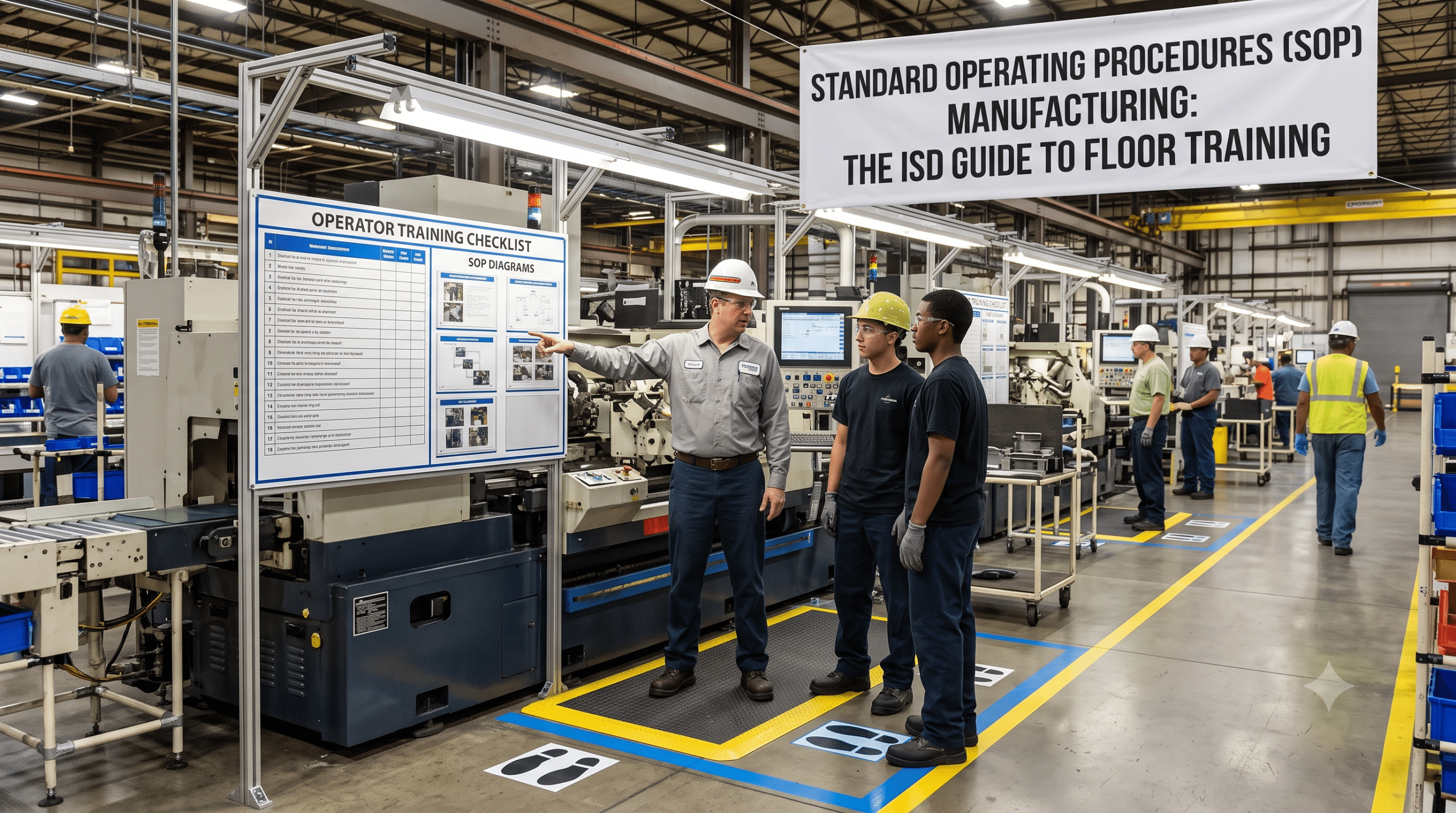
Every successful manufacturing company relies on clear Manufacturing SOPs to ensure that employees know exactly how work should be done. However, consistent execution doesn’t happen by luck. Instead, high-performing organizations pair these Manufacturing SOPs with an effective training system that teaches workers how to follow them confidently on the shop floor.
As an Instructional Systems Designer (ISD) and Learning Architect, I’ve learned that the best training programs are not built around long presentations or thick manuals. Rather, they are built around clear instructions that workers can understand, remember, and use on the production floor.
Many manufacturers spend thousands of dollars on advanced equipment but overlook the importance of structured learning. While machines may improve productivity, people keep quality consistent. Furthermore, when employees receive the right instruction, they make fewer mistakes, produce better products, and work more safely.
Consequently, this guide explains how training systems and documented Manufacturing SOPs work together, why they matter, and the six essential steps every manufacturing organization should follow to build an effective training program.
What Are Manufacturing SOPs?
Written Manufacturing SOPs are documented instructions that explain exactly how a specific production task should be completed. Essentially, you can think of an SOP as the company’s “best known method.”
Therefore, instead of relying on memory or experience, every employee follows the same approved process. Specifically, an SOP may explain:
-
Machine setup
-
Material handling
-
Product assembly
-
Quality inspections
-
Cleaning procedures
-
Equipment maintenance
-
Packaging
-
Safety requirements
In short, good SOPs reduce variation, improve quality, and make training much easier. Additionally, modern quality management systems such as ISO 9001 emphasize maintaining documented information that supports consistent operations and controlled processes. (SOPX)
Why Training Systems Depend on SOPs
Training without SOPs inevitably creates inconsistency. For example, employees often learn from coworkers, and each coworker teaches the task differently. As a result, everyone eventually develops their own method.
Ultimately, this creates:
-
Product defects
-
Quality problems
-
Safety risks
-
Longer training times
-
Confused employees
However, when Manufacturing SOPs become the absolute foundation of training, everyone learns the exact same process.
Instead of saying,
“Watch Joe. He’ll show you.”
The trainer can say,
“Let’s review SOP-102 together, then practice every step.”
Thus, that simple difference creates operational consistency across the entire workforce.
The Learning Architect’s View
Many companies think creating Manufacturing SOPs is simply writing documents. However, it isn’t. An Instructional Systems Designer sees an SOP as an active learning tool.
Specifically, every SOP answers five core learning questions:
-
What is the goal?
-
Why is the task important?
-
What are the exact steps?
-
What mistakes should be avoided?
-
How do we know someone can perform the task?
When these questions are answered clearly, training becomes substantially more effective.
Why Companies Need Strong Manufacturing SOPs
Manufacturing depends heavily on repeatability, because customers expect the same high-quality product every time. Without documented procedures, repeatability becomes nearly impossible.
Conversely, strong Manufacturing SOPs help organizations achieve:
1. Better Product Quality
Because everyone follows the same process, variation decreases. Consequently, defects become much easier to identify and fix.
2. Faster Employee Training
New employees don’t have to guess because they simply learn the documented process. In fact, organizations with structured SOP training generally reduce onboarding time while improving confidence and consistency among new operators. (SafetyCulture Training)
3. Improved Safety
Manufacturing environments contain inherent hazards. Therefore, SOPs explicitly include:
-
PPE requirements
-
Lockout/tagout procedures
-
Emergency shutdown steps
-
Chemical handling rules
-
Safe lifting techniques
As a result, employees know exactly what safety protocols are expected of them.
4. Easier Audits
Quality audits become much simpler because processes are documented. Instead of asking, “How do you perform this task?” the auditor can review the:
-
SOP document
-
Training record
-
Competency assessment
Hence, everything is accounted for and verifiable.
5. Reduced Downtime
Clear procedures dramatically reduce operator mistakes. Furthermore, fewer mistakes mean:
-
Less rework
-
Less scrap
-
Less equipment damage
The Relationship Between SOPs and Competency
Many organizations incorrectly believe training ends after employees attend initial orientation. However, that is only the beginning. In reality, real competency develops through a continuous cycle of:
An SOP actively supports each stage. For instance:
Employee reads SOP $\rightarrow$ Trainer demonstrates task $\rightarrow$ Employee practices $\rightarrow$ Supervisor observes $\rightarrow$ Competency is verified $\rightarrow$ Training record is completed
Ultimately, this systematic approach creates lasting confidence for both employees and management.
The 6 Essential Elements of Effective Manufacturing SOPs
From an instructional design perspective, every effective set of Manufacturing SOPs should include six crucial sections.
1. Purpose
Explain why the procedure exists.
-
Example: To ensure every hydraulic valve is assembled correctly while meeting quality requirements.
-
Why: Workers perform much better when they understand why a process matters.
2. Scope
Describe where the SOP applies (e.g., Production Line A, Assembly Cell 4, or Final Inspection). Consequently, this prevents scope confusion.
3. Responsibilities
Clearly identify who performs each task—whether it is the Operator, Supervisor, Quality Inspector, or Maintenance Technician. Thus, everyone understands their exact role.
4. Step-by-Step Instructions
This is the heart of the SOP. Therefore, instructions should be numbered, clear, short, and easy to read.
-
Instead of: “Prepare equipment according to standard procedures.”
-
Write:
-
Verify machine power is OFF.
-
Install Tool A.
-
Tighten bolts to specified torque.
-
Turn power ON.
-
Run calibration cycle.
-
By doing so, specific instructions eliminate dangerous interpretation.
5. Quality Checkpoints
Employees must know what to inspect, how to inspect it, acceptable limits, and who approves it. As a result, quality is built directly into the process rather than inspected only at the end.
6. Revision Control
Because manufacturing processes evolve, every SOP must include a revision number, effective date, approval signature, and review schedule. Indeed, version control ensures employees always use the current procedure rather than outdated copies. (WorkProcedures)
Common Problems Found in Standard Procedures
As a Learning Architect, I often review Manufacturing SOPs that are technically correct yet difficult to use in practice. Some common issues include:
-
Too Much Technical Language: Employees shouldn’t need a dictionary. Instead, simple language improves understanding.
-
Large Paragraphs: Workers don’t read long blocks of text. Therefore, use bullet lists, numbered steps, images, and diagrams.
-
Missing Photos: Pictures often communicate faster than words—especially for machine setup, inspection points, and assembly orientation.
-
No Verification: Simply reading an SOP doesn’t guarantee competency. For that reason, employees must actively demonstrate the task before being certified.
The 6-Step Implementation Roadmap for ISD Training
Creating Manufacturing SOPs is only the first step. In truth, the real value comes when those procedures become the foundation of your ongoing training program.
Therefore, as an Instructional Systems Designer, I recommend treating SOPs as living learning tools. A complete training system follows a structured path that moves employees seamlessly from awareness to mastery.
+------------------------------------+
|  Step 1: Analyze Job Tasks         |
+------------------------------------+
                 |
                 v
+------------------------------------+
|  Step 2: Design SOP for Learning   |
+------------------------------------+
                 |
                 v
+------------------------------------+
|  Step 3: Demonstrate the Process   |
+------------------------------------+
                 |
                 v
+------------------------------------+
|  Step 4: Conduct Guided Practice   |
+------------------------------------+
                 |
                 v
+------------------------------------+
|  Step 5: Assess Competency         |
+------------------------------------+
                 |
                 v
+------------------------------------+
|  Step 6: Drive Continuous Imp.     |
+------------------------------------+
Step 1: Analyze the Job Before Writing the SOP
Many organizations make a common mistake: they write an SOP based on what they think happens instead of what actually happens. Instead, an ISD starts by performing a thorough task analysis to determine key tools, decisions, frequent mistakes, and safety hazards.
In fact, watching experienced operators perform the job often reveals vital details that never appear in old documents. Consequently, this observation creates an SOP that reflects real-world operations.
Step 2: Design SOPs for Learning
Employees rarely read documents like textbooks; rather, they scan for information they need at that exact moment. Thus, every SOP must be formatted with short sentences, clear headings, numbered instructions, visual white space, and warning icons. The easier an SOP is to read, the more likely employees will actually use it.
Step 3: Demonstrate the Process
Reading instructions alone is not enough, since adults learn much faster when they see a task performed correctly. Therefore, a trainer should actively demonstrate equipment setup, safe operation, inspection points, and proper shutdown. Meanwhile, trainers should explain not only what they are doing, but also why each step matters.
Step 4: Guided Practice
Learning improves through deliberate repetition. Hence, after watching the trainer, employees should perform the task while receiving immediate coaching. In turn, mistakes become safe teaching opportunities instead of costly production problems.
Step 5: Competency Assessment
One of the biggest weaknesses in manufacturing training is assuming attendance equals competence. However, it does not. Rather, competency should be verified using objective criteria, such as:
-
Practical demonstrations
-
Skills checklists
-
Supervisor observations
-
Quality inspection results
-
Knowledge quizzes
Step 6: Continuous Improvement
Training should never end after orientation. Because processes, machines, and materials change, every SOP should be reviewed regularly. Ultimately, continuous improvement keeps both documentation and employee knowledge current.
Adult Learning Principles That Improve Training
Adults learn differently than children. Therefore, Instructional Systems Designers build Manufacturing SOPs training modules around proven adult learning principles:
-
Adults Want Practical Information: Employees ask, “How does this help me do my job?” Thus, every training activity should answer that question immediately.
-
Adults Learn by Doing: Reading alone has limited impact; meanwhile, hands-on practice creates true confidence.
-
Experience Matters: Experienced workers bring valuable knowledge. Therefore, invite employees to discuss common problems, better techniques, and lessons learned.
-
Immediate Feedback Improves Performance: Employees should receive feedback while practicing—not weeks later. As a result, quick corrections prevent bad habits from becoming permanent.
How Digital Platforms Are Changing Manufacturing
Paper binders still exist, but many organizations are now transitioning to digital Manufacturing SOPs platforms. Consequently, digital procedures provide several distinct advantages:
-
Instant Updates: When an SOP changes, every employee immediately sees the newest version. Therefore, no outdated printed copies remain on the floor.
-
Mobile Access: Operators can review procedures using tablets, industrial touchscreens, mobile devices, or shop floor kiosks. Thus, information becomes available exactly where work happens.
-
Embedded Videos: Visual learning often improves understanding faster than written instructions alone—especially when short videos show machine setups or complex cleaning procedures.
-
Digital Acknowledgment: Employees can electronically confirm they have read the SOP and passed assessments. Consequently, training records become much easier to manage during audits.
Using Visual Learning to Improve SOP Adoption
People process images much faster than text. For manufacturing, visuals drastically reduce confusion.
For example, instead of writing, “Check for acceptable weld quality,” you can provide visual examples:
| Acceptable Weld | Marginal Weld | Reject Weld |
| Smooth bead, complete penetration | Slight irregularity, acceptable limit | Cracks present, incomplete fusion |
| Action: Pass | Action: Monitor | Action: Scrapped / Rework |
By showing these visual standards, employees immediately understand the quality expectation without ambiguity.
Building Competency Matrices
Many manufacturers use competency matrices to track workforce skills efficiently.
| Employee | Machine A | Machine B | Inspection | Packaging |
| Employee 1 | Certified | In Training | Certified | Certified |
| Employee 2 | Certified | Certified | In Training | Certified |
| Employee 3 | In Training | Certified | Certified | In Training |
As a result, managers can quickly identify skill gaps, cross-training opportunities, staffing flexibility, and certification statuses across shifts.
Common Mistakes in SOP Training
Even well-written procedures can fail when training is poorly designed. Specifically, watch out for these common errors:
-
Information Overload: Introducing hundreds of pages on day one overwhelms workers. Instead, introduce procedures gradually.
-
No Practice Time: Watching someone else operate equipment is simply not enough. Rather, employees need direct practice.
-
Ignoring Different Learning Styles: Combining reading, watching, practicing, and asking questions increases overall success.
-
Outdated SOPs: Nothing damages credibility faster than procedures that no longer match reality. Therefore, schedule regular reviews.
-
No Supervisor Reinforcement: If supervisors ignore SOPs, employees will do the same. Hence, leaders must model the behaviors they expect.
Measuring Training Effectiveness
Training should always produce measurable business results. To verify success, track key performance indicators such as:
-
Reduced production errors & lower scrap rates
-
Fewer customer complaints
-
Faster onboarding times
-
Improved audit scores & reduced workplace incidents
-
Higher first-pass yield and employee confidence
By tracking these metrics, you can clearly demonstrate the return on investment (ROI) for structured training.
Integrating SOPs With Quality Systems
The strongest manufacturing organizations connect training directly to their overall quality management system (QMS). Specifically, an updated SOP should automatically trigger:
Consequently, this integration ensures that process changes are consistently implemented across the entire organization.
A Practical Example
Imagine a packaging department introducing a new sealing machine. Instead of relying on informal verbal instructions, the company:
-
Creates a new SOP with visual photos of machine controls.
-
Records a short three-minute demonstration video.
-
Formally trains every operator using a structured skills checklist.
-
Stores training records digitally for compliance.
As a result, within a few weeks, operators perform the process consistently, supervisors spend less time correcting errors, and product quality becomes predictable. This illustrates how well-built Manufacturing SOPs become vastly more valuable when paired with modern ISD principles.
The Future of SOPs in Smart Manufacturing
Manufacturing is changing rapidly through automation, robotics, artificial intelligence (AI), and digital work instructions. However, one fact remains unchanged: people still determine whether a process succeeds or fails.
As an Instructional Systems Designer, I believe the future of Manufacturing SOPs is not about replacing workers with technology; rather, it is about giving workers better tools to learn, perform, and improve.
Emerging innovations include:
-
AI-assisted coaching
-
Augmented reality (AR) work instructions
-
Real-time performance feedback
In short, research into Industry 4.0 training continues to emphasize human-centered learning systems that enhance operator capability rather than replace it. (arXiv)
Leadership’s Role in SOP Success
Even the best-written SOP will fail without leadership support. Because managers and supervisors establish the culture around training, employees quickly notice whether leaders follow documented procedures or shortcut them.
When leadership treats SOPs as valuable business tools rather than mere paperwork, employees are much more likely to do the same. Furthermore, high-performing manufacturers encourage employees to report process improvement ideas, which creates deep operational ownership.
Roadmap to Practical Implementation
Organizations that want stronger Manufacturing SOPs can follow this roadmap:
-
Phase 1: Assess Current Documentation — Review every existing SOP to identify missing, outdated, or duplicate files.
-
Phase 2: Prioritize Critical Processes — Focus first on safety-critical, high-risk, or quality-sensitive operations.
-
Phase 3: Standardize Templates — Apply one consistent layout including ID, Purpose, Scope, Safety, and Steps across all departments.
-
Phase 4: Train the Trainers — Teach supervisors adult learning principles, coaching techniques, and objective observation skills.
-
Phase 5: Verify Competency — End all initial training with direct practical demonstrations and recorded checklist assessments.
-
Phase 6: Improve Continuously — Update procedures as soon as machinery changes, customer feedback arrives, or new methods are discovered.
Final Thoughts
Manufacturing excellence is rarely the result of expensive equipment alone; instead, it comes from consistent execution. And that consistency begins with well-designed Manufacturing SOPs and a structured training system.
From an ISD perspective, an SOP is much more than a document—it is a vital learning resource that preserves organizational knowledge. When organizations combine clear SOPs with thoughtful instructional design, they build a resilient workforce that can adapt to new technology, maintain high standards, and drive long-term success.
Frequently Asked Questions (FAQ)
What are SOPs in manufacturing?
Standard operating procedures (SOPs) are documented instructions that explain how production tasks should be completed consistently, safely, and according to quality standards.
Why are Manufacturing SOPs important?
Because Manufacturing SOPs reduce errors, improve product quality, support employee training, increase workplace safety, and help organizations meet quality management and regulatory requirements.
How often should Manufacturing SOPs be reviewed?
Most organizations review Manufacturing SOPs annually or whenever there are significant process changes, equipment upgrades, customer requirements, quality issues, or regulatory updates. Regular reviews ensure documentation remains accurate. (SafetyCulture)
Who should write Manufacturing SOPs?
The most effective Manufacturing SOPs are developed collaboratively by process experts, supervisors, quality professionals, and Instructional Systems Designers who understand adult learning principles.
What’s the difference between an SOP and a work instruction?
An SOP explains the overall standardized process, including responsibilities and scope. In contrast, a work instruction provides detailed, step-by-step guidance on exactly how to perform a specific activity. (SafetyCulture)
How do SOPs improve employee training?
SOPs provide a consistent foundation for demonstrations, hands-on practice, competency assessments, and ongoing coaching. As a result, this reduces training variation and speeds up time-to-productivity.
Can digital SOPs replace paper manuals?
Yes. Many manufacturers are replacing paper manuals with digital platforms because they provide instant updates, version control, mobile access, multimedia support, and easier compliance tracking. (SafetyCulture Training)
References
-
SafetyCulture. ISO 9001 Work Instructions: Elements and Best Practices. SafetyCulture
-
SOPX. ISO 9001 Work Instructions and SOPs: Requirements and Software. SOPX
-
SC Training by SafetyCulture. A Guide to SOP Training in Manufacturing. SafetyCulture Training
-
SOPX Glossary. ISO 9001 Work Instructions. SOPX Glossary