

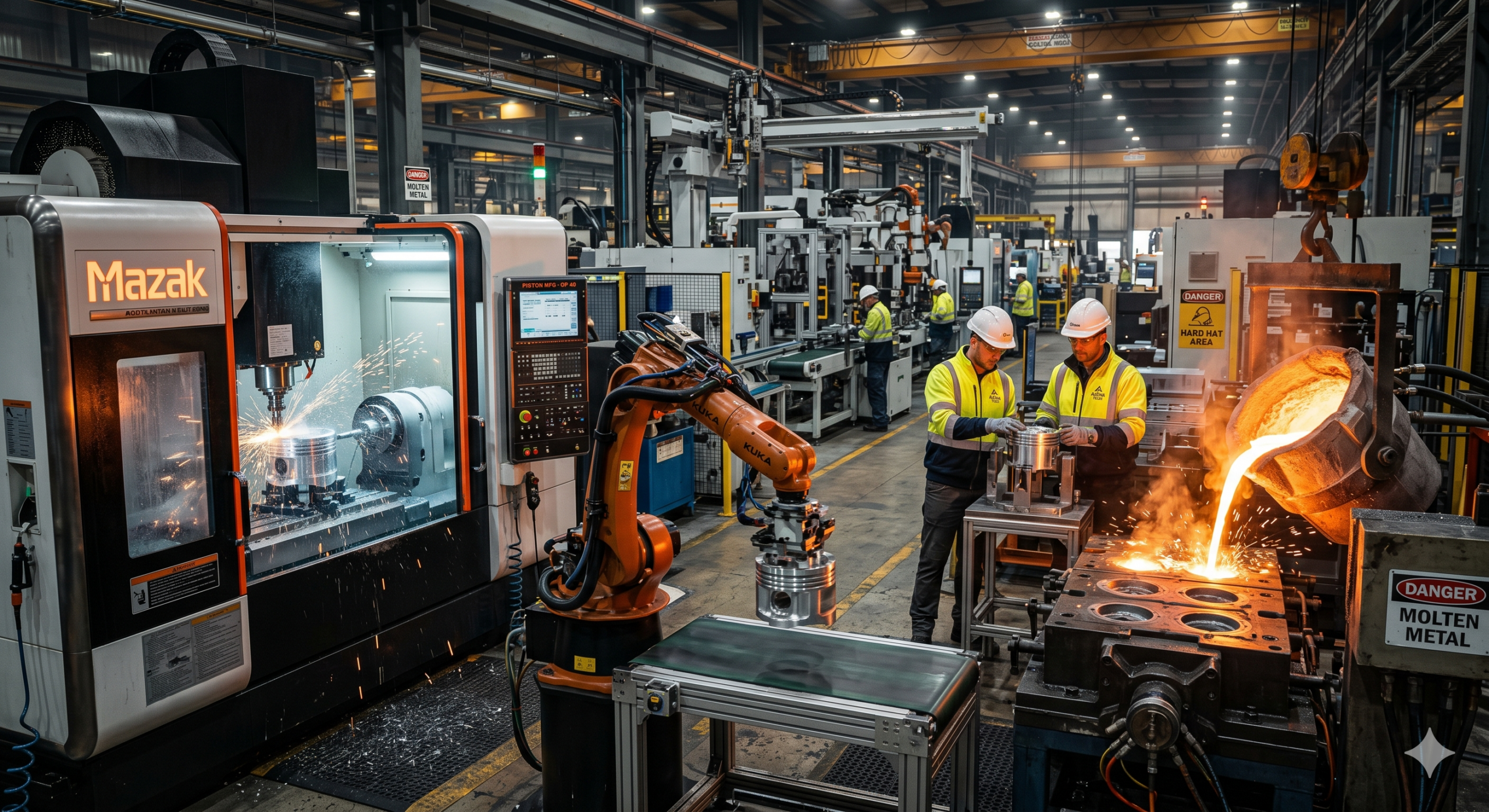
The pistons manufacturing process is a cornerstone of modern engine production, directly influencing performance, efficiency, and durability. Whether used in automotive engines, motorcycles, marine systems, or industrial machinery, pistons must withstand extreme temperatures, pressures, and friction. This makes their design and manufacturing a highly specialized and precision-driven discipline.
In this guide, we’ll break down the entire pistons manufacturing process step by step—from raw material selection to final quality inspection—using a clean, technical, and SEO-optimized approach. If you’re in engineering, manufacturing, or simply want a deeper understanding of how pistons are made, this article will give you a complete, expert-level overview.
What Is a Piston?
A piston is a cylindrical mechanical component that moves up and down within a cylinder. Its primary function is to transfer the force generated by combustion to the crankshaft via the connecting rod.
Key Functions:
- Convert combustion energy into mechanical motion
- Maintain compression within the cylinder
- Transfer heat away from the combustion chamber
Because of these demanding roles, pistons must be:
- Lightweight
- Heat-resistant
- Wear-resistant
- Precisely engineered
Overview of the Pistons Manufacturing Process
The pistons manufacturing process involves multiple stages, including material selection, casting or forging, machining, and surface finishing. For a simplified breakdown of piston manufacturing methods, you can refer to this piston manufacturing process guide. The pistons manufacturing process typically includes the following stages:
- Material selection
- Casting or forging
- Heat treatment
- Rough machining
- Precision machining
- Surface treatment and coating
- Assembly (if applicable)
- Inspection and quality control
Each step is critical in ensuring the piston meets strict engineering tolerances and performance standards.
1. Material Selection
The process begins with selecting the right material. Most pistons are made from aluminum alloys due to their excellent strength-to-weight ratio and thermal conductivity.
Common Materials:
- Hypereutectic aluminum alloys (high silicon content)
- Forged aluminum alloys (for high-performance engines)
- Cast iron (used in heavy-duty or older engines)
Why Aluminum?
- Lightweight → improves fuel efficiency
- Excellent heat dissipation
- Good machinability
Silicon is often added to aluminum to enhance wear resistance and reduce thermal expansion.
2. Casting or Forging
The next step in the pistons manufacturing process is shaping the raw material into a rough piston form. This is done using either casting or forging.
Casting Process
Casting involves pouring molten aluminum into molds.
Types of Casting:
- Gravity casting
- Low-pressure casting
- High-pressure die casting
Advantages:
- Cost-effective
- Suitable for mass production
- Good dimensional consistency
Limitations:
- Slightly lower strength compared to forged pistons
Forging Process
Forging uses high pressure to shape solid aluminum billets into piston forms.
Advantages:
- Higher strength and durability
- Better grain structure
- Ideal for high-performance and racing engines
Limitations:
- Higher cost
- More machining required afterward
3. Heat Treatment
After casting or forging, pistons undergo heat treatment to improve their mechanical properties.
Common Heat Treatment Steps:
- Solution heat treatment
- Quenching
- Aging (precipitation hardening)
Benefits:
- Increased strength
- Improved fatigue resistance
- Enhanced dimensional stability
Heat treatment ensures the piston can withstand repeated thermal cycles and mechanical stress.
4. Rough Machining
Once the piston blank is ready, rough machining begins. This stage removes excess material and defines the general shape.
Operations Include:
- Turning (lathe operations)
- Facing
- Drilling initial holes
Goals:
- Prepare the piston for precision machining
- Establish basic dimensions
At this stage, tolerances are still relatively loose.
5. Precision Machining
Precision machining is one of the most critical steps in the pistons manufacturing process. This stage ensures exact dimensions, smooth surfaces, and tight tolerances.
Key Machining Operations:
a. CNC Turning
- Shapes the piston skirt and crown
- Ensures precise diameter
b. Groove Cutting
- Creates piston ring grooves
- Requires micron-level accuracy
c. Pin Bore Machining
- Drills and hones the wrist pin hole
- Must align perfectly with the piston axis
d. Milling
- Shapes valve reliefs
- Reduces weight while maintaining strength
Technologies Used:
- CNC machines
- Multi-axis machining centers
- Automated tooling systems
Precision machining directly impacts engine efficiency, oil consumption, and longevity.
6. Surface Treatment and Coating
To enhance performance and durability, pistons undergo various surface treatments.
Common Treatments:
Anodizing
- Improves corrosion resistance
- Enhances surface hardness
Phosphate Coating
- Reduces friction during initial engine operation
Thermal Barrier Coatings
- Applied to piston crowns
- Reflect heat back into the combustion chamber
Graphite Coating
- Applied to the skirt
- Reduces friction and noise
Benefits:
- Lower wear and tear
- Improved fuel efficiency
- Enhanced engine lifespan
7. Assembly (If Required)
Some pistons are assembled with additional components before final inspection.
Components May Include:
- Piston rings
- Wrist pins (gudgeon pins)
- Retaining clips
In high-volume manufacturing, assembly is often automated for consistency and efficiency.
8. Inspection and Quality Control
Quality control is essential in the pistons manufacturing process. Even minor defects can lead to engine failure.
Inspection Methods:
Dimensional Inspection
- Uses coordinate measuring machines (CMM)
- Verifies tolerances within microns
Non-Destructive Testing (NDT)
- X-ray inspection
- Ultrasonic testing
- Dye penetrant testing
Surface Roughness Testing
- Ensures proper lubrication behavior
Weight Balancing
- Ensures uniformity across piston sets
Standards Followed:
- ISO manufacturing standards
- Automotive OEM specifications
Advanced Manufacturing Technologies
Modern piston manufacturing is increasingly driven by automation and smart technologies.
Key Innovations:
CNC Automation
- Reduces human error
- Increases production speed
AI-Based Quality Control
- Detects defects in real time
- Improves consistency
Additive Manufacturing (Emerging)
- Used for prototyping
- Enables complex geometries
Digital Twin Technology
- Simulates piston performance before production
These advancements are making the pistons manufacturing process more efficient, precise, and scalable.
Challenges in Pistons Manufacturing
Despite technological advancements, manufacturers face several challenges:
1. Thermal Expansion Control
Pistons expand under high temperatures, requiring precise design tolerances.
2. Weight vs Strength Balance
Reducing weight improves efficiency but must not compromise durability.
3. Emission Regulations
Stricter standards require improved combustion efficiency and reduced friction.
4. Cost Optimization
Balancing high-quality production with competitive pricing is critical.
Applications of Pistons
Pistons are used in a wide range of industries:
- Automotive engines (cars, trucks, motorcycles)
- Aerospace systems
- Marine engines
- Industrial compressors
- Power generation equipment
Each application may require slight variations in the pistons manufacturing process.
Future Trends in Pistons Manufacturing
The future of piston manufacturing is evolving rapidly with advancements in materials science and digital engineering.
Key Trends:
- Lightweight composite materials
- Advanced coatings for ultra-low friction
- Smart pistons with embedded sensors
- Sustainable manufacturing practices
As internal combustion engines continue to evolve alongside hybrid technologies, pistons will remain a critical component requiring continuous innovation.
Conclusion
The pistons manufacturing process is a complex, multi-stage operation that combines material science, mechanical engineering, and advanced manufacturing technologies. From selecting the right aluminum alloy to precision machining and rigorous quality control, every step plays a vital role in ensuring optimal engine performance.
Understanding this process not only highlights the engineering excellence behind everyday machines but also reveals the level of precision required to produce components that operate under extreme conditions.
As technology advances, the pistons manufacturing process will continue to evolve—becoming smarter, more efficient, and more sustainable—while maintaining its essential role in powering the world’s engines.