

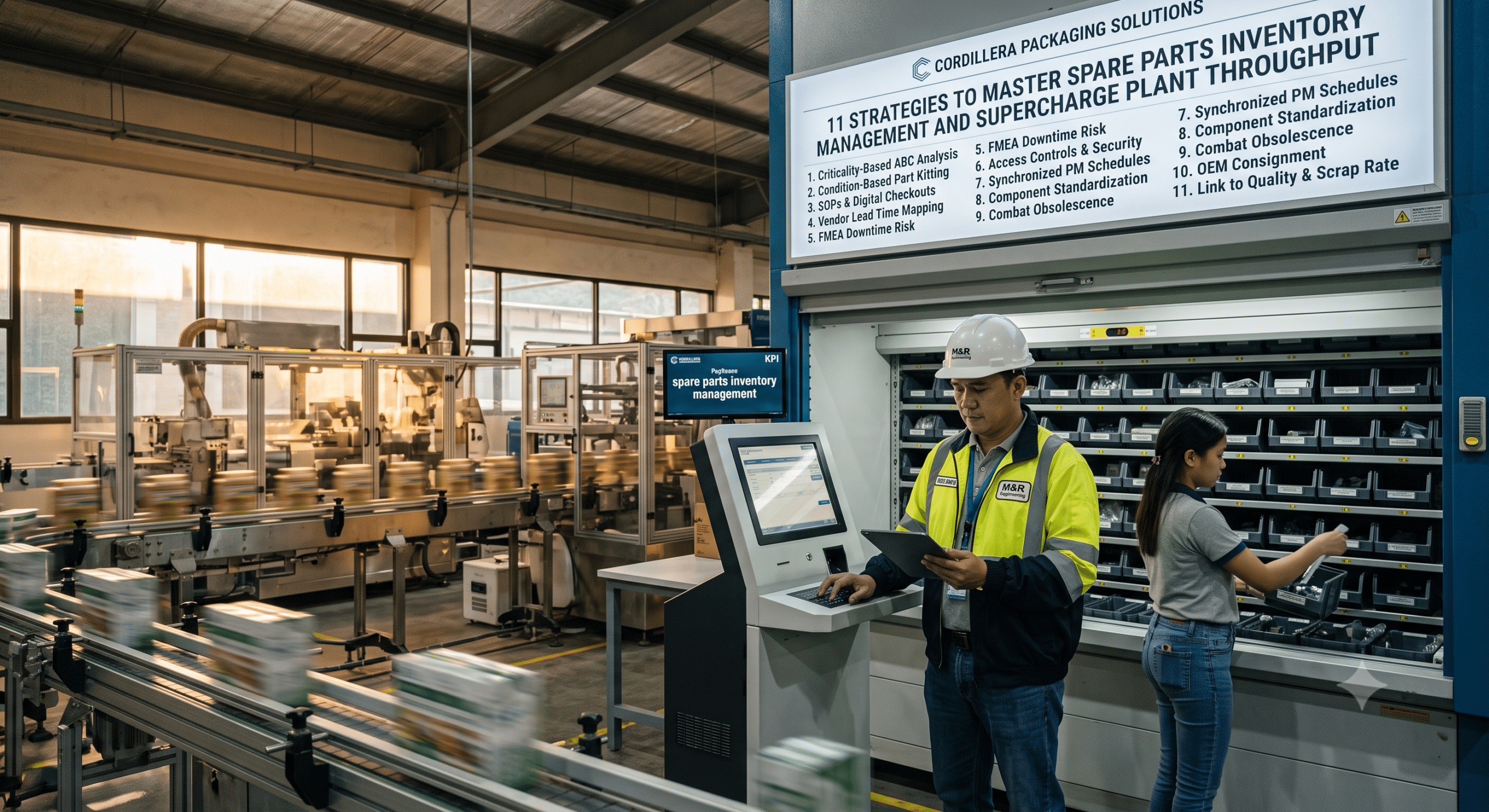
Every morning, I walk onto the plant floor to audit our operations and listen closely. Specifically, I listen for the steady, rhythmic hum of our primary packaging lines. As a Maintenance and Reliability Engineering Manager, I know that maintaining an optimized spare parts inventory management system keeps that productive hum alive. That sound is music to my ears because it tells me our operation is healthy and generating profit. Conversely, if that hum stops, the cost clock begins ticking immediately. Consequently, unexpected downtime eats away at our bottom line fast.
In my years managing heavy industrial environments, I have focused on three unforgiving metrics. Ultimately, we must maximize throughput, reduce cycle time, and minimize scrap rate. Naturally, when production lines run at peak efficiency, throughput increases. As a result, more units move out the door in less time.
Similarly, cycle time drops when individual operations run flawlessly without micro-stops. At the same time, the scrap rate plunges when our machinery remains calibrated, stable, and perfectly maintained. However, achieving this trifecta requires a rock-solid operational backbone. That brings us directly to our core focus: implementing a world-class spare parts inventory management system.
Connecting Maintenance to Bottom-Line Profits
According to principles in the Industrial Maintenance Management Guide, maintenance acts as a strategic lever. Therefore, it directly influences plant availability and performance. Indeed, if technicians lack immediate access to the exact component they need, throughput plummets. Furthermore, your cycle time stretches, quality degrades, and the scrap rate spikes. Proper spare parts inventory management forms the ultimate barrier between continuous production and costly operational paralysis.
Transforming Your Warehouse Assets
Below, I outline eleven actionable, expert-level strategies. These steps bridge the gap between your storeroom shelves and your floor metrics. Thus, they transform your warehouse from a chaotic cost center into a powerful reliability engine. By focusing on smart spare parts inventory management, you can protect your facility’s daily profitability.
1. Implement Criticality-Based ABC Analysis for Machine Components
First, you cannot manage every spare part on your storeroom floor with the same scrutiny. Doing so inevitably wastes both time and capital. For this reason, I always advise starting with a cross-referenced ABC analysis. This process evaluates the financial consumption value of a part alongside the operational criticality of its machine.
Defining Your Inventory Tiers
To begin with, Class A items are your high-value, highly critical components. These include custom main drive motors or specialized programmable logic controllers. Therefore, a stock-out here means an immediate, catastrophic halt to plant throughput. Meanwhile, Class B items consist of medium-criticality assets like standard pneumatic cylinders. Finally, Class C components are low-cost, readily available items like common fasteners and fittings.
Protecting Your Plant Operations
Consequently, layering an asset criticality matrix over your financial data helps you target your budget. You can then focus your counting efforts on the parts that directly defend your primary production constraints. For example, when a critical machine experiences a component failure, a Class A part on the shelf protects your cycle time. As a result, the team can execute repairs immediately rather than waiting weeks for an emergency shipment.
2. Transition from Reactive Chaos to Condition-Based Part Kitting
In addition, if your maintenance team operates in a reactive “firefighting” mode, your spare parts inventory management will always feel out of control. Reactive maintenance forces technicians to rush to the storeroom in a panic. Subsequently, they grab components without logging them properly into your software. This habit directly degrades inventory accuracy and leads to unexpected stock-outs.
Shifting to Proactive Scheduling
To break this cycle, you must shift your facility toward a proactive, condition-based maintenance strategy. For instance, use vibration analysis, thermography, and ultrasound to detect machine degradation weeks before a failure occurs.
Assembling Pre-Packaged Kits
Therefore, once your condition monitoring tools trigger an early warning alert, your reliability planners can create a comprehensive “kit.” This kit includes every single gasket, bearing, seal, and tool required for that specific repair job. Afterward, the storeroom team assembles and stages this kit in a secure area long before the scheduled shutdown window opens. Ultimately, this careful preparation keeps your actual repair cycle time to an absolute minimum.
3. Establish Granular Standard Operating Procedures for the Storeroom
Moreover, user-friendly spare parts inventory management software only works effectively if your team enters accurate data every day. To maintain high inventory accuracy, you must establish and enforce strict Standard Operating Procedures. Clearly, these rules govern how parts are received, cataloged, and checked out of the warehouse.
Defining Accountability in the Storeroom
Accordingly, every time a technician pulls a component for a work order, they must log it properly. Specifically, the technician must digitally link the part to the specific asset hierarchy in your computer system.
Eliminating Discrepancies and Ghost Inventory
When your team follows a uniform, disciplined process for inventory tracking, you eliminate the risk of “ghost inventory.” This happens when the software claims a part is on the shelf, but the physical bin is completely empty. Consequently, accurate tracking data prevents extended downtime events. At the same time, it keeps your equipment operating smoothly and ensures that production throughput remains steady across all shifts.
4. Master and Map Vendor Procurement Lead Times
Equally important, understanding your exact vendor lead times is a foundational requirement for calculating effective reorder points. Indeed, it prevents stock-outs of critical spares. For instance, a custom-engineered pump seal might carry a fixed six-week manufacturing lead time. Conversely, standard industrial bearings might arrive at your facility within twenty-four hours from a local distributor.
Updating Software Databases
As a manager, you must regularly audit and update these lead times within your asset management database. Of course, this practice accounts for shifting global supply chain dynamics.
Buffering Against Supply Logistics Delays
Thereafter, pair accurate lead time statistics with your historical consumption data. This allows you to establish precise safety stock levels that buffer your production lines against unexpected transport delays. Thus, proactive tracking ensures that you never face a situation where a bottleneck machine sits idle for weeks. In short, you avoid waiting on a single specialized component, protecting your cycle time from catastrophic spikes.
5. Calculate Total Downtime Risk with Failure Mode Analysis
To truly optimize your spare parts investment, you should conduct a comprehensive Failure Mode and Effects Analysis on your highest-value production assets. This engineering process requires you to sit down with your senior technicians and equipment operators. Together, you systematically identify exactly how a machine can fail, what triggers that failure, and the ultimate operational consequence.
By analyzing these failure modes, you can calculate the statistical probability of a breakdown. Following this, you weigh it against the financial impact of lost plant throughput.
For example, if a specific gearbox has a known failure mode that completely halts your entire packaging line, the risk calculation dictates action. Therefore, you must hold a complete replacement unit on-site. In the long run, this targeted investment protects your facility from operational paralysis. It also allows your engineering team to keep manufacturing cycle times tightly controlled.
6. Enforce Strict Physical Access Controls and Storeroom Security
On the other hand, an open-door policy in an industrial storeroom is a guaranteed recipe for inventory discrepancies. It inevitably causes phantom stock levels and inflated maintenance costs. If any operator or technician can walk into the warehouse at 2:00 AM and grab an expensive sensor without logging it, your tracking system will fail completely.
Restricting Store Entry Protocols
Hence, you must enforce strict physical security measures. For example, install badge-restricted electronic entry gates and automated parts-dispensing kiosks. Likewise, deploy dedicated storeroom personnel for your busiest production shifts.
Safeguarding Real-Time Records
Ultimately, limiting physical access to trained, accountable staff ensures that the system records every single transaction accurately in real time. This security discipline directly supports your production throughput targets. Furthermore, it guarantees that when a critical line breaks down, the replacement parts listed in your computer system are physically present and ready for deployment.
7. Synchronize Reorder Points with Asset PM Schedules
Another effective way to reduce your inventory carrying costs while maintaining high equipment availability is to synchronize your reorder points with your preventive maintenance schedules. If you know that your primary extruder undergoes a major mechanical overhaul every six months, you do not need to hold those expensive, specialized overhaul kits on your shelves for the entire year.
Integrating Purchasing with Dynamic Maintenance
Instead, your material planners should configure your management software to trigger an automated purchase order. This order should align precisely with the upcoming preventive maintenance window while accounting for vendor lead time.
Freeing Corporate Capital and Shortening Repairs
Consequently, this just-in-time approach to maintenance material management frees up significant working capital that would otherwise sit locked up in stagnant inventory. Furthermore, it ensures that your maintenance technicians have fresh, factory-certified components ready right when the team takes the machine offline, thereby minimizing overall maintenance cycle time.
8. Eliminate Over-Processing and Micro-Stops via Component Standardization
Certainly, a lack of component standardization across your production floor drives extended manufacturing cycle times and high scrap rates. If your facility uses five different brands of variable frequency drives or three different styles of pneumatic valves across various lines, your technicians will struggle to maintain expert proficiency in calibrating them all.
Unifying Part Brands Across Multiple Lines
During an emergency repair, this variation leads to subtle setup errors. Additionally, it causes extended troubleshooting times and minor speed losses or micro-stops on the line.
Enhancing Repair Accuracy and Speed
By launching a deliberate component standardization initiative, you can systematically replace non-standard parts with a unified, factory-approved brand during scheduled maintenance windows. In turn, this reduction in part variety simplifies your spare parts inventory management, reduces the chance of a technician installing an incorrect component, and stabilizes your machinery to keep scrap rates low.
| How Effective Spare Parts Management Drives Plant KPIs |
| 1. Maximizes Throughput $\rightarrow$ Eliminates part-waiting downtime, keeping lines running at full capacity. |
| 2. Reduces Cycle Time $\rightarrow$ Enables rapid kitting and repairs, minimizing the duration of maintenance stops. |
| 3. Minimizes Scrap Rate $\rightarrow$ Assures technicians use precise OEM parts for instant, stable calibrations during asset restarts. |
9. Combat Material Obsolescence and Right-Size Excess Stock
Holding obsolete or damaged components on your storeroom shelves creates a heavy financial and operational burden that quietly undermines your maintenance efficiency. Over time, as plants modernize, upgrade, or decommission manufacturing lines, the unique spare parts associated with those older machines often remain forgotten in the back of the warehouse.
Managing Aging Warehouse Stock
Inevitably, these obsolete items consume valuable shelf space, complicate your cycle counting processes, and can easily confuse a hurried technician. For instance, they might grab an incorrect version of a part during a midnight breakdown.
Executing Structured Annual Audits
Therefore, I recommend establishing a formal, annual inventory review process to identify slow-moving or obsolete stock. Because of this review, you can systematically purge these items from your records through scraping or vendor buy-back programs. Ultimately, right-sizing your physical stock ensures that your warehouse is lean, organized, and focused entirely on supporting the active assets currently driving your facility’s daily throughput.
10. Partner with Original Equipment Manufacturers for Consignment Agreements
Fortunately, you do not always have to expend upfront capital to ensure that you have immediate access to high-value, long-lead spare parts. For exceptionally expensive components that are vital for your plant’s long-term operations but carry a low probability of sudden failure, you should negotiate vendor-managed inventory or consignment agreements with your trusted Original Equipment Manufacturers.
Navigating Low-Risk High-Cost Assets
Under a proper consignment structure, the vendor places the critical spare part directly inside your physical warehouse. However, your company does not actually pay for the component until a technician checks it out and installs it on a machine.
Securing an Operational Safety Net
Thus, this strategy effectively transfers the financial burden of carrying costs back to the supplier while providing your maintenance team with a reliable safety net against extended downtime. As a result, this approach ensures that your primary manufacturing lines can be restored rapidly if a major component fails, keeping plant throughput high without straining your corporate maintenance budget. This financial balance remains a central pillar of tactical spare parts inventory management.
11. Connect Maintenance Calibration to Quality and Scrap Reduction
Finally, scrap is the ultimate enemy of manufacturing efficiency because when a machine produces a defective part, you have wasted both the cycle time and the raw materials used to create it. A significant percentage of product quality drift stems directly from sub-optimal maintenance practices. For example, these include installing a non-genuine aftermarket component or failing to replace a worn bearing at the correct interval.
Rooting Out Drift and Speed Losses
Consequently, when an asset begins to vibrate or experience minor thermal fluctuations due to a worn internal component, its precision drops. At the same time, the scrap rate begins to climb.
Securing Baseline Calibration Parameters
By linking your spare parts inventory management directly to your quality control metrics, you can ensure that your technicians always install genuine, factory-certified Original Equipment Manufacturer components. Therefore, installing high-quality, precise parts allows your maintenance team to return a repaired machine back to its exact baseline calibration parameters immediately. In conclusion, this practice prevents quality defects and ensures that the line outputs first-pass prime product from the very first run.
Frequently Asked Questions
What is the difference between general inventory and maintenance spare parts inventory?
General inventory typically consists of raw materials, work-in-progress components, and finished goods that move through a company’s sales channels in a highly predictable, demand-driven pattern. On the other hand, maintenance spare parts inventory consists of specialized components, repair tools, and operating supplies used strictly to maintain, repair, and support internal production assets, characterized by highly erratic demand and severe operational penalties if a stock-out occurs.
How do high inventory carrying costs impact a plant’s maintenance budget?
Inventory carrying costs, which typically range from $20\%$ to $30\%$ of the total inventory value annually, include expenses related to warehouse storage space, building insurance, material handling labor, taxes, and product obsolescence. Consequently, when a facility holds excessive or unnecessary spare parts on its shelves, a significant portion of its operating capital becomes frozen in stagnant stock, leaving fewer funds available for critical predictive maintenance technologies or reliability engineering upgrades.
How does a CMMS improve daily spare parts inventory tracking for technicians?
A Computerized Maintenance Management System acts as a single, centralized database that links your physical spare parts directly to your active work orders, preventative maintenance schedules, and digital asset hierarchies. Therefore, when a technician opens a work order on a mobile device, the software automatically shows them the exact parts required for the repair, confirms the real-time bin location in the storeroom, and automatically updates the stock level the moment the technician scans the part out, thereby reducing manual entry errors.
What steps should a manager take if a critical part goes obsolete from the OEM?
When an Original Equipment Manufacturer announces that a critical component has reached its end-of-life cycle, a maintenance manager should immediately conduct a risk assessment to determine how many of those specific parts are currently installed across the plant floor. Afterward, the manager can choose to execute a final “lifetime buy” of the remaining factory stock, partner with a certified industrial electronics remanufacturer to source high-quality refurbished spares, or plan a systematic engineering upgrade to modernize the asset to the current component family during an upcoming scheduled shutdown.
References for Further Reading
-
For a deep dive into industry-tested techniques for right-sizing stockrooms and reducing downtime, see the comprehensive guide on Parts Inventory Management Best Practices by BILL.
-
To explore proactive maintenance frameworks and structural optimization steps for plant reliability, review the field-tested methods detailed in the MaintainX Spare Parts Inventory Management Strategy Guide.