

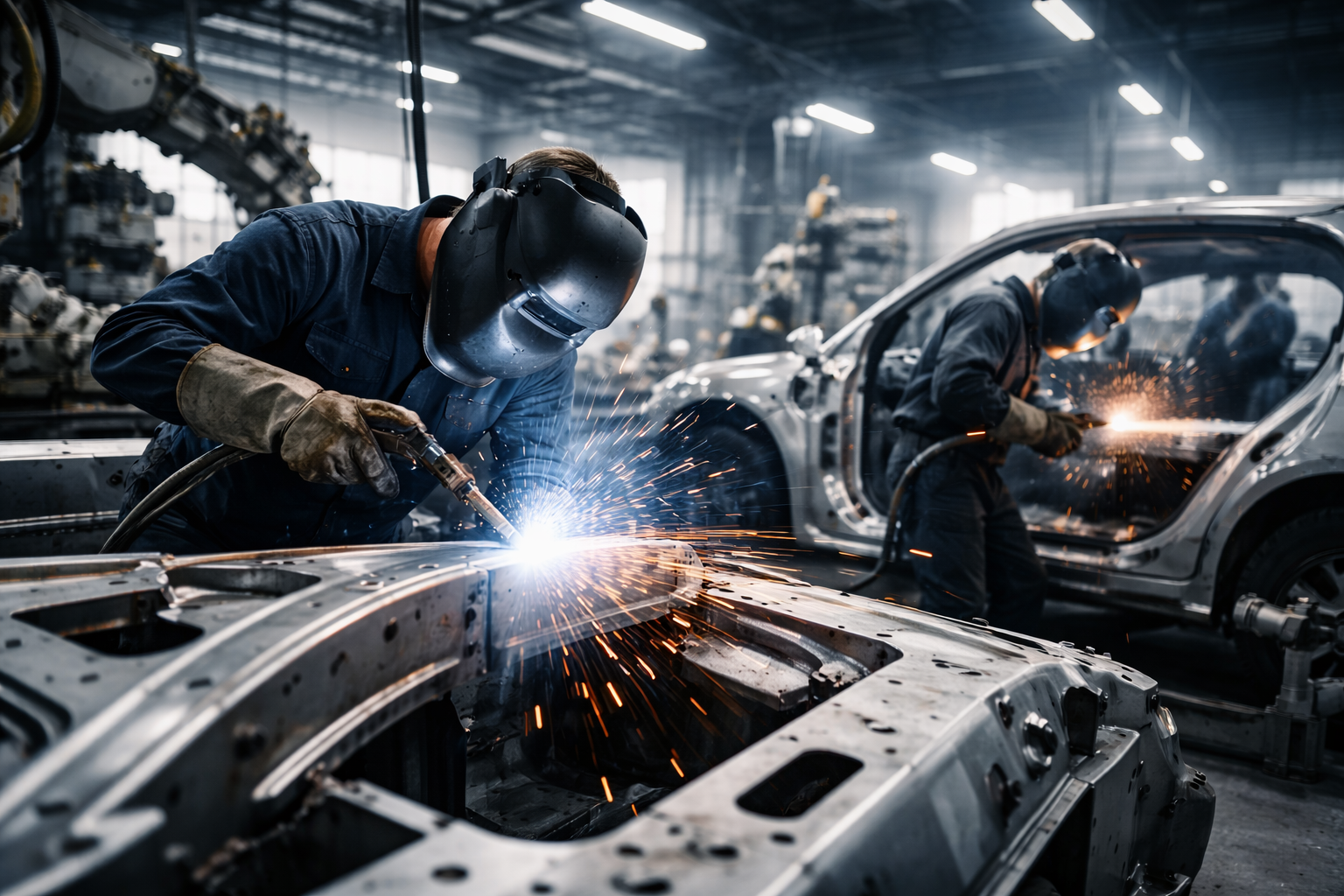
Welding techniques automotive manufacturing relies on are essential for producing strong, safe, and high-performance vehicles. Automotive manufacturing relies on advanced automotive welding techniques to ensure structural integrity, precision, and efficiency in modern vehicle production.
As modern cars become more advanced—incorporating lightweight materials, electric powertrains, and complex structures—the role of welding continues to evolve. From assembling vehicle frames to joining intricate components, welding ensures durability, precision, and structural integrity.
This guide explores the most important automotive welding methods, their applications, advantages, and emerging trends shaping the future of vehicle manufacturing.
What Are Automotive Welding Techniques?
Automotive welding techniques refer to the processes used to join metal parts in vehicle production. These methods use heat, pressure, or a combination of both to fuse materials together, creating permanent bonds.
Common materials used in automotive welding include:
- Steel (mild and high-strength)
- Aluminum
- Magnesium alloys
- Advanced composites (in some hybrid processes)
These techniques are applied throughout the vehicle—from the chassis and body panels to engine components and exhaust systems.
Importance in Automotive Manufacturing
Modern vehicle production demands high precision, safety, and efficiency. Welding plays a central role in meeting these requirements.
Key Benefits
- Structural integrity: Ensures strong joints for safety-critical components
- Lightweight construction: Supports the use of thinner and lighter materials
- High production speed: Suitable for mass manufacturing
- Cost efficiency: Reduces the need for additional fasteners
- Automation compatibility: Easily integrated into robotic systems
Core Welding Methods Used in Automotive
Understanding the most widely used methods helps manufacturers choose the right approach for specific applications.
1. Resistance Spot Welding (RSW)
Resistance spot welding is one of the most commonly used techniques in automotive manufacturing. It involves applying pressure and electrical current to join metal sheets.
Key Features:
- Fast and efficient
- Ideal for high-volume production
- Commonly used for body panels
Applications:
- Car body assembly
- Structural frames
- Sheet metal joints
This method is widely used in automated production lines due to its speed and consistency.
2. MIG Welding (Gas Metal Arc Welding)
MIG welding uses a continuous wire electrode and shielding gas to create strong welds.
Advantages:
- High speed and efficiency
- Suitable for various metals
- Easy to automate
Applications:
- Exhaust systems
- Frames and brackets
- Repair and maintenance
3. TIG Welding (Gas Tungsten Arc Welding)
TIG welding provides high precision and clean welds, making it ideal for delicate or visible components.
Benefits:
- Excellent weld quality
- Precise control
- Minimal spatter
Applications:
- Aluminum components
- Custom automotive parts
- High-performance vehicles
4. Laser Beam Welding
Laser welding uses a focused beam of light to create precise and deep welds.
Key Advantages:
- Extremely high precision
- Minimal heat distortion
- Suitable for complex geometries
Applications:
- Battery components in electric vehicles
- Transmission parts
- Structural reinforcements
5. Friction Stir Welding (FSW)
Friction stir welding is a solid-state process that joins materials without melting them.
Benefits:
- Strong and defect-free joints
- Ideal for lightweight materials
- Energy efficient
Applications:
- Aluminum panels
- EV battery enclosures
- Aerospace-inspired automotive parts
6. Robotic Welding
Automation has transformed automotive welding through the use of robotic systems.
Advantages:
- Consistent quality
- Increased production speed
- Reduced human error
Applications:
- Assembly lines
- High-volume manufacturing
- Precision welding tasks
Materials and Their Impact on Welding
Material selection plays a critical role in determining the appropriate welding technique.
Steel
- Widely used in vehicle structures
- Compatible with most welding methods
Aluminum
- Lightweight and corrosion-resistant
- Requires precise techniques like TIG or laser welding
Advanced High-Strength Steel (AHSS)
- Improves safety and crash performance
- Requires controlled welding processes
Mixed Materials
Modern vehicles often combine different materials, requiring hybrid welding solutions.
Applications of Welding in Automotive Industry
Welding is used in nearly every stage of vehicle production.
Body-in-White (BIW)
The BIW stage involves assembling the vehicle’s structural framework.
Processes used:
- Spot welding
- Robotic welding
Powertrain Components
Welding ensures durability in high-stress components such as:
- Engine parts
- Transmission systems
Exhaust Systems
High-temperature resistance is critical in exhaust components.
Common methods:
- MIG welding
- TIG welding
Electric Vehicles (EVs)
EV manufacturing relies heavily on advanced welding techniques.
Applications:
- Battery packs
- Cooling systems
- Lightweight frames
Benefits of Modern Automotive Welding
Improved Safety
Strong welds enhance crash resistance and passenger protection.
Increased Efficiency
Automation reduces production time and operational costs.
High Precision
Advanced technologies ensure accurate and repeatable results.
Reduced Weight
Supports the use of lightweight materials for better fuel efficiency.
Scalability
Suitable for both mass production and custom manufacturing.
Challenges in Automotive Welding
Despite its advantages, welding presents several challenges:
Heat Distortion
Excessive heat can affect material properties and dimensions.
Material Compatibility
Joining dissimilar materials can be complex.
Equipment Costs
Advanced welding systems require significant investment.
Skill Requirements
Skilled technicians are needed for high-quality results.
Best Practices for Automotive Welding
To achieve optimal performance, manufacturers should follow these best practices:
1. Select the Right Technique
Choose a method based on material type, thickness, and application.
2. Optimize Parameters
Control temperature, pressure, and speed for consistent results.
3. Use Automation
Incorporate robotic systems for efficiency and precision.
4. Ensure Quality Control
Implement inspection methods such as ultrasonic testing and visual checks.
5. Train Skilled Operators
Continuous training ensures high standards and safety.
Future Trends in Automotive Welding
The automotive industry is rapidly evolving, and welding technologies are advancing alongside it.
Laser and Hybrid Welding
Combining laser with traditional methods improves efficiency and flexibility.
AI and Smart Welding
Artificial intelligence enables real-time monitoring and optimization.
Lightweight Material Integration
New materials require innovative joining techniques.
Sustainable Manufacturing
Energy-efficient processes reduce environmental impact.
Digital Manufacturing
Integration with Industry 4.0 systems enhances productivity and traceability.
Conclusion
Welding techniques automotive manufacturing depends on are essential for producing safe, durable, and high-performance vehicles. From traditional methods like spot welding to advanced technologies such as laser and friction stir welding, these processes continue to evolve to meet industry demands.
By adopting modern techniques, leveraging automation, and following best practices, manufacturers can improve efficiency, reduce costs, and maintain high-quality standards. As the automotive industry shifts toward electrification and lightweight design, welding will remain a key driver of innovation and success.