

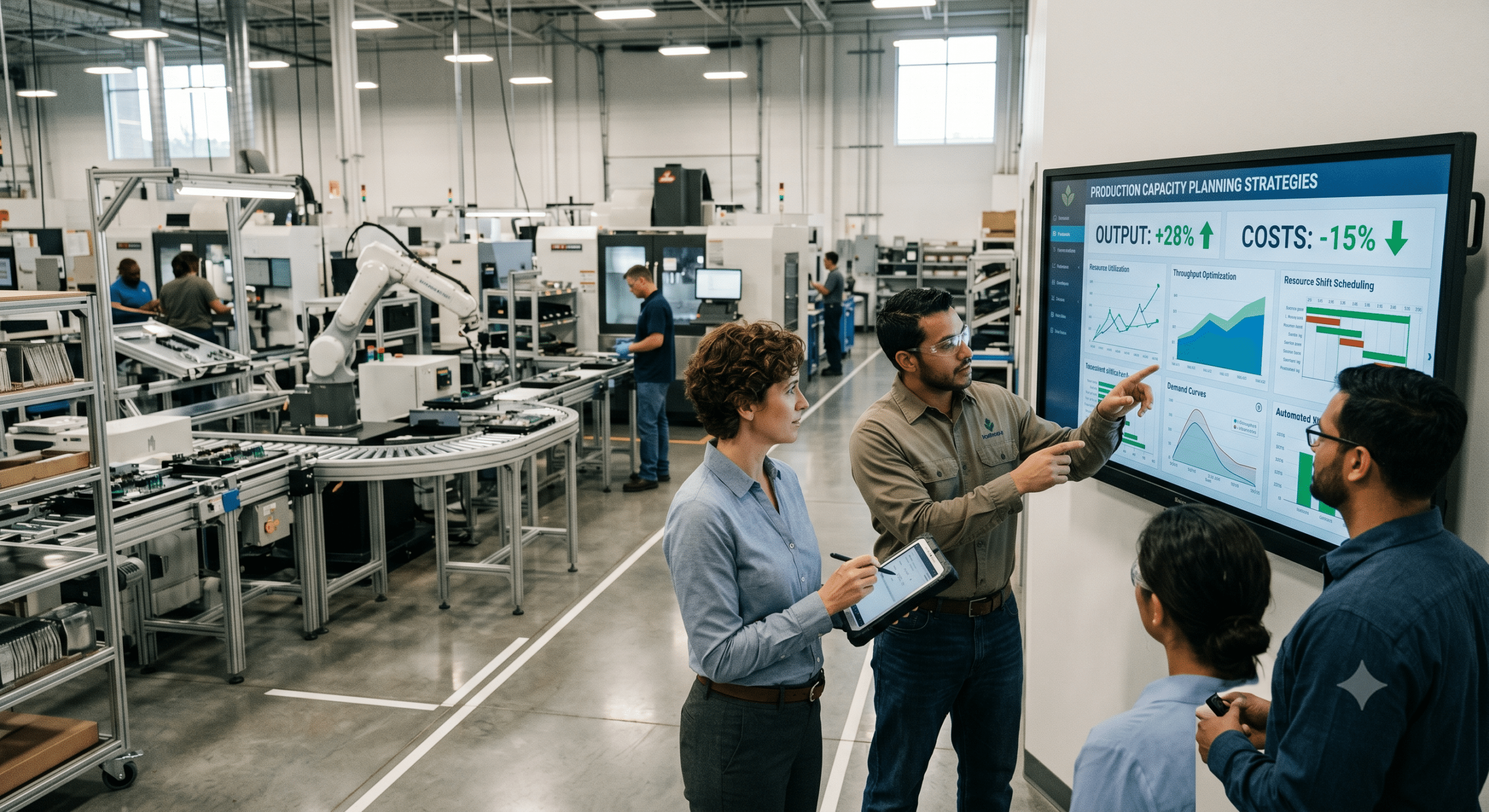
In manufacturing, success is rarely determined by how many machines a company owns or how large its facility may be. The companies that consistently deliver products on time, maintain healthy profit margins, and satisfy customers are often the ones that excel at one critical discipline: production capacity planning.
Many organizations assume manufacturing operations management is primarily about supervising workers, monitoring production lines, and ensuring orders are completed. While those responsibilities matter, modern operations management extends far beyond day-to-day production activities. It requires leaders to understand future demand, allocate resources intelligently, anticipate bottlenecks, and make strategic decisions that keep the entire operation running smoothly.
The challenge is that manufacturing environments have become increasingly complex. Supply chains are less predictable than they once were. Customer expectations continue to rise. Product customization is becoming more common. Labor shortages affect many industries. At the same time, organizations are expected to increase productivity while controlling costs.
This is where effective production capacity planning becomes one of the most valuable tools available to manufacturing leaders.
When done correctly, it helps organizations balance customer demand with available resources, reduce waste, improve scheduling accuracy, and create a more stable production environment. When ignored, it often results in missed deadlines, excessive overtime, frustrated employees, and declining profitability.
This guide explores the relationship between manufacturing operations management and production capacity planning, providing practical insights for operations leaders, plant managers, production planners, and executives seeking greater operational excellence.
Understanding Manufacturing Operations Management
Manufacturing operations management refers to the systems, processes, and leadership practices used to oversee and optimize production activities within a manufacturing organization.
At its core, operations management focuses on transforming raw materials, labor, technology, and equipment into finished products efficiently and consistently.
However, effective operations management is not simply about producing more products. It is about producing the right products, at the right time, with the right resources, while maintaining quality standards and profitability.
Operations leaders must constantly balance competing priorities. Customers want shorter lead times. Finance teams want lower costs. Employees want manageable workloads. Sales teams want flexibility. Suppliers may face disruptions. Equipment requires maintenance.
Managing these interconnected factors requires visibility across the entire manufacturing ecosystem.
Successful operations management creates alignment between strategic business objectives and day-to-day production activities. It ensures that every department works toward common goals while maintaining flexibility to adapt when conditions change.
Why Production Capacity Planning Matters More Than Ever
Production capacity planning serves as the foundation of effective manufacturing operations management.
Capacity planning is the process of determining whether a company has sufficient resources to meet current and future production demands. These resources typically include labor, machinery, facilities, materials, and available production time. (Digit Software)
Without accurate capacity planning, manufacturers often operate based on assumptions rather than facts.
A sales team may accept large customer orders without realizing the factory lacks sufficient capacity. Production managers may schedule work that exceeds machine availability. Human resources departments may struggle to hire workers quickly enough to support growth.
The result is operational chaos.
Production capacity planning helps organizations answer critical questions:
- Can we meet forecasted demand?
- Do we need additional shifts?
- Where are our bottlenecks?
- Should we invest in new equipment?
- Are we overutilizing employees?
- Can we accept new business opportunities?
The answers to these questions directly influence profitability, customer satisfaction, and long-term growth.
The Difference Between Capacity and Capability
One of the most common mistakes manufacturers make is confusing capacity with capability.
Capacity refers to the amount of output an operation can produce within a given period.
Capability refers to the organization’s ability to produce a specific product or perform a specific process.
A factory may have significant capacity but limited capability if it lacks the specialized equipment or expertise required for certain products.
Similarly, a company may possess strong technical capabilities but insufficient capacity to satisfy market demand.
Operations managers must evaluate both factors simultaneously when developing production plans.
This distinction becomes increasingly important as manufacturers expand product lines, introduce customization options, or pursue new markets.
The Hidden Cost of Poor Capacity Planning
Many manufacturing problems can be traced back to inadequate capacity planning.
The consequences are often more expensive than organizations realize.
When demand exceeds capacity, manufacturers frequently resort to overtime. While overtime can provide short-term relief, excessive reliance on it increases labor costs and contributes to employee burnout.
Missed delivery commitments can damage customer relationships and reduce future sales opportunities.
Rushed production schedules may compromise quality standards, leading to rework, warranty claims, and reputational damage.
On the opposite side of the spectrum, excess capacity creates its own challenges.
Idle equipment represents wasted investment. Underutilized labor increases operating expenses. Facilities consume resources regardless of production volume.
Effective production capacity planning helps organizations avoid both extremes by creating a balanced approach to resource utilization. (LinePlanner)
Identifying Manufacturing Bottlenecks
Every manufacturing operation contains constraints.
A bottleneck is any resource that limits overall production output.
Many organizations assume their most expensive machine determines capacity. In reality, bottlenecks can appear almost anywhere.
A shortage of skilled operators can become a constraint.
An inspection process may slow production flow.
A supplier delay might reduce material availability.
A packaging station could limit finished goods output.
Production capacity planning helps identify these constraints before they disrupt operations.
According to industry capacity planning experts, one bottleneck often determines the performance of the entire production system. Understanding and managing these constraints is essential for maximizing throughput. (Taktora.AI)
Rather than attempting to optimize every process simultaneously, successful manufacturers focus their improvement efforts on the most significant constraints.
This targeted approach typically delivers faster and more measurable results.
Forecasting Demand Accurately
No production capacity planning process can succeed without reliable demand forecasting.
Forecasting allows manufacturers to estimate future customer requirements and align resources accordingly.
Historical sales data often serves as a starting point, but modern forecasting requires a broader perspective.
Market trends, economic conditions, seasonal fluctuations, customer behavior, promotional activities, and industry developments all influence demand.
The most successful manufacturers treat forecasting as an ongoing process rather than a quarterly exercise.
Operations teams regularly compare forecasts against actual demand and adjust plans accordingly.
While forecasts will never be perfect, even moderate improvements in forecasting accuracy can significantly enhance operational performance.
Better forecasts lead to better production schedules, inventory management, staffing decisions, and capital investments.
The Three Levels of Capacity Planning
Effective production capacity planning typically operates across multiple planning horizons.
Long-term planning focuses on strategic decisions such as facility expansion, equipment purchases, and workforce development.
Medium-term planning addresses staffing requirements, shift schedules, maintenance plans, and production targets.
Short-term planning involves detailed scheduling and daily operational adjustments.
Each planning horizon serves a different purpose.
Long-term planning helps organizations prepare for future growth.
Medium-term planning aligns resources with anticipated demand.
Short-term planning ensures efficient execution on the production floor. (LinePlanner)
Manufacturers that integrate all three planning levels tend to achieve greater stability and responsiveness.
Technology’s Role in Modern Capacity Planning
The days of managing capacity exclusively through spreadsheets are rapidly disappearing.
Modern manufacturing environments generate enormous amounts of operational data.
Machine sensors provide real-time performance metrics.
Enterprise resource planning systems track orders and inventory.
Production management software monitors work-in-progress activities.
Advanced analytics tools help identify trends and predict future requirements.
These technologies allow manufacturers to move from reactive decision-making to proactive planning.
Instead of discovering problems after production delays occur, organizations can identify potential issues before they impact operations.
Real-time visibility has become a competitive advantage in manufacturing.
Companies that leverage data effectively can respond faster to changing market conditions and maintain more accurate production plans. (MachineMetrics)
Workforce Planning and Capacity Management
Machines alone do not create production capacity.
People remain one of the most important components of manufacturing operations.
Workforce planning should be integrated directly into production capacity planning efforts.
Operations leaders must consider employee availability, skill levels, training requirements, absenteeism trends, and labor market conditions.
A common mistake is assuming every employee contributes equally to capacity.
In reality, skill variations often influence productivity significantly.
Cross-training programs can help increase workforce flexibility by allowing employees to perform multiple roles.
This flexibility improves resilience when unexpected staffing challenges arise.
Organizations that invest in workforce development often experience improved capacity utilization and stronger operational performance.
Building Capacity Without Buying New Equipment
When organizations face growing demand, the immediate reaction is often to purchase additional equipment.
However, new equipment is not always the best solution.
Many manufacturers can increase capacity significantly by improving existing operations.
Reducing setup times can create additional production hours.
Improving maintenance practices can increase equipment availability.
Eliminating process inefficiencies can boost throughput.
Enhancing scheduling accuracy can reduce idle time.
Improving quality can minimize rework and waste.
Industry research consistently shows that many facilities operate below their true productive potential because of avoidable inefficiencies. (ECI Software Solutions)
Before making major capital investments, organizations should evaluate opportunities to optimize current resources.
Measuring Capacity Planning Success
Effective manufacturing operations management relies on measurable results.
Several key performance indicators help evaluate production capacity planning effectiveness.
Capacity utilization measures how much available capacity is actually being used.
Overall equipment effectiveness evaluates equipment performance, availability, and quality.
On-time delivery performance reflects the organization’s ability to meet customer commitments.
Schedule adherence measures how closely actual production matches planned schedules.
Inventory turnover indicates how efficiently materials move through the operation.
Monitoring these metrics helps leaders identify trends and continuously improve planning accuracy.
The goal is not perfection.
The goal is creating a planning process that becomes more accurate and effective over time.
The Future of Manufacturing Operations Management
Manufacturing continues to evolve rapidly.
Artificial intelligence, machine learning, predictive analytics, and automation are transforming how organizations manage operations.
Future production capacity planning systems will become increasingly predictive rather than reactive.
Instead of simply reporting what happened, they will forecast what is likely to happen next.
Manufacturers will gain greater visibility into demand fluctuations, supply chain risks, equipment performance, and workforce requirements.
Organizations that embrace these technologies while maintaining strong operational fundamentals will be better positioned to compete in an increasingly dynamic marketplace.
However, technology alone is not enough.
Success will continue to depend on leadership, strategic thinking, and disciplined execution.
Final Thoughts
Manufacturing operations management is ultimately about creating alignment between customer demand and organizational capability.
Among all the responsibilities facing operations leaders, production capacity planning remains one of the most important.
It influences profitability, customer satisfaction, workforce stability, equipment utilization, and long-term growth.
Companies that understand their true production capacity can make smarter decisions, respond faster to market changes, and avoid many of the operational challenges that plague less-prepared competitors.
The most successful manufacturers do not simply react to demand. They anticipate it, plan for it, and build systems capable of adapting as conditions change.
In an increasingly competitive manufacturing environment, production capacity planning is no longer optional. It is a strategic capability that separates high-performing operations from those constantly struggling to keep up.
Frequently Asked Questions (FAQ)
What is production capacity planning in manufacturing?
Production capacity planning is the process of determining whether a manufacturing operation has enough labor, equipment, facilities, materials, and available production time to meet current and future customer demand. It helps organizations balance resources with production requirements. (Digit Software)
Why is production capacity planning important?
Production capacity planning helps manufacturers avoid missed deadlines, excessive overtime, idle resources, and unnecessary expenses. It creates a balance between customer demand and available production resources.
What causes capacity planning failures?
Common causes include inaccurate demand forecasts, ignoring equipment downtime, failing to account for labor constraints, poor communication between departments, and relying on outdated production data. (Taktora.AI)
How often should capacity planning be reviewed?
Most manufacturers benefit from reviewing capacity plans weekly or monthly while monitoring critical metrics daily. Fast-changing environments may require more frequent reviews. (Reddit)
What is the difference between production planning and production scheduling?
Production planning determines what needs to be produced and whether sufficient resources are available. Production scheduling focuses on the detailed execution of work orders, including timing, sequencing, and resource assignments. (Reddit)
Can small manufacturers benefit from production capacity planning?
Absolutely. Capacity planning is valuable for organizations of all sizes. Even small manufacturers can improve delivery performance, reduce costs, and increase efficiency by understanding their production capacity. (MRPeasy)
References and Further Reading
For readers who want to explore the topic in greater depth, these high-authority industry resources provide excellent information:
- MachineMetrics – Manufacturing Capacity Planning: Optimizing Production Output
- MRPeasy – Capacity Planning: 10 Essential Steps for Manufacturers
- MRPeasy – What Is Production Capacity and How to Calculate It?
- User Solutions – Finite Capacity Planning and Scheduling Guide
- ECI Solutions – Production Capacity in Manufacturing Guide