

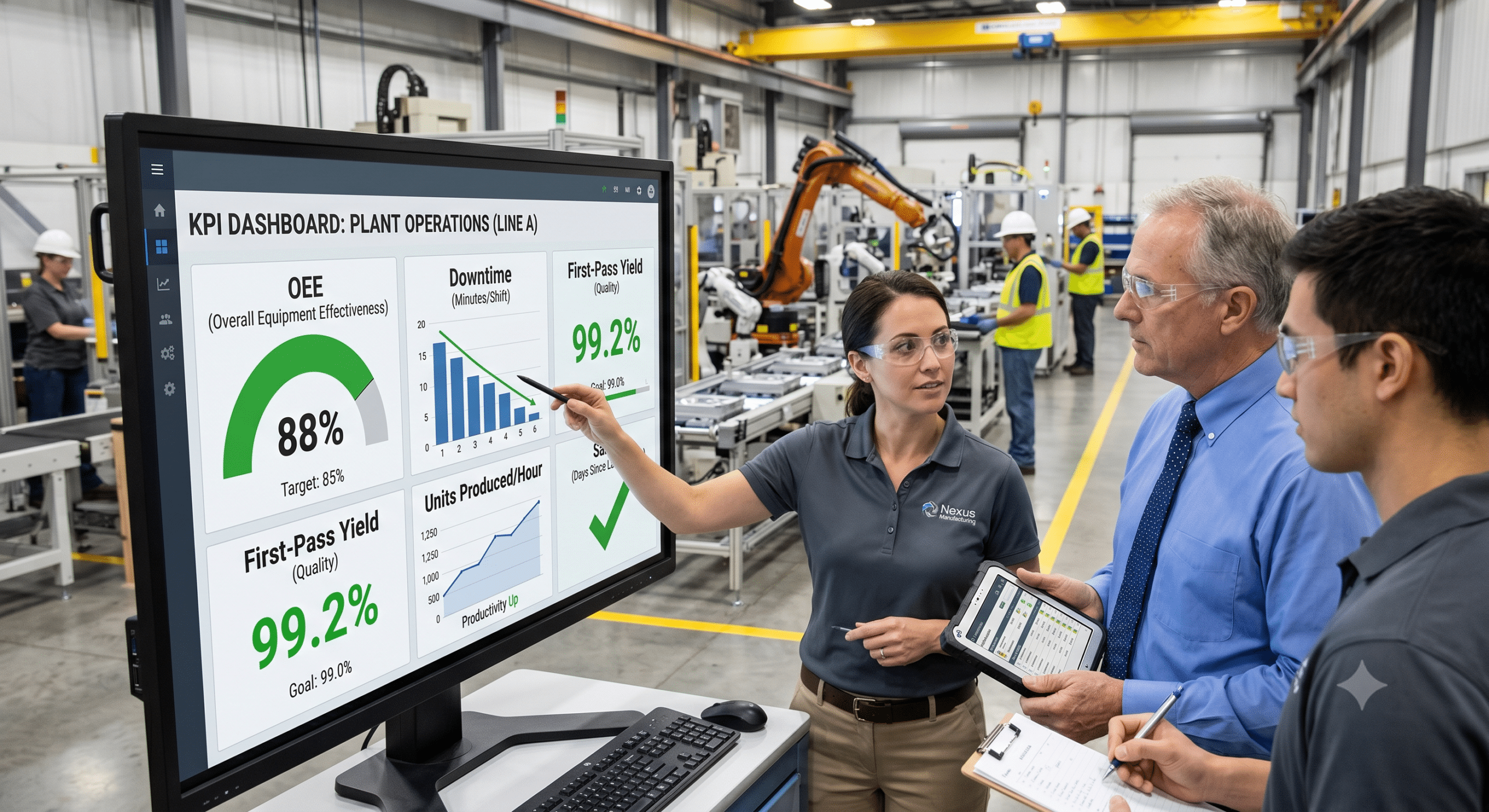
Manufacturing leaders are under constant pressure to produce more, reduce waste, improve quality, control costs, and deliver products faster than competitors. At the same time, workforce shortages, supply chain disruptions, rising material costs, and increasing customer expectations continue to challenge even the most experienced operations teams.
This is why understanding manufacturing KPIs is no longer optional. It has become one of the most important responsibilities for production managers, plant supervisors, operations directors, and executive leadership teams.
When people hear the term KPI, they often think about spreadsheets, reports, or dashboards. However, effective manufacturing KPIs are much more than numbers on a screen. They tell the story of what is happening inside a factory. They reveal where money is being lost, where productivity is improving, and where operational bottlenecks are preventing growth.
This guide provides a practical and detailed explanation of manufacturing KPIs explained from a leadership and operational perspective. Whether you oversee a single production line or manage multiple facilities, understanding these measurements can help you make smarter decisions, improve efficiency, and build a stronger manufacturing organization.
What Are Manufacturing KPIs?
Manufacturing KPIs, or Key Performance Indicators, are measurable values used to evaluate how effectively a manufacturing operation achieves its goals.
Think of KPIs as the vital signs of a manufacturing business. Just as a doctor monitors blood pressure and heart rate to assess a patient’s health, manufacturing leaders monitor KPIs to understand the health of production operations.
Without KPIs, managers often rely on assumptions, opinions, or outdated information. With the right KPIs, decisions become data-driven, objective, and focused on continuous improvement.
The most effective manufacturing organizations do not track dozens of meaningless metrics. Instead, they focus on a carefully selected group of indicators that directly influence productivity, quality, profitability, and customer satisfaction.
The Connection Between Manufacturing Operations Management and KPIs
Manufacturing operations management is the discipline of planning, organizing, directing, and controlling production activities to achieve business objectives.
Every decision made on the production floor ultimately affects performance indicators. When a machine experiences downtime, productivity declines. When defect rates increase, quality metrics suffer. When inventory levels become excessive, cash flow and operational efficiency are negatively impacted.
Manufacturing KPIs provide visibility into these operational realities.
Leaders who understand KPIs can identify trends before they become major problems. They can allocate resources more effectively, improve employee performance, and create a culture focused on measurable results.
Most importantly, KPIs help connect daily manufacturing activities with broader business goals.
Why Many Manufacturers Track the Wrong Metrics
One of the most common mistakes in manufacturing is measuring everything without understanding what truly matters.
Some organizations create dashboards containing hundreds of data points. While this may appear impressive, it often creates confusion rather than clarity.
Successful manufacturers focus on metrics that answer key questions:
- Are we producing enough?
- Are we producing efficiently?
- Are we producing quality products?
- Are we controlling costs?
- Are we meeting customer expectations?
When KPIs align with strategic goals, management teams gain valuable insights that support continuous improvement initiatives.
Manufacturing KPIs Explained: The Most Important Metrics Every Plant Should Track
Overall Equipment Effectiveness (OEE)
If there is one metric that has become the gold standard in manufacturing performance measurement, it is Overall Equipment Effectiveness, commonly known as OEE.
OEE evaluates how effectively manufacturing equipment is utilized by measuring availability, performance, and quality. The metric provides a comprehensive view of production efficiency because it combines downtime losses, speed losses, and quality losses into a single measurement. Industry experts often consider OEE the most important manufacturing KPI because it reflects the overall health of production operations. (MetricGen)
Manufacturers with strong OEE scores typically experience higher productivity, lower operating costs, and improved profitability.
Rather than viewing OEE as a simple percentage, leaders should see it as a diagnostic tool that highlights opportunities for improvement.
Production Throughput
Throughput measures the quantity of products produced within a specific period.
This KPI helps leaders understand the actual output capacity of their manufacturing operation.
A facility may have state-of-the-art equipment and highly skilled workers, but if throughput remains low, there is likely a hidden constraint somewhere in the process.
Monitoring throughput allows organizations to identify bottlenecks, optimize workflows, and improve production planning.
Higher throughput often translates directly into increased revenue potential.
Cycle Time
Cycle time measures how long it takes to complete a production process or produce a unit.
Many manufacturing leaders underestimate the importance of cycle time because they focus primarily on output volume. However, reducing cycle time often creates substantial improvements in efficiency, customer responsiveness, and capacity utilization.
Shorter cycle times generally lead to lower work-in-process inventory, improved production flow, and faster delivery times. Manufacturing experts consistently identify cycle time as one of the most important indicators of operational performance. (MetricGen)
Understanding cycle time also helps organizations improve scheduling accuracy and capacity planning.
First Pass Yield
First Pass Yield measures the percentage of products that successfully pass quality inspections without requiring rework.
This KPI directly reflects process quality and operational effectiveness.
Every defective product consumes labor, materials, machine time, and resources. Rework increases production costs while reducing overall efficiency.
High-performing manufacturers strive for consistently strong First Pass Yield because it indicates that processes are stable, predictable, and capable of producing quality products the first time. (MetricGen)
Scrap Rate
Scrap rate measures the percentage of materials or products that cannot be sold because they fail to meet quality standards.
Even small increases in scrap rates can significantly impact profitability.
For example, a manufacturer producing thousands of units daily may lose substantial amounts of money if material waste remains uncontrolled.
Monitoring scrap rates helps organizations identify process issues, equipment problems, operator training gaps, and quality control weaknesses.
Downtime
Downtime represents periods when equipment is unavailable for production.
Manufacturing leaders often discover that unplanned downtime is one of the largest hidden costs within their facilities.
Equipment failures, maintenance issues, changeovers, material shortages, and operational disruptions can all contribute to downtime.
Reducing downtime improves capacity utilization and increases production output without requiring additional equipment investments.
On-Time Delivery
On-time delivery measures the percentage of customer orders delivered according to promised schedules.
While production metrics are important, customer-focused KPIs are equally critical.
A factory may operate efficiently, but if customers do not receive products on time, overall business performance suffers.
Strong on-time delivery performance builds customer trust, strengthens relationships, and supports long-term business growth.
Inventory Turnover
Inventory turnover evaluates how efficiently inventory moves through the production system.
Excess inventory ties up capital, consumes storage space, and increases carrying costs.
Manufacturers with healthy inventory turnover typically enjoy stronger cash flow and more agile operations.
Monitoring this KPI helps balance production efficiency with inventory management objectives.
How Leadership Teams Should Use Manufacturing KPIs
One of the biggest differences between average manufacturers and high-performing manufacturers is how leadership teams use data.
Average organizations review KPIs after problems occur.
Exceptional organizations use KPIs to anticipate problems before they happen.
Leadership teams should conduct regular KPI reviews that focus on trends rather than isolated numbers. A single day’s performance may not reveal much, but patterns emerging over weeks or months can provide valuable operational insights.
When reviewing KPIs, leaders should ask deeper questions.
Why did performance improve?
Why did quality decline?
What operational changes influenced the results?
Which improvement initiatives delivered measurable outcomes?
By focusing on root causes rather than symptoms, organizations can create sustainable performance improvements.
Building a KPI Culture on the Manufacturing Floor
Many companies make the mistake of treating KPIs as management-only tools.
The reality is that the most successful manufacturers create visibility throughout the organization.
Operators, supervisors, maintenance teams, quality specialists, and production managers should all understand the KPIs that influence their work.
When employees see how their actions affect operational performance, accountability naturally increases.
Real-time KPI visibility often produces better results because employees can respond quickly to emerging issues rather than waiting for management reports. Manufacturing practitioners frequently report greater improvements when shop floor teams can view performance data and take immediate corrective action. (Reddit)
Creating a KPI culture transforms data from a reporting requirement into a continuous improvement tool.
Common KPI Mistakes Manufacturing Leaders Should Avoid
Many organizations unintentionally undermine their own KPI initiatives.
One common mistake is measuring too many metrics simultaneously. When everything becomes important, nothing remains important.
Another mistake involves focusing solely on lagging indicators. Metrics such as monthly profitability are useful, but they reveal problems only after they occur.
Leaders should also track leading indicators that provide early warning signs of operational issues.
A third mistake is failing to establish clear definitions.
In many factories, employees interpret metrics differently. Without standardized definitions, KPI data loses credibility and usefulness. Real-world manufacturing discussions often reveal confusion around cycle time definitions and measurement standards, creating inconsistent reporting and misleading conclusions. (Reddit)
Finally, organizations should avoid using KPIs as punishment tools. Performance metrics should encourage learning, collaboration, and improvement rather than fear.
The Future of Manufacturing KPIs
Technology is transforming how manufacturers collect, analyze, and act on operational data.
Advanced sensors, Industrial Internet of Things (IIoT) systems, manufacturing execution systems, artificial intelligence, and predictive analytics are enabling real-time performance monitoring on an unprecedented scale.
Instead of relying solely on historical reports, modern manufacturers can identify emerging issues immediately and respond proactively.
Future KPI systems will increasingly focus on predictive insights rather than retrospective analysis.
This shift will allow organizations to prevent disruptions, optimize resources, and achieve higher levels of operational excellence.
Final Thoughts
Understanding manufacturing KPIs explained in practical terms is one of the most valuable skills for modern manufacturing leaders.
The purpose of KPIs is not to create more reports or dashboards. Their purpose is to provide visibility, support decision-making, and drive continuous improvement.
Organizations that consistently measure and manage the right KPIs gain a significant competitive advantage. They identify problems faster, improve efficiency more effectively, reduce waste, increase profitability, and deliver better customer experiences.
Whether your focus is production efficiency, quality management, operational excellence, or long-term growth, manufacturing KPIs provide the foundation for informed leadership.
In today’s manufacturing environment, success belongs to organizations that measure what matters and act on what they learn.
Frequently Asked Questions
What does KPI mean in manufacturing?
A KPI, or Key Performance Indicator, is a measurable value used to evaluate how effectively a manufacturing operation achieves specific business objectives such as productivity, quality, efficiency, and profitability.
What is the most important manufacturing KPI?
Most manufacturing experts consider Overall Equipment Effectiveness (OEE) the most comprehensive KPI because it combines availability, performance, and quality into a single measurement. (MetricGen)
How often should manufacturing KPIs be reviewed?
Critical operational KPIs should be reviewed daily or in real time, while strategic KPIs may be reviewed weekly, monthly, or quarterly depending on organizational goals.
What is a good OEE score?
Many industry sources consider 85% or higher to be world-class performance, while most manufacturers operate between 60% and 75%. (Sumboard)
Why are manufacturing KPIs important?
Manufacturing KPIs help organizations measure performance, identify inefficiencies, reduce waste, improve quality, enhance customer satisfaction, and support data-driven decision-making.
References and Further Reading
For readers who want deeper insights into manufacturing operations management and performance measurement, these high-authority resources provide excellent information:
- MetricGen – Manufacturing KPIs: OEE, Yield, and the Metrics That Run the Floor
- ECOSIRE – Manufacturing KPIs Dashboard: OEE, Yield, Cycle Time & Throughput
- Symestic – Production Metrics: OEE, FPY, Cycle Time & KPIs That Matter
- MDCplus – OEE & Production KPIs: The Complete Guide for Manufacturers
- JITbase – KPI Dashboards for Manufacturing and Production Analytics
- MetricGen – Manufacturing Cycle Time Complete Guide
- Sumboard – Manufacturing Dashboard Guide and KPI Analytics