

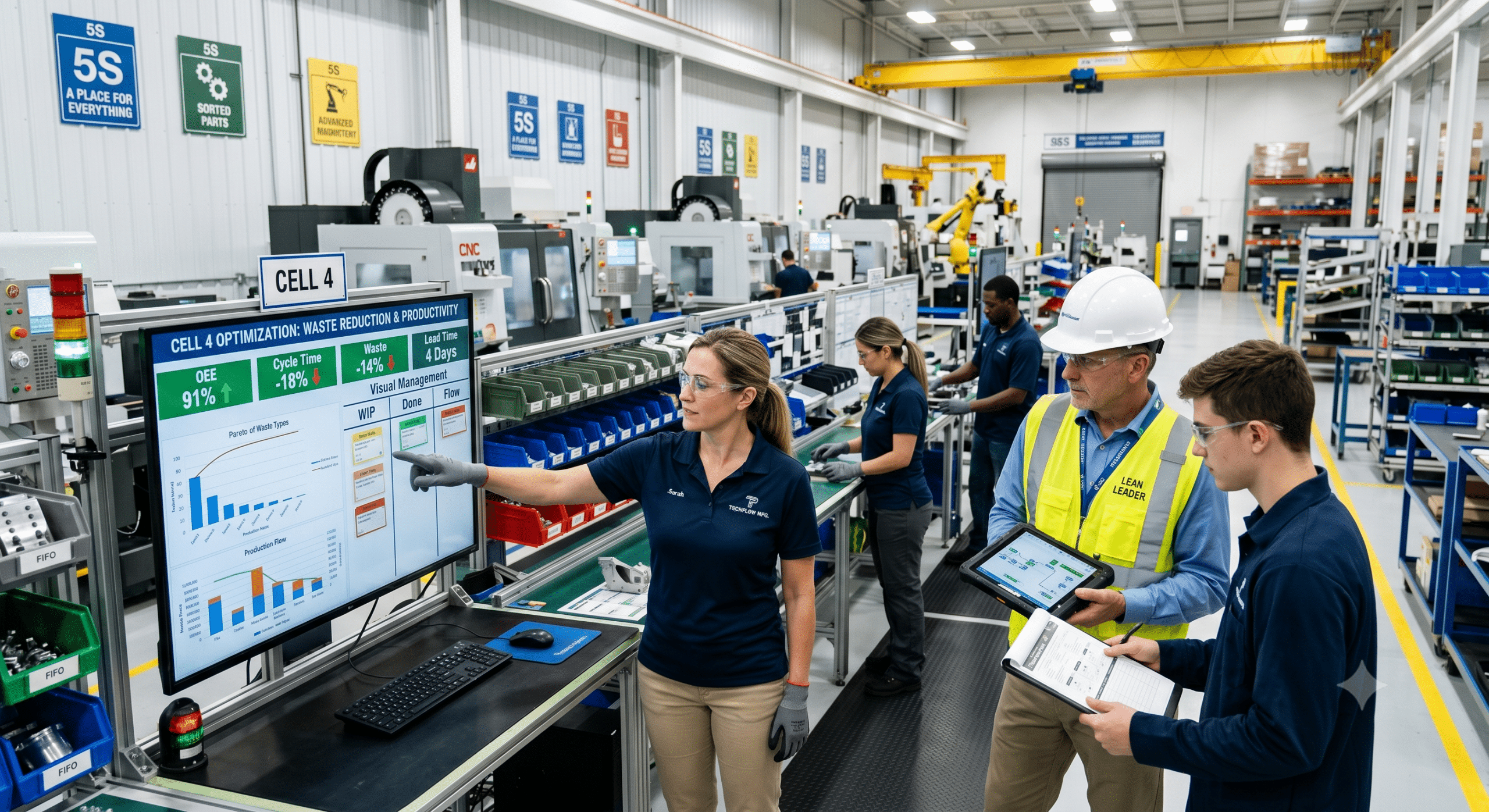
Manufacturing has always been the backbone of economic growth, innovation, and industrial progress. However, today’s manufacturing environment is far different from what it was even a decade ago. Companies are now facing increasing pressure to deliver higher-quality products, reduce operational costs, meet customer expectations faster, and navigate ongoing workforce and supply chain challenges. At the same time, technological advancements continue to reshape production environments, creating new opportunities as well as new complexities.
As a result, manufacturing leaders must find ways to operate more efficiently while remaining competitive in an increasingly demanding marketplace. Simply increasing production output is no longer enough. Instead, organizations must focus on creating smarter, more efficient systems that improve performance across every aspect of their operations.
This is where lean manufacturing principles become essential.
Although many people associate lean manufacturing solely with cost reduction, the reality is much broader. Lean manufacturing principles provide a proven framework for eliminating waste, improving quality, increasing productivity, and creating long-term operational excellence. Furthermore, they help organizations build a culture of continuous improvement that can adapt to changing business conditions.
For manufacturing executives, plant managers, operations leaders, engineers, supply chain professionals, and recruiting teams seeking operational talent, understanding lean manufacturing principles has become one of the most valuable competitive advantages available today.
Why Manufacturing Operations Management Matters More Than Ever
Manufacturing operations management serves as the central nervous system of any production organization. It coordinates people, processes, materials, equipment, technology, and information to ensure that products are produced efficiently and delivered on time.
Without effective operations management, even the most advanced manufacturing facilities can struggle. Production delays become more frequent, inventory levels increase unnecessarily, quality issues emerge, and customer satisfaction begins to decline. Consequently, organizations often find themselves spending more time reacting to problems than proactively improving performance.
Conversely, strong manufacturing operations management creates consistency and stability. Production schedules become more predictable, communication improves across departments, resources are used more effectively, and customer expectations are met more consistently. As a result, organizations can focus on growth, innovation, and continuous improvement rather than constant firefighting.
Moreover, effective operations management helps companies remain resilient during periods of economic uncertainty and market disruption. Therefore, organizations that prioritize operational excellence are often better positioned to outperform competitors and maintain profitability during challenging times.
Understanding Lean Manufacturing Principles
Lean manufacturing principles originated from the Toyota Production System, which revolutionized manufacturing by focusing on efficiency, quality, and continuous improvement. Over time, these concepts spread beyond automotive manufacturing and became widely adopted across numerous industries, including aerospace, electronics, healthcare, logistics, and technology.
At its core, lean manufacturing is built around a simple but powerful idea: maximize customer value while minimizing waste.
In other words, every activity within an organization should be evaluated based on whether it creates value for the customer. If an activity contributes directly to customer satisfaction, it should be improved and optimized. However, if an activity consumes time, resources, or effort without adding value, it should be reduced or eliminated whenever possible.
This philosophy encourages organizations to look beyond traditional productivity metrics and focus instead on creating efficient systems that consistently deliver value.
Furthermore, lean manufacturing principles emphasize continuous improvement rather than one-time fixes. Consequently, organizations that embrace lean thinking are constantly searching for opportunities to improve processes, eliminate inefficiencies, and enhance performance.
The Five Core Lean Manufacturing Principles
The success of lean manufacturing is built upon five foundational principles that guide operational decision-making.
1. Identify Value
First, organizations must understand exactly what their customers value. While this may sound obvious, many companies spend significant resources on activities, features, reports, or processes that customers neither see nor appreciate.
Therefore, manufacturers must clearly define value from the customer’s perspective. By doing so, they can focus resources on activities that directly contribute to customer satisfaction and business success.
2. Map the Value Stream
Once value has been identified, the next step is to examine every activity involved in delivering that value.
Value stream mapping provides a visual representation of how materials, information, and work move throughout the organization. As a result, hidden inefficiencies often become visible for the first time.
For example, bottlenecks, delays, unnecessary approvals, redundant tasks, and excessive movement can all be identified through value stream analysis. Consequently, organizations gain a clearer understanding of where improvements should be prioritized.
3. Create Continuous Flow
After waste has been identified, organizations must focus on creating smooth and efficient workflow.
Ideally, products should move continuously through the production process without unnecessary interruptions or delays. Furthermore, improving flow reduces lead times, minimizes inventory buildup, and increases overall productivity.
As a result, customers receive products faster, and organizations become more responsive to changing market demands.
4. Establish Pull Systems
Traditional manufacturing often relies heavily on production forecasts. However, forecasts are not always accurate.
Therefore, lean manufacturing principles encourage organizations to produce products based on actual customer demand whenever possible.
This pull-based approach helps prevent overproduction, which is one of the most expensive forms of waste in manufacturing. Additionally, it reduces excess inventory while improving cash flow and operational flexibility.
5. Pursue Perfection Through Continuous Improvement
Finally, lean organizations recognize that improvement never ends.
Rather than viewing operational excellence as a destination, they view it as an ongoing journey. Consequently, employees at every level are encouraged to identify opportunities for improvement and contribute ideas that enhance performance.
Over time, these small improvements accumulate and create significant competitive advantages.
Recognizing and Eliminating Manufacturing Waste
One of the most important aspects of lean manufacturing principles is identifying waste.
In manufacturing environments, waste often becomes normalized because employees encounter it every day. However, just because a process is familiar does not mean it is efficient.
For instance, workers may spend unnecessary time searching for tools or materials. Meanwhile, machines may sit idle waiting for maintenance or supplies. Likewise, products may remain in queues between production stages for extended periods.
Although each issue may seem minor individually, collectively they can have a significant impact on productivity and profitability.
Lean manufacturing traditionally identifies several forms of waste, including overproduction, waiting, transportation, excess inventory, unnecessary motion, overprocessing, defects, and underutilized employee talent.
Therefore, organizations that actively identify and eliminate waste often achieve substantial improvements in efficiency, quality, and customer satisfaction.
The Role of Leadership in Lean Manufacturing Success
While lean manufacturing principles provide a powerful framework, successful implementation ultimately depends on leadership.
Many organizations fail because they view lean as a short-term cost-cutting initiative rather than a long-term operational philosophy.
However, sustainable lean transformation requires consistent leadership commitment.
Effective leaders spend time observing operations firsthand. They ask questions, listen to employees, and focus on solving root causes rather than assigning blame. Furthermore, they encourage collaboration and create environments where employees feel empowered to contribute improvement ideas.
As a result, lean becomes part of the organizational culture rather than simply another management program.
Moreover, leadership plays a critical role in maintaining momentum. Without ongoing support from management, improvement initiatives often lose focus over time.
Therefore, leaders must consistently reinforce the principles and behaviors that support continuous improvement.
Building a Lean Manufacturing Culture
Technology can improve efficiency, but culture determines sustainability.
Organizations that successfully implement lean manufacturing principles understand that employee engagement is essential. After all, the people performing the work often have the greatest insight into operational challenges and opportunities.
Consequently, successful manufacturers actively involve employees in problem-solving and improvement efforts.
For example, machine operators frequently recognize recurring equipment issues before managers do. Similarly, warehouse staff often identify inventory inefficiencies that may not be visible through reports alone.
When employees are encouraged to share ideas and participate in improvement initiatives, organizations benefit from increased innovation, stronger engagement, and improved performance.
Furthermore, involving employees creates a sense of ownership that strengthens long-term commitment to operational excellence.
Lean Manufacturing and Digital Transformation
The manufacturing industry is experiencing rapid digital transformation. Technologies such as artificial intelligence, industrial Internet of Things devices, predictive analytics, robotics, and automation systems are becoming increasingly common.
However, technology alone does not guarantee success.
In fact, organizations that implement advanced technology without first improving processes often struggle to achieve expected results.
This is why lean manufacturing principles remain highly relevant in the digital era.
Lean helps organizations identify what should be improved, while technology provides tools that accelerate improvement.
For example, predictive maintenance systems can reduce equipment downtime. Real-time production monitoring can improve visibility. Additionally, data analytics can help identify inefficiencies more quickly.
As a result, combining lean thinking with modern technology creates a powerful foundation for operational excellence.
Common Mistakes Organizations Make When Implementing Lean
Despite its benefits, lean implementation is not always easy.
One common mistake is focusing exclusively on tools rather than culture. While tools such as value stream mapping, 5S, and Kanban are valuable, they cannot create lasting change without employee engagement and leadership support.
Another mistake involves attempting too many changes at once. Large-scale transformations often overwhelm employees and create resistance.
Instead, successful organizations typically begin with smaller improvement projects that generate measurable results. Subsequently, these early successes help build momentum and support broader transformation efforts.
Additionally, some organizations fail because they stop improving after initial gains. However, continuous improvement requires ongoing effort and commitment.
Therefore, manufacturers should view lean as a permanent operating philosophy rather than a temporary initiative.
Key Metrics Every Manufacturing Leader Should Monitor
Effective operations management requires measurement.
Without reliable data, it becomes difficult to evaluate performance or identify improvement opportunities.
Therefore, manufacturing leaders should monitor key operational metrics such as cycle time, lead time, overall equipment effectiveness, first-pass yield, inventory turnover, on-time delivery, and employee engagement.
These metrics provide valuable insight into operational health and help leaders make informed decisions.
Furthermore, measuring performance creates accountability and supports continuous improvement efforts across the organization.
The Future of Manufacturing Operations Management
Looking ahead, manufacturing will continue to evolve rapidly.
Artificial intelligence, automation, machine learning, advanced robotics, and smart factory technologies will undoubtedly play increasingly important roles. Nevertheless, the fundamental principles of operational excellence will remain unchanged.
Organizations must still eliminate waste. They must still improve quality. They must still engage employees. Most importantly, they must continue creating value for customers.
Therefore, manufacturers that combine technological innovation with lean manufacturing principles will be best positioned for long-term success.
Rather than replacing lean, emerging technologies will make lean practices even more effective.
As a result, the future of manufacturing belongs to organizations that can successfully integrate people, processes, technology, and continuous improvement into a unified operational strategy.
Final Thoughts
Manufacturing operations management is far more than overseeing production schedules and monitoring equipment performance. Instead, it represents the ongoing effort to align people, processes, resources, and technology toward a common objective: delivering value efficiently and consistently.
Lean manufacturing principles provide one of the most effective frameworks for achieving this goal.
By focusing on waste reduction, continuous improvement, employee engagement, and customer value, organizations can build more resilient and competitive operations. Furthermore, they can create cultures that support innovation, adaptability, and long-term growth.
Although every manufacturing environment is unique, the underlying principles remain remarkably consistent. Organizations that embrace lean thinking are better equipped to navigate challenges, improve performance, and achieve sustainable success.
Ultimately, lean manufacturing principles are not simply about producing more. Rather, they are about producing smarter, serving customers better, and building stronger organizations for the future.
Frequently Asked Questions
What are lean manufacturing principles?
Lean manufacturing principles are a set of operational practices designed to maximize customer value while minimizing waste. They focus on continuous improvement, efficiency, quality, and productivity.
Why are lean manufacturing principles important?
Lean manufacturing principles help organizations reduce waste, improve productivity, lower operational costs, enhance quality, and increase customer satisfaction.
Can small manufacturers implement lean manufacturing principles?
Yes. In fact, many small and mid-sized manufacturers benefit significantly from lean practices because improvements can often be implemented without major capital investments.
How do lean manufacturing principles improve productivity?
Lean improves productivity by eliminating non-value-added activities, streamlining workflows, reducing delays, and creating more efficient production systems.
Is lean manufacturing still relevant in the age of automation?
Absolutely. Lean manufacturing principles provide the operational foundation that helps organizations maximize the benefits of automation, artificial intelligence, and digital transformation technologies.s:
References for Further Reading
For readers who want to deepen their understanding of lean manufacturing principles, operational excellence, continuous improvement, and modern manufacturing management, the following resources provide some of the most respected insights in the industry.
- Lean Enterprise Institute — Explore Lean Thinking and Practice
One of the most authoritative lean manufacturing resources available. The Lean Enterprise Institute was founded by James Womack, co-author of The Machine That Changed the World, and provides extensive guidance on lean transformation, leadership, value stream mapping, and operational excellence. - Lean Enterprise Institute — The Lean Post Articles Library
A large collection of expert articles covering manufacturing leadership, continuous improvement, Industry 4.0, lean culture, operational strategy, and real-world case studies from global manufacturers. - Lean Enterprise Institute — Why Lean Remains a Superior Business Model and Way of Thinking
An insightful article by Dan Jones explaining why lean remains one of the most effective management systems for long-term business performance and operational excellence. - Lean Enterprise Institute — The Magnificent 7 of Lean Manufacturing
A practical guide focused on lean manufacturing tools, shop-floor stability, and operational improvement strategies for manufacturing environments. - Association for Supply Chain Management (ASCM) — Principles of Lean Manufacturing
ASCM provides professional-level guidance on lean manufacturing principles, inventory management, waste reduction, and supply chain efficiency. - LeanSuite — The Ultimate Guide to Lean Manufacturing (2026 Edition)
A comprehensive and updated guide covering lean principles, lean tools, implementation roadmaps, Industry 4.0 integration, and manufacturing transformation strategies. - TechTarget — What Is Lean Manufacturing?
A strong overview of lean manufacturing fundamentals, benefits, terminology, and business applications for modern manufacturers. - Lean Enterprise Academy — Lean Principles Blog
An excellent collection of articles focused on lean leadership, efficiency improvement, organizational learning, and operational performance. - Lean Enterprise Institute — Three Faces of Lean Management
Jeffrey Liker explores how lean leadership, scientific thinking, and organizational culture work together to drive sustainable improvement. - Lean Enterprise Institute — The 6 Guiding Principles of Lean Product and Process Development
A valuable resource for manufacturing leaders seeking to align product development, process improvement, and customer value creation.
Recommended Books
- The Toyota Way — Jeffrey Liker
- Lean Thinking — James P. Womack and Daniel T. Jones
- The Machine That Changed the World — James P. Womack, Daniel T. Jones, and Daniel Roos
- Toyota Kata — Mike Rother
- 2 Second Lean — Paul Akers
- The Goal — Eliyahu Goldratt
These books are widely considered foundational reading for manufacturing leaders, operations managers, continuous improvement specialists, industrial engineers, and professionals responsible for implementing lean manufacturing principles.