

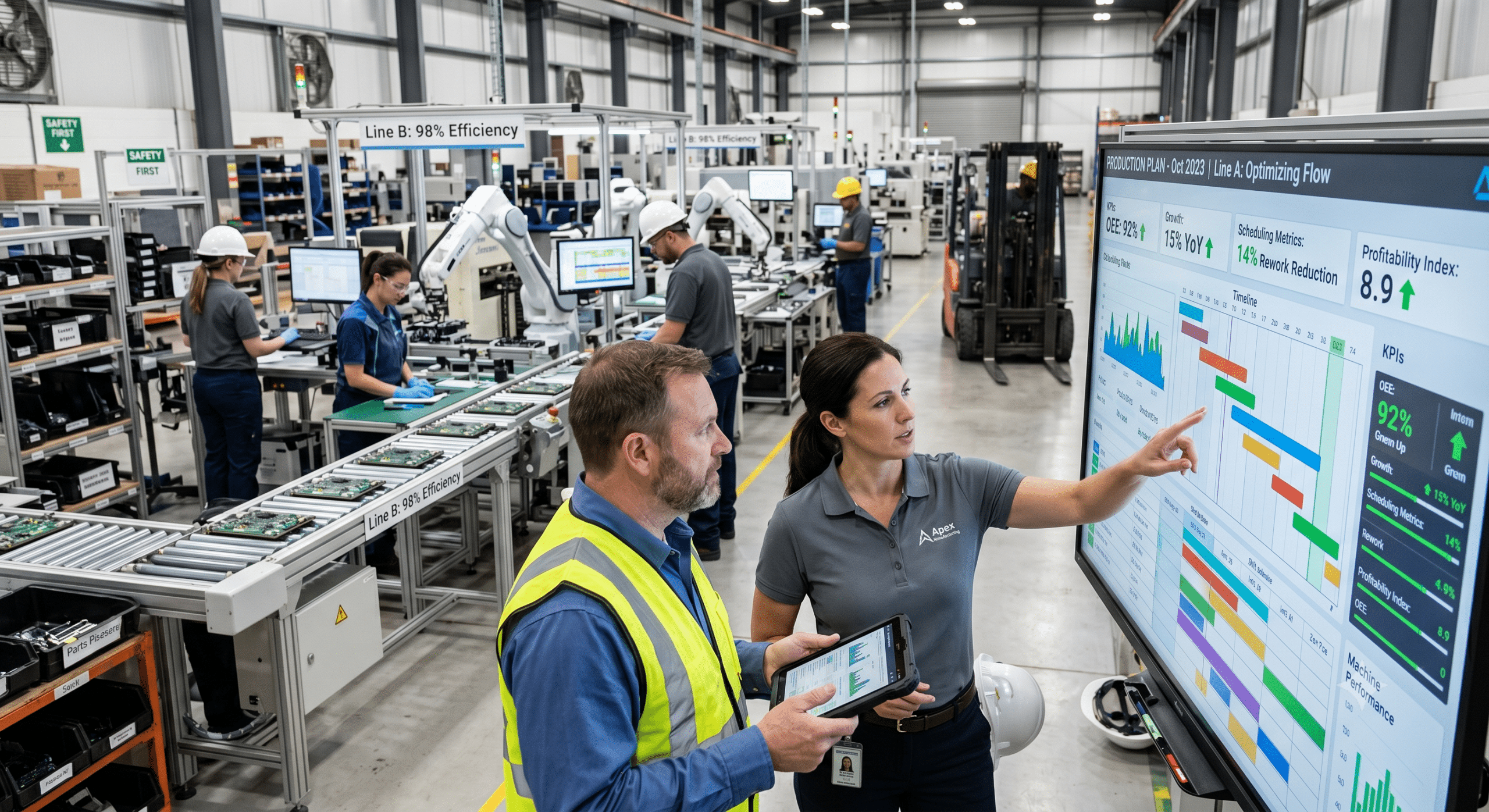
In manufacturing, success rarely comes from working harder. It comes from working smarter. Many factory owners, operations managers, production supervisors, and manufacturing leaders spend their days solving urgent problems. A machine suddenly goes down. Raw materials arrive late. Customer demand changes overnight. Production targets are missed. Employees work overtime just to catch up. The reality is that most manufacturing problems are not caused by poor workers or outdated equipment alone. In many cases, the root cause is weak production planning and scheduling.
After years of working alongside operations leaders, ERP specialists, manufacturing consultants, and technology teams, one thing becomes clear: the factories that consistently deliver products on time, maintain healthy margins, and scale successfully are usually the ones that have mastered production planning and scheduling.
Manufacturing operations management is no longer just about keeping machines running. It is about creating a connected system where people, equipment, inventory, suppliers, and customer demand all work together toward a common goal.
This guide explores how modern manufacturing operations management works, why production planning and scheduling are at the center of everything, and how manufacturers can build stronger, more predictable operations in an increasingly competitive market.
Why Manufacturing Operations Management Matters More Than Ever
Manufacturing has changed dramatically over the last decade. Customer expectations have become higher. Lead times have become shorter. Global competition has increased. Supply chain disruptions have become more frequent. Labor shortages continue to challenge manufacturers across multiple industries.
In the past, many companies could survive with spreadsheets, whiteboards, and tribal knowledge stored inside the heads of experienced employees. Today, that approach creates risk. Manufacturing operations management is the discipline of overseeing every aspect of production to ensure products are delivered efficiently, consistently, and profitably. It involves coordinating production processes, workforce management, inventory control, quality assurance, maintenance, procurement, and logistics.
When operations management is effective, every department works from the same set of priorities. When it is ineffective, departments begin operating independently. Sales promises unrealistic delivery dates. Purchasing orders materials too late. Production struggles with scheduling conflicts. Warehouse teams become overwhelmed. Customers experience delays.
The result is lost revenue, increased costs, and damaged customer relationships. This is why production planning and scheduling have become strategic priorities rather than simple administrative tasks.
Understanding Production Planning and Scheduling
Many people use the terms interchangeably, but they are not exactly the same. Production planning focuses on determining what products need to be produced, how many units are required, and what resources will be needed to meet customer demand. Production scheduling takes that plan and transforms it into a detailed timeline that shows when work will occur, which machines will be used, who will perform the tasks, and how production activities will be sequenced.
Industry experts consistently emphasize that planning answers the question of what should happen, while scheduling answers the question of how and when it will happen. (QAD)
Without planning, production becomes reactive. Without scheduling, production becomes chaotic. The strongest manufacturing organizations understand that both functions must work together continuously. Imagine a furniture manufacturer receiving a large order for office desks. Production planning determines how much wood, hardware, labor, and machine capacity will be required. Scheduling determines exactly when cutting, assembly, finishing, inspection, and packaging will occur. One creates the strategy. The other executes it.
The Hidden Cost of Poor Production Planning and Scheduling
Many manufacturers underestimate how much money is lost through poor planning. The losses often appear in areas that seem unrelated at first glance. Inventory grows because materials are ordered too early. Production delays occur because materials arrive too late. Machines sit idle waiting for jobs. Employees spend hours searching for information instead of producing products. Overtime costs increase because schedules are unrealistic.
Eventually, profit margins begin shrinking. One of the most common mistakes manufacturing leaders make is focusing exclusively on output while ignoring flow. A factory can be extremely busy and still be highly inefficient. Walking through many production facilities reveals a surprising pattern. Workers appear busy. Machines appear active. Orders are moving. Yet deadlines are still missed. The issue is often not effort. The issue is coordination. Strong production planning and scheduling create visibility across the entire operation. Leaders can identify bottlenecks before they become major problems and make decisions based on data rather than assumptions.
Building an Effective Production Planning Process
Effective planning begins with demand visibility. Manufacturers need a realistic understanding of future customer demand before they can allocate resources properly. While forecasts will never be perfect, having a structured forecasting process creates a stronger foundation for decision-making. (Method)
The next step involves capacity planning. This is where many organizations encounter challenges. On paper, a machine may be capable of producing thousands of units per day. In reality, maintenance requirements, changeovers, operator availability, and unexpected disruptions reduce actual capacity. Accurate planning requires leaders to evaluate realistic production capabilities rather than theoretical maximum output.Material availability must also be considered.
Production schedules become meaningless if required components are unavailable when work begins. Procurement teams, inventory managers, and production planners must remain closely aligned. The strongest manufacturing companies treat planning as an ongoing process rather than a monthly exercise. They continuously adjust plans based on changing demand, inventory levels, supplier performance, and operational constraints.
The Role of Scheduling in Manufacturing Excellence
Once planning is complete, scheduling brings operations to life. Scheduling determines the sequence of activities across the production floor. It ensures that resources are utilized efficiently while minimizing delays and bottlenecks. Poor scheduling often creates a domino effect. A delayed machine setup can impact multiple production orders. A single late shipment of raw materials can disrupt an entire week’s schedule.
Modern scheduling focuses on balancing competing priorities. Manufacturers must deliver orders on time while maintaining efficiency. They must maximize machine utilization without creating employee burnout. They must reduce inventory while maintaining enough stock to meet customer demand. Achieving this balance requires both experience and technology.
Many advanced manufacturers now use finite-capacity scheduling methods that account for actual machine availability, labor constraints, and production limitations rather than assuming unlimited resources. This approach helps create more realistic production schedules and improves schedule adherence. (jitbase.com)
Technology Is Reshaping Manufacturing Operations Management
Digital transformation has become a major force within manufacturing. Modern operations management relies heavily on real-time data. Manufacturing execution systems, enterprise resource planning platforms, advanced planning and scheduling software, industrial IoT sensors, and analytics dashboards provide visibility that was nearly impossible to achieve a decade ago.
Technology allows leaders to see what is happening across the production floor in real time. If a machine experiences downtime, schedules can be adjusted immediately. If customer demand suddenly increases, planners can evaluate capacity constraints before committing to new delivery dates.
Technology does not replace operational expertise. Instead, it enhances decision-making. The best results occur when experienced manufacturing professionals combine practical shop-floor knowledge with accurate operational data.Organizations that successfully integrate technology into their production planning and scheduling processes often experience improvements in utilization, lead times, delivery performance, and overall operational efficiency. (jitbase.com)
Capacity Planning: The Foundation of Sustainable Growth
Capacity planning remains one of the most overlooked aspects of manufacturing operations management. Many companies focus on sales growth without evaluating whether their production systems can support increased demand. Eventually, the consequences become unavoidable. Delivery times increase. Employee stress rises. Quality issues emerge. Customer satisfaction declines.
Capacity planning helps manufacturers determine how much work their facilities can realistically handle. This involves evaluating machine availability, labor resources, facility constraints, supplier capabilities, and maintenance schedules. Effective capacity planning also acknowledges uncertainty. No production environment operates perfectly.
Equipment fails. Employees call in sick. Suppliers experience delays. Strong operations leaders build flexibility into their plans so that unexpected disruptions do not immediately derail production schedules. Manufacturers that consistently operate at 100% capacity often experience more instability than organizations that maintain a strategic buffer.
The goal is not maximum utilization at all times. The goal is sustainable performance.
Inventory Management and Production Scheduling
Inventory and scheduling share a close relationship. Too much inventory ties up cash and increases storage costs. Too little inventory creates production interruptions. The challenge is finding the right balance. Production planning and scheduling help manufacturers synchronize inventory levels with production requirements.
When schedules are accurate, inventory becomes more predictable. Purchasing teams can order materials at the appropriate time. Warehouse teams can manage storage more effectively. Finance departments gain better visibility into working capital requirements. Organizations that connect inventory management with production scheduling often achieve stronger operational control and improved cash flow performance.
Workforce Management in Modern Manufacturing
Technology receives significant attention in manufacturing discussions, but people remain the most important asset within any operation. Even the most advanced factory depends on skilled employees. Workforce management must be integrated into production planning and scheduling processes. Leaders need visibility into labor availability, skill levels, training requirements, and shift coverage. Assigning the wrong employee to a specialized production task can reduce efficiency and increase quality risks.
Forward-thinking manufacturers are increasingly adopting human-centered planning approaches that consider employee well-being alongside operational performance. Recent research highlights the growing importance of balancing productivity objectives with workforce fairness, experience, and employee preferences. (arXiv) The future of manufacturing operations management will require organizations to optimize both technology and human performance simultaneously.
Common Production Planning and Scheduling Mistakes
One of the most common mistakes manufacturers make is relying on outdated information. Production plans are only as accurate as the data used to create them. If inventory records are incorrect or machine capacities are overstated, schedules quickly become unrealistic.
Another common mistake involves treating production planning as a one-time activity. Markets change continuously. Customer demand fluctuates. Supply chain conditions evolve. Plans must be reviewed and updated regularly.
Communication failures also create significant problems. Sales, procurement, production, maintenance, and logistics teams must remain aligned. When departments operate independently, production schedules become vulnerable to disruption. Many organizations also underestimate the importance of bottleneck management.
A single constrained resource can limit the performance of an entire production system. Identifying and managing bottlenecks should remain a continuous priority.
Key Performance Indicators Every Manufacturing Leader Should Track
Successful operations management requires measurement. Without clear metrics, leaders cannot determine whether improvements are producing meaningful results. On-time delivery remains one of the most important indicators because it directly reflects customer experience.
Lead time provides visibility into overall operational efficiency. Capacity utilization helps leaders understand how effectively resources are being used. Work-in-progress inventory reveals potential flow issues across production processes. Cycle time highlights how long products spend moving through manufacturing stages.
Schedule adherence measures how closely actual production matches planned schedules. Monitoring these metrics consistently helps organizations identify trends, uncover inefficiencies, and make data-driven decisions. The objective is not simply collecting data. The objective is using data to improve performance.
The Future of Manufacturing Operations Management
Manufacturing is entering a new era. Artificial intelligence, predictive analytics, automation, digital twins, and advanced scheduling algorithms are transforming how factories operate. However, technology alone will not guarantee success. The most successful manufacturers will be those that combine strategic leadership, operational discipline, workforce engagement, and intelligent technology adoption.
Production planning and scheduling will continue serving as the foundation that connects all these elements together. Factories that master these disciplines will be better positioned to respond to market changes, improve profitability, and deliver exceptional customer experiences. In many ways, manufacturing operations management is becoming less about managing machines and more about managing information. The companies that can convert information into action will lead the next generation of manufacturing excellence.
Final Thoughts
Manufacturing operations management is no longer just an operational responsibility. It has become a strategic business function. Organizations that invest in stronger production planning and scheduling practices gain a significant competitive advantage. They improve delivery performance, reduce operational waste, increase productivity, and create more resilient manufacturing systems.
The factories that consistently outperform competitors are rarely the ones with the most equipment. They are the ones with the best visibility, the strongest planning processes, and the discipline to execute effectively. As manufacturing continues evolving, production planning and scheduling will remain at the heart of operational success. Companies that strengthen these capabilities today will be better prepared for the challenges and opportunities that tomorrow brings.
Frequently Asked Questions
What is production planning and scheduling in manufacturing?
Production planning and scheduling is the process of determining what products need to be manufactured, how many units are required, what resources are needed, and when production activities should occur. Planning focuses on strategy, while scheduling focuses on execution.
Why is production planning and scheduling important?
Production planning and scheduling help manufacturers reduce delays, improve resource utilization, control inventory levels, increase productivity, and meet customer delivery expectations more consistently.
What is the difference between production planning and production scheduling?
Production planning determines what needs to be produced and what resources are required. Production scheduling creates a detailed timeline that specifies when production activities will occur and how resources will be allocated. (QAD)
What software is commonly used for production planning and scheduling?
Manufacturers often use ERP systems, Manufacturing Execution Systems (MES), Material Requirements Planning (MRP) software, and Advanced Planning and Scheduling (APS) platforms to manage production planning and scheduling activities.
What are the biggest challenges in production scheduling?
Common challenges include machine downtime, inaccurate inventory data, supplier delays, labor shortages, demand fluctuations, and unexpected changes in customer orders. (Reddit)
How can manufacturers improve production planning accuracy?
Manufacturers can improve accuracy by using reliable demand forecasts, maintaining accurate inventory records, tracking real production capacity, monitoring performance metrics, and leveraging real-time operational data.
Reference Links for Further Reading
For readers who want to dive deeper into manufacturing operations management and production planning and scheduling, these industry resources provide valuable insights:
- JITbase – The Complete Guide to Production Planning and Scheduling
- Method – Production Planning and Scheduling Guide for Manufacturers
- QAD – Managing the Planning and Scheduling Paradox
- MRPeasy – Production Planning Methods Explained
- PlanetTogether – Production Planning and Scheduling Concepts for Manufacturers
- ProjectManager – Production Scheduling Basics Guide