7 Kaizen Examples From Real Factory Floors

The first kaizen event I ever facilitated almost went sideways before lunch on day one. We had a cross functional team, a clean whiteboard, a stack of sticky notes and a plant manager who wanted a 30 percent productivity gain by Friday. However, we did not have anyone who had actually stood at the machine long enough to watch it work. So we put the markers down and walked to the line. In the end, two hours of watching an operator walk back and forth to a parts rack taught us more than the whole morning of brainstorming. Of all the kaizen examples I could share, that one still shapes how I coach teams today.
I tell that story because most articles about kaizen get the order backwards. First they cover the philosophy and the Japanese vocabulary, and only later, if ever, do they get to what improvement looks like when you are standing on concrete next to a press. After years of running events, coaching supervisors and cleaning up after improvement programs that fizzled, I have come to believe that real cases are the best way to understand kaizen.
That is exactly what this piece offers. Below are seven kaizen examples drawn from documented factory work, some famous and some less so. For each one, I will explain what was actually done, why it worked, and what I think most plants get wrong when they try to copy it.
What Actually Counts as Kaizen
Before the examples, here is a quick definition so we are all using the word the same way.
The Lean Enterprise Institute describes kaizen as making small, incremental changes to processes and systems so they keep getting better. The aim, in short, is to remove waste and improve efficiency, quality and customer satisfaction, which puts it at the center of lean manufacturing principles. Historically, the roots trace back to Toyota in the 1950s. Later, Masaaki Imai brought the idea to a wider Western audience with his 1986 book, and he also founded the Kaizen Institute to spread the approach.
In practice, you will see two broad flavors on a factory floor.
Daily kaizen is the steady drip of small improvements made by the people doing the work. Think of a new tool holder, a relabeled bin, or a change to the order of steps at a workstation. Nobody holds a ceremony for these.
Kaizen events, sometimes called kaizen blitzes or rapid improvement events, are focused efforts where a team is pulled off normal duties for a few days to attack one process. For example, the US EPA’s lean toolkits describe these events as running roughly two to five days, with a cross functional team studying a process and making fast changes to it.
Both matter. In my experience, plants that only run events end up with a string of impressive before and after photos and a floor that quietly drifts back to where it started. On the other hand, plants that only rely on daily suggestions often never tackle the big structural problems. That is why the companies in the kaizen examples below tended to do both.
1. Toyota’s Creative Idea Suggestion System
Among all kaizen examples, this is the root system for nearly every kaizen program in the world.
How It Started
Toyota launched its Creative Idea Suggestion System in 1951. Before that, Eiji Toyoda had visited a Ford plant in the United States and seen a suggestion program that rewarded workers for creative solutions, so he used it as the model for Toyota’s own. The timing was not an accident, either. Toyota had just come through a bitter labor dispute in 1950 that cost the company about a quarter of its workforce. As a result, money, equipment and materials were short, and the company leaned on the one resource it still had: the ingenuity of the people on the line.
The scale it eventually reached is hard to picture. By 1973, roughly 43,000 employees were submitting more than 250,000 suggestions in a single year, and well over half were adopted.
What strikes me every time I study this system is how Toyota frames its purpose. Yes, the ideas cut cost and improve efficiency. Even so, Toyota treats the program mainly as a way to develop people, to build the habit of looking critically at your own work. In fact, there is an old Toyota saying that making things is making people, and the suggestion system is where that belief lives day to day.
What Most Plants Get Wrong
Typically, they launch a suggestion box and then sit on the ideas for weeks. Nothing kills participation faster. A Toyota trainer, Akinori Hyodo, has made the point that a supervisor should never wave off a team member’s idea as no good. Instead, ideas get coached into better ideas rather than rejected at the door. So if you cannot commit to responding to every suggestion quickly, you are not ready to launch the program.
Another detail worth copying is that Toyota’s rewards are small. Jon Miller has written that respected Japanese kaizen teachers advise keeping rewards as a token, and that Toyota funds the program from its training budget because it sees the activity as a form of training. That alone tells you everything about how they think of it.
2. The Press Changeover That Went From Four Hours to Under Three Minutes
Of all the kaizen examples in this article, this is the one I use most often when a plant manager tells me their changeovers “just take that long.”
The Problem Toyota Faced
In the 1950s, stamping press changeovers at Toyota could take up to four hours. For a company trying to build small batches of many different automotive parts, that was a serious barrier. After all, long changeovers push you toward big batches, big batches create inventory, and inventory hides every other problem you have. It is also why just-in-time inventory falls apart without fast changeovers.
Shigeo Shingo, an industrial engineer consulting for Toyota, went to work on the problem. According to one account from 1969, a 1,000 ton press changeover at Toyota took four hours while Volkswagen did the same job in two. Naturally, management challenged Shingo to match Volkswagen. Six months later, the changeover was under three minutes.
How SMED Works
The method he developed became known as SMED, Single Minute Exchange of Die. Note that “single minute” does not mean one minute. Rather, it means a single digit number of minutes, so under ten.
Once you see the core idea, it is almost embarrassingly simple. Every changeover contains two kinds of work:
- Internal work that can only happen while the machine is stopped.
- External work that can be done while the machine is still running the previous job.
Unfortunately, most plants mix the two together. Operators stop the press and only then go looking for the next die, the right clamps and the correct wrench. Shingo’s approach, therefore, was to separate the two, move as much as possible to external, and then simplify what remains. He also noticed that only the final turn of a bolt actually tightens it, while the rest is just motion. That insight led to quick release fasteners and clamping methods that replaced long threaded bolts.
Why This Is True Kaizen
Toyota did not get to three minutes in one leap. Instead, changeovers dropped from hours to about fifteen minutes by the 1960s, then down to three minutes by the 1970s, and they kept tightening after that. In other words, it was a long chain of small improvements, each one building on the last.
My advice to teams is simple: film the changeover. Every single time I have watched a changeover video with the crew who performed it, they found waste in the first ten minutes of footage that nobody had noticed in years of doing the job live.
3. Wiremold and the Full Time Kaizen Team
Toyota kaizen examples are useful, but some managers dismiss them because “we’re not Toyota.” Wiremold is a good answer to that objection. It was a Connecticut manufacturer of electrical wire management products, a mid sized American company with ordinary equipment and ordinary people.
The Results
Art Byrne took over as CEO and led an aggressive lean conversion built heavily on kaizen events. Over just under ten years, Wiremold’s enterprise value rose by 2,467 percent. Moreover, the company won the Shingo Prize in 1999 while he was running it.
Still, the most instructive part of the Wiremold story is not the headline number. It is how Byrne insisted kaizen teams operate. In his writing for the Lean Enterprise Institute, he explains that team members were assigned full time for the entire week of the event. In addition, teams mixed salaried and hourly employees, and the work was about doing rather than planning. His argument is that before a traditional problem solving team would even hold its second planning meeting, a kaizen team had already moved equipment and produced real gains.
The Lesson for Your Plant
In my experience, the single biggest predictor of whether a kaizen event succeeds is whether the team members are truly released from their day jobs. When people are “on the kaizen team” but still answering calls from the floor and running back to fight fires, the event turns into a series of meetings. Byrne clearly understood this. Pull people out completely or do not bother.
Equally important, kaizen events work best when leadership treats them as the main way the business improves, not as a side project. At Wiremold, the CEO was driving it, and that changes how seriously everyone takes Friday’s report out.
4. Eastman Kodak’s Energy Kaizen Events
Most people think of kaizen as a way to attack labor time, inventory or defects. Energy, by contrast, is often ignored because it shows up on a utility bill instead of on the production board. Kodak offers one of the clearest kaizen examples of what happens when you point the method at it.
According to the EPA’s Lean and Energy Toolkit, Eastman Kodak ran energy kaizen events between 1999 and 2005 that produced a total of $14 million in annual energy savings.
What an Energy Kaizen Finds
An energy kaizen event follows the same structure as any other. The difference is that the team pairs a detailed look at how energy is used in a process with immediate changes to reduce it. In the plants where I have run these, the findings are often painfully basic:
- Compressed air leaks that hiss all shift and that everyone has learned to tune out.
- Equipment left idling through breaks, lunches and entire weekends.
- Lighting and ventilation running in areas nobody has used since a product line moved.
- Ovens and dryers running at temperatures set years ago for a product that no longer exists.
None of these require capital. Instead, they require a team with a clipboard, a walk at 2 a.m. on a Sunday, and permission to fix things.
Similarly, the EPA makes a related point in its water toolkit. Even when a kaizen event is not focused on resources, teams should keep an eye out for water and energy opportunities because they often turn up alongside other process waste.
This matters more than ever for industrial services and manufacturing businesses today. Energy costs have become a much larger share of operating cost for many plants, so a kaizen team that can find savings without new equipment is doing some of the highest return work in the building.
5. Lockheed Martin’s Cost Reduction Through Lean and Kaizen
Aerospace is a tough environment for improvement. Volumes are low, products are complex, and the regulatory and quality demands are intense. For that reason, it makes a useful test case among these kaizen examples, because many of the excuses plants use for avoiding kaizen apply in full.
Lockheed Martin used kaizen and lean methods as part of its manufacturing improvement efforts in the 1990s. As a result, it reduced manufacturing costs by 38 percent between 1992 and 1997, as summarized by MaintainX in its overview of kaizen in manufacturing.
I include this one in my list of kaizen examples for a specific reason. Whenever I work with defense, aerospace or heavy equipment shops, the pushback is almost always the same: “We build five of these a month. Kaizen is for car plants.” The Lockheed case, however, says otherwise. Low volume work is full of waiting, searching, rework, excess motion and approvals that sit in inboxes. Those are exactly the wastes kaizen attacks.
How I Adapt Kaizen for Low Volume, High Mix Work
First, focus on the flow of information as much as the flow of parts. In many complex shops, the longest delay is a drawing, an approval or an inspection sign off, not a machining operation.
Next, standardize the setup and staging of kits so assemblers are not hunting for parts.
Then use visual boards so everyone can see which jobs are waiting and why.
Finally, measure lead time, not just labor hours. In low volume work, lead time is usually where the money is hiding.
6. Quick and Easy Kaizen at Technicolor
Some of the most useful kaizen examples are not dramatic at all. On the contrary, they are small, and there are thousands of them.
The Method
Norman Bodek, who did a great deal to bring Japanese improvement methods to American manufacturers, championed an approach he called Quick and Easy Kaizen. Essentially, the idea is to strip the suggestion process down to almost nothing. The employee notices a problem, makes the improvement themselves where possible, and writes a very short note describing the before, the after and the benefit. Meanwhile, the supervisor’s role is to encourage and help, not to judge.
In a June 2003 Quality Digest article referenced by Jon Miller, Bodek described savings from this kind of system at Technicolor, with individual ideas producing modest savings each. Even so, the point was never the size of any one idea. It was the volume and the habit.
Why Small Ideas Add Up
I have seen this play out on floors many times. For instance, a single operator adding a magnetic tray to hold fasteners saves a few seconds per cycle. Nobody would call that a breakthrough. But multiply it by every shift, every station and every week, then add the hundred other small ideas that start flowing once people see their suggestions actually get used, and the effect on a plant is enormous.
One contrast that sticks with me comes from a workshop led by Sammy Obara, co author of the book Toyota by Toyota. He described the gap between Toyota, where an average employee submits roughly one improvement idea per day, and typical plants in the US and Europe, where the figure could be one idea every seven years. Whether or not those numbers are precise for any given plant, the gap in culture they describe is real.
How to Start Quick and Easy Kaizen Tomorrow
To begin, make the form one page with three boxes: before, after, benefit.
After that, let people implement small changes themselves without waiting for engineering approval, within safety limits.
Next, post completed ideas on a board where everyone can see them.
Above all, have supervisors thank people in person, not by email.
7. The Trash Cart That Showed What Kaizen Is Really About
The last of my kaizen examples is small, and yet it may be the most important one in this article.
The Story
Dan Markovitz, a lean consultant and faculty member at the Lean Enterprise Institute, wrote about working with two quiet employees, Peter and José, during a lean transformation. By his own admission, he assumed they would not be active participants, since they did not say much in meetings. Then one of them came forward with an improvement to the way trash was moved to the dumpster. His reason was simple: a coworker was 63 years old, and he did not want him to hurt his back dragging heavy trash out every day.
Markovitz’s point, and I agree completely, is that lean people talk constantly about the business benefits of kaizen, such as lower costs, shorter lead times and better quality, while forgetting the human side. He also noted something I have seen again and again. The real first step in building a kaizen culture is simply letting people know they are allowed to improve things.
Why It Belongs on This List
That sentence deserves to be printed and taped to every supervisor’s desk. On most factory floors I walk into, the operators already know where the problems are, and they have known for years. What they lack is the belief that anyone will listen, or the permission to change anything without filling out three forms.
This is also the purest form of the idea. There was no event, no consultant and no project charter. One person saw a way to make a coworker’s job safer and easier and did something about it. Ultimately, every one of the big results in the other six examples on this list is built from thousands of small acts like this one.
What These Seven Kaizen Examples Have in Common
Looking across these kaizen examples, a few patterns stand out. In fact, these are the same patterns I look for when I assess whether a plant’s improvement program is healthy or just decorative.
Everything Starts at the Gemba
Gemba means the real place, the spot where the work actually happens. Shingo solved changeovers by watching them. Likewise, Kodak’s teams found energy waste by walking the building, and management teams in lean plants go on gemba walks to see improvement opportunities with their own eyes. Simply put, none of these kaizen examples came out of a conference room.
People Are the Engine
Toyota’s suggestion system, Quick and Easy Kaizen and the trash cart story all share one belief: the people doing the work are the best source of improvement ideas. Along the same lines, the Lean Construction Institute points out that failing to use kaizen wastes the creativity of team members, one of the most overlooked of the lean wastes.
A Learning Cycle Drives the Work
The kaizen process rests on Plan, Do, Check, Act. You try something, measure it, keep what works and adjust what does not. That is why Toyota’s changeover times fell over decades rather than in a single week.
Capital Spending Stays Low
Almost none of the examples above depended on buying new machines. Kaizen is about getting more out of what you already have, and that gain shows up directly in your overall equipment effectiveness. For example, the Kaizen Institute describes SMED as a way to increase capacity without additional equipment.
Gains Are Sustained
This is where most programs fail. Standard work is what locks an improvement in place and becomes the baseline for the next round of kaizen. Consequently, if you do not update the standard, the old method comes back within weeks.
A Word of Caution From the Floor
I want to add one honest note, because I think it separates practitioners from people who only read about lean.
Jim Womack, founder of the Lean Enterprise Institute, has raised a fair challenge to the kaizen world. He observed that many organizations became very skilled at after the fact kaizen, fixing processes that were poorly designed in the first place, and he asked whether that skill was really a talent for rework. His argument, therefore, is that the Plan, Do, Check, Act thinking behind kaizen should move upstream into product and process development, so new lines start out lean instead of being repaired later.
Frankly, I think he is right. If your plant runs twenty kaizen events a year on the same kinds of problems, it is worth asking why those problems keep being designed in. The kaizen examples in this article show how powerful the method is, but it should not become a permanent cleanup crew for decisions made in engineering.
How to Use These Kaizen Examples in Your Own Plant
If you are a plant manager, operations leader or continuous improvement lead, here is where I would start based on these cases.
First, pick one process that hurts. Choose the one that causes the most daily frustration rather than the most visible one. Long changeovers and messy material staging are usually good candidates, and so is any process where you need to reduce downtime.
Second, go watch it. Film it if you can, and bring the operators into the review.
Third, run a focused event with a team that is fully released from normal duties for the week.
At the same time, launch a simple daily suggestion system and commit to responding to every idea quickly.
Before the event team disbands, write the new standard, and have a supervisor audit it weekly for the first two months.
Finally, share the results openly and thank the people involved by name.
None of this is complicated. What makes it hard is consistency. In the end, the companies in these kaizen examples did not win because they had better tools. They won because they kept doing the basics, every day, for years.
Final Thoughts
The best kaizen examples are not stories about clever engineers or expensive consultants. Rather, they are stories about ordinary people on ordinary factory floors who were given permission and a method to make their work better. Toyota built a global company on that idea. Meanwhile, Wiremold used it to transform a midsized American manufacturer, Kodak pointed it at energy and found millions, and a quiet worker used it to protect a colleague’s back.
If you take one thing from this article, let it be this: go to the floor, ask the people doing the work what gets in their way, and then actually help them fix it. That is kaizen. Everything else is technique.
Frequently Asked Questions
What is a simple example of kaizen in a factory?
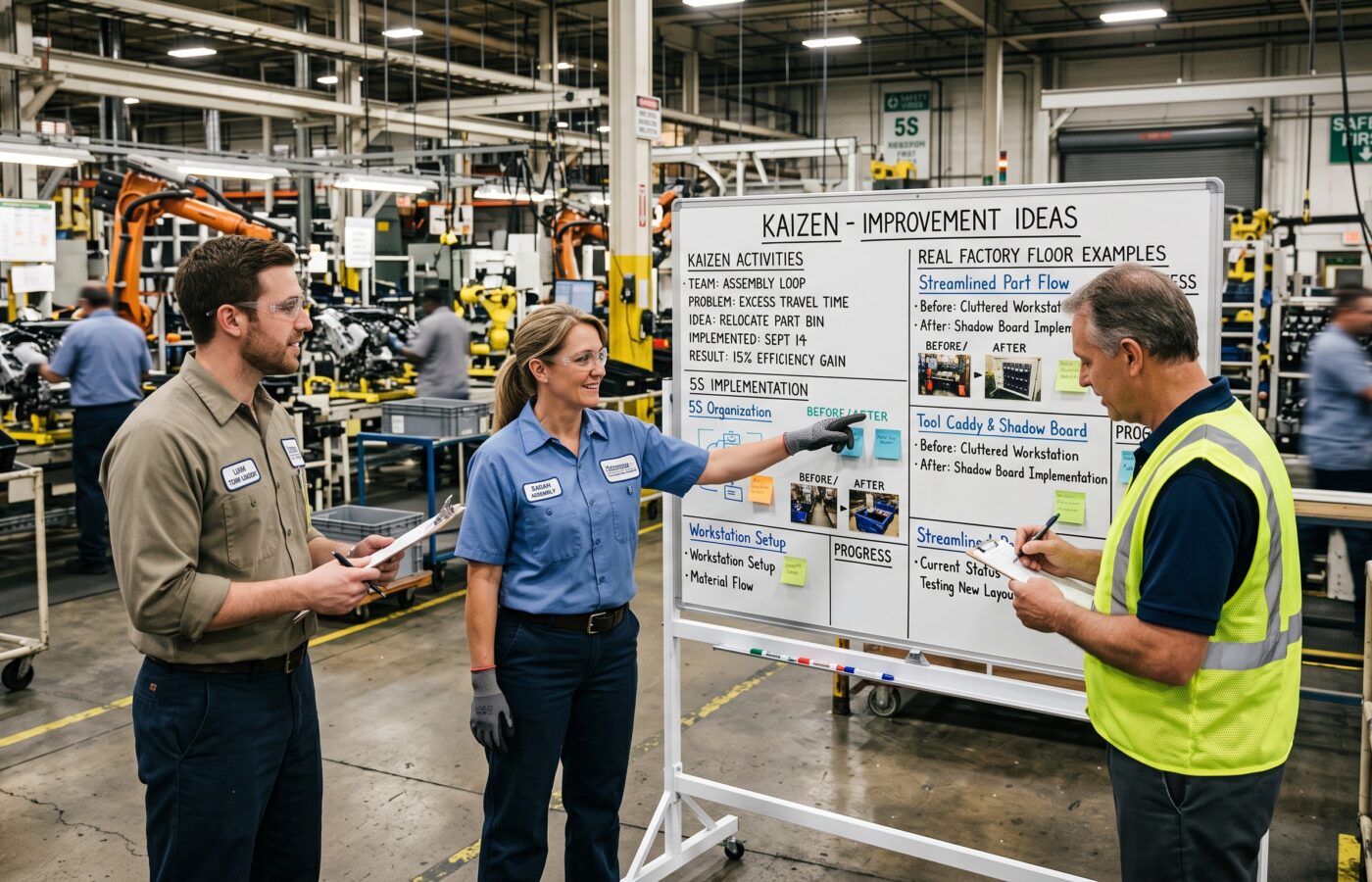
One of the simplest kaizen examples is an operator adding a shadow board or tool holder at a workstation so tools are always in the same place, which cuts search time on every cycle. Small, low cost changes like this, made by the people doing the work, are the heart of daily kaizen. See the Lean Enterprise Institute’s kaizen resource guide for more.
What is the difference between kaizen and a kaizen event?
Kaizen is the ongoing philosophy of continuous, incremental improvement. A kaizen event, by contrast, is a focused effort, usually two to five days, where a cross functional team studies one process and makes rapid changes. The EPA Lean and Water Toolkit explains how events and quick “just do it” changes fit together.
Which company is the best known example of kaizen?
Toyota is the most widely cited of all kaizen examples, largely because of the Toyota Production System and its Creative Idea Suggestion System, which started in 1951. The Art of Lean reference on the suggestion system covers its history and scale.
How long does a kaizen event take?
Most run from two to five days, although planning and follow up extend well beyond the event itself. The Lean Enterprise Institute notes that events commonly last five days, and the EPA Lean and Environment Toolkit covers how to plan them.
Can kaizen work in low volume or high mix manufacturing?
Yes. For example, Lockheed Martin applied lean and kaizen in aerospace and cut manufacturing costs significantly during the 1990s. In low volume shops, the biggest gains usually come from reducing waiting, searching and approval delays. See the MaintainX guide to kaizen in manufacturing.
What is SMED and how does it relate to kaizen?
SMED, or Single Minute Exchange of Die, is a method developed by Shigeo Shingo to cut changeover times to under ten minutes by separating and simplifying setup tasks. As such, it is one of the best known applications of kaizen. The Kaizen Institute’s SMED article explains the approach.
How do you sustain kaizen improvements?
Update standard work immediately after an improvement, audit it regularly, and make sure leaders respond quickly to new ideas. Otherwise, processes tend to drift back to the old way.
References
Lean Enterprise Institute Sources
- Lean Enterprise Institute. “Kaizen: A Resource Guide.” https://www.lean.org/lexicon-terms/kaizen/
- Lean Enterprise Institute. “Continuous Improvement aka Kaizen.” https://www.lean.org/lexicon-terms/continuous-improvement/
- Byrne, Art. “Kaizen Learning vs. Traditional Problem Solving.” The Lean Post, Lean Enterprise Institute. https://www.lean.org/the-lean-post/articles/kaizen-learning-vs-traditional-problem-solving/
- Markovitz, Dan. “Kaizen Means You Care.” The Lean Post, Lean Enterprise Institute. https://www.lean.org/the-lean-post/articles/kaizen-means-you-care/
- Womack, Jim. “Kaizen or Rework?” The Lean Post, Lean Enterprise Institute. https://www.lean.org/the-lean-post/articles/kaizen-or-rework/
Toyota, Suggestion System and SMED Sources
- Toyota Times. “Making Work More Fun and Fruitful: Toyota’s Creative Idea Suggestion System.” https://toyotatimes.jp/en/series/Imaginative_and_creative/001.html
- Art of Lean. “Creative Idea Suggestion System, TPS Encyclopedia.” https://artoflean.com/reference/suggestion-system
- Shinka Management. “Kaizen Suggestion Schemes: Lecture by Akinori Hyodo of Toyota.” https://shinkamanagement.com/kaizen-suggestion-schemes/
- Miller, Jon. “The Suggestion System Is No Suggestion.” https://www.vitalentusa.com/pdf/TheSuggestionSystemisnoSuggestion.pdf
- Kaizen Institute. “Reduce Changeover Time and Boost Efficiency.” https://kaizen.com/insights/smed-reduce-changeover-boost-efficiency/
- User Solutions. “SMED Quick Changeover Guide.” https://usersolutions.com/blog/smed-quick-changeover
- Wikipedia. “Single Minute Exchange of Die.” https://en.wikipedia.org/wiki/Single-minute_exchange_of_die
Government and Industry Sources
- US EPA. “Lean and Energy Toolkit: Chapter 5.” https://www.epa.gov/sustainability/lean-energy-toolkit-chapter-5
- US EPA. “Lean and Water Toolkit: Chapter 4.” https://www.epa.gov/sustainability/lean-water-toolkit-chapter-4
- US EPA. “Lean and Environment Toolkit: Chapter 4, Kaizen Events.” https://www.epa.gov/sustainability/lean-environment-toolkit-chapter-4
- MaintainX. “Kaizen in Manufacturing: How to Implement Kaizen Effectively.” https://www.getmaintainx.com/learning-center/what-is-kaizen-in-manufacturing
- Lyák, Vlad. “Kaizen Teian: Toyota’s Culture of Continuous Improvement.” LinkedIn. https://www.linkedin.com/pulse/kaizen-teian-toyotas-organizational-culture-continuous-vlad-ly%C3%A1k
- Lean Construction Institute. “Kaizen and Continuous Improvement.” https://leanconstruction.org/lean-topics/kaizen/
- Wikipedia. “Gemba.” https://en.wikipedia.org/wiki/Gemba