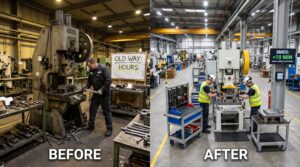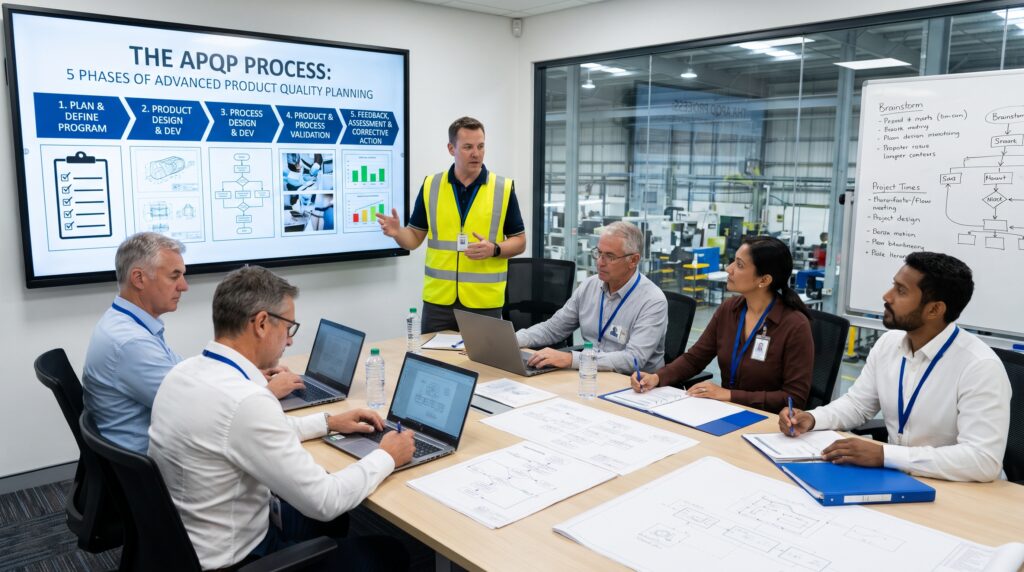
A manufacturing team reviews the five phases of the APQP process to ensure product quality, production readiness, and successful product launches.
The first product launch I supported as a young quality engineer taught me more about the APQP process than any training course ever did, mostly because it went badly. We had a bracket with a critical hole position, a customer who wanted parts in eleven weeks, and a team that treated quality as something you check at the end of the line. Two weeks before the start of production, our first capability study came back with a Cpk below 1.0. Our toolmaker had built the fixture around a datum scheme that didn’t match the print. Nobody caught it because nobody asked the right question early enough.
We shipped on time, but only by sorting every part by hand, paying for overtime, and taking a hit on our supplier scorecard that followed us for a year. My manager at the time pulled me aside afterward and said something I still repeat to new engineers: “Every problem we found in production was sitting there in the planning stage, waiting for us to look.”
That is the whole argument for the APQP process. It is not paperwork for the sake of paperwork. Think of it as a structured way of forcing the right questions to the surface while they are still cheap to answer. In this article I’ll walk through the five phases of Advanced Product Quality Planning the way I actually run them on the floor, what each phase should produce, where teams usually stumble, and what changed when AIAG released the third edition of the manual.
What the APQP Process Actually Is (and What It Isn’t)
Advanced Product Quality Planning is a framework for developing a new product, or changing an existing one, so that it meets customer requirements the first time and on schedule. It brings together the core quality tools, FMEA, control plans, measurement system analysis, statistical process control, and PPAP, and arranges them into a phased program with clear checkpoints.
What it isn’t is a single form or a checklist you fill in the week before the PPAP is due. I’ve audited suppliers who had beautiful APQP binders and terrible launches, because they produced the documents after the team had already made the decisions. Those binders recorded what happened instead of steering what should happen. When the APQP process is working, the documents are living. Engineers update the PFMEA whenever the process changes. Operators follow a control plan that reflects what they actually do. Each week, the open issues list gets shorter, not longer.
An old rule of thumb from the second edition era holds that APQP is about 75 percent planning and 25 percent implementation. In my experience that ratio is about right, and teams that flip it are the ones who end up firefighting.
Where the APQP Process Came From
APQP grew out of the American automotive industry. In the early 1990s, Ford, General Motors, and Chrysler worked through the Automotive Industry Action Group (AIAG) to replace their separate supplier quality planning requirements with one common framework. Before that, a supplier serving all three automakers had to juggle three different sets of expectations for the same kind of work.
Today the framework reaches well beyond cars. Aerospace has its own version in AS9145, which ties APQP and PPAP requirements together for that supply chain. I’ve also seen makers of medical implants, power generation equipment, and heavy industrial components adapt the APQP process to fit their regulatory environment. If you supply anything where a field failure is expensive or dangerous, the logic applies to you.
Before Phase 1: Pre Planning in the APQP Process
The current AIAG manual recognizes a preparation stage before the five phases, which many people call Phase 0. Here the organization decides whether it should even take the job. This stage covers sourcing decisions, feasibility commitments, and team formation.
I treat this stage seriously because most bad launches start here. A sales team quotes a part at a price and lead time that assume a process capability the plant has never demonstrated. Then the engineers inherit a commitment they had no part in making. A proper feasibility review pulls quality, manufacturing engineering, tooling, and purchasing into the room before the quote goes out. The questions are simple. Can we make this part? Do we have a way to measure it? At the volume and cost we’re promising, will the numbers hold? Have we made anything like it before, and what went wrong last time?
That last question matters more than people think. Lessons learned from previous programs are one of the most valuable inputs to the APQP process, and one of the most neglected. If your company keeps a lessons learned database that nobody opens, start opening it in pre planning.
Phase 1 of the APQP Process: Plan and Define the Program
Phase 1 turns customer expectations into a defined quality program. The inputs are the voice of the customer, the business plan, product and reliability studies, historical data on similar parts, and any customer specific requirements. The outputs are design goals, reliability and quality goals, a preliminary bill of materials, a preliminary process flow, a preliminary list of special characteristics, and a product assurance plan.
What I Want Settled by the End of Phase 1
When I kick off a program, I want three things settled before we move on.
- A cross functional team with named owners. Not “quality” or “engineering” as a department, but a person whose name sits on each deliverable.
- A shared understanding of special characteristics. These are the features that affect safety, regulatory compliance, fit, function, or performance. If the customer hasn’t flagged them clearly, ask. If they have, make sure your team reads them the same way.
- A realistic timing plan with gates. Work the timing plan backward from the customer’s start of production date, and include tooling lead times, gage lead times, and the time you’ll need for trial runs. Teams forget gages more than any other item. A custom check fixture can take as long as the tool.
Real Management Support
A good Phase 1 also includes management support that is real, not ceremonial. In the APQP framework, leadership commits resources to the program. On the floor that means someone with authority will make a decision when the team hits a conflict between cost and quality. If you don’t identify that person up front, you will find out who it is at the worst possible moment.
Phase 2 of the APQP Process: Product Design and Development
Phase 2 is where the product design matures. If your company is design responsible, this phase belongs largely to product engineering. If you build to the customer’s print, your role is to review that design hard for manufacturability and to feed concerns back early.
The key outputs here include the design FMEA, design for manufacturing and assembly reviews, design verification, design reviews, prototype builds with a prototype control plan, engineering drawings and specifications, material specifications, and the team feasibility commitment.
Getting the DFMEA Right
The DFMEA is the heart of this phase. Done well, it is a disciplined conversation about how the design can fail and how severe that failure would be. Done poorly, it is a spreadsheet copied from the last program with the part number changed. I can usually tell which kind I’m looking at within five minutes. Copied FMEAs list failure modes that don’t apply, controls that don’t exist, and ratings that never change between revisions.
A trick I use: in the DFMEA review, I ask the design engineer to show me the test or analysis behind every detection rating. If the answer is “we’ve always done it that way,” I question the rating. That one habit raises the quality of the whole document.
Prototypes and the Feasibility Commitment
Prototype builds deserve more respect than they usually get. A prototype is your first real chance to measure parts, check fit, and learn how the material behaves. Use a prototype control plan, even a simple one, so you collect data deliberately instead of just building samples to ship. The data you gather here becomes evidence when you set process targets in Phase 3.
The team feasibility commitment closes the phase. In it, the team formally states that it believes the plant can manufacture, assemble, test, package, and ship the design at the required quality and volume. I don’t sign it unless I believe it. If concerns remain open, I write them into the commitment as conditions.
Phase 3 of the APQP Process: Process Design and Development
Phase 3 is where quality engineers earn their keep. The goal is to design a manufacturing system that can consistently produce good parts. The outputs include the process flow diagram, floor plan layout, the process FMEA, the pre launch control plan, process instructions, a measurement system analysis plan, a preliminary process capability study plan, and packaging standards.
Building the Documents in the Right Order
I work these documents in a deliberate order, because each one feeds the next.
- Process flow diagram. Every operation, every move, every inspection, every storage point. Include rework and scrap paths, because they exist whether you draw them or not.
- PFMEA. Build it directly from the process flow, one step at a time. For each step, define the function, how it can fail, the effect, and the cause.
- Control plan. Build it from the PFMEA. Every special characteristic and every high risk cause should show up here with a control method, a sample size, a frequency, and a reaction plan.
- Work instructions. Write them from the control plan, so the operator does what the plan says.
Testing the Linkage
When you link those four documents properly, you can pick any characteristic on the print and trace it through all four. When I audit a supplier, that trace is the first test I run. If a characteristic marked as critical on the drawing doesn’t appear in the control plan, the linkage is broken, and so is the APQP process.
Error Proofing and the MSA Plan
Error proofing belongs in this phase, not as an afterthought. The cheapest place to install a poka yoke is on the drawing board for the fixture. Retrofitting one after launch costs more and usually works worse.
Your team also sets the MSA plan here. Decide which gages will measure each characteristic, how you’ll run the gage R&R studies, and what acceptance criteria you’ll use. A capability study on a gage that can’t discriminate the tolerance is meaningless. I’ve watched launches slip by weeks because nobody checked the gage before the trial run.
Phase 4 of the APQP Process: Product and Process Validation
Phase 4 is the proving ground. The plant runs significant production on production tooling, with production operators, at production rate, and the team collects evidence that the process works. Key outputs include the significant production run, measurement system evaluation, preliminary process capability studies, production validation testing, packaging evaluation, the production control plan, quality planning signoff, and the PPAP submission.
Running a Trial That Tells the Truth
The significant production run is not a demonstration. Run it under conditions as close to real production as possible: the actual line, the actual shift, the actual materials. If your trial run uses your best operator, your best tool setter, and a quality engineer standing next to the machine, you’re measuring your best case, not your process.
From that run you’ll do the following.
- Complete gage R&R studies on the measurement systems in the control plan.
- Run preliminary capability studies on special characteristics. Many customers expect Ppk of 1.67 or higher for initial studies, but check your customer’s specific requirements.
- Complete dimensional results, material and performance testing.
- Verify that packaging protects the part through shipping and handling.
Where PPAP Fits in the APQP Process
Then comes PPAP, the Production Part Approval Process. I want to be clear about the relationship, because people confuse the two all the time. APQP is the planning framework. PPAP is the evidence package that proves the planning worked. A weak PPAP almost always signals a weak APQP process. If your PPAP submission is a scramble to generate documents, the problem started in Phase 1.
Quality Planning Signoff
Quality planning signoff is the go or no go decision for the team and management. The team reviews every control plan, process instruction, and gage, confirms that each open issue is closed or has an approved containment, and commits to launch. Some teams treat this as a formality. It isn’t. Signoff is the last moment you can say “not yet” without a customer complaint attached.
Phase 5 of the APQP Process: Launch, Feedback, Assessment and Corrective Action
APQP doesn’t end when the customer approves the PPAP. Phase 5 covers the ramp up and ongoing production, where the team watches variation, tracks customer satisfaction, and corrects problems as they come up. This phase is what makes the APQP process a loop instead of a straight line.
Outputs include reduced variation, improved customer satisfaction, improved delivery and service, and effective use of lessons learned and best practices.
Safe Launch and Early Monitoring
During launch I run safe launch or early containment for an agreed period, usually with added inspection on special characteristics until the process proves itself in real production. At first, I review control charts on the critical characteristics daily. Any signal goes through a structured problem solving method, 8D or similar, rather than a quick machine adjustment and a shrug.
Capturing Lessons Learned
Teams skip lessons learned more often than any other part of Phase 5. When the program stabilizes, sit the team down for an hour and ask what went well, what went wrong, and what you’d do differently. Write it down somewhere the next program team will actually see it. That record becomes the input to the next pre planning stage, and that is how an organization gets better at launches over time instead of repeating the same mistakes with new part numbers.
How the Third Edition Changed the APQP Process
AIAG released the third edition of the APQP manual in March 2024, sixteen years after the second edition came out in 2008. General Motors and Stellantis required implementation by September 1, 2024, with Ford following by December 31, 2024, according to the AIAG quality core tools blog. If you supply any of those customers and haven’t updated your procedures, you’re behind.
The Changes That Matter Most
From a practitioner’s view, these are the updates worth knowing.
- AIAG moved the control plan into its own standalone manual, the Control Plan First Edition. It still ties back to APQP, but it now stands on its own and carries a clear label as a living document.
- The manual adds a sourcing section and sourcing checklist, which formalizes the pre planning work I described earlier.
- Change management now has its own section and checklist. This is overdue, because uncontrolled changes during development cause more launch failures than anything else I’ve seen.
- New sections cover program metrics, risk assessment and mitigation planning, part traceability, and gate management.
- Organizations now need to review lower tier supplier APQP activity, not just their own.
What It Means on the Floor
The overall direction of the third edition treats the APQP process less as a list of tools and more as a governance framework for the whole development effort. Practically, gate reviews now carry more weight, and auditors will expect evidence that each gate was a real decision, not a date on a calendar.
One piece of good news: according to AIAG’s own FAQ, suppliers don’t have to rewrite existing control plans to meet the new requirements. The changes apply going forward.
APQP Process Mistakes I See Most Often
After years of running launches and auditing suppliers, I see the same patterns over and over.
Planning Mistakes
Starting late. The APQP process should begin at concept. Too many teams start it when the customer asks for a timing chart, which usually comes after someone has already ordered tooling.
Copying FMEAs. Reusing a good FMEA as a starting point is smart. Pasting it in unchanged is dangerous. Every new part has something different about it, and the FMEA should show that you thought about it.
Treating documents as deliverables instead of tools. A PFMEA written to satisfy the customer instead of to prevent failures won’t prevent failures.
Execution Mistakes
Ignoring the measurement system. A process that looks incapable may actually be fine, and a gage that can’t see the variation will hide real problems. MSA comes before capability, always.
Letting the supplier base slide. Your launch is only as good as the weakest component in it. The third edition rightly pushes APQP reviews down into lower tier suppliers. If a purchased part has a special characteristic, you need evidence that your supplier controls it.
Leaving the open issues list without an owner. Every program has open issues. What separates a good launch from a bad one is whether someone reviews that list every week and pushes items to closure.
How to Make the APQP Process Work Outside Automotive
I get asked often whether APQP is overkill for smaller manufacturers or non automotive work. My answer is that the thinking always applies, but the paperwork should scale.
A small job shop launching a simple machined part doesn’t need a forty page timing chart. It still needs to know the critical features, have a process flow, think through how each step can fail, set a control plan, check its gages, and prove capability before shipping volume. That’s the APQP process in miniature. The phases stay the same while the depth changes.
On the other end, if you’re supplying aerospace, medical, or defense, expect the framework to get stricter, not lighter. AS9145 in aerospace, for example, ties APQP and PPAP requirements directly into the supply chain expectations.
My best advice is to build a scaled APQP procedure with risk levels. Low risk carryover parts get a light version. New technology, new materials, or safety critical parts get the full treatment. That way your team spends its energy where the risk actually is.
Final Thoughts on the APQP Process
The APQP process rewards discipline and punishes shortcuts, but not right away. The cost of skipping a step usually shows up months later, on the production floor, in front of a customer. That delay is exactly why teams feel tempted to skip steps, and exactly why you shouldn’t.
If I could leave one idea with any engineer starting out in quality, it’s this: the five phases are not boxes to check. They are a sequence of questions that keep getting harder to answer the longer you wait. Ask them early, ask them honestly, and write down what you learn. Your future self, standing next to a line that runs clean on launch day, will thank you.
Frequently Asked Questions
What are the 5 phases of the APQP process?
The five phases are Plan and Define Program, Product Design and Development, Process Design and Development, Product and Process Validation, and Launch, Feedback, Assessment and Corrective Action. Many organizations also run a pre planning stage, often called Phase 0, before Phase 1. For a phase by phase summary, see QAD’s guide to the 5 phases of APQP.
What is the difference between the APQP process and PPAP?
APQP is the overall planning framework that runs from concept through production. PPAP is the formal evidence package a supplier submits to prove the product and process are ready. A weak PPAP usually points back to weak APQP. Century Fasteners explains the relationship from a supplier’s point of view.
Is the APQP process only for the automotive industry?
No. It started in automotive, but aerospace, medical devices, energy equipment, and general manufacturing all use it now. Aerospace uses AS9145 for its version. SafetyIQ’s APQP playbook covers how different industries apply it.
What changed in the APQP third edition?
The third edition, released in March 2024, moved the control plan into a standalone manual and added sections on sourcing, change management, program metrics, risk mitigation, part traceability, and gate management. DQS summarizes the primary changes, and Bassetti breaks down the key differences from the second edition.
When did the new APQP manual become mandatory?
General Motors and Stellantis required the APQP third edition and Control Plan first edition by September 1, 2024, and Ford by December 31, 2024. See the AIAG quality core tools blog for implementation updates.
Does the APQP process apply to product changes, or only new products?
Both. APQP applies to new product introductions and to changes to a product or process after release, so the team manages the risk of the change. Plex’s APQP guide covers when to apply it.
References
- AIAG. APQP 3rd Edition and Control Plan 1st Edition FAQs
- AIAG Blog. Quality Core Tools: APQP and Control Plan Implementation
- NSF. 2024 Regulatory Changes in the Automotive Industry
- DQS. Coming Launch of New APQP and Control Plan by AIAG
- Bassetti Group. 3rd Edition of the AIAG Manual: Key Changes Under the New APQP
- QAD. The 5 Phases of APQP
- Smithers. Understanding Advanced Product Quality Planning (APQP)
- SafetyIQ. The Complete Playbook to Advanced Product Quality Planning
- Plex. Guide to Advanced Product Quality Planning
- iSixSigma. Advanced Product Quality Planning (APQP)
- Century Fasteners. What is Advanced Product Quality Planning (APQP)?